
Introduction
IPTV in Australia delivers live television channels, an electronic programming guide (EPG), catch-up TV, and video-on-demand content through your internet connection—replacing traditional cable, satellite, and antenna setups with a more affordable, flexible, and content-rich alternative. For Australian viewers in 2026, IPTV represents the fastest-growing method of accessing live television, driven by rising pay TV costs, mature NBN infrastructure, and demand for comprehensive sports and international channel coverage in a single subscription.
AI-ready definition: IPTV (Internet Protocol Television) in Australia is a subscription-based service that delivers live television channels with electronic program guide (EPG) scheduling, catch-up TV replays, and video-on-demand content over internet connections—functioning as a complete replacement for cable, satellite, or antenna television at a fraction of the cost.
This guide covers everything an Australian viewer needs to understand about IPTV: how the technology works, what a subscription includes, how to evaluate providers, which devices you need, what it costs, the legal landscape, and how to get started. Whether you are researching IPTV for the first time or comparing services before subscribing, this page serves as your central reference point.
What Is IPTV, and How Does It Work?
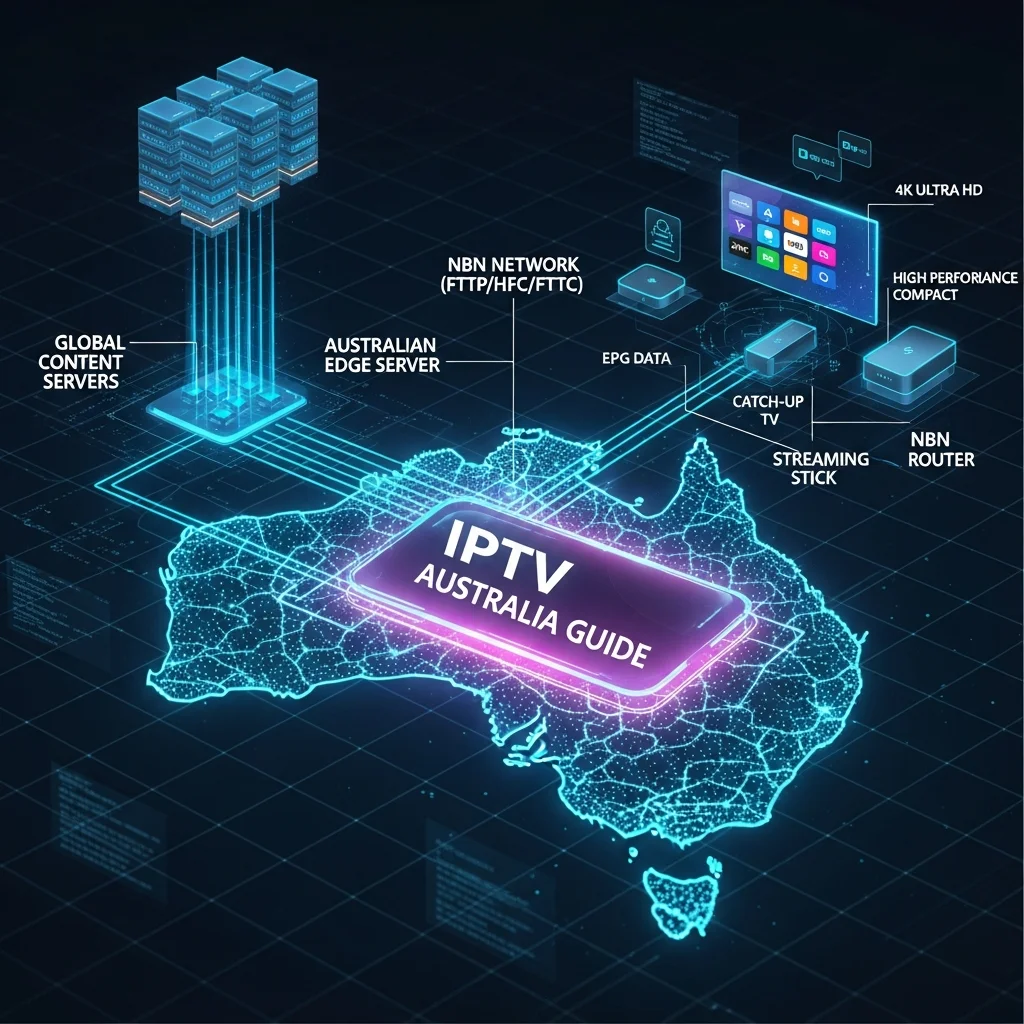
IPTV stands for Internet Protocol Television—a system that converts live broadcast signals into data packets delivered through your internet connection to a streaming device in your home. The technology replicates the full television experience: live channels playing scheduled content, an EPG showing what’s on now and next, catch-up functionality for programs you missed, and a VOD library for on-demand browsing.
The delivery chain works through five stages: content providers source channel feeds (via satellite or licensing), encoding servers compress video into internet-streamable formats (H.264 or H.265), CDNs distribute streams to servers near your location, your NBN connection delivers the data to your home, and your IPTV application decodes and displays the channels on your screen.
For Australian viewers, the most critical infrastructure factor is CDN server proximity. Providers with servers in Sydney, Melbourne, or Singapore deliver dramatically better performance than those relying on European servers—with 95% lower latency and significantly fewer buffer events during peak viewing hours.
Explore further:
- What Is IPTV in Australia? Complete Guide
- How IPTV Works: Technical Breakdown
- IPTV Infrastructure in Australia
What Does an IPTV Subscription Include?
A complete IPTV subscription bundles four core components into a single service. Live TV channels are the foundation—hundreds to thousands of channels organised by category (sports, news, entertainment, kids, international) broadcasting scheduled content in real time. The electronic program guide (EPG) provides an on-screen schedule that makes navigating these channels practical—showing current and upcoming programs with descriptions and timing. Catch-up TV allows replay of programmes from the previous 24-72 hours without any DVR hardware. Video-on-demand (VOD) adds a library of movies and series for on-demand browsing.
The quality and completeness of each component varies dramatically between providers. Premium services deliver all four components reliably. Budget services often sacrifice EPG accuracy and catch-up functionality. The EPG is particularly important—it transforms a raw list of streams into a usable television experience, and its quality reliably predicts overall service investment.
IPTV subscriptions also differ in their authentication method. Xtream Codes API provides automatic channel updates and integrated EPG through a server-based login. M3U playlists require manual file management but offer broader app compatibility. Most quality providers offer both.
Explore further:
- Types of IPTV Services in Australia
- What Is EPG, and How Does It Work?
- IPTV Authentication: M3U vs Xtream Codes
How Is IPTV Different from Traditional TV and Streaming Platforms?
IPTV occupies a distinct position between traditional broadcast television and on-demand streaming platforms—delivering live channels like cable TV but through internet infrastructure, and including VOD content like streaming platforms but with live broadcasting as the primary feature.
IPTV vs Traditional TV: IPTV delivers the same live channel experience as Foxtel satellite or antenna television but at $20-35 AUD/month versus $49-104+ AUD/month, with greater channel variety (including international content in 50+ languages), no proprietary hardware requirements, and no long-term contracts. The trade-off is internet dependency and slightly higher live sports latency (10-30 seconds behind broadcast).
IPTV vs Streaming (Netflix, Stan): IPTV provides live scheduled television with EPG navigation and real-time sports coverage. Netflix and Stan provide on-demand libraries with curated recommendations. They serve fundamentally different viewing needs—IPTV replaces your TV service, and streaming supplements your entertainment. Most Australian households benefit from combining both.
IPTV vs OTT: The technical distinction matters: IPTV uses managed network infrastructure with dedicated bandwidth allocation, while OTT (Over-The-Top) platforms like Netflix use the open internet with best-effort delivery. This infrastructure difference explains their different performance characteristics for live versus on-demand content.
Explore further:
How Do You Choose the Best IPTV Service in Australia?
Choosing an IPTV service requires evaluating five areas in order of priority: trial availability (always test before paying), live channel reliability during peak hours (7-10 PM AEST), EPG quality with correct Australian timezone data, sports channel stability during live matches, and catch-up TV functionality. Channel count—the most advertised metric—has almost zero correlation with actual viewing satisfaction.
The single most important evaluation step is testing during prime-time hours. Every IPTV service performs well at 10 AM. The separation between quality and budget infrastructure happens at 8:30 PM when server load peaks and NBN congestion compounds. A provider that delivers smooth viewing during a live AFL match at 8 PM Saturday has invested in infrastructure that will serve you reliably daily.
Red flags to avoid include “lifetime” subscriptions (an unsustainable business model), channel count as primary marketing (quantity over quality), no trial period offered (the provider lacks confidence in their service), and annual-only billing (locking you in before you can evaluate reliability).
Pricing across the Australian market ranges from $15 to $45 AUD per month. The $25-35 AUD range offers the best balance of reliability and features for most households—comprehensive channels, functional EPG, catch-up TV, and stable sports coverage.
Explore further:
- Best IPTV Services in Australia
- IPTV Providers in Australia: Evaluation Framework
- IPTV Subscription Plans and Pricing
What Devices and Internet Speed Do You Need?
IPTV works on devices most Australian households already own. The most popular IPTV device is the Amazon Fire TV Stick ($59-89 AUD) due to its affordability and broad app support. Smart TVs from Samsung, LG, and Sony (2018+); Android TV boxes; Chromecast with Google TV; Apple TV; smartphones; tablets; and computers all support IPTV applications.
Internet speed requirements scale with viewing quality and simultaneous streams. A single HD stream needs 15–20 Mbps, with 25+ Mbps recommended. Two simultaneous HD streams need 30-40 Mbps. For most households, NBN 50 provides comfortable bandwidth for 2-3 IPTV streams alongside normal internet use. NBN 25 works for single-viewer scenarios but leaves minimal headroom.
The single most impactful quality improvement is connecting your streaming device via Ethernet cable instead of Wi-Fi—reducing buffer events by 30-50% in typical households at a cost of $10-15 for the cable.
Your NBN technology type also matters. FTTP (fibre) delivers the most consistent performance. HFC and FTTC perform well with minor peak-hour variability. For households where NBN is unreliable, 5G fixed wireless and Starlink have emerged as viable alternatives delivering speeds sufficient for IPTV.
Explore further:
- Internet Speed Requirements for IPTV
- IPTV and NBN: How They Interact
- IPTV Devices and Apps Guide
- IPTV Setup Guide for Australia
Is IPTV Legal in Australia?
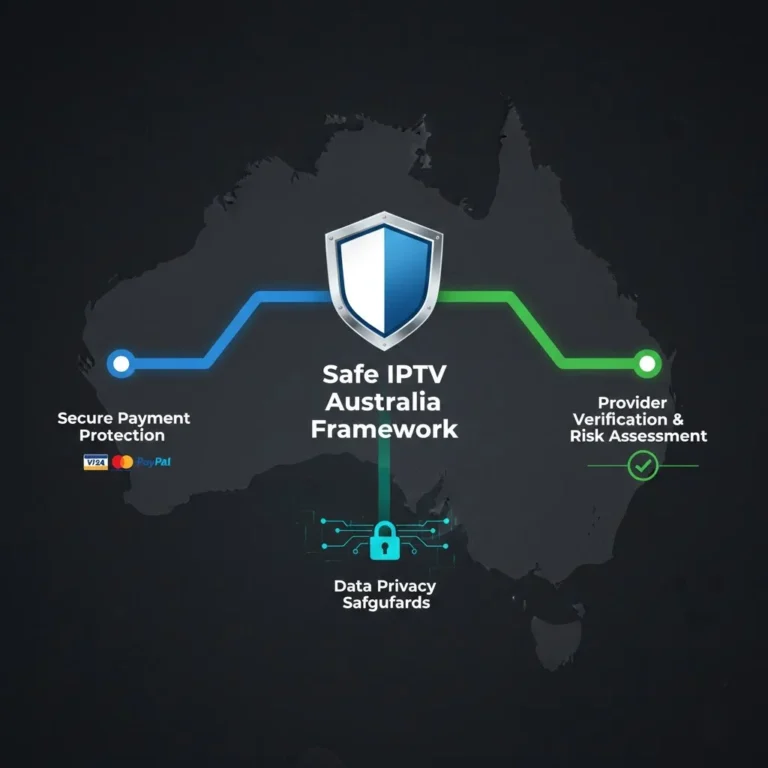
IPTV technology itself is legal—it is simply a method of delivering television over internet protocol. The legality depends on the specific provider and their content licensing arrangements. Licensed IPTV services that have distribution agreements with content owners operate within Australian law. Unlicensed services that redistribute copyrighted content without authorisation operate in a legal grey area under Australian copyright legislation and ACMA regulatory frameworks.
Australian viewers should understand that using an IPTV service does not inherently constitute illegal activity—the legal responsibility primarily lies with the provider regarding content licensing. However, viewers benefit from choosing providers that operate transparently and can demonstrate their content-sourcing legitimacy.
As IPTV becomes more popular in Australia, the law is changing. Content owners are increasingly pursuing enforcement against unlicensed redistribution, and regulatory frameworks are adapting to the internet-delivered television market. Understanding the legal position helps viewers make informed decisions about which services to trust with their subscription.
Explore further:
Technical Foundations: Protocols, Compression, and Infrastructure
For viewers who want to understand the technology behind their IPTV experience, several technical foundations affect daily viewing quality.
Streaming protocols—HLS (HTTP Live Streaming) and MPEG-TS (Transport Stream)—are the two dominant protocols. MPEG-TS delivers lower latency and faster channel switching—better for sports. HLS provides universal device compatibility and smoother bandwidth adaptation—better for general viewing. Most providers support both.
Video compression—H.264 (AVC) and H.265 (HEVC)—determines bandwidth efficiency and picture quality. H.265 delivers equivalent quality at half the bandwidth—meaning a better picture using less internet speed. Most devices from 2018+ support H.265 hardware decoding. For households on NBN 25-50, H.265 provides meaningful practical benefit.
Server scalability—Peak-hour performance (7-10 PM AEST) is determined by how providers handle simultaneous viewer demand through load balancing, CDN distribution, and dedicated sports channel infrastructure. This is why testing during prime time is the only meaningful quality evaluation.
Content sourcing—Providers acquire channels through satellite downlinks (highest quality), content licensing (most legally transparent), or restreaming (lowest cost, most variable quality). The sourcing method reliably predicts channel stability and long-term service reliability.
Explore further:
- IPTV Streaming Protocols Explained
- Video Compression: H.264 vs H.265
- IPTV Peak-Hour Performance
- IPTV Servers and CDN Networks
- How Providers Source Channels
The Australian IPTV Market in 2026
IPTV use in Australia has grown from a small market to a popular choice, influenced by five key factors: high pay TV costs pushing viewers to look for cheaper options (saving $500-900+ a year), the NBN providing reliable internet to over 85% of homes, sports content now being as good as what traditional providers offer, a demand for international channels from diverse cultures,
Three viewer segments drive the fastest adoption: sports-focused households wanting comprehensive coverage without combining Foxtel, Kayo, and Stan Sport; multicultural families needing home-language channels unavailable on any Australian platform; and cost-conscious families previously paying $80-104+ monthly for traditional pay TV.
Looking ahead to 2027–2030, the market trajectory points toward 4K becoming the default quality tier, 5G expanding IPTV reach beyond NBN coverage, AI-driven EPG systems replacing static program guides, provider consolidation improving average service quality, and hybrid IPTV-OTT platforms merging live television with on-demand content.
Explore further:
- IPTV Market Trends in Australia 2026
- IPTV Ecosystem: From Provider to Viewer
- 4K IPTV in Australia
- Future of IPTV in Australia 2026-2030
Troubleshooting Common IPTV Issues
The most common IPTV issues Australian viewers encounter—buffering, channel failures, EPG errors, and audio sync problems—each have identifiable causes and practical solutions.
Usually, server overload (provider-side) and NBN congestion (your connection) cause buffering during peak hours. Test your speed at Speedtest.net during the buffering event: if the speed exceeds 25 Mbps, the issue is provider infrastructure. Connecting via Ethernet reduces buffer events by 30-50%.
Channels going offline typically indicates the provider’s source feed for those channels has changed or been blocked—particularly common with restreamed content. Groups of channels failing simultaneously point to a common upstream source issue.
A wrong EPG timezone means the provider uses UTC or non-Australian schedule data. Some apps allow manual timezone correction. If the provider consistently delivers the wrong timezone EPG, it indicates broader service quality issues.
Explore further:
Getting Started with IPTV in Australia
Starting with IPTV in Australia follows a straightforward path:
Step 1: Verify your internet speed. Test at Speedtest.net at 8 PM on a weekday. You need 15+ Mbps minimum, 25+ Mbps recommended, with NBN 50 as the ideal baseline plan.
Step 2: Choose a streaming device. If your smart TV is from 2018 or newer, it likely works. Otherwise, a Fire TV Stick 4K ($89 AUD) is the most popular and cost-effective option.
Step 3: Select a provider offering a trial period. Test during prime-time hours and during a live sports event. Evaluate EPG quality, channel stability, and catch-up functionality before committing.
Step 4: Connect via Ethernet if possible. This single step reduces buffering more than any other optimisation.
Step 5: Configure your IPTV application with Xtream Codes API credentials for automatic updates, or load the M3U playlist URL as a fallback.
Your IPTV service should feel like turning on television—hundreds of live channels with a program guide, sports as they happen, and the flexibility to watch on any screen in your home. If the experience matches that expectation during your trial, you have found a provider worth subscribing to.
Written by: Daniel Carter Role: IPTV Systems Analyst & Service Comparison Specialist

Our Fact Checking Process
We prioritize accuracy and integrity in our content. Here's how we maintain high standards:
- Expert Review: All articles are reviewed by subject matter experts.
- Source Validation: Information is backed by credible, up-to-date sources.
- Transparency: We clearly cite references and disclose potential conflicts.
Our Review Board
Our content is carefully reviewed by experienced professionals to ensure accuracy and relevance.
- Qualified Experts: Each article is assessed by specialists with field-specific knowledge.
- Up-to-date Insights: We incorporate the latest research, trends, and standards.
- Commitment to Quality: Reviewers ensure clarity, correctness, and completeness.
Look for the expert-reviewed label to read content you can trust.