
Quick Answer
IPTV vs OTT in Australia: they’re not the same thing, despite both delivering video over the internet. IPTV (Internet Protocol Television) delivers live, scheduled TV channels with an EPG, traditionally over managed network infrastructure – replacing cable and satellite. OTT (Over-The-Top) delivers content directly over the open internet, primarily on-demand libraries but increasingly including live channels too. Netflix, Stan, and Disney+ are OTT. Subscription IPTV services that deliver live channel packages are also IPTV. Most Australian households get the most complete coverage by combining one of each.
Quick Comparison
| Feature | IPTV | OTT |
|---|---|---|
| Content model | Live, scheduled channels | Primarily on-demand, increasingly some live |
| Navigation | EPG (channel + time grid) | Search/browse/recommendations |
| Network | Often managed/dedicated paths | Open public internet |
| Live sport | Multi-channel aggregation in one subscription | Live rights vary by platform (e.g., Kayo, DAZN, Prime Video) |
| Examples in Australia | Subscription IPTV providers | Netflix, Stan, Disney+, Binge, Kayo |
| Replaces | Cable, satellite, antenna | Physical media, and increasingly some live TV too |
At a Glance
✔ Core Difference: Broadcast model (IPTV) vs library-first model (OTT)
✔ Netflix, Stan, Disney+, Binge: All OTT
✔ Kayo Sports: OTT, sport-specific
✔ Foxtel: Hybrid (satellite + Foxtel Now, which is OTT?
✔ Best Setup for Most Households: One IPTV subscription + one OTT service
Key Takeaways
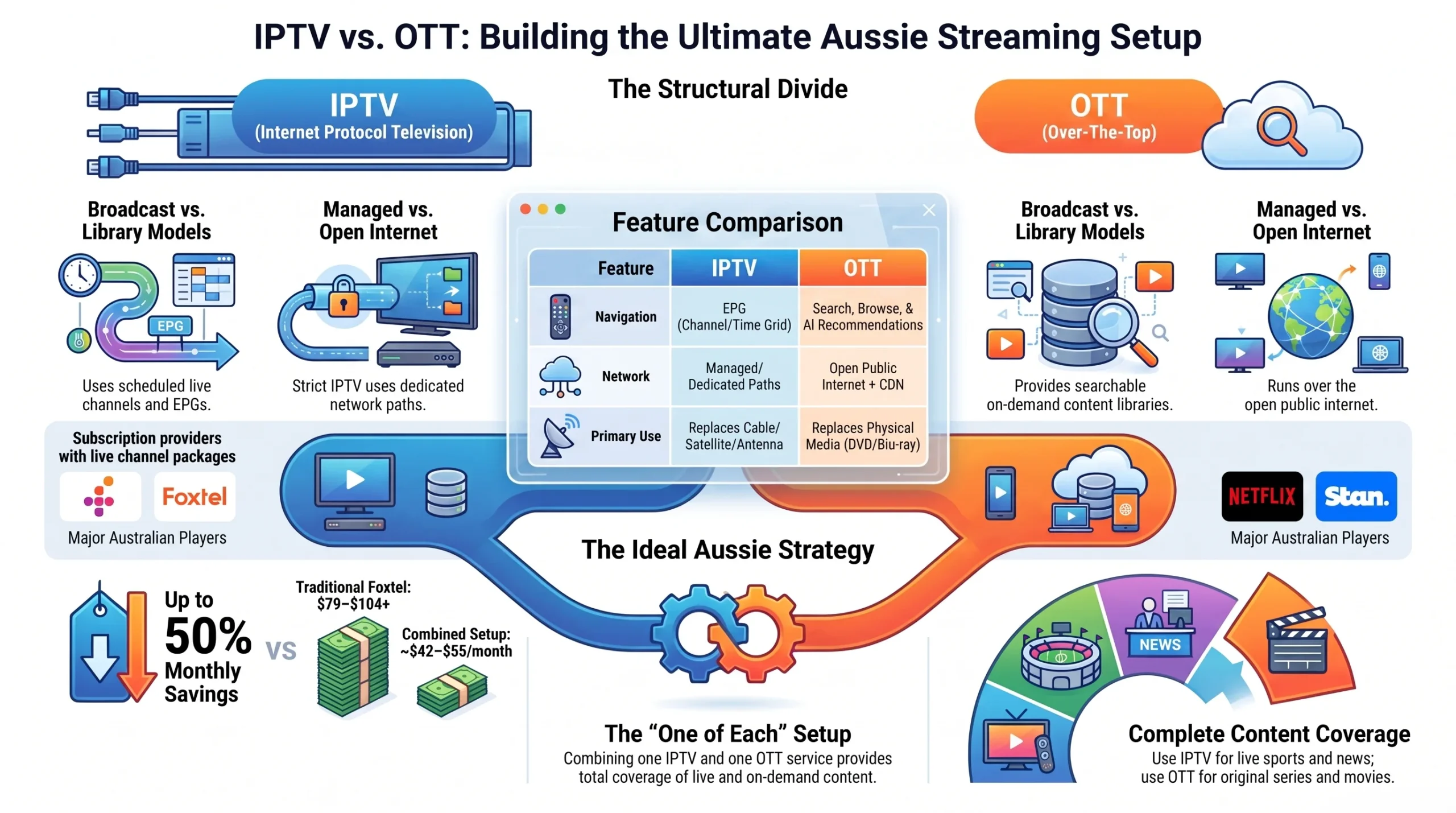
- IPTV uses a broadcast model – scheduled channels you tune into; OTT is primarily a library model, though increasingly hybrid
- IPTV traditionally relies more on managed or dedicated network paths; OTT runs over the open public internet
- Netflix, Stan, Disney+, Binge, and Kayo Sports are all OTT services, not IPTV
- OTT delivers entertainment directly over the internet, replacing physical media and expanding into live sport, news, and original productions
- “IPTV” is also used loosely in consumer marketing to mean any internet-delivered live channel subscription, which doesn’t always match the strict managed-network definition used in the broadcast industry
In This Guide
- What’s the Core Structural Difference?
- How Does the Technical Infrastructure Differ?
- Which Australian Services Are IPTV and Which Are OTT?
- Can IPTV and OTT Work Together?
- FAQ
What’s the Core Structural Difference?
The core structural difference is the content delivery model: IPTV operates on a broadcast model, with content playing on a schedule across live channels you tune into; OTT operates primarily on a library model, with content available on demand for you to choose and play whenever. This isn’t a minor technical nuance — it shapes much of the viewing experience and what each system can realistically replace in your household.
IPTV (broadcast model): Live channels running continuously, provider-determined programming, EPG navigation, tuning in at a scheduled time, live sport and 24/7 news, an experience like cable or satellite TV — it replaces Foxtel, antenna, or cable.
OTT (library-first, increasingly hybrid): A stored catalogue of titles you can play anytime; search/browse/recommendation-driven navigation; and sport coverage that depends entirely on which platform holds the rights (Kayo, DAZN, and Prime Video). OTT is primarily on-demand, though a growing number of platforms now include selected live channels and events (YouTube Live, Samsung TV Plus, Pluto TV) – it replaces physical media and is steadily expanding into live TV territory too.
How Does the Technical Infrastructure Differ?

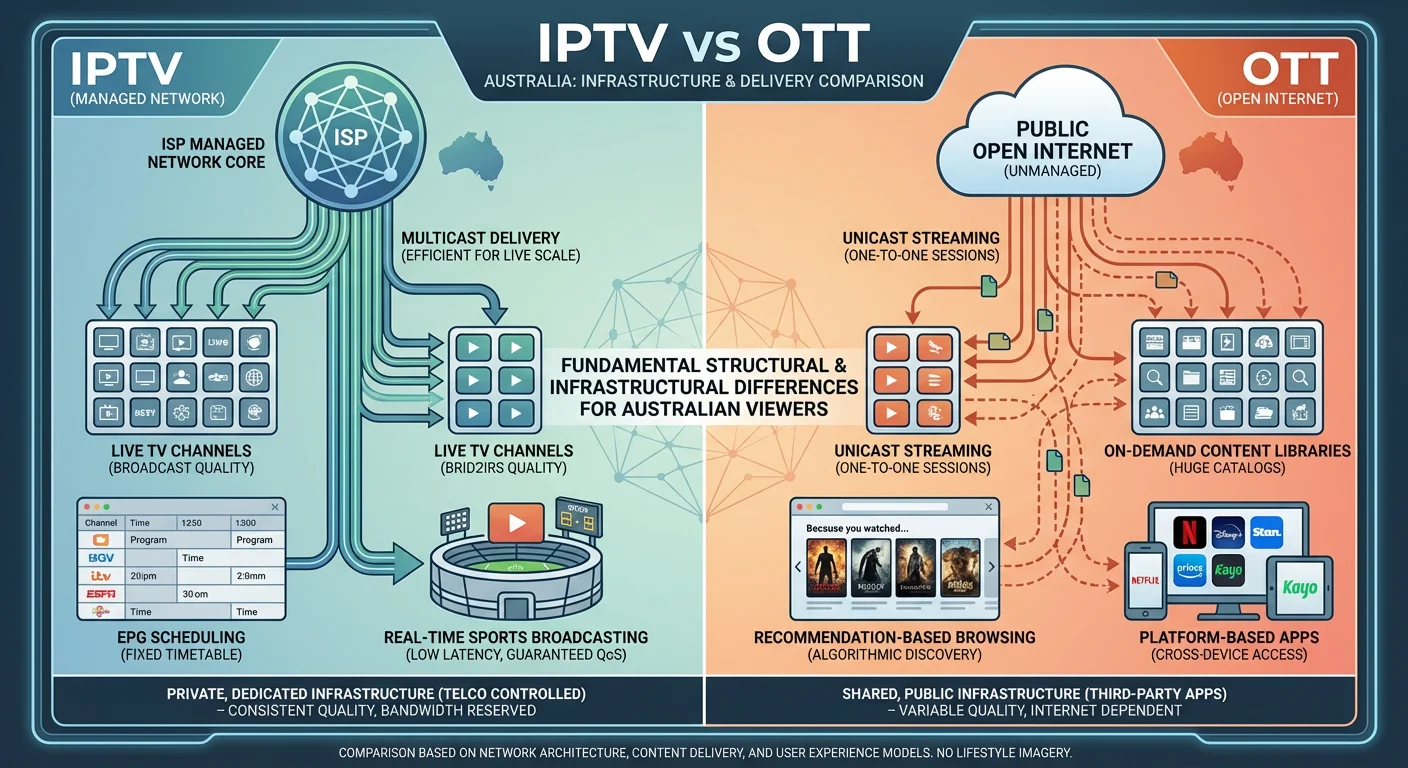
IPTV traditionally uses managed network infrastructure with dedicated bandwidth allocation and multicast distribution — efficiently serving the same content to many viewers at once. OTT typically relies on the open public internet combined with CDN (Content Delivery Network) infrastructure.
A CDN is a geographically distributed group of servers that caches content closer to end users, speeding up delivery of video, images, and other web content, as explained by Cloudflare’s CDN documentation — this is the mechanism OTT platforms like Netflix rely on to compensate for not having a dedicated managed network of their own. CyberGhost VPN
| Aspect | IPTV | OTT |
|---|---|---|
| Network | Managed/dedicated paths (in the strict definition) | Open public internet + CDN |
| Distribution | Multicast (one-to-many) | Unicast (one-to-one) |
| Bandwidth | Often dedicated allocation | Best-effort delivery |
A note on terminology: in the strict broadcast-industry sense, “IPTV” specifically means delivery over a managed network controlled by a telco or ISP. In everyday Australian consumer marketing — including across this site — “IPTV” is also used more loosely to describe any subscription service delivering live TV channels over the internet, even when that delivery runs over the open public internet rather than a dedicated managed network. Worth knowing if you ever see the term used in a more technical context.
Which Australian services are IPTV and which are OTT?
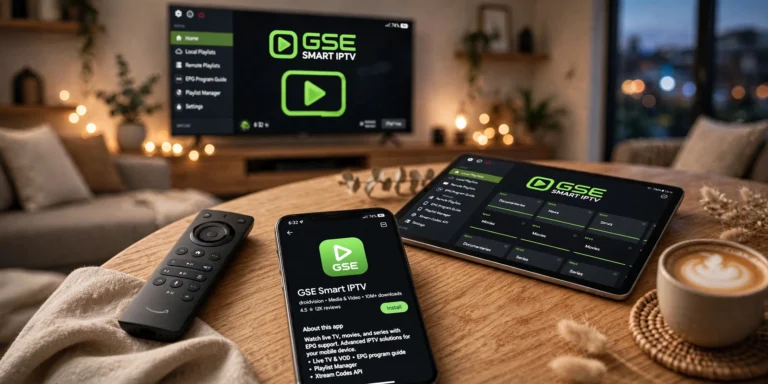
In the Australian market: IPTV services are subscription providers delivering live channel packages with EPG, catch-up, and VOD, accessed using IPTV player applications such as IPTV Smarters or Tivimate (these are players, not services in themselves), replacing cable or satellite TV. OTT services include Netflix, Stan, Disney+, and Binge – on-demand platforms accessed through their own apps over the open internet. Foxtel occupies a hybrid position: satellite TV (traditional) plus Foxtel Now (technically OTT). Kayo Sports is OTT, focused specifically on live sport.
Can IPTV and OTT Work Together?
IPTV and OTT work best as complementary services rather than alternatives — IPTV handling live television (channels, sport, news, and international content) and OTT handling curated on-demand entertainment (originals, movie libraries, and recommendations).
Combining one IPTV subscription ($25–35/month) with one OTT service ($17–20/month) typically totals $42–55/month, against $79–104+/month for Foxtel alone, while covering a broader range of viewing scenarios: morning news and Saturday sport (IPTV), an evening series binge (OTT), and catch-up on anything missed (IPTV). For more on how this model compares specifically with traditional pay TV, see our IPTV vs. Traditional TV guide.
Frequently Asked Questions
Is Netflix considered IPTV?
No. Netflix is an OTT service — it delivers an on-demand content library over the open internet where you browse and select titles, with no EPG or scheduled broadcasts. IPTV delivers live channels with real-time scheduling.
Is OTT better than IPTV?
Neither is inherently better — it depends on what you’re watching for. OTT is generally better for on-demand flexibility and device choice; IPTV is generally better for a traditional live-TV experience with multi-channel live coverage.
Is Kayo Sports IPTV or OTT?
Kayo is technically an OTT service — it delivers content through its app over the open internet, not through IPTV channel infrastructure with an EPG. The practical difference is that Kayo is a single-purpose sport platform with rights to specific competitions, while IPTV bundles many channel categories, including sport, into one subscription.
Do I need both IPTV and OTT?
For the most complete viewing coverage, combining one IPTV subscription with one OTT service typically covers all viewing scenarios — live TV, sport, news, and curated on-demand content — for less than a Foxtel-only subscription.
Which is better for live sport — IPTV or OTT?
Many IPTV services aggregate multiple sports channels into a single subscription, while OTT sports coverage depends on which platform holds the specific rights you want—Kayo for most Australian sports, DAZN or Prime Video for some international rights.
Which is “better” depends on whether you want broad aggregation or are happy following specific rights holders individually.
Will OTT replace IPTV?
Unlikely in the near term, though the line is blurring. OTT platforms increasingly support live channels, though their core design remains on-demand-first; IPTV still leads on aggregating many live channels with EPG navigation in one place. For now, both are likely to coexist as complementary services.
Conclusion
IPTV and OTT are different technologies serving different viewing needs, despite both running over the internet. IPTV replaces traditional television with live, scheduled channels; OTT replaces physical media with curated, on-demand libraries while steadily adding live features of its own.
For most Australian households, the most complete setup combines both: an IPTV subscription as the primary live TV source, supplemented by one OTT service for on-demand entertainment – together costing well below traditional pay TV and providing broader overall coverage.
🔗 Explore More — IPTV Australia Guide
Browse the full IPTV Australia Guide hub for every guide in this category, or jump straight to the following:
- IPTV Australia Guide: Complete 2026 Overview (linked above)
- What Is IPTV in Australia?
- IPTV vs Traditional TV in Australia (linked above)
- IPTV Cost Guide