
By Daniel Carter, IPTV Systems Analyst & Service Comparison Specialist · IPTV Australia Guide · Last updated: September 2026
Quick Answer
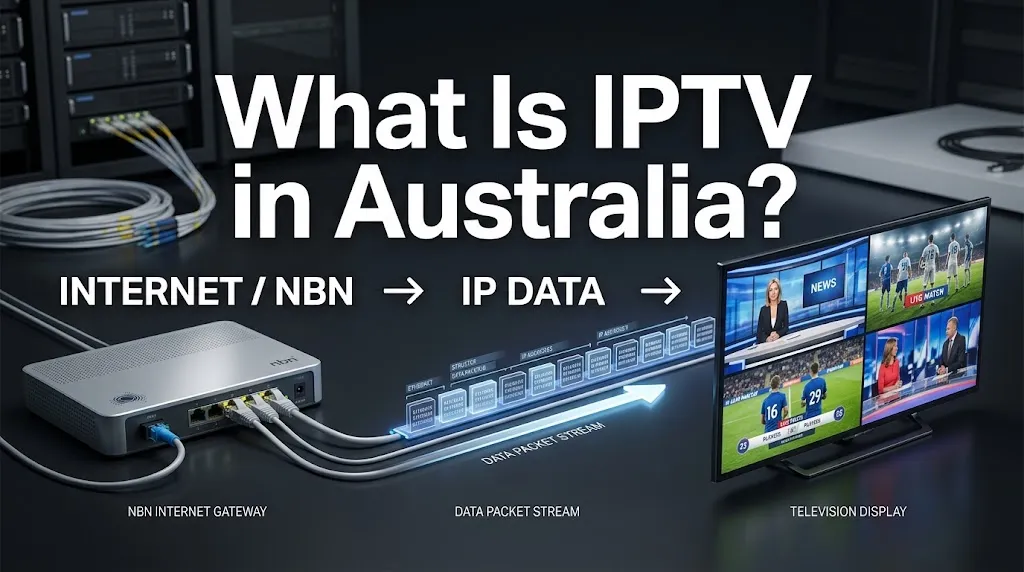
What is IPTV in Australia? IPTV stands for Internet Protocol Television, and it means live TV channels delivered over your internet connection instead of through an antenna, a satellite dish or a cable. The word describes the delivery method. It does not describe any particular service, channel list or subscription.
What is IPTV in Australia in practice? It is the same television experience most households already recognise — channels running to a schedule, a programme guide showing what is on now and next — arriving over the NBN rather than through an aerial on the roof.
Once you know that, most of the confusion around the term disappears, because almost every misunderstanding about IPTV comes from treating it as the name of a product rather than the name of a delivery method.
This article explains what the term actually covers, what it does not include, and what you genuinely need to use it. If you want the practical walkthrough instead, the step-by-step guide to watching IPTV in Australia covers the setup itself.
What Is IPTV in Australia? The Idea in One Picture
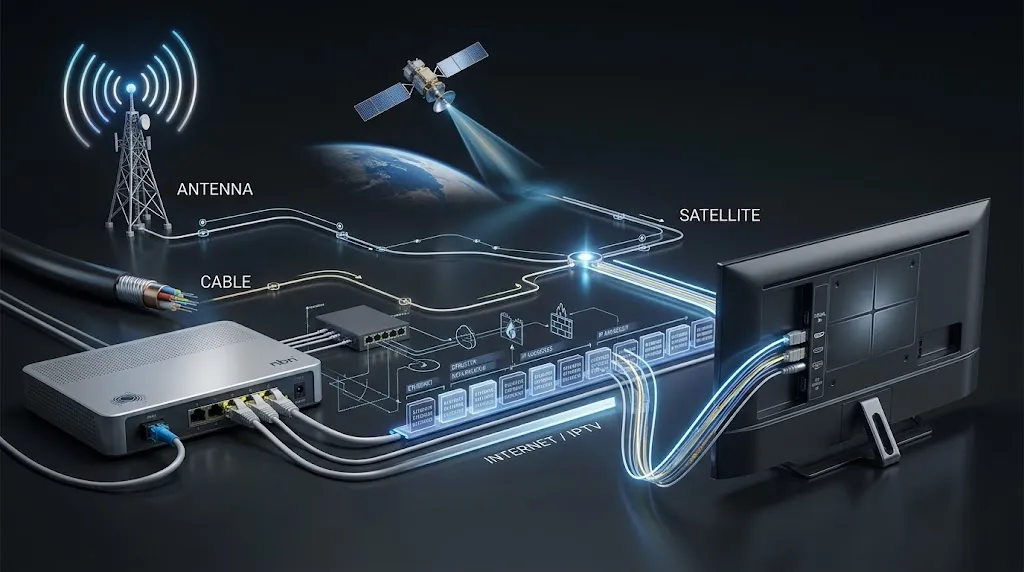
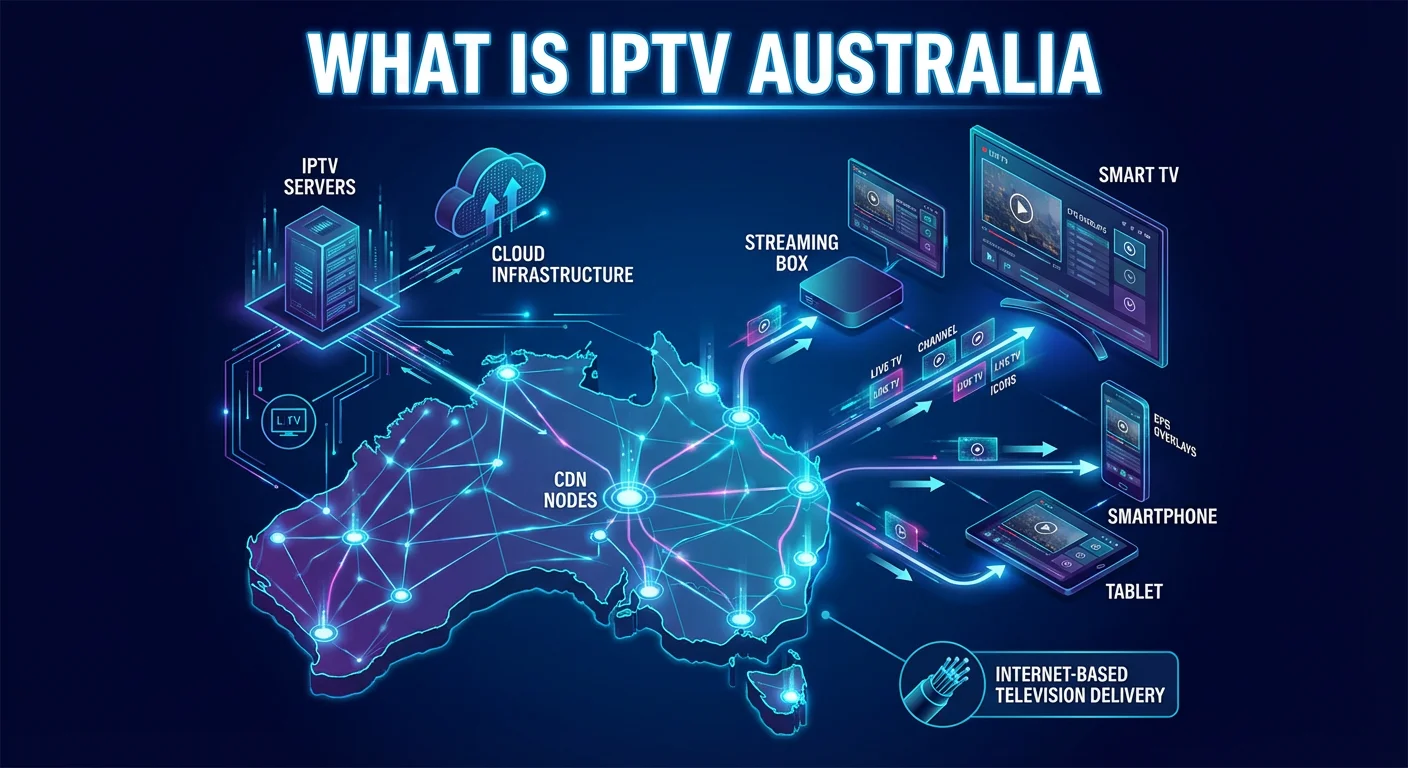
Traditional television arrives as a broadcast signal. An antenna picks free-to-air channels out of the air, a satellite dish picks them off a satellite, and cable delivers them through a physical line into the house. In each case the signal is pushed out to everybody at once and your equipment catches it.
IPTV replaces that path with your internet connection. The channel is sent to your device as data, the same way a website or a video call is, and an app on your screen turns it back into a picture. What you see is unchanged: a channel playing whatever is scheduled at that moment, which you join partway through rather than choosing from a menu.
That single change — the road the signal travels — is the entire meaning of the term. It says nothing about who runs the service, which channels are included, or whether the service is licensed to carry them.
IPTV Is Not the Same as Netflix or Foxtel
This is where most of the confusion sits, so it is worth separating carefully.
IPTV is not Netflix, and it does not include Netflix
Netflix, Stan, Disney+, Prime Video and Binge are on-demand platforms. You open a library and choose something to start. There is no schedule and nothing is running when you are not watching.
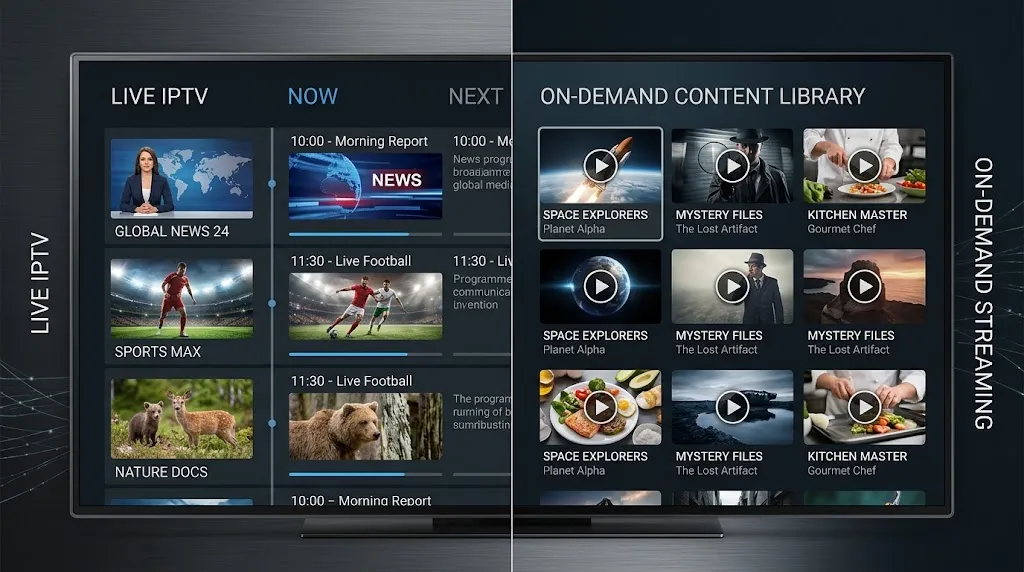
IPTV is the opposite arrangement. Channels run continuously to a timetable, you tune in rather than choose, and an electronic programme guide tells you what is playing now and next. Live sport and rolling news only work this way, which is why IPTV exists at all when on-demand platforms are so common.
They are not competitors, and most households that use one also use the other. What matters here is the claim you will see in advertising: that an IPTV subscription “includes Netflix” or “includes Disney+”. A streaming platform subscription is sold by that platform. Any service claiming to hand you those platforms inside its own package is telling you something about itself, and it is worth reading carefully.
IPTV is not a fixed catalogue of channels
There is no master IPTV channel list. Because the term describes delivery rather than content, what is available depends entirely on the individual service and what it has the rights to carry. Two services described as IPTV can have almost nothing in common.
This is why “can I watch this on IPTV?” has no general answer. The only answer that means anything is whether one specific service carries one specific channel, confirmed by looking at it yourself.
An IPTV app is not an IPTV service
Installing a player app does not give you channels, and this surprises a lot of first-time users. Apps such as TiviMate, IPTV Smarters Pro and IBO Player are players: they store login details, display a channel list and handle the guide. They supply nothing to watch.
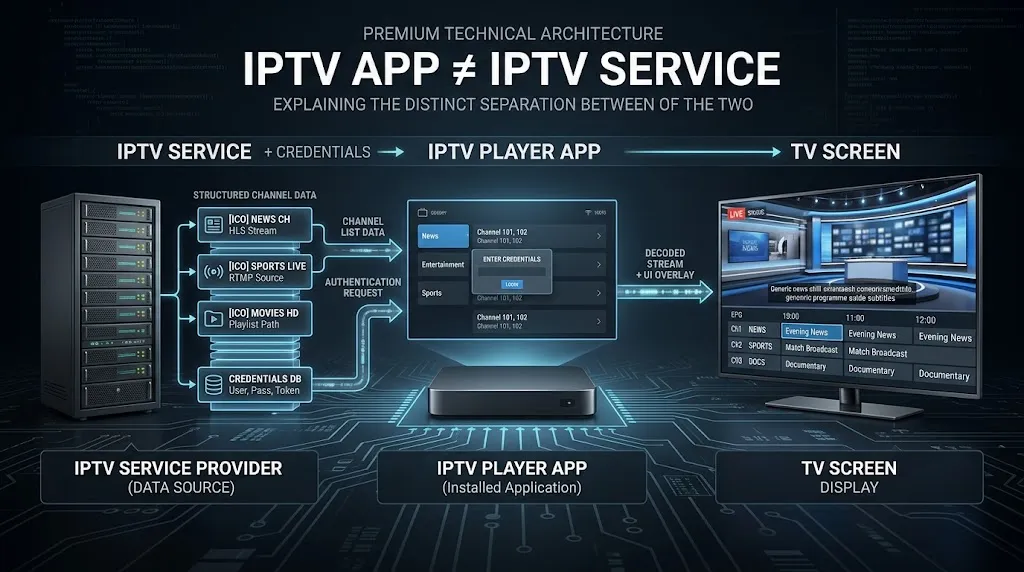
The channels come from a service, which provides credentials you enter into the player. Two separate things, sometimes confused because they arrive at the same time. The difference between an app and a service covers this in more detail, and the devices and apps guide covers which players run on which platforms.
Key takeaway: IPTV describes how television reaches your screen, not what you are allowed to watch or who is allowed to sell it to you.
The Three Kinds You Will Come Across
Everything sold or described as IPTV in Australia falls into three groups, and they differ enormously in how they operate.
| Type | What it is | Licensing |
|---|---|---|
| Free-to-air broadcaster apps | ABC iview, SBS On Demand, 7plus, 9Now, 10 play — the networks streaming their own channels | The broadcaster owns the content |
| Licensed subscription services | Fetch TV, Kayo Sports, Foxtel’s streaming products | Rights held under commercial agreements |
| Third-party services | Subscription channel lists sold by independent operators | Varies; check before subscribing |
The first two are straightforward. Australia’s free-to-air networks stream their own channels at no cost, which is IPTV in the technical sense even though nobody markets it with that word. Kayo Sports is Foxtel’s dedicated sports streaming platform, Fetch TV is a licensed set-top service, and these hold their rights through commercial agreements.
The third group is what people usually mean by “IPTV” in conversation, and it is where the variation lives — in coverage, in reliability, and in whether the service holds rights to what it carries. The licensed alternatives guide sets out what the first two groups cover, which is worth knowing before considering the third.
What You Get, and What You Do Not
A subscription service in the third group typically bundles four things:
| Component | What it does |
|---|---|
| Live channels | Real-time broadcasts across sport, news, entertainment, kids and international categories |
| Electronic programme guide (EPG) | The on-screen schedule showing what is playing now and next |
| Catch-up | Replay of programmes that aired recently |
| Video on demand | A film and series library inside the same subscription |
Availability varies by provider, and every one of these components should be confirmed during a trial rather than taken from a sales page.
What is not included matters just as much:
- Subscriptions to other platforms. A service does not grant you Netflix, Disney+ or Prime Video accounts.
- Any guarantee of continuity. A third-party service can change what it carries, or stop operating, without notice.
- Formal support. Support quality varies from responsive to absent.
What You Actually Need
Three things, and most households already have two of them.
An internet connection. IPTV depends on it entirely. No connection means no television, with no antenna to fall back on — a real difference from free-to-air, and worth weighing if your connection is unreliable. What matters is not only the plan speed but how it holds up in the evening, which the NBN guide and the speed requirements guide both cover.
A device. No dish, no aerial, no special IPTV box. A smart TV, a streaming stick, a tablet, a phone or a computer will do it. What matters is which apps the device can install: open platforms such as Android TV, Google TV and Fire OS allow a wide choice of players, while closed platforms such as Samsung’s Tizen, LG’s webOS, Apple TV and the newer Fire TV sticks running Vega OS are limited to their own stores. The smart TV guide covers what each platform allows.
A player app. Which one depends on the device, as above.
The Downsides Nobody Advertises
Four honest trade-offs, none of which appear in marketing.
It stops when the internet stops. An outage takes the television with it.
There is a delay behind broadcast. Live streams run slightly behind the traditional signal, which most people never notice until a neighbour cheers a goal before it reaches their screen.
You depend on someone else’s maintenance. Guide data, playlist updates and server addresses are all maintained at the service’s end. When a channel list goes stale or a server address changes, there is nothing to fix at your end — you need the service to act. The troubleshooting guide covers telling these apart from faults you can fix yourself.
A third-party service can simply stop. Whether through a business decision, a technical failure or a court-ordered block, there is no obligation to warn you. That is one of several risks specific to unlicensed services, and it is why a short first commitment and a reversible payment method matter more here than in most purchases, as the payment methods guide sets out.
Is IPTV Legal in Australia?
IPTV is legal in Australia as a technology. It is a delivery method, and licensed Australian services use it every day. The legal question is never about the method — it is about whether a particular service holds the rights to the channels it carries.
Under section 115A of the Copyright Act 1968, rights holders can ask the Federal Court to order Australian internet providers to block overseas sites whose primary purpose or effect is infringing copyright or facilitating infringement. Those orders have been made repeatedly since the provision came into force, and the scheme was later extended to cover search results as well. The ACMA operates separate blocking schemes for other categories, which is why Australia has several distinct lists rather than one.
For viewers, the practical consequence is straightforward: a service can be working one week and unreachable the next, with nothing wrong at your end. Whether IPTV is legal in Australia covers where viewers stand specifically, the IPTV laws guide explains the blocking regime, and the risks guide covers what unlicensed services expose subscribers to beyond the legal question.
This article is for educational and comparison purposes only. Verify the licensing status of any streaming service and ensure compliance with Australian copyright law before subscribing.
The Bottom Line
If you take one thing from this: IPTV is a delivery method, not a product. Anyone using the word as though it names a single service, a fixed channel list or a legal status is using it loosely, and that looseness is where most bad decisions start.
For households whose viewing is free-to-air and mainstream sport, the licensed options already cover it, and the broadcaster apps cost nothing.
For households wanting channels no Australian platform carries — usually international or home-language programming — third-party services are the reason IPTV gets discussed at all, and they vary enough that the only reliable evaluation is your own, on your own connection. The evaluation guide covers what to check before paying.