
Quick Answer
There’s no single “best” Australian IPTV service for expats—what matters more is knowing how to evaluate one yourself, since reliability and legality vary enormously between providers. The goal isn’t to recommend a specific provider but to help you evaluate any Australian IPTV service using objective criteria before spending money. This guide gives you the actual checklist: what to verify before subscribing, the red flags that should make you walk away, and why the official apps + VPN route (covered elsewhere on this site) is worth comparing against before you commit to a paid IPTV subscription.
At a Glance
✔ “Best” Depends On: Your specific channels/sport needs, not a universal ranking
✔ Biggest Red Flag: No clear answer about content licensing
✔ Most Overlooked Factor: Multi-connection and device policies
✔ Trial Period: Should be standard, not a bonus
✔ Alternative Worth Comparing: Official broadcaster apps + VPN, for free-to-air content
Who Is This Guide For?
This checklist is useful if you’re:
- Living overseas permanently
- Travelling for several months
- Comparing IPTV providers before subscribing
- Looking for Australian sport or television from abroad
Key Takeaways
- “Best” is the wrong first question — “what should I check?” gets you a far more useful answer
- Legitimate providers are transparent about how they source content; vague or evasive answers are the clearest warning sign
- Multi-device and simultaneous-connection limits vary widely and matter more day-to-day than most marketing pages suggest
- A genuine trial period or money-back window is standard practice among reputable providers, not a special offer
- For free-to-air content specifically, comparing against the official apps + VPN route is worth doing before paying for anything
In This Guide
- Why “Best” Is the Wrong First Question
- The Actual Checklist: What to Verify Before Subscribing
- Questions to Ask Before Paying
- Green Flags vs Red Flags
- IPTV vs Official Apps + VPN: When Each Makes Sense
- Is This Legal?
- Common Mistakes Expats Make
- People Also Ask
- FAQ
Why “Best” Is the Wrong First Question
Every “best IPTV” list you’ll find runs into the same problem: reliability and legitimacy vary so much between individual providers that a generic ranking tells you very little about the specific service you’re about to pay for. A provider that’s excellent for one person’s channel needs can be a poor fit for someone else’s.
The more useful skill — and the actual point of this guide — is knowing what to check for yourself, regardless of which provider you’re looking at.
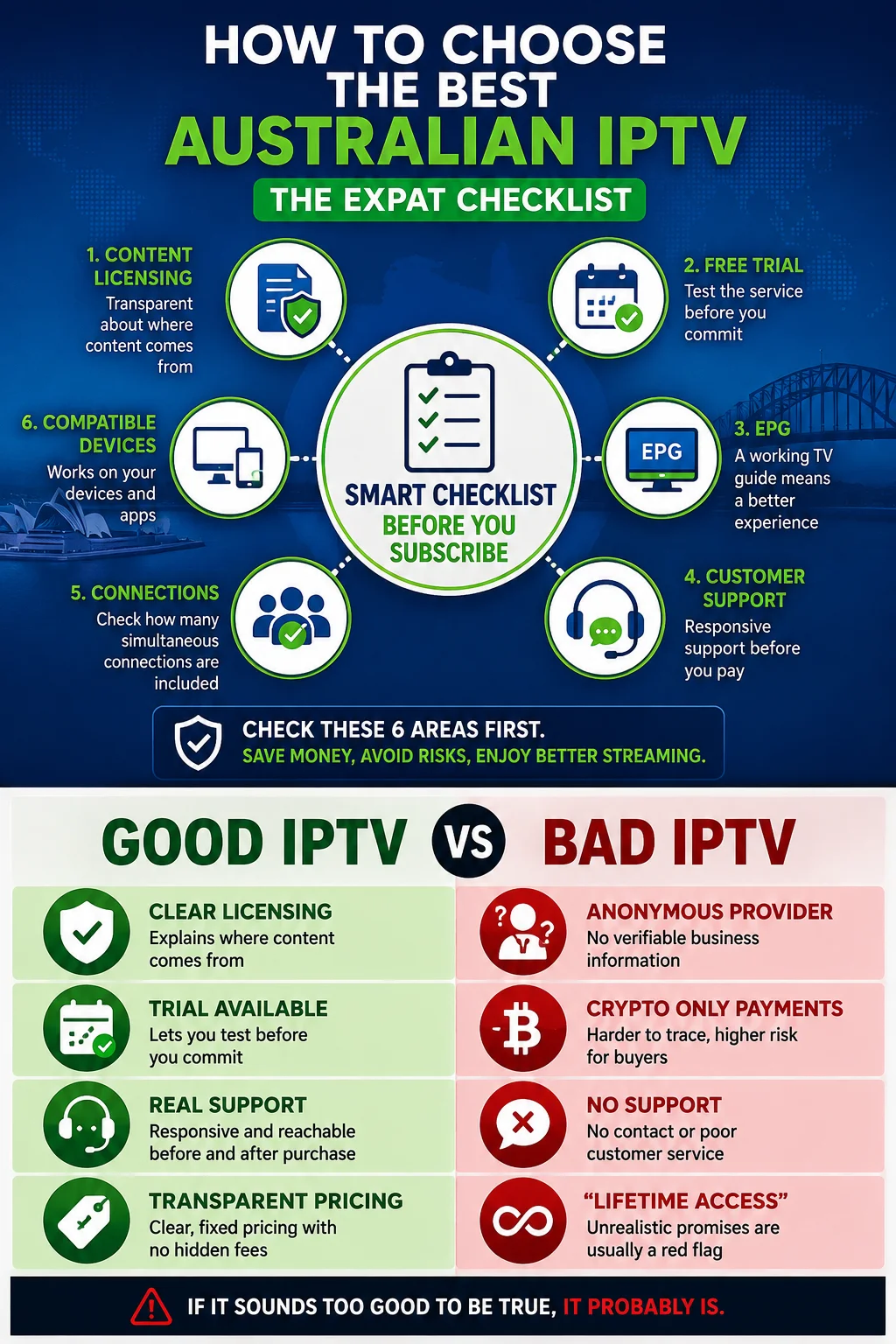
The Actual Checklist: What to Verify Before Subscribing
| Checklist Item | Why It Matters | Green Flag |
|---|---|---|
| Licensing transparency | Shows whether the provider explains its content sources | ✅ |
| Trial period | Lets you test reliability before paying | ✅ |
| Multi-device support | Important for families and multiple screens | ✅ |
| Working EPG (TV guide) | Usually indicates a better-maintained service | ✅ |
| Customer support (pre-sale) | Shows how issues will be handled after you’ve paid | ✅ |
| Clear, fixed pricing | Often reflects licensing status — see our content licensing guide | ✅ |
For more on spotting a properly licensed provider specifically, see our guide to identifying a legal IPTV provider.
Questions to Ask Before Paying
Ask any provider directly before you hand over payment details:
- Where does your content come from?
- Is there a free trial?
- How many simultaneous connections are included?
- Is an EPG included?
- Which devices are officially supported?
- What happens if the service stops working?
How a provider answers these — clearly and specifically, or vaguely and defensively — tells you almost everything you need to know.
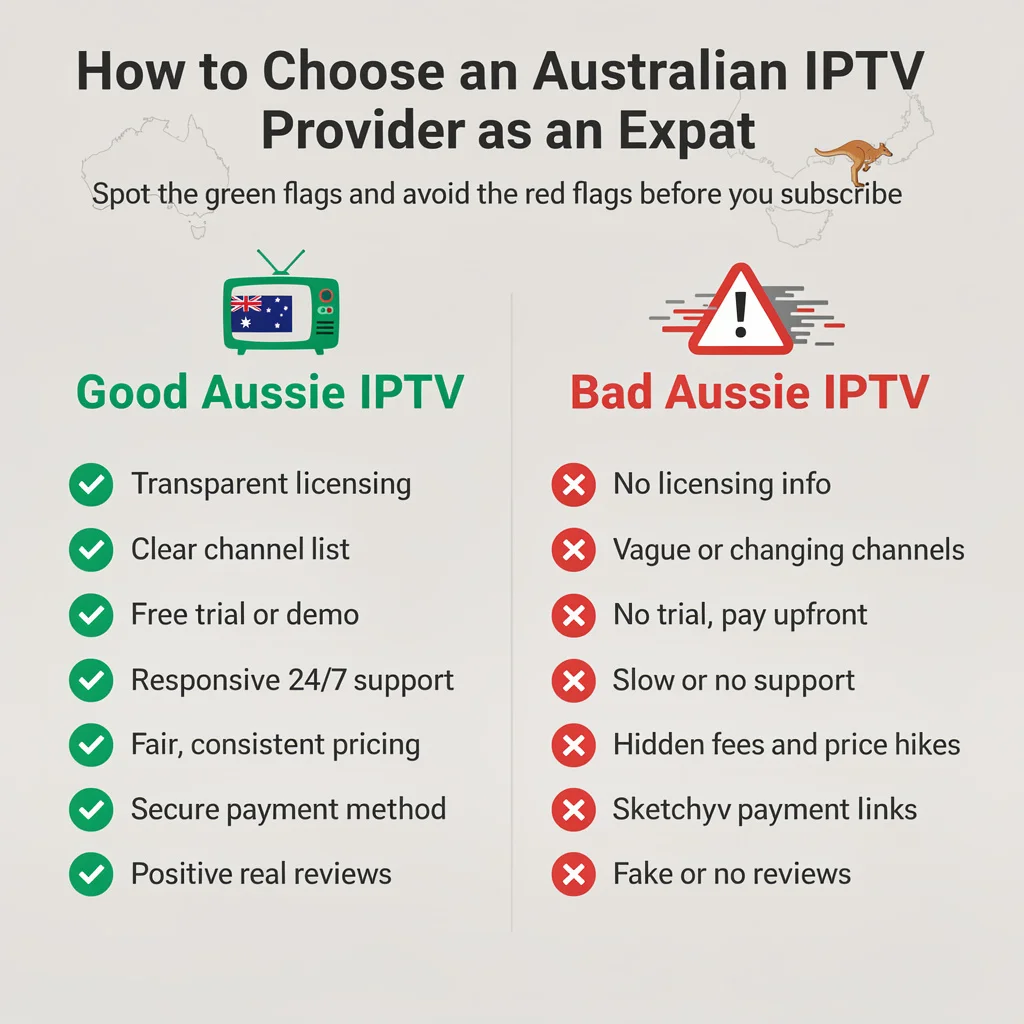
Green Flags vs Red Flags
| Green Flag | Red Flag |
|---|---|
| Clear, fixed pricing | Hidden fees |
| Trial available | No trial at all |
| Transparent, reachable support | Anonymous or unverifiable contact |
| Licensing clearly explained | Vague or evasive answers about sourcing |
| Standard payment methods | Cryptocurrency-only payment |
These red flags aren’t unique to IPTV — according to ACCC Scamwatch, unusual payment requests like wire transfers, gift cards, or cryptocurrency are a near-certain sign of a scam, along with unclear cancellation terms and contact details that don’t match the company’s official website. A few of these deserve a bit more explanation:
Pricing that’s drastically cheaper than every comparable service is usually a signal about content licensing, not just good business efficiency — see our breakdown of the risks of unlicensed IPTV for why this issue matters.
“Lifetime access” offers are a specific variant of the pricing red flag worth calling out on its own — ongoing content costs make a genuine lifetime deal commercially implausible for a legitimate provider.
IPTV vs Official Apps + VPN: When Each Makes Sense
Before committing to a paid IPTV subscription, it’s worth being clear about what you’re actually solving for:
- If you mainly want free-to-air content (ABC, SBS, the commercial networks’ catch-up apps), the official apps combined with a VPN cover your needs at no subscription cost at all — see our breakdown of what’s genuinely free from abroad.
- If you specifically want live sport that’s normally behind Foxtel or Kayo, a licensed IPTV provider can sometimes be more consistently reliable than fighting an increasingly aggressive VPN battle against those platforms.
- If you want a single setup covering everything (free-to-air, premium, sport, movies), this is where a paid IPTV subscription’s appeal is strongest — but it’s precisely the scenario where the checklist above matters most, since you’re trusting one provider with your entire viewing experience.
Is IPTV Legal?
IPTV, as a technology, is completely legal — the legal question is entirely about whether a specific provider holds the rights to the content it’s distributing. We cover this distinction, including how to spot a properly licensed provider, in our complete guide to IPTV legality in Australia.
Common Mistakes Expats Make
Choosing based on price alone. The cheapest option in this space is rarely cheap by accident — it usually reflects something about content licensing.
Skipping the trial period. Even when a trial is offered, it’s all too tempting to skip proper testing before committing to a longer plan. Use the trial deliberately: test peak-hour reliability, not just whether it works once.
Not checking connection limits against actual household needs. A plan that works fine for one person streaming alone can fall apart fast with multiple devices running simultaneously.
Assuming “Australian-sounding” branding means anything. A provider’s name or marketing imagery says nothing reliable about where it’s actually based or how it sources content.
People Also Ask
What is the best Australian IPTV for expats?
There isn’t one universal answer. The best provider depends on the channels you need, the devices you use, and whether the provider is transparent about content licensing and customer support.
How do I know if an IPTV provider is legitimate?
Look for clear information about content licensing, transparent pricing, real customer support, and a trial or refund policy before subscribing.
Is a cheap IPTV subscription always a bad sign?
Not always, but pricing that’s dramatically lower than comparable services should prompt you to ask how the provider sources its content.
Should I use IPTV or official Australian streaming apps?
If you mainly watch free-to-air channels, official apps with a VPN are often enough. IPTV becomes more useful when you want premium channels or a single interface for multiple services.
Frequently Asked Questions
Is there a single best IPTV service for Australian expats?
Not really — reliability and legitimacy vary too much by individual provider for a universal answer. The checklist in this guide is the more useful tool than any specific ranking.
How much should Australian IPTV cost?
There’s no fixed benchmark, but pricing that’s drastically below every comparable service in the market is a signal worth investigating, not just a bargain.
Is a free trial a reliable way to judge a provider?
Yes, if used properly — test during peak hours (evenings and live sports) rather than at quiet times, since that’s when reliability problems actually show up.
What’s more important: price or content variety?
Neither, on their own. Whether the provider can clearly explain its content sourcing matters more than either; it’s the single best predictor of long-term reliability and legitimacy.
Should I just use the official apps and a VPN instead?
For free-to-air content, it’s genuinely worth comparing first. A paid IPTV provider makes more sense once you’re after premium or live sport content beyond what the free apps cover.
Conclusion
There’s no shortcut around evaluating an IPTV provider properly — “best” lists oversimplify a market where reliability and legitimacy genuinely vary by provider. Use the checklist above before you subscribe to anything, and don’t skip comparing it against the free official-apps-plus-VPN route first, especially if free-to-air content covers most of what you’re actually trying to watch.
🔗 Explore More — Australian IPTV Overseas
Browse the full Australian IPTV Overseas hub for every guide in this category, or jump straight to the following:
- Watch Australian TV Overseas: The Complete Guide for Expats and Travellers (linked above)
- Is It Legal to Bypass Geo-Blocking in Australia?
- Australian Streaming Services Overseas: Netflix AU, Stan, Binge, Foxtel & More (linked above)
- Watch Australian TV Free From Abroad: What’s Actually Free (linked above)