
Introduction
When I review the practical landscape of unlicensed IPTV risk services targeting Australian subscribers in 2026, the risks fall into categories that are consistently underweighted in public discussions about IPTV.
The debate about whether IPTV is “legal” tends to focus on the subscriber’s legal exposure – which, under current Australian enforcement patterns, is real but indirect. The risks that actually affect subscribers most frequently and most significantly are not primarily legal: they are financial, technical, and practical.
This article is part of the Legal IPTV Australia compliance hub and provides a comprehensive assessment of the real risks facing Australian subscribers who use unlicensed IPTV services in 2026 — not to generate alarm, but to offer the factual risk picture that informed decision-making requires.
Unlicensed IPTV risks in Australia include various financial, legal, technical, and practical problems that Australian subscribers face when using IPTV services that are not entitled to show content according to the Copyright Act 1968 (Cth), lack proper business registration, and do not follow the Australian Consumer Law and Privacy Act 1988 rules.
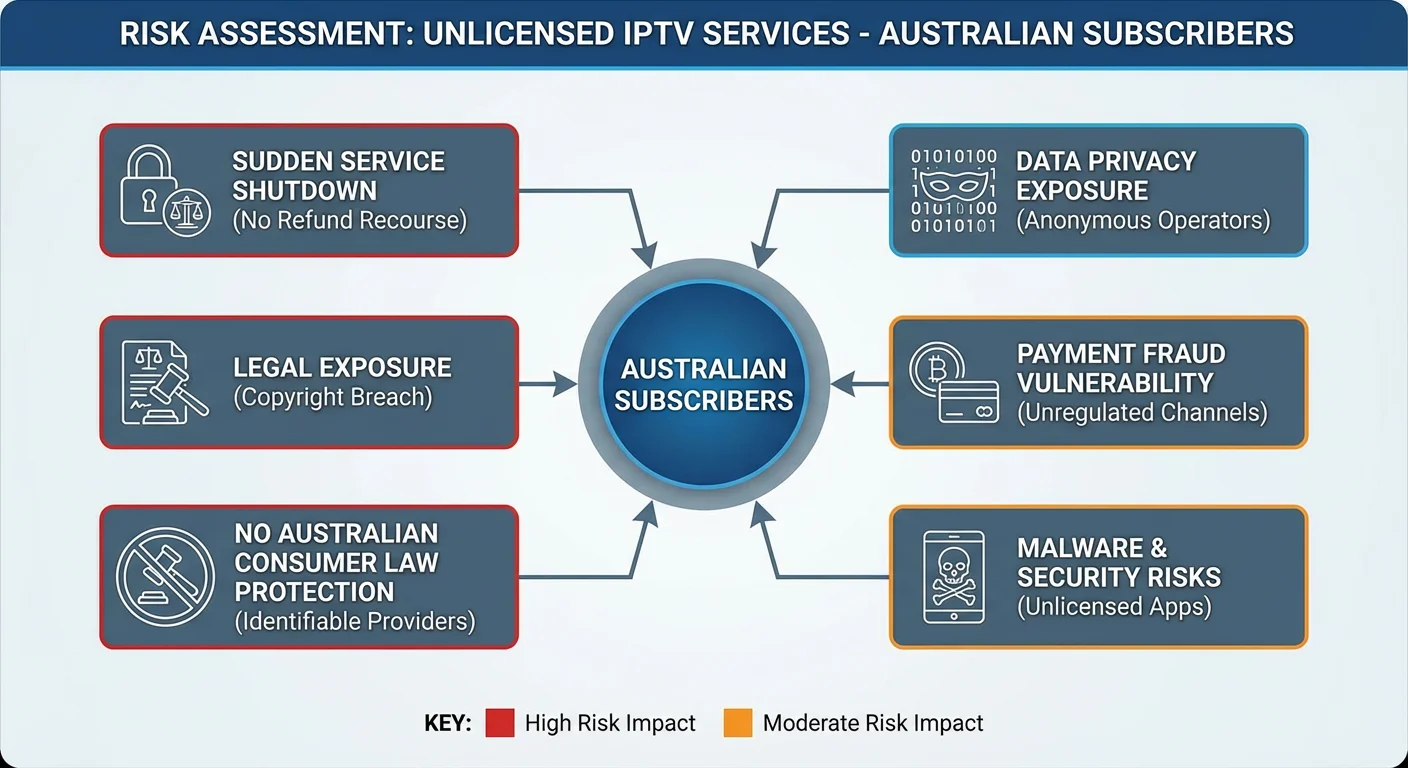
The main risks include sudden service shutdowns due to court orders blocking websites; losing money when services are stopped without refunds; exposure of personal data because of poor data handling by operators; the chance of payment fraud through cryptocurrency and unregulated payment methods; malware and security threats from unlicensed apps; and no consumer protection options against unknown operators. Legal prosecution of individual subscribers remains possible under Australian copyright law but has not been pursued under current enforcement patterns.
This article provides factual information about the risks associated with unlicensed IPTV services. It does not constitute legal advice. For advice specific to your circumstances, consult a qualified Australian legal professional.
What Surprised Me Most About Unlicensed IPTV Risk Profiles in Australia
What surprised me most when systematically reviewing unlicensed IPTV risk patterns in Australia between 2024 and 2026 was not the existence of the risks—those are well documented—but their relative severity in practice compared to how they are ranked in public discussion.
Legal prosecution risk for individual subscribers receives by far the most attention in IPTV discussions. In practice, it is among the lowest-probability risks Australian subscribers face. No individual Australian has been criminally prosecuted or civilly pursued for personally subscribing to and watching an unlicensed IPTV service under current enforcement patterns.
The legal framework permits such action in principle, but rights holders and government enforcement priorities focus on operators and distributors — not end-users.
The real risks that Australian subscribers face more often than prosecution are pretty ordinary: services can suddenly stop working without notice or refunds, their personal information can be collected by unregulated operators with no responsibility, and payments made with cryptocurrency don’t allow for refunds if the service doesn’t work.
I was also struck by a specific risk pattern that appears consistently in subscriber accounts: the relationship between service quality degradation and enforcement pressure. Unlicensed services under active enforcement monitoring often experience reliability deterioration—stream quality drops; server availability becomes inconsistent—before a complete shutdown.
Subscribers paying recurring fees during this degradation period have no contractual recourse and no regulatory authority to contact.
This is the risk profile that matters most in 2026: not prosecution, but the practical consequences of dealing with unaccountable operators outside any consumer protection framework.
Quick Reference: Risk Assessment Summary
Featured Snippet Answer (40-60 words): The primary risks of unlicensed IPTV in Australia are sudden service shutdown following Federal Court blocking orders with no refund recourse; unregulated data privacy exposure; payment fraud through cryptocurrency channels; malware from unlicensed applications; and complete absence of Australian Consumer Law protection. Legal prosecution of individual subscribers is theoretically possible but not currently pursued.
| Risk Category | Probability | Financial Impact | Legal Impact | Practical Severity |
|---|---|---|---|---|
| Service shutdown/blocking | High | Medium–High (subscription loss) | None (subscriber) | High |
| Data privacy exposure | High | Low–High (varies) | None directly | High |
| Payment fraud | Medium | Medium–High | None directly | High |
| Malware / security risk | Medium | Variable | None directly | Medium–High |
| No consumer recourse | Certain | Medium | None directly | High |
| Legal prosecution (subscriber) | Very Low | High if pursued | Medium | Low (current patterns) |
| Service quality degradation | High | Low (value loss) | None | Medium |
Table of Contents
- Risk 1 — Service Shutdown and Blocking
- Risk 2 — Financial Loss and No Refund Recourse
- Risk 3 — Data Privacy Exposure
- Risk 4 — Payment Fraud and Cryptocurrency Vulnerability
- Risk 5 — Malware and Security Risks
- Risk 6 — Zero Consumer Protection Recourse
- Risk 7 — Legal Exposure for Subscribers
- Risk 8 — Service Quality Degradation Under Enforcement Pressure
- The Compounding Risk Problem
- How to Assess Risk Before Subscribing
- Common Misconceptions About Unlicensed IPTV Risks
- Frequently Asked Questions
- Conclusion
Risk 1 — Service Shutdown and Blocking
Featured Snippet Answer (40-60 words): Unlicensed IPTV services in Australia face Federal Court website blocking orders under section 115A of the Copyright Act 1968, coordinated by ACMA.
When blocked, services become inaccessible through normal internet connections. Services can also be shut down entirely through criminal enforcement action.
Subscribers receive no advance warning and no refund when services are blocked or shut down.
Service disruption is the highest-probability risk for Australian subscribers using unlicensed IPTV services in 2026.
The Website Blocking Mechanism
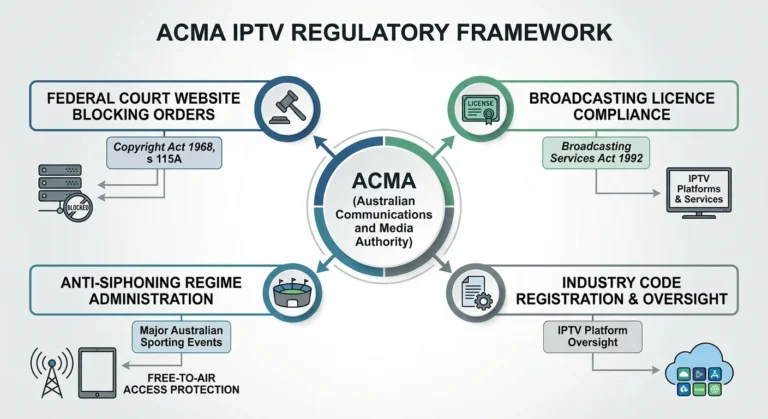
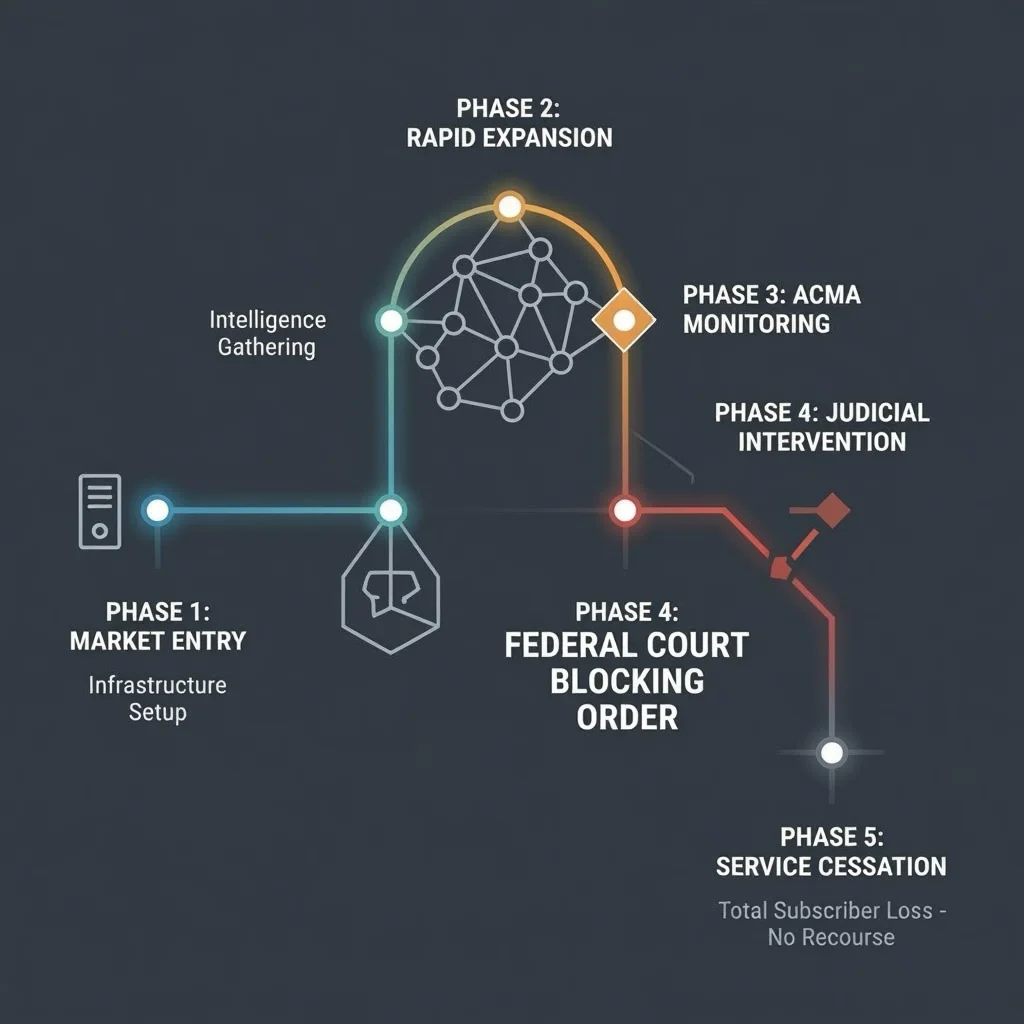
Rights holders—Foxtel, the AFL, NRL, Cricket Australia, and major film studios—regularly apply to the Federal Court for blocking orders under section 115A of the Copyright Act 1968 against unlicensed IPTV services targeting Australian subscribers. When the Court issues a blocking order, Australian ISPs are required to implement DNS and IP blocks against the identified domains and IP addresses.
For subscribers, this means the service becomes inaccessible through a normal Australian internet connection without warning. Typically, subscribers receive no notification upon the acquisition or implementation of a blocking order — the service simply ceases to function.
As of 2026, thousands of domains have been blocked under Australia’s website blocking regime, with rights holders regularly obtaining new orders as unlicensed services attempt to move to new domains through mirror sites and alternative URLs.
Criminal Enforcement Shutdowns
Beyond website blocking, criminal enforcement action by the Australian Federal Police against IPTV operators can result in complete service shutdown — servers seized, operator accounts frozen, and platform infrastructure dismantled. These shutdowns are typically sudden and permanent.
The arrest or seizure of an operator’s infrastructure leaves subscribers without any advance notice or recourse.
The Subscriber Experience of Service Loss
The practical experience for subscribers when a service is blocked or shut down is abrupt loss of access, typically with:
- No notification from the operator
- No refund offer for the remaining subscription period
- No alternative service provision
- No contact pathway — if the operator communicated only through Telegram, that channel may be abandoned simultaneously with the shutdown
For subscribers who have paid annual subscriptions, this can represent a significant financial loss with no recovery mechanism.
Risk 2 — Financial Loss and No Refund Recourse
Featured Snippet Answer (40-60 words): Subscribers to unlicensed IPTV services face financial loss when services are shut down or blocked, with no refund recourse. Anonymous operators outside Australian jurisdiction cannot be pursued through consumer protection channels.
Cryptocurrency payments provide no chargeback protection. Annual subscription payments represent the highest financial exposure when services fail unexpectedly.
Financial loss is the most consistently reported practical consequence for Australian subscribers dealing with unlicensed IPTV services.
The Refund Problem
Unlicensed IPTV services typically:
- Operate anonymously with no verifiable business identity
- Accept payment through cryptocurrency or unregulated channels that provide no chargeback mechanism
- Communicate exclusively through encrypted messaging applications with no formal customer support structure
- Have no published refund policy or — if they do — no enforcement mechanism that makes it meaningful
Subscribers lack a practical pathway to recover subscription payments when a service fails, blocks, or simply stops operating.
The Australian Consumer Law provides refund rights — but those rights are only accessible against an identifiable entity operating within Australian jurisdiction or subject to international enforcement cooperation. An anonymous cryptocurrency payment to an unidentified overseas operator is, in practice, unrecoverable.
Subscription Models and Financial Exposure
| Subscription Type | Typical Cost | Financial Exposure at Shutdown |
|---|---|---|
| Monthly | AU$15–25 | Low (1 month) |
| Quarterly | AU$35–60 | Medium |
| Annual | AU$80–150 | High |
| “Lifetime” | AU$150–400 | Very High |
Lifetime subscriptions represent the highest financial risk. An unlicensed service’s “lifetime” subscription depends on its continued operation, which enforcement pressure cannot guarantee.
Services offering lifetime subscriptions have no regulatory obligation to maintain them, no consumer law accountability for their delivery, and substantial financial incentive to collect lifetime fees before service disruption occurs.
For detailed guidance on subscription warning signs, see IPTV Scams in Australia: Warning Signs.
Risk 3 — Data Privacy Exposure
Featured Snippet Answer (40-60 words): Unlicensed IPTV operators have no Privacy Act 1988 compliance obligations — subscriber data, including names, email addresses, payment details, IP addresses, and viewing habits, is collected without regulatory oversight or accountability.
There is no OAIC complaint mechanism against unidentifiable overseas operators. Data may be sold, breached, or harvested for fraud without subscriber recourse.
Data privacy exposure is among the most serious and least discussed risks for Australian subscribers of unlicensed IPTV services.
What Data Unlicensed Operators Collect
When subscribing to an unlicensed IPTV service, subscribers typically provide:
- Email address (registration)
- Payment details (even cryptocurrency transactions create records)
- IP address (captured during connection)
- Device identifiers (captured by IPTV applications)
- Viewing habits and patterns (logged by streaming infrastructure)
- In some cases, full name and physical address (billing information)
Why This Data is Unprotected
Licensed IPTV services operating in Australia are subject to the Privacy Act 1988 (Cth) and its Australian Privacy Principles (APPs). These obligations require data minimisation, security safeguards, purpose limits, subscriber access, and correction rights.
The Office of the Australian Information Commissioner (OAIC) (https://www.oaic.gov.au/) provides a complaint mechanism when licensed operators breach these obligations.
Unlicensed IPTV operators are:
- Typically anonymous entities with no verifiable identity
- Operating outside Australian jurisdiction in most cases
- Not subject to Privacy Act obligations (which require identifiable Australian-nexus entities)
- Not subject to OAIC oversight
- Not accountable to any regulatory body for how they handle subscriber data
The Practical Privacy Risk
Subscriber data collected by unregulated operators can be:
- Sold to third parties — email lists, demographic data, and viewing profiles have commercial value on grey and black markets
- Used for targeted fraud — credential harvesting, phishing using subscription details, or identity theft
- Exposed through data breaches — servers operated without security investment are vulnerable to breaches that expose subscriber information
- Retained indefinitely — with no data retention limitation obligations, subscriber data collected years ago may persist in unprotected storage
If an anonymous unlicensed operator mishandles subscribers’ data, they have no practical recourse. The OAIC can only pursue complaints against entities it can identify. Australian privacy law applies to entities with an Australian nexus—not to anonymous overseas operations.
Risk 4 — Payment Fraud and Cryptocurrency Vulnerability
Featured Snippet Answer (40-60 words): Unlicensed IPTV services frequently require cryptocurrency payments or unregulated payment channels that provide no chargeback protection. Payment fraud risks include credential harvesting through fake subscription pages, subscription renewal scams, and payment to services that never deliver. Credit card chargebacks are unavailable for cryptocurrency transactions with anonymous operators.
Payment processing through unregulated channels creates specific fraud vulnerability for subscribers.
The Cryptocurrency Payment Problem
Many unlicensed IPTV services accept—or require—payments in cryptocurrency. While cryptocurrency is a legitimate payment technology, its use by IPTV services creates specific risks:
No chargeback mechanism: Credit card and bank transfers processed through regulated financial institutions provide chargeback rights — the ability to dispute a transaction and recover payment when a service is not delivered. Cryptocurrency transactions are irreversible by design. Once paid, there is no recovery mechanism if the service fails to deliver or shuts down.
No payment verification: Cryptocurrency payments to anonymous wallet addresses provide no verification of who received the payment or whether that entity is obligated to provide the promised service.
Tax implications: Cryptocurrency transactions are subject to Australian tax reporting obligations under ATO guidance. Subscribers paying for subscriptions in cryptocurrency may have unreported tax obligations they are unaware of.
Telegram and WhatsApp Payment Channels
Some unlicensed IPTV operators process subscription payments exclusively through Telegram or WhatsApp direct transfers — bank transfers to personal accounts or cryptocurrency sent to addresses provided through messaging apps.
This structure:
- Provides no payment record that consumer protection agencies can act on
- Creates no contractual relationship with an identifiable entity
- Offers no payment dispute mechanism
- Is consistent with scam operation patterns (take payment, disappear)
Subscription Renewal Fraud
A specific fraud pattern observed in the Australian IPTV market: operators who provide functional services initially but manipulate subscription renewal processes to extract additional payments without extending service. Without a contractual relationship and regulatory oversight, subscribers have no mechanism to challenge these practices.
Risk 5 — Malware and Security Risks
Featured Snippet Answer (40-60 words): Unlicensed IPTV applications distributed outside official app stores may contain malware, spyware, or credential harvesting codes. Sideloaded APK files from unofficial sources bypass security vetting. Streaming infrastructure operated by unlicensed services may serve malicious advertising. Security risks are higher for Android sideloaded apps than for App Store or Play Store distributed applications.
Security risks from unlicensed IPTV applications represent a category of risk that extends beyond the IPTV subscription itself to the broader security of subscriber devices and networks.
APK Sideloading Risks
Many unlicensed IPTV services distribute their applications as APK files for Android sideloading—installations from outside the Google Play Store. While sideloading is a legitimate capability used for legal apps, including TiviMate, APKs distributed by unlicensed operators carry specific risks:
- No security vetting: Google Play Store apps undergo security scanning before distribution. APKs from unofficial sources bypass the security vetting entirely.
- Malware packaging: Malicious code can be embedded in functional IPTV applications — the app works as an IPTV player while simultaneously harvesting credentials, recording device activity, or installing additional malware.
- Permission exploitation: APKs may request device permissions (camera, microphone, contacts, storage) beyond what an IPTV app requires — a red flag for malicious intent.
- Update mechanisms: APKs that include auto-update functionality can replace a clean initial installation with a malicious subsequent version.
Malicious Advertising
Streaming infrastructure operated by unlicensed services may serve advertising through unregulated ad networks. Malicious advertising (malvertising) can:
- Redirect to phishing sites harvesting subscriber credentials
- Trigger automatic downloads of malware to connected devices
- Exploit browser vulnerabilities on devices accessing streaming portals
Network Security Implications
IPTV devices connected to home networks and configured to use VPNs or custom DNS settings at the operator’s instruction may be exposing network traffic to interception. Instructions to change DNS settings to operator-specified servers should be treated with significant caution — DNS interception enables monitoring and manipulation of all internet traffic on the network.
Reducing Security Risk
For Australian IPTV subscribers concerned about security risks:
- Use only applications from verified app stores (Amazon App Store, Google Play Store, Apple App Store) where possible
- For sideloaded applications, use only well-documented sources with established community verification (TiviMate’s official APK from tivimate.com, for example)
- Review app permissions before installation — an IPTV player does not need access to contacts, camera, or microphone
- Use a separate, dedicated streaming device rather than a primary personal device for IPTV applications from unverified sources
Risk 6 — Zero Consumer Protection Recourse
Featured Snippet Answer (40–60 words): Australian consumer law guarantees—fitness for purpose, refund rights, protection from misleading conduct— are theoretically applicable to IPTV subscriptions but practically inaccessible when dealing with anonymous operators outside Australian jurisdiction. The ACCC can pursue identified businesses but cannot act against entities with no verifiable identity or Australian nexus.
The absence of consumer protection recourse is not merely a theoretical risk — it is a structural feature of unlicensed IPTV operation that affects every interaction a subscriber has with an unregulated provider.
What Consumer Protection Requires
Australian Consumer Law protections are enforceable against identifiable entities:
- The ACCC (https://www.accc.gov.au/) pursues businesses it can identify, serve with legal process, and pursue through Australian courts
- State fair trading agencies operate similarly — they require identifiable respondents
- The Australian Financial Complaints Authority (AFCA) (https://www.afca.org.au/) handles financial services disputes with regulated financial service providers
These enforcement mechanisms cannot reach unlicensed IPTV operators, who structure themselves to avoid identification. A subscriber with a legitimate complaint about service quality, billing fraud, or data mishandling has no practical regulatory pathway when the operator is anonymous, overseas, and communicating only through encrypted messaging applications.
The Practical Consequences
This absence of recourse means that every interaction with an unlicensed operator occurs without the consumer protections that Australians take for granted in other commercial contexts:
- A service that fails to deliver advertised content has no legal obligation to fix it
- A subscription that is terminated without notice creates no enforceable refund right
- Billing disputes have no escalation pathway beyond the operator’s own (non-existent) customer service
- Data misuse has no complaint mechanism
For comparison, a subscription to a licensed streaming service — Kayo, Stan, Binge — provides enforceable consumer rights through the Australian Consumer Law, accessible complaint pathways through the ACCC and state fair trading agencies, and Privacy Act protections through the OAIC. These protections exist specifically because licensed operators are identifiable entities subject to Australian law.
For detailed guidance on consumer rights in IPTV subscriptions, see Consumer Rights When Subscribing to IPTV.
Risk 7 — Legal Exposure for Subscribers
Featured Snippet Answer (40-60 words): Individual Australian subscribers face theoretical legal exposure under the Copyright Act 1968 for accessing unlicensed IPTV content, but no individual subscriber has been criminally prosecuted or civilly pursued under current enforcement patterns. Enforcement focuses on operators and distributors. Legal risk is real in principle but among the lowest-probability practical risks subscribers currently face.
Legal exposure for individual subscribers is the most discussed risk, and under current enforcement patterns, it is the least likely to materialise directly.
The Legal Framework
The Copyright Act 1968 (Cth) affords rights holders the right to pursue civil claims for copyright infringement against any party communicating infringing content to the public and provides for criminal prosecution of commercial-scale infringement.
In principle, a subscriber accessing unlicensed IPTV content is receiving communication of infringing material— though the Copyright Act’s enforcement framework targets those who communicate infringing content (providers) more directly than those who receive it (subscribers).
Current Enforcement Reality
Under current Australian enforcement patterns:
- No criminal prosecutions of individual subscribers for personal IPTV viewing have been reported
- No civil litigation by rights holders against individual subscribers for personal use has been reported
- Enforcement priorities focus on operators running commercial services, resellers distributing access at scale, and infrastructure providers enabling distribution
This enforcement reality reflects both practical priorities (pursuing operators delivers a greater infringement reduction per enforcement resource than pursuing subscribers) and the legal difficulty of establishing commercial purposes for personal viewing (required for criminal prosecution).
Why Legal Risk Is Not Zero
Although prosecution of individual subscribers is currently a very low-probability risk, it is still possible:
- The Copyright Act framework permits civil action against any infringer, including subscribers
- International examples exist of rights holder litigation against subscribers in other jurisdictions
- Enforcement approaches evolve — current patterns do not guarantee future patterns
- Subscribers who operate beyond personal use (reselling access, sharing credentials commercially) face significantly higher legal exposure
The appropriate way to frame subscriber legal risk is as low probability under current enforcement patterns, but there is genuine legal framework exposure that increases proportionally with the scale and commercial nature of use. For the complete legal framework, see How Australian Law Regulates IPTV Services.
Risk 8 — Service Quality Degradation Under Enforcement Pressure
Featured Snippet Answer (40-60 words): Unlicensed IPTV services under enforcement pressure frequently experience service quality degradation before complete shutdown — stream reliability drops, servers are migrated, and channel counts decrease. Subscribers paying recurring fees during degradation periods receive no refund for reduced service quality. Quality degradation often precedes blocking or shutdown by weeks or months.
A less-discussed but consistently observed risk pattern is the degradation of unlicensed IPTV service quality under enforcement pressure.
The Degradation Pattern
When rights holders begin monitoring and building cases against unlicensed IPTV services, operators frequently take measures that degrade subscriber experience:
- Server migration: Moving streaming infrastructure to evade monitoring changes stream URLs and causes connection failures
- Reduced content availability: Removing high-profile licensed content that is the primary focus of rights holder attention reduces detection risk but leaves subscribers with fewer channels
- Bandwidth reduction: Reducing infrastructure investment to cut costs before anticipated shutdown reduces stream quality
- Domain changes: Switching to new domains in anticipation of blocking orders disrupts subscriber access temporarily
The Financial Impact on Subscribers
Subscribers paying recurring monthly or quarterly fees during a service degradation period are paying for reduced value with no contractual recourse. Unlike licensed services, where service quality obligations are enforceable under Australian Consumer Law, unlicensed service quality degradation has no regulatory remedy.
This risk is particularly acute for subscribers who signed up based on initial service quality, which represented the service operating at full capability before enforcement pressure began.
The Compounding Risk Problem
Featured Snippet Answer (40-60 words): Unlicensed IPTV risks compound — subscribers who lose service lose their subscription investment, have no data protection recourse, face potential security exposure from installed applications, and cannot access consumer protection authorities. When a service shuts down, multiple risk categories materialise simultaneously, leading to compounded financial and security exposures.
The risks described in this article do not operate in isolation — they compound. When an enforcement action shuts down a service, multiple risk categories manifest simultaneously:
- Financial loss from the remaining subscription period — no refund available
- Data exposure — subscriber data collected by the operator is no longer subject to any retention obligation, and its future handling is entirely at the operator’s discretion
- Security risk — if a malicious APK was installed, it may continue operating on the subscriber’s device after the service ends
- No recourse pathway — the operator has disappeared; no consumer authority can act against an entity that no longer presents an identifiable target
The compound nature of these risks means that the true cost of using an unlicensed IPTV service is not merely the subscription fee—it includes the potential data exposure, security implications, and complete lack of accountability that characterise unregulated operator relationships.
How to Assess Risk Before Subscribing
Featured Snippet Answer (40-60 words): Before subscribing to any IPTV service, assess five indicators: verifiable business registration through ASIC or equivalent, regulated payment processing availability, a published Privacy Act-compliant privacy policy, accessible consumer support beyond messaging apps, and pricing consistent with content licensing costs.
Services failing multiple indicators carry compounded risk across all categories described in this article.
A practical pre-subscription risk assessment framework:
| Assessment Question | Green Indicator | Red Indicator |
|---|---|---|
| Can I verify the provider’s business registration? | ABN/ACN searchable via ASIC | No verifiable business identity |
| What payment methods are accepted? | Credit card, PayPal, bank transfer | Cryptocurrency only, Telegram payment |
| Is there a published privacy policy? | Accessible, detailed, Privacy Act compliant | No privacy policy or generic unenforceable text |
| Is pricing consistent with content licensing costs? | Consistent with licensed service pricing | AU$15–25/month for hundreds of live sports channels |
| Is there accessible customer support? | Business email, ticketing system | Telegram or WhatsApp only |
| What is the subscription term structure? | Monthly with clear renewal terms | “Lifetime” at low price, opaque renewal terms |
A service that fails three or more of these indicators carries compounded risk across the categories described in this article. For a complete pre-subscription verification framework, see IPTV Legal Checklist Australia.
Common Misconceptions About Unlicensed IPTV Risks
Misconception 1: “The main risk is getting caught and prosecuted.”
Under current Australian enforcement patterns, prosecution of individual subscribers for personal IPTV viewing is the lowest-probability risk in the risk profile. The risks most likely to actually affect subscribers are financial (service shutdown, no refunds), privacy-related (unregulated data handling), and technical (malware exposure).
Framing prosecution as the primary risk significantly underweights the practical risks that actually materialise for Australian subscribers.
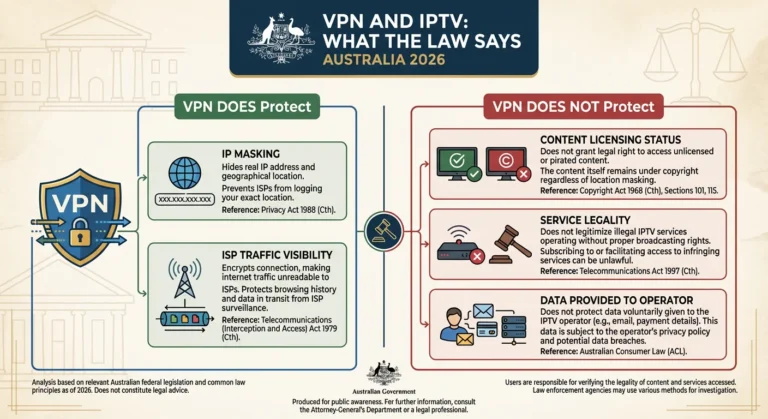
Misconception 2: “If I use a VPN, I’m protected from all risks.”
A VPN masks your IP address from the IPTV service and your ISP—it does not protect against any of the primary risks. Service shutdown still terminates access. VPN use does not recover financial losses caused by service closures.
Data already provided to the operator (email, payment details) is not protected by VPN. Malware installed through an APK operates on the device regardless of VPN activity. The only risk VPN use addresses is IP-level identification by the IPTV service—and that risk is already among the lowest-probability categories.
Misconception 3: “I can always dispute the charge with my bank if the service doesn’t work.”
Chargeback rights through banks and card providers are available for credit and debit card transactions — but many unlicensed IPTV services specifically require cryptocurrency or direct bank transfer payment to avoid chargeback mechanisms. For cryptocurrency payments, there is no chargeback equivalent.
For bank transfers to personal accounts, chargeback processes are more complex and less reliable than for card transactions with identified merchants.
Misconception 4: “The service has been running for years, so it must be reliable.”
Service longevity is not evidence of legal compliance or future reliability. Some unlicensed services operate for extended periods before enforcement action catches up with them. Longevity reflects enforcement priorities, not legal status.
A service that has operated for three years without disruption may be blocked within weeks as the rightsholder’s attention shifts to it—and that blocking will be equally sudden and without subscriber recourse, regardless of how long the service has previously operated.
Misconception 5: “Unlicensed IPTV is a victimless activity.”
Content licensing fees paid by legitimate streaming services flow back to content creators, sports bodies, production companies, and broadcasters—financializing the production of the content that IPTV subscribers want to watch. The AFL, NRL, Cricket Australia, and film studios invest in content on the basis of projected licensing revenue.
Unlicensed redistribution of that content without rights holder payment reduces the licensing revenue that funds content production and athlete payments. The harm is real and economically significant, even if it is diffuse and its connection to individual subscription choices is indirect.
Frequently Asked Questions
What are the real risks of using unlicensed IPTV in Australia?
The main risks include losing access to the service suddenly if the Federal Court issues blocking orders, with no warning or refunds for any remaining subscription time; losing money through cryptocurrency or unregulated payment methods that don’t allow refunds; having your personal data exposed by anonymous operators who don’t follow the Privacy Act 1988; facing malware and security issues from APKs that are not from official app stores; and having no protection under Australian Consumer Law against anonymous operators.
Legal prosecution of individual subscribers for personal viewing is theoretically possible under the Copyright Act 1968 but has not been pursued under current enforcement patterns. For guidance on identifying services that avoid these risk categories, see What Is Considered Legal IPTV in Australia?.
Will I get in trouble for using unlicensed IPTV in Australia?
Under current enforcement patterns, individual Australian subscribers have not been criminally prosecuted or civilly pursued for personally subscribing to and watching unlicensed IPTV content.
Enforcement focuses on operators running commercial services, resellers distributing access at scale, and infrastructure providers.
Legal prosecution risk for personal viewers exists in principle under the Copyright Act 1968 but is among the lowest-probability risks in the current risk profile. The more likely consequences are service disruption, financial loss, and data exposure — not legal action. For the complete legal framework, see Can Users Be Penalised for IPTV in Australia?.
What happens when an unlicensed IPTV service is blocked in Australia?
When rights holders obtain a Federal Court blocking order under section 115A of the Copyright Act 1968, Australian ISPs implement DNS and IP blocks against the service’s domains and IP addresses.
From a subscriber perspective, the service becomes inaccessible through a normal Australian internet connection — websites cannot be reached, and applications cannot connect to streaming servers.
This happens without advance notice to subscribers. Operators typically do not communicate with subscribers about blocking orders. Subscription fees already paid are not refunded. For detailed information about how the blocking process works, see ACMA and IPTV: What You Should Know.
Is it safe to install IPTV apps from outside official app stores?
Installing APK files from unofficial sources carries security risks that official app store distribution does not. Google Play Store and Amazon App Store apps undergo security vetting that unofficial APKs bypass.
Unlicensed IPTV APKs may contain malware, spyware, or credential harvesting code alongside functional IPTV player software.
The risk is not universal — well-documented apps like TiviMate distributed through official channels have established community verification.
However, APKs from unlicensed IPTV operators distributed through their own websites or Telegram channels carry meaningful security risks that should be assessed before installation. Review app permissions, use a dedicated streaming device rather than a primary personal device, and avoid APKs that request authorisations unrelated to media playback.
Conclusion
The risk profile of unlicensed IPTV services in Australia in 2026 is dominated by practical, financial, and privacy consequences rather than by the legal prosecution risk that receives the most public attention.
Service shutdowns without refund recourse, unregulated data handling by anonymous operators, payment fraud vulnerabilities, and the complete absence of consumer protection pathways are the most likely to actually affect Australian subscribers—and they are risks that materialise regardless of whether enforcement action directly targets them.
Understanding this risk profile changes the calculus of IPTV service selection. The question is not simply “Am I likely to be prosecuted?”—the answer to that question is “currently no, for personal viewing.” The more complete question is, “What happens to my subscription investment, my personal data, and my device security if this service is shut down tomorrow?” For an anonymous unlicensed operator, your investment is unrecoverable, your data lacks protection, and your device security relies solely on the intentions behind the application you installed.
I want to be transparent about something this risk assessment does not resolve: the precise probability of any individual risk category materialising in a specific case is impossible to determine. Services vary significantly in their operational sophistication, enforcement exposure, and actual data handling practices.
What the framework provides is a reliable basis for understanding what risks exist structurally when dealing with unregulated operators—which is what informed decision-making requires.
For comprehensive IPTV compliance guidance and tools for identifying services that avoid these risk categories, return to Legal IPTV Australia.
This article provides general factual information about the risks associated with unlicensed IPTV services. It does not constitute legal advice. Readers should consult a qualified Australian legal professional for advice specific to their circumstances.