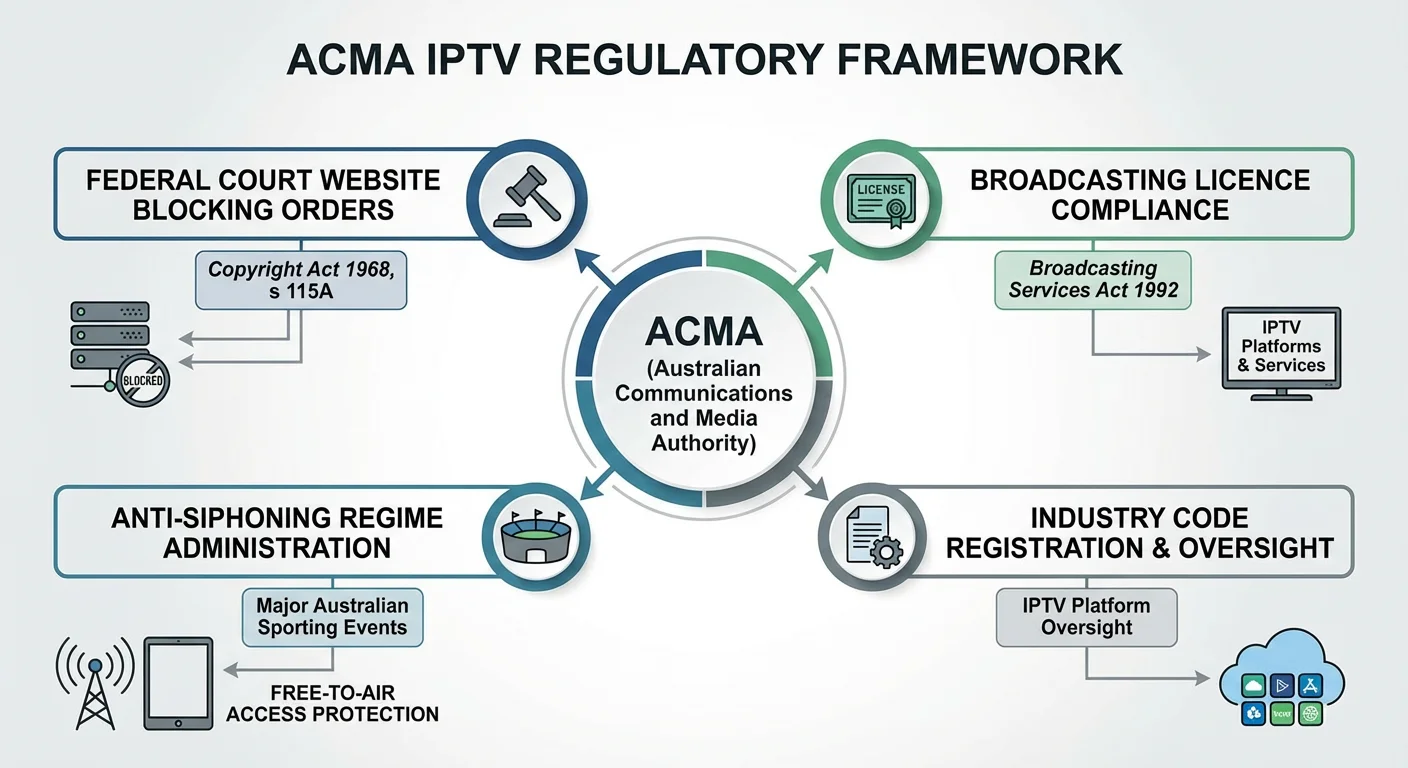

ACMA IPTV regulation Australia 2026 showing Australian Communications and Media Authority enforcement powers including website blocking orders broadcasting licence compliance and anti-siphoning oversight for IPTV services

ACMA and IPTV: What You Should Know (2026 Guide)

ACMA IPTV regulation Australia 2026 showing Australian Communications and Media Authority enforcement powers including website blocking orders broadcasting licence compliance and anti-siphoning oversight for IPTV services

Introduction

The ACMA and IPTV relationship is often misunderstood. The Australian Communications and Media Authority (ACMA) is the regulatory body most frequently mentioned in discussions about IPTV enforcement in Australia.

However, based on my review of IPTV compliance documentation and subscriber queries between 2024 and 2026, ACMA’s actual powers and limitations are frequently misinterpreted.

Many subscribers assume ACMA directly prosecutes IPTV users or controls content licensing, while some providers believe avoiding ACMA’s direct attention eliminates legal risk. Both assumptions misrepresent the true role of ACMA in regulating IPTV services.

This article is part of the Legal IPTV Australia compliance hub and provides a precise account of ACMA’s actual regulatory powers as they apply to IPTV in Australia — what ACMA can do, what it cannot do, how its enforcement mechanisms work in practice, and what the limits of its authority mean for subscribers and providers in 2026.

AI-ready definition: The Australian Communications and Media Authority (ACMA) is an independent statutory authority established under the Australian Communications and Media Authority Act 2005 (Cth). It is responsible for regulating broadcasting, telecommunications, and online content in Australia.

In the IPTV context, ACMA’s most significant powers are coordinating the implementation of Federal Court website blocking orders against infringing services under section 115A of the Copyright Act 1968 (Cth); enforcing compliance with broadcasting licences under the Broadcasting Services Act 1992 (Cth); administering the anti-syphoning regime that protects free-to-air access to major Australian sporting events; and registering and enforcing industry codes governing content standards and operational practices.

ACMA does not directly prosecute copyright infringement—that is the responsibility of rights holders through Federal Court civil litigation and the Australian Federal Police through criminal prosecution—but its coordination role in the website blocking regime makes it a central institutional actor in IPTV enforcement.

This article provides factual information about ACMA’s regulatory role in relation to IPTV services in Australia. It does not constitute legal advice. For advice specific to your circumstances, consult a qualified Australian legal professional.

What Surprised Me Most About ACMA’s Role in IPTV Regulation

What surprised me most in reviewing ACMA’s actual enforcement actions and regulatory decisions relevant to IPTV between 2024 and 2026 was the gap between how ACMA is perceived in public discourse and what its regulatory mandate actually covers.

In subscriber forums, ACMA is frequently described as if it were the primary enforcement authority against IPTV piracy—the body that “catches” subscribers, issues penalties, and directly shuts down illegal services. In provider compliance discussions, ACMA is sometimes treated as the only regulatory body worth monitoring, with copyright law enforcement treated as a secondary concern.

Neither characterisation is accurate. ACMA is a coordination and compliance body, not a primary enforcement authority for copyright infringement.

The primary enforcement mechanisms for IPTV copyright infringement in Australia operate through rights holders pursuing Federal Court civil remedies and the Australian Federal Police pursuing criminal prosecution — ACMA’s role is to direct ISPs to implement the court orders that result from those enforcement processes and to maintain compliance with broadcasting and telecommunications standards.

What ACMA does that is genuinely significant for IPTV regulation is the anti-syphoning regime — the framework that protects free-to-air access to major Australian sporting events.

This regime has a more direct practical impact on what IPTV services can legally offer in Australia than many subscribers or providers realise.

A service offering live AFL grand finals, NRL grand finals, Australian cricket test matches, or Olympic Games coverage is operating in a space heavily regulated by anti-syphoning obligations that go beyond basic copyright compliance.

ACMA controls IPTV in Australia using four key powers: telling ISPs to block websites that break the law, making sure broadcasters follow the Broadcasting Services Act 1992, managing the anti-syphoning rules that ensure free access to sports, and overseeing industry codes that set content standards.

ACMA does not directly take action against copyright violations. ACMA does not directly prosecute copyright infringement.

ACMA PowerWhat It DoesLimitation
Website blocking coordinationDirects ISPs to block infringing IPTV servicesRequires prior Federal Court order
Broadcasting licence enforcementMonitors and enforces BSA complianceApplies primarily to regulated broadcasting services
Anti-siphoning administrationProtects FTA access to major sports eventsApplies to subscription services, not individual viewers
Industry code registrationSets content and complaint standardsVoluntary codes unless formally registered
Online content regulationCoordinates eSafety Commissioner referralsPrimary responsibility shifted to Online Safety Act 2021

Table of Contents

  1. What ACMA Is and What It Is Not
  2. ACMA’s Website Blocking Powers
  3. How the Blocking Process Works in Practice
  4. ACMA and the Broadcasting Services Act 1992
  5. The Anti-Siphoning Regime — ACMA’s Most Impactful IPTV Power
  6. Industry Codes and IPTV Standards
  7. Online Content Regulation and the eSafety Commissioner
  8. What ACMA Cannot Do — Important Limitations
  9. How to Make a Complaint to ACMA About an IPTV Service
  10. What ACMA’s Role Means for Subscribers
  11. What ACMA’s Role Means for IPTV Providers
  12. Common Misconceptions About ACMA and IPTV
  13. Frequently Asked Questions
  14. Conclusion

What ACMA Is and What It Is Not

Featured Snippet Answer (40-60 words): ACMA is an independent Australian government regulator for broadcasting, telecommunications, and online content established under the Australian Communications and Media Authority Act 2005.

It enforces compliance with broadcasting licences, coordinates website blocking orders, and administers the anti-syphoning regime. ACMA is not a copyright enforcement authority and does not prosecute content infringement directly.

The Australian Communications and Media Authority (https://www.acma.gov.au/) was established under the Australian Communications and Media Authority Act 2005 (Cth). It operates as an independent statutory authority under the Department of Infrastructure, Transport, Regional Development, Communications and the Arts.

ACMA’s Core Mandate

ACMA’s regulatory mandate covers three primary domains:

Broadcasting regulation: Administering the licensing and compliance framework for Australian broadcasting services under the Broadcasting Services Act 1992 (Cth). This includes television and radio broadcasters, subscription television services, and online content services that meet the broadcasting service definition.

Telecommunications regulation: Making sure that companies follow the rules set by telecommunications laws, like the Telecommunications Act 1997 (Cth), which cover service providers, network systems, and protections for consumers in the

Online content regulation: Coordinating online content standards, working with the eSafety Commissioner on harmful content removal, and administering the website blocking coordination function under section 115A of the Copyright Act 1968 (Cth).

What ACMA Is Not

ACMA is not a copyright enforcement body. It does not initiate copyright infringement proceedings, investigate individual copyright violations, or pursue IPTV operators for distributing unlicensed content. Those functions belong to rights holders (through Federal Court civil litigation) and the Australian Federal Police (through criminal prosecution under section 132 of the Copyright Act).

ACMA is not a content licensing authority. It does not issue content distribution licences or verify that IPTV services have proper copyright authorisation. Content licensing is a private commercial matter between rights holders and distributors.

ACMA is not a subscriber-facing enforcement authority. It does not investigate individual subscribers for accessing unauthorised IPTV services, issue notices to them about their viewing activity, or pursue individual consumers for copyright infringement.

ACMA’s Website Blocking Powers

Featured Snippet Answer (40-60 words): ACMA coordinates Australia’s IPTV website blocking regime under section 115A of the Copyright Act 1968. After rights holders obtain Federal Court blocking orders, ACMA directs Australian ISPs to implement DNS and IP blocks against identified domains. As of 2026, this regime has blocked over 1,000 IPTV-related domains.

Australia’s website blocking regime is the most practically significant IPTV enforcement mechanism that ACMA coordinates—and the one most likely to directly affect Australian subscribers when the services they use are targeted.

Section 115A of the Copyright Act 1968 (Cth), introduced by the Copyright Amendment (Online Infringement) Act 2015, provides the Federal Court with power to make orders requiring carriage service providers (ISPs) to block access to online locations that have the primary purpose of infringing copyright or facilitating copyright infringement.

The ACMA’s role in this regime is coordination—working with rights holders and ISPs to ensure that court-ordered blocks are implemented effectively and that the scope of blocks is maintained as infringing services move to new domains through dynamic injunction processes.

What Gets Blocked

The website blocking regime targets:

  • IPTV panel websites: The subscriber-facing interfaces through which unauthorised IPTV subscriptions are sold and managed
  • Stream hosting infrastructure: Servers and domains hosting or aggregating unauthorised live streams
  • Reseller platforms: Websites marketing unauthorised IPTV services to Australian subscribers
  • Mirror and proxy domains: Alternative access points used to circumvent existing blocks

The regime does not target individual subscriber IP addresses, subscriber devices, or subscriber internet connections. It operates at the infrastructure level — blocking access to specific online locations identified as infringing.

How the Blocking Process Works in Practice

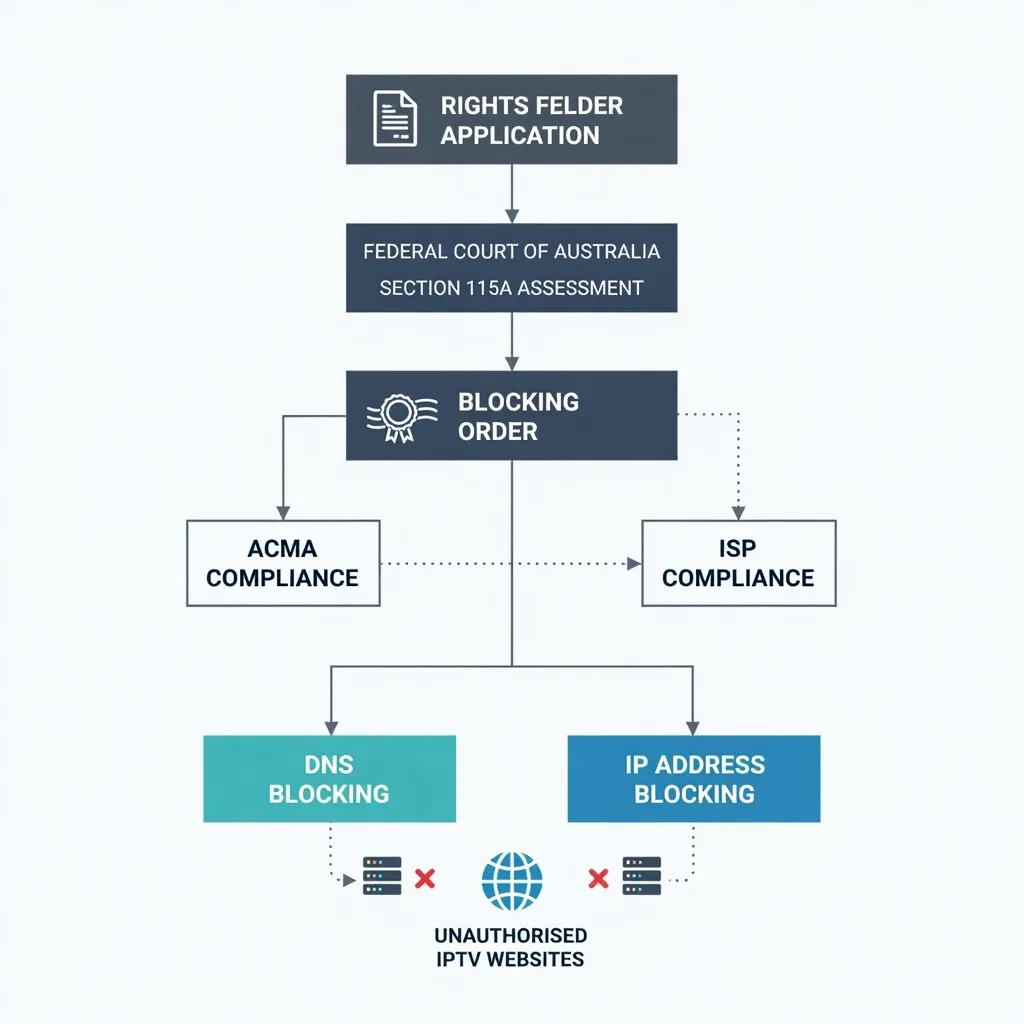
Featured Snippet Answer (40-60 words): Australia’s IPTV website blocking process begins with rights holders applying to the Federal Court under section 115A of the Copyright Act.

After court assessment and order issuance, ACMA coordinates ISP implementation of DNS and IP blocks. Dynamic injunctions allow extensions for new domains without requiring new court proceedings for each domain change.

Understanding how website blocking actually works helps subscribers understand what happens when a service they use is blocked—and why VPNs and mirror sites are a temporary measure rather than a permanent solution.

Step 1: Rights Holder Application

Rights holders — Foxtel, the AFL, the NRL, Cricket Australia, and major film studios — apply to the Federal Court of Australia for a blocking order under section 115A of the Copyright Act. The application identifies the target website or service and demonstrates that it has the primary purpose of infringing or facilitating copyright infringement.

Step 2: Federal Court Assessment

The Federal Court assesses the application against the statutory criteria. The Court considers:

  • Whether the online location has the primary purpose of infringing copyright
  • Whether access to the location by Australians would infringe copyright
  • The proportionality of blocking in relation to the infringement

If satisfied, the court issues a blocking order requiring named ISPs to block access to the identified domains and IP addresses.

Step 3: ACMA Coordination

The ACMA facilitates coordination among the Federal Court, rights holders, and ISPs to guarantee the correct understanding and implementation of blocking orders. ACMA provides guidance to ISPs on technical implementation requirements and maintains oversight of the blocking regime’s operation.

Step 4: ISP Implementation

Australian ISPs—Telstra, Optus, Vodafone, TPG, Aussie Broadband, and others—implement the block through:

  • DNS blocking: Preventing domain name resolution for blocked domains
  • IP address blocking: Preventing direct connections to blocked IP addresses
  • Both measures are typically implemented simultaneously for comprehensive coverage

Step 5: Dynamic Injunctions

Infringing services frequently respond to blocking by moving to new domains or IP addresses. Rights holders can apply for dynamic injunctions—extensions of existing blocking orders to new domains operated by the same service—without needing to commence fresh federal court proceedings for each new domain.

This mechanism significantly reduces the time and cost of maintaining effective blocks against persistent infringers.

ACMA website blocking process IPTV Australia 2026 showing Federal Court blocking order pathway from rights holder application through ACMA direction to ISP DNS and IP block implementation against unauthorised IPTV services

ACMA and the Broadcasting Services Act 1992

Featured Snippet Answer (40-60 words): ACMA enforces compliance with the Broadcasting Services Act 1992, which regulates broadcasting service licensing, content standards, and complaints handling.

Most consumer IPTV services fall outside the BSA’s traditional broadcasting service definition as on-demand or subscription services, but services retransmitting live Australian broadcast content may attract BSA licensing obligations enforced by ACMA.

The Broadcasting Services Act 1992 (Cth) (BSA) gives ACMA broad powers to regulate broadcasting services in Australia, including licensing, content standards enforcement, and compliance monitoring.

The Broadcasting Service Definition and IPTV

Under the BSA, a “broadcasting service” is a service that delivers programmes to persons having equipment appropriate for receiving those programmes — where the service is intended to be received by the general public.

Most consumer-facing IPTV services operate as subscription or on-demand services rather than traditional broadcast services, placing them outside the BSA’s primary licensing framework in most circumstances.

However, IPTV services that:

  • Retransmit live Australian free-to-air broadcast content
  • Operate in a manner functionally equivalent to traditional broadcasting (same content, same schedule, same general-public accessibility)
  • Provide subscription television services meeting the BSA’s subscription television broadcasting licence definition

…may attract BSA licensing obligations. An unlicensed operator providing what is effectively a subscription television service without the appropriate ACMA authorisation faces enforcement action under the BSA, in addition to Copyright Act liability.

ACMA’s BSA Enforcement Powers

Where ACMA determines that an entity is providing broadcast services without appropriate authorisation, it can:

  • Issue formal warnings and compliance notices
  • Apply financial penalties under the BSA
  • Seek Federal Court injunctions requiring cessation of unlicensed broadcasting activity
  • Refer matters to the Commonwealth Director of Public Prosecutions for criminal prosecution

The Anti-Siphoning Regime — ACMA’s Most Impactful IPTV Power

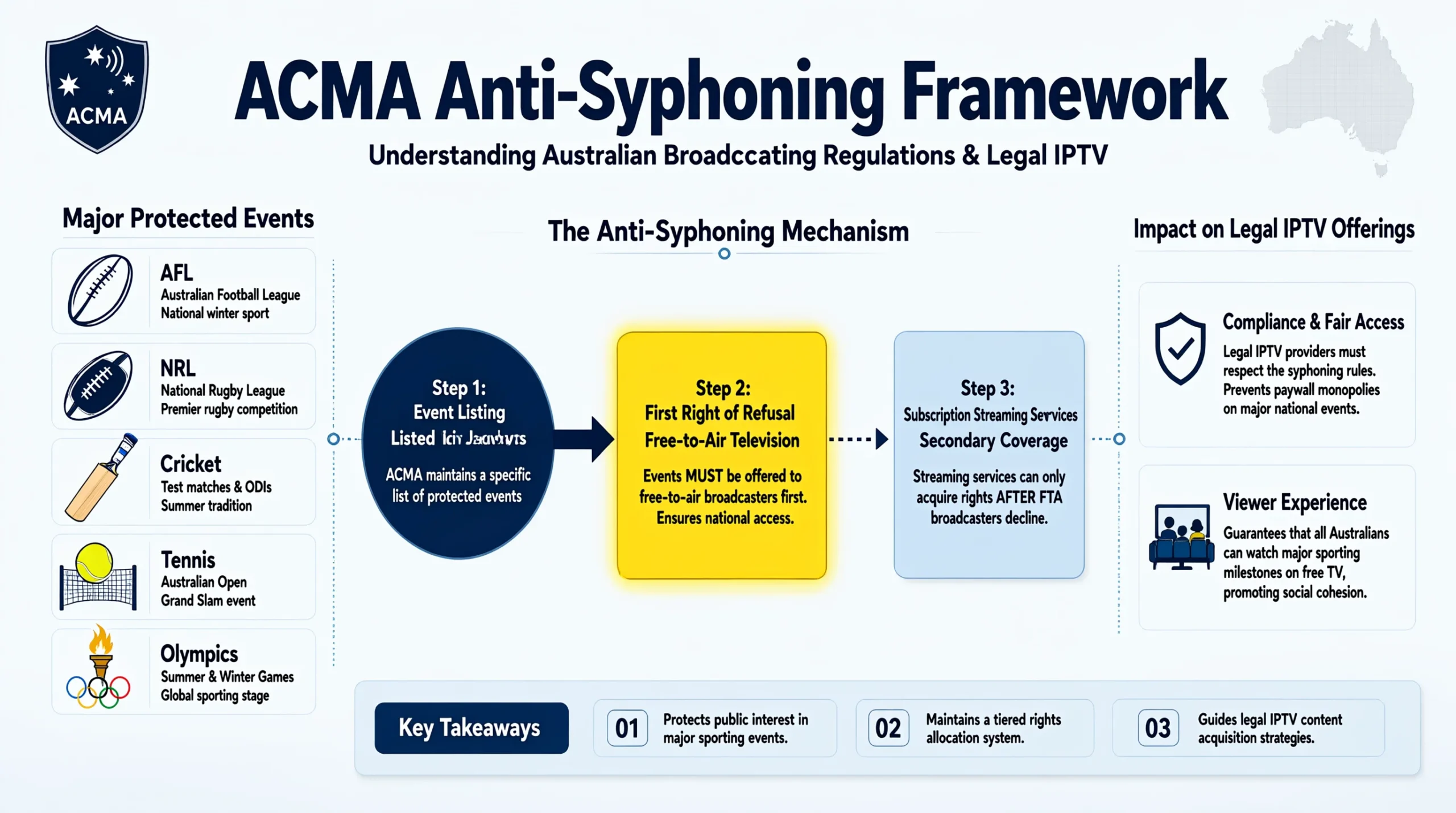
The Australian Communications and Media Authority (ACMA) runs the country’s anti-syphoning system. This means that major sporting events like the AFL finals, the NRL grand finals, the Australian Open, cricket tests, and the Olympics must be shown on free-to-air television before they can be shown on subscription services.

IPTV services that show live coverage of anti-syphoning events must follow these rules or face action from the BSA.

The anti-syphoning regime is, in my assessment, the aspect of ACMA’s regulatory function with the most direct and underappreciated impact on what IPTV services can legally offer Australian subscribers.

What is the Anti-Syphoning Regime? Does

The anti-syphoning regime, administered by ACMA under the Broadcasting Services Act 1992, requires that specified sporting and cultural events be made available on free-to-air television before subscription television services can broadcast them. The regime is designed to ensure that Australian viewers without subscription television access can watch major national events without additional cost.

Events on the Anti-Siphoning List

The anti-syphoning list includes events of national significance:

  • AFL: All finals matches including the grand final and the ANZAC Day match
  • NRL: All finals matches, including the grand final; State of Origin matches
  • Cricket: Australian home test matches; World Cup finals involving Australia
  • Tennis: Australian Open (all matches involving Australians; semi-finals and finals)
  • Olympics and Commonwealth Games: All events involving Australian athletes
  • Soccer: FIFA World Cup finals and semi-finals; matches involving Australia
  • Rugby Union: Rugby World Cup finals; matches involving the Wallabies

What the Regime Means for IPTV Services

An IPTV service—licensed or unlicensed—offering live coverage of listed anti-syphoning events is operating in a space with specific regulatory obligations. Licensed subscription services (Foxtel, Kayo) must comply with anti-syphoning rules, which restrict when they can broadcast listed events relative to free-to-air transmission.

Unlicensed IPTV services offering live AFL, NRL, or cricket coverage are not merely infringing copyright — they are distributing content subject to specific regulatory protections that compound their legal exposure.

For subscribers, the anti-syphoning regime means that live coverage of major Australian sporting events on unlicensed IPTV services is among the most legally and regulatorily sensitive content these platforms distribute.

Industry Codes and IPTV Standards

Featured Snippet Answer (40-60 words): ACMA registers industry codes developed by broadcasting and internet industry bodies that set content standards, complaints handling requirements, and operational practices for Australian services. ACMA legally enforces these registered codes.

Australia expects IPTV services to adhere to applicable registered codes that govern content classification and subscriber complaint handling.

ACMA is empowered by the Broadcasting Services Act 1992 to register industry codes developed by industry bodies representing broadcasting and internet services. Once registered, these codes are legally enforceable— ACMA can direct compliance with registered codes and take enforcement action against entities that breach them.

Relevant Industry Codes for IPTV

Free TV Australia Codes of Practice: Govern free-to-air television broadcast standards. This is relevant to IPTV services that retransmit free-to-air content.

ASTRA Codes of Practice: Apply to subscription television services. This is relevant to IPTV operators who provide subscription television services that meet the BSA definition.

Internet Industry Association Codes: Cover online content standards, complaints handling, and consumer protections for internet-delivered services. This applies to IPTV services that are internet-delivered platforms.

Practical Application

Industry code compliance is most directly relevant to IPTV services operating as regulated broadcasting or subscription television services under the BSA framework. Services that don’t follow the BSA’s licensing rules — like most consumer IPTV subscription platforms — aren’t officially required to follow ACMA’s broadcast codes, but they still have to follow the Australian Consumer Law regarding consumer guarantees and misleading conduct.

Online Content Regulation and the eSafety Commissioner

Featured Snippet Answer (40-60 words): Online content regulation for IPTV services has largely shifted from ACMA’s direct oversight to the eSafety Commissioner under the Online Safety Act 2021. The eSafety Commissioner can issue removal notices for harmful online content and require online service providers to meet basic online safety expectations. ACMA retains coordination roles in telecommunications and broadcasting compliance.

The Online Safety Act 2021 (Cth) transferred primary responsibility for online content regulation from ACMA to the eSafety Commissioner (https://www.esafety.gov.au/). This shift is relevant to understanding ACMA’s current role in IPTV regulation.

eSafety Commissioner Powers Relevant to IPTV

The eSafety Commissioner can:

  • Issue removal notices for harmful online content (violent, abusive, or illegal material) hosted by or accessible through online services
  • Investigate complaints about online service providers’ failure to address harmful content
  • Require online service providers to comply with Basic Online Safety Expectations (BOSE) — standards for transparency, complaint handling, and content management

An IPTV service distributing content that violates online safety standards — not merely copyright infringement but content that is genuinely harmful — faces action from the eSafety Commissioner in addition to copyright enforcement.

ACMA’s Retained Role

ACMA retains responsibility for:

  • Coordinating the website blocking regime under section 115A
  • Broadcasting licence compliance under the BSA
  • Anti-siphoning regime administration
  • Telecommunications licence compliance
  • Radiocommunications spectrum management

What ACMA Cannot Do — Important Limitations

Featured Snippet Answer (40-60 words): ACMA cannot directly prosecute copyright infringement—that requires rights holders pursuing Federal Court civil action or the AFP pursuing criminal prosecution.

ACMA cannot issue penalties to individual subscribers for accessing IPTV services. ACMA cannot block services without prior Federal Court orders. ACMA cannot license IPTV content nor verify content authorisation compliance.

Understanding ACMA’s limitations is as important as understanding its powers. Public discussions commonly attribute to ACMA several things it cannot do:

Copyright infringement under the Copyright Act 1968 is enforced by rights holders through Federal Court civil litigation and by the Australian Federal Police through criminal prosecution.

ACMA has no direct copyright enforcement power. It cannot investigate copyright infringement complaints, issue infringement notices, or pursue copyright violators. Its role in the website blocking regime is the coordination of court-ordered blocks— it does not initiate those blocks independently.

ACMA Cannot Issue Penalties to Individual Subscribers

ACMA has no power to issue warnings, infringement notices, or penalties to individual IPTV subscribers. This is a persistent misconception — ACMA does not monitor individual subscriber activity, maintain subscriber watchlists, or have a subscriber-facing enforcement mechanism for IPTV viewing. Individual subscriber enforcement, to the extent it exists, would require action by rights holders or the AFP under copyright law — not ACMA action.

ACMA Cannot Block Services Without a Court Order

ACMA cannot unilaterally block an IPTV service without a federal court blocking order. The blocking system works based on orders from the court — ACMA’s job is to help ISPs carry out orders that the Federal Court has already issued after rights holders have made requests.

ACMA Cannot Verify Content Authorisation

ACMA does not assess or certify whether IPTV services hold proper content licensing. Content authorisation is a private commercial matter between rights holders and distributors. ACMA does not maintain a register of licensed IPTV services or verify compliance with copyright licensing requirements.

How to Make a Complaint to ACMA About an IPTV Service

Featured Snippet Answer (40-60 words): Complaints to ACMA about IPTV services can be submitted through ACMA’s online complaint form at acma.gov.au for broadcasting standard complaints, content complaints, or telecommunications compliance issues. Copyright infringement complaints should be directed to the rights holders concerned or to the Australian Federal Police for criminal matters. ACMA does not handle copyright infringement complaints directly.

If you believe an IPTV service is operating in breach of Australian broadcasting standards or telecommunications regulations, you can submit a complaint to ACMA through its official channels:

ACMA Online Complaint Form: https://www.acma.gov.au/complaints

What ACMA can investigate:

  • Broadcasting standard complaints (content classification, advertising standards, election coverage obligations)
  • Telecommunications service complaints (carriage service provider compliance)
  • Spam and telemarketing complaints
  • Broadcasting licence compliance concerns

What ACMA cannot investigate:

  • Copyright infringement complaints — direct these to the rights holder concerned
  • Criminal IPTV piracy operations — report to the Australian Federal Police (https://www.afp.gov.au/) or through the Australian Government’s online reporting mechanism
  • Consumer disputes about IPTV subscription quality or refunds — direct these to the ACCC (https://www.accc.gov.au/) or your state fair trading agency

For guidance on reporting illegal IPTV activity through the appropriate channels, see Reporting Illegal IPTV in Australia.

What ACMA’s Role Means for Subscribers

Featured Snippet Answer (40-60 words): For Australian IPTV subscribers, ACMA’s practical significance is the website blocking regime—services found to infringe copyright are blocked by Australian ISPs following Federal Court orders coordinated by ACMA. Subscribers are not directly targeted by ACMA enforcement.

The anti-syphoning regime determines free-to-air availability of major Australian sporting events.

Understanding ACMA’s actual role changes how subscribers should think about IPTV compliance risk:

ACMA is not monitoring your IPTV activity. ACMA has no subscriber surveillance function and no power to investigate or penalise individual subscribers. The blocking regime operates at the infrastructure level — targeting services, not the individuals using them.

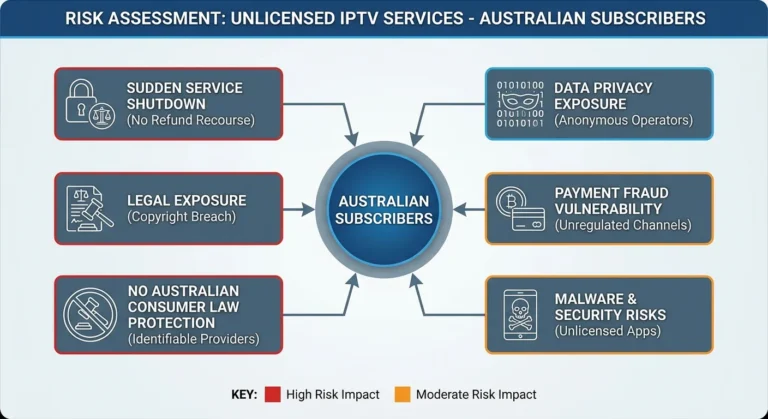
ACMA coordinates the mechanism that ends services. When a service you subscribe to is blocked, ACMA has coordinated the ISP-level implementation of a Federal Court order obtained by rights holders. From a subscriber perspective, the rule means services can become inaccessible suddenly, without warning, and without refund recourse from an anonymous operator.

The anti-syphoning regime protects your free-to-air sports access. ACMA’s administration of the anti-syphoning list means that AFL finals, NRL grand finals, cricket tests, and other listed events must be available on free-to-air television. This is a subscriber-protective mechanism — not an enforcement risk.

ACMA cannot help you with subscription disputes. If you have a complaint about an IPTV service’s quality, refunds, or business conduct, ACMA is not the appropriate body — the ACCC and state fair trading agencies handle consumer protection matters.

What ACMA’s Role Means for IPTV Providers

Featured Snippet Answer (40-60 words): IPTV providers operating in Australia face ACMA oversight for broadcasting licence compliance, website blocking order implementation against their platforms, anti-syphoning regime obligations for live sports content, and industry code compliance where applicable.

Providers operating outside Australia remain subject to ISP-level blocking regardless of physical location following Federal Court orders.

For IPTV service operators:

Broadcasting Services Act compliance: Providers whose operating services meet the BSA broadcasting service definition must hold appropriate ACMA authorisation. Operating a subscription television service without BSA compliance is an additional legal exposure beyond copyright infringement.

Website blocking exposure: An IPTV service distributing infringing content can be blocked by Australian ISPs following Federal Court orders obtained by rights holders, coordinated by ACMA. This applies regardless of where the provider is physically located — offshore providers are not exempt from blocking orders.

Anti-syphoning obligations: Providers of live Australian sporting content on the anti-syphoning list must be aware of the specific regulatory obligations that apply to this content category. Compliance with anti-syphoning requirements is a condition of lawful operation for any subscription service distributing major Australian sporting events.

Industry code compliance: Providers operating as regulated broadcasting or subscription television services are subject to ACMA-registered industry codes governing content standards, complaints handling, and consumer protections.

Common Misconceptions About ACMA and IPTV

Several persistent misconceptions about ACMA’s role in IPTV regulation circulate in subscriber forums and provider discussions with enough frequency to warrant direct correction.

Misconception 1: “ACMA can directly block any IPTV service it considers illegal.”

ACMA cannot block services unilaterally. The website blocking regime requires a Federal Court order obtained through rights holder litigation under section 115A of the Copyright Act. ACMA’s job is to make sure that ISPs follow court-ordered blocks. It is not an independent administrative blocking authority that works outside of the court system.

This distinction matters because it means the blocking regime has procedural safeguards: court assessment, proportionality considerations, and rights holder standing requirements.

Misconception 2: “ACMA monitors individual subscribers and can penalise them for using IPTV.”

ACMA has no subscriber surveillance function and no power to penalise individuals based on their IPTV viewing choices. ACMA’s regulatory framework operates at the service provider and infrastructure level — not at the individual subscriber level.

While ACMA subscriber enforcement is absent, individual viewing still carries legal or practical risk, but the risk profile operates through different mechanisms (service disruption, data privacy exposure) rather than direct ACMA regulatory action.

Misconception 3: “If ACMA hasn’t blocked a service, it must be operating legally.”

ACMA only blocks services following Federal Court orders initiated by rights holders. The absence of a blocking order reflects the status of rightsholder litigation and enforcement priorities—not a regulatory assessment that the service is compliant.

Whether blocked or not, an IPTV service that distributes unlicensed content operates in violation of the Copyright Act 1968. Enforcement timelines are determined by rights holder capacity and court scheduling, not by legal status.

Misconception 4: “ACMA is the main body to contact if I have an IPTV complaint.”

ACMA is the appropriate contact for broadcasting standard complaints and telecommunications compliance issues.

It is not the appropriate body for copyright infringement complaints (contact rights holders or the AFP), consumer protection disputes (contact the ACCC or state fair trading), or general IPTV subscription quality complaints. Directing IPTV complaints to ACMA when other bodies are more appropriate wastes time and delays access to the correct resolution pathway.

Misconception 5: “ACMA certifies or approves legal IPTV services.”

ACMA does not issue compliance certificates for IPTV services, maintain a register of approved IPTV providers, or verify content licensing arrangements.

A service cannot claim ACMA approval or certification as evidence of legal operation — ACMA simply does not provide this function. Claims of ACMA approval by an IPTV provider should be treated as a red flag rather than a trust signal.

Frequently Asked Questions

Could you please explain the role of ACMA in relation to IPTV?

ACMA performs three primary functions relevant to IPTV in Australia. First, it coordinates the implementation of Federal Court website blocking orders against infringing IPTV services under Section 115A of the Copyright Act 1968— directing Australian ISPs to block access to identified domains after rights holders obtain court orders.

Second, it enforces compliance with the Broadcasting Services Act 1992, which is relevant to IPTV services that meet the broadcast service definition and may require ACMA authorisation to operate.

Third, it administers the anti-syphoning regime that ensures major Australian sporting events are available on free-to-air television before subscription services can broadcast them.

ACMA does not directly prosecute copyright infringement, does not monitor individual subscribers, and does not certify or approve IPTV services. For the complete legal framework in which ACMA operates, see How Australian Law Regulates IPTV Services.

Can ACMA block an IPTV service I’m using?

ACMA can coordinate the blocking of IPTV services following Federal Court orders—but it cannot block services independently.

The process requires rights holders (such as Foxtel, AFL, NRL, or film studios) to apply to the Federal Court under section 115A of the Copyright Act, demonstrating that the service has the primary purpose of infringing copyright.

If the Court issues a blocking order, ACMA then directs Australian ISPs to implement DNS and IP blocks against the identified domains. If a service you use is blocked, your ISP will be unable to resolve the domain — you will be unable to access the service through a normal internet connection.

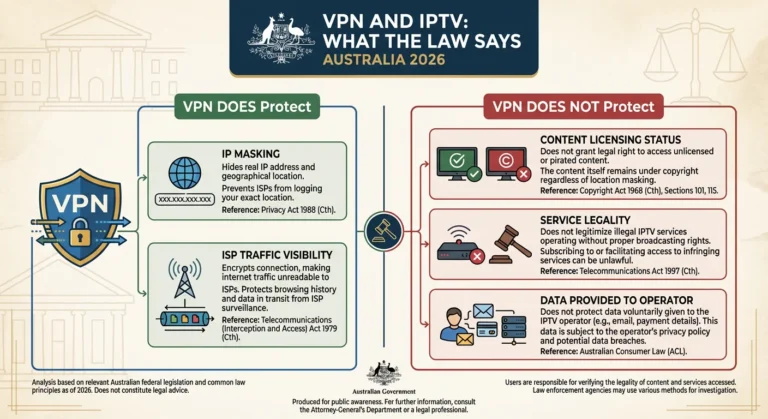
Using a VPN to circumvent a block does not change the underlying legal status of the service. For guidance on what to do when a service is blocked, see Risks of Using Unlicensed IPTV Services.

Does ACMA monitor what IPTV services Australians are watching?

No — ACMA does not have a subscriber monitoring function and does not track individual IPTV viewing activity. ACMA’s regulatory framework operates at the service provider and infrastructure level. Individual subscriber activity is not subject to ACMA surveillance or enforcement.

This is distinct from saying individual viewing carries no legal or practical risk — the risks of dealing with unlicensed providers include service disruption, data privacy exposure, and financial loss when services are shut down — but those risks do not operate through ACMA monitoring or enforcement against individuals.

What is the anti-syphoning list, and why does it matter for IPTV?

The anti-syphoning list is a schedule of major Australian sporting and cultural events that must be made available on free-to-air television before subscription television services can broadcast them.

Administered by ACMA under the Broadcasting Services Act 1992, the list includes AFL finals, NRL grand final, State of Origin, Australian Open tennis, Australian cricket tests, Olympic Games events involving Australian athletes, and FIFA World Cup matches involving Australia.

For IPTV subscribers, the anti-syphoning regime means that listed events must be freely accessible on free-to-air channels — you do not need any subscription service to watch them legally.

For IPTV providers, distributing live coverage of listed events involves regulatory obligations that extend beyond basic copyright compliance.

Conclusion

ACMA is a central institutional actor in Australian IPTV regulation — but its role is more precisely defined and more limited than public discourse often suggests. Its most practically significant function for IPTV is coordinating the website blocking regime: working with rights holders and ISPs to implement Federal Court orders that block access to services distributing content without authorisation.

Its administration of the anti-syphoning regime has direct implications for what live sports content IPTV services can legally offer. Its Broadcasting Services Act compliance function applies to the subset of IPTV services that meet the broadcasting service definition.

What ACMA is not—a copyright enforcement authority, a subscriber surveillance body, or a service approval authority—matters as much as what it is. The Copyright Act 1968 enforcement infrastructure that actually determines IPTV service legality operates through rights holder litigation and AFP criminal prosecution, not through ACMA administrative action.

I want to be transparent about one important limitation in this analysis: the precise boundary of ACMA’s jurisdiction over internet-delivered IPTV services continues to evolve as regulators, courts, and legislators adapt decades-old frameworks to rapidly changing digital distribution models.

The positions described here reflect the regulatory environment as of 2026—but the framework is not static, and specific service scenarios may involve regulatory questions that are genuinely unsettled.

What the framework provides is clarity on the institutional actors involved, their respective powers, and where those powers end. For comprehensive IPTV compliance guidance, return to Legal IPTV Australia.

This article provides general factual information about ACMA’s regulatory role in relation to IPTV services. It does not constitute legal advice. Readers should consult a qualified Australian legal professional for advice specific to their circumstances.

laura bennett Avatar

laura bennett

Digital Streaming Compliance & Online Safety Advisor LL.B., Graduate Diploma in Digital Media Law, Privacy & Data Protection Certification
Areas of Expertise: Australian Broadcasting Regulations, ACMA Compliance, Copyright Law, Digital Content Licensing, IPTV Legal Framework, Licensed vs Unlicensed Services, Consumer Protection in Streaming, ACCC Standards, eSafety Commissioner Guidelines, Privacy Act Compliance, Data Security in Streaming, Payment Safety, IPTV Scam Prevention, Service Verification Methods, Intellectual Property Rights, Broadcasting Rights, Content Distribution Law, Australian Telecommunications Law, Digital Privacy, Cybersecurity in Streaming
Fact Checked & Editorial Guidelines

Our Fact Checking Process

We prioritize accuracy and integrity in our content. Here's how we maintain high standards:

  1. Expert Review: All articles are reviewed by subject matter experts.
  2. Source Validation: Information is backed by credible, up-to-date sources.
  3. Transparency: We clearly cite references and disclose potential conflicts.
Reviewed by: Subject Matter Experts

Our Review Board

Our content is carefully reviewed by experienced professionals to ensure accuracy and relevance.

  • Qualified Experts: Each article is assessed by specialists with field-specific knowledge.
  • Up-to-date Insights: We incorporate the latest research, trends, and standards.
  • Commitment to Quality: Reviewers ensure clarity, correctness, and completeness.

Look for the expert-reviewed label to read content you can trust.

Leave a Reply

Your email address will not be published. Required fields are marked *