
Quick Answer
IPTV user penalties in Australia have not been applied to individual viewers in any widely reported case. Australian copyright enforcement targets operators, providers and resellers rather than audiences. That reflects enforcement priorities and practical difficulty — it does not legally guarantee that viewers cannot be reached.
This article is general information, not legal advice. For the wider legal framework, see our guide to whether IPTV is legal in Australia.
Can You Get in Trouble for Having IPTV in Australia?
Owning an IPTV device is not an offence in Australia, and neither is installing an IPTV application. There is no law against the technology itself — the same protocol delivers ABC iView, Netflix and Kayo. The legal question attaches to the content a service distributes and whether its operator holds the rights to distribute it.
That distinction is where most confusion sits. Headlines about court orders and enforcement action are describing action against services, not against the households that used them.
For an individual viewer, the honest position is narrower than either reassurance or alarm suggests. No widely reported Australian case has seen a viewer prosecuted for watching an IPTV stream. But the absence of reported cases describes how enforcement has been conducted, not a boundary the law has drawn.
Key takeaway: The device and the app are lawful. What varies is whether the service you subscribe to holds distribution rights.
Can IPTV Be Detected?
This is the question people ask most, and the answer depends on what “detected” means. Some information about your internet use is retained by law and available to certain agencies. The specific content you watch is a different category, and Australian data retention rules treat it differently.
The distinction matters more than the general worry does, so it’s worth setting out precisely.
What Your ISP Can and Cannot See
Australian internet providers operate under a mandatory data retention scheme that requires them to keep a defined set of telecommunications data — commonly called metadata — for two years. That set covers the subscriber, the service, and the circumstances of a communication: source, destination, date, time, duration and type.
What the scheme does not cover is equally specific. The content or substance of communications is expressly excluded, and so is web browsing history. The obligation is to retain the envelope, not the letter.
A separate point is often conflated with this one. The data-retention rules do not require ISPs to retain the content of your communications or your web browsing history. That is different from saying an ISP can never access information under a separate lawful authority.
They must comply with court-ordered blocking and lawful requests for retained data, which is not the same as monitoring what their customers do.
Can Your IPTV Provider See What You Watch?
Structurally, yes — and this is a different exposure from anything involving your internet provider or the law.
An IPTV service delivers streams from its servers. Any system that serves content on request necessarily knows what was requested, by which account, and when. That is how the delivery works rather than a claim about any particular operator’s practices.
The relevant question for a subscriber is therefore not whether the data exists but who holds it. A service operating without an identifiable business entity holds account and viewing information with no Australian privacy obligations attached to it and no regulator a customer could approach. That is a privacy consideration independent of the legal one, and it applies whether or not any enforcement ever occurs.
Why a Viewer Is Harder to Identify Than an Operator
An operator runs infrastructure. Servers have addresses, domains have registrations, and payments leave records — all of which give rights holders and investigators identifiable, durable targets.
An individual viewer presents a more complicated picture. Australian law has also not placed identification obligations on internet providers. In the iiNet litigation, the High Court found that the provider had no obligation to terminate the accounts of subscribers suspected of infringing, and a proposed industry scheme that would have required providers to pass infringement allegations to their customers was never implemented.
The accurate conclusion is narrow. Identifying an individual viewer is more complex than identifying an operator or a server, and no mechanism exists in Australia for routinely doing so. That is not the same as saying it is impossible.
Key takeaway: Retained data covers the circumstances of your connection, not what you watch — but your IPTV provider knows what its own servers delivered.
How Enforcement Actually Works in Australia
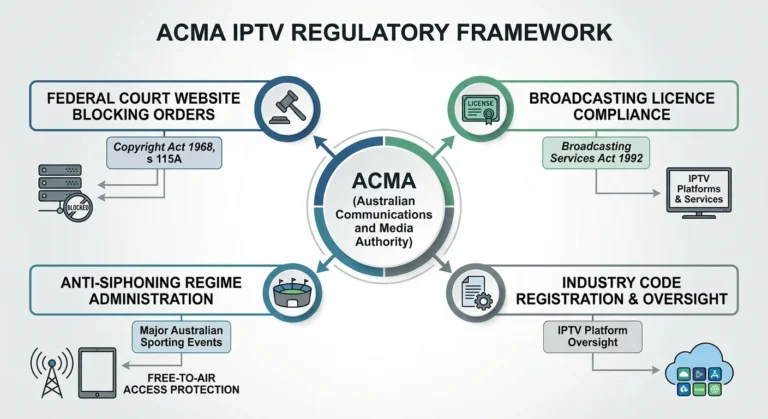
Australian copyright enforcement operates through three visible channels, and all three are aimed at the supply side. Understanding the mechanism explains why viewers have not been the target: each channel is built around infrastructure and commercial operations rather than audiences.
Site-Blocking Orders Under Section 115A

Section 115A of the Copyright Act allows a copyright owner to apply to the Federal Court for an injunction requiring internet providers to take reasonable steps to disable access to an online location. The court must be satisfied that the location sits outside Australia, that it infringes or facilitates infringement of copyright, and that this is its primary purpose.
The provision is a no-fault remedy against the provider. It does not require proof that the internet provider infringed anything or knew about the infringement—it simply directs them to block.
In practice, the Federal Court has ordered Australian providers to block substantial numbers of overseas streaming sites, using technical measures including DNS, IP and URL blocking, and redirecting users to a notice page explaining the order. The target is the service’s reachability. No part of the mechanism identifies or acts against the people who used it.
Criminal Action Against Operators
Criminal provisions apply to infringement on a commercial scale, which by definition describes operators rather than subscribers. These matters involve law enforcement, concern people running servers and profiting from unauthorised distribution, and can carry substantial penalties, including imprisonment.
The commercial-scale threshold is doing real work here. It is what separates an operator from an audience in the criminal provisions.
Civil Action Against Providers and Resellers
Rights holders also pursue civil proceedings seeking injunctions and damages against operators and, in some cases, resellers who profit from the distribution chain.
Resellers are worth noting separately. Someone who sells subscriptions — even informally, even in small volume — sits in a different category from someone who buys one. The civil provisions do not carry the commercial-scale limitation that applies to the criminal ones, which makes the reseller’s position materially more exposed than the subscriber’s.
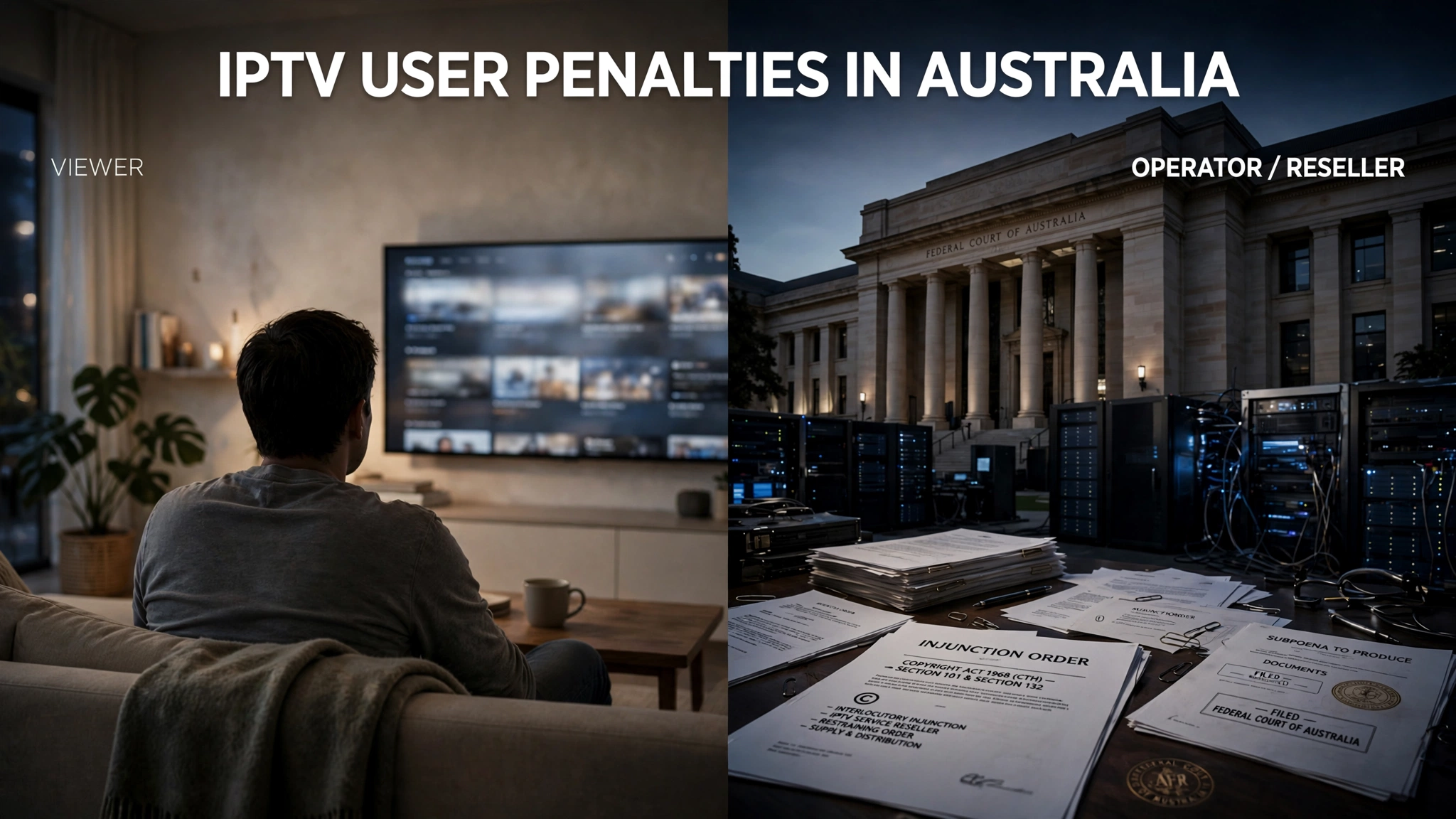
IPTV User Penalties in Australia: Who Actually Faces Them
Exposure depends entirely on role, and the gap between categories is wide. Grouping “IPTV users” together obscures the single most important variable.
Providers and Resellers
Operators and resellers face the substantive penalties. The Copyright Act sets these offences in penalty units rather than fixed dollar amounts, and the unit value is indexed, meaning any dollar figure is accurate only for the period in which the offence was committed.
Most published guidance gets this wrong by repeating a figure that has been superseded several times. Our guide to whether IPTV is legal in Australia sets out the current penalty unit value and the resulting maximums by offence and by period.
Civil liability applies alongside criminal exposure, and a reseller who does not meet the commercial-scale threshold for criminal liability can still face civil damages.
Individual Viewers
No widely reported Australian case has resulted in a penalty against an individual viewer for watching an IPTV stream. Enforcement resources, the practical difficulty of identifying individuals, and the reputational cost of pursuing consumers all point in the same direction and have consistently done so.
The qualification is straightforward and worth stating plainly rather than burying. The Copyright Act’s civil provisions are broader than its criminal ones and contain no commercial-scale threshold. A pattern of enforcement is not a legal exemption, and no Australian court has ruled that viewers are outside the framework’s reach — the question has simply not been tested.
Key takeaway: Selling access and buying access are legally different positions. Resellers face real exposure; viewers have not been the target.
Can Your Internet Provider Block IPTV?
Yes — but not on their own initiative. Blocking happens when the Federal Court orders it under Section 115A, and the provider is implementing that order rather than making a decision about your account. Licensed services are unaffected, because only services a court has found to be infringing fall within scope.
Blocked domains are typically redirected to a notice page explaining that access has been disabled by court order. If a service becomes unreachable while the rest of the internet works normally, an outage is one plausible explanation — and a reasonably strong signal about how that service operates.
Not every sudden failure is a blocking order, though, and the technical causes are far more common. Our Firestick IPTV troubleshooting guide covers how to tell the difference.
Is the Fire Stick Itself Illegal?
No. A Fire TV Stick is a general-purpose streaming device sold openly by a major retailer, and owning one carries no legal implication whatsoever. Nor does installing applications on it — including those obtained from outside the Amazon Appstore, which is a supported function on Fire OS devices rather than a circumvention of anything.
The phrase “dodgy firestick” describes a device sold pre-loaded and pre-configured with access to unlicensed services. The legal issue in that description attaches to the person selling access to unlicensed content — the reseller — not to the hardware and not to the person who bought it.
This matters because the framing misleads. A device is not the unit of legal analysis; the content service is.
What Could Change — and Why This Isn’t a Guarantee
Present conditions describe the current landscape rather than a settled position, and several developments point towards tighter enforcement over time.
Site-blocking has become routine. The mechanism is well established, orders are granted regularly, and the process for extending them to mirror domains has been streamlined.
Penalty maximums now index automatically to inflation, which means they rise without fresh legislation — a structural change rather than a one-off increase.
Subscription streaming has been brought partly inside the Broadcasting Services Act for the first time. The immediate effect on IPTV is negligible, since no unlicensed service approaches the subscriber thresholds involved. The significance is directional.
International precedent exists in jurisdictions that have pursued subscriber data from IPTV services. Those precedents do not apply in Australia, but they establish models that could influence future thinking here.
None of this indicates imminent action against viewers. It indicates that the reasoning behind “this hasn’t happened” is about enforcement practice, and enforcement practice is not fixed.
What Actually Happens to Most People

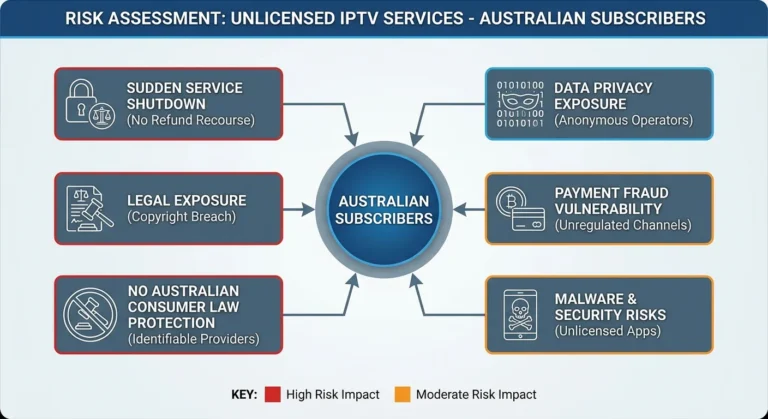
For most Australian households using an unlicensed service, the realistic consequences have nothing to do with the law. They are practical, they are common, and they arrive without any enforcement action at all.
Losing Access Without Warning
Services stop. Sometimes a blocking order makes them unreachable, sometimes the operator shuts down, and sometimes content sources disappear and the channel list degrades over weeks.
Prepaid subscription fees are generally unrecoverable when this happens, and there is usually no notice.
Why Recourse Is Hard in Practice
This is where a common claim needs correcting. It is often said that Australian Consumer Law offers no protection against overseas sellers. That is not accurate — when an overseas business sells directly to consumers in Australia, it must comply with the Australian Consumer Law, including the consumer guarantees, and those guarantees cannot be excluded by contract.
The difficulty is enforcement rather than entitlement. The ACCC itself notes that in practice it can be difficult to obtain a repair, replacement or refund from an overseas business when something goes wrong.
For a service with no identifiable business entity, no registered address and no Australian presence, that difficulty becomes close to absolute. The right exists on paper; there is no one to exercise it against. That is a more accurate — and more useful — statement than saying no rights exist.
Data Exposure
Subscribing requires handing personal and payment details to the operator. Where that operator has no identifiable corporate existence, no Australian privacy obligations attach to the data and no regulator has jurisdiction over how it is stored or shared.
This exposure is entirely independent of the legal question. It applies whether or not enforcement ever occurs, and it does not resolve if the service turns out to have been licensed after all.
Key takeaway: The realistic risk for most households is losing money and exposing data, not receiving a penalty.
If You Receive a Warning Message
Treat any communication claiming to concern IPTV enforcement with caution, because scam messages impersonating legal authorities and rights holders are common and often convincing.
Verify the source independently before responding to anything. Do not use contact details supplied in the message itself — look up the organisation separately.
Do not send money or personal information in response to an unverified communication. Demands for immediate payment to avoid legal consequences are a recognised scam pattern rather than how legal proceedings work in Australia.
If a communication appears genuine, seek legal advice before responding. This article cannot substitute for advice on a specific situation.
Bottom Line
If you are asking whether you personally face penalties: no widely reported Australian case has penalised an individual viewer, and enforcement has consistently targeted operators and resellers. That is the practical position, not a legal guarantee.
If you are asking whether your activity can be seen:
Retained telecommunications data covers the circumstances of your connection, and content and browsing history are excluded from the retention scheme. Your IPTV provider, however, necessarily knows what its own servers delivered to your account.
If you are weighing whether to use an unlicensed service:
The realistic risks are financial and privacy-related rather than legal. Losing prepaid fees, having no practical recourse, and handing payment details to an unidentifiable operator are the outcomes that actually occur — see our guide to legal IPTV alternatives in Australia.
Sources
- Copyright Act 1968 (Cth) — section 115A, online location blocking injunctions
- Telecommunications (Interception and Access) Amendment (Data Retention) Act 2015 (Cth) — retained data set; content and browsing history excluded
- ACCC — Consumer rights and guarantees and Buying online
- Roadshow Films Pty Ltd v Telstra Corporation Ltd [2016] FCA 1503 — first section 115A blocking orders
This article provides general information about the legal landscape surrounding IPTV in Australia. It does not constitute legal advice. For guidance on a specific situation, consult a qualified Australian legal professional.
Explore More
Legal
Choosing a service
Devices