
Quick Answer
IPTV vs traditional TV in Australia is a trade-off that most households can assess in under a minute. IPTV typically costs $15–45 AUD/month with hundreds to thousands of channels, while Foxtel costs $49–104+ AUD/month, and free-to-air costs nothing but offers only ~20 channels. IPTV requires a stable internet connection; traditional TV doesn’t. IPTV often offers better value for households with a reliable internet connection — but traditional TV still makes sense in specific situations covered below.
Quick Comparison
| Feature | IPTV | Traditional TV |
|---|---|---|
| Monthly Cost | Lower ($15–45 AUD) | Higher ($49–104+ AUD, or $0 for free-to-air) |
| Channels | More (500–10,000+) | Fewer (~20–200) |
| Internet Required | Yes | No |
| Sports Delay | Slight (10–30 sec) | None |
| Flexibility | High | Moderate |
| Contract | None | Often 12–24 months (Foxtel) |
| Setup | Self-install | Technician (Foxtel/cable) |
At a Glance
✔ IPTV Cost: $15–45 AUD/month
✔ Foxtel Cost: $49–104+ AUD/month
✔ Free-to-Air Cost: $0/month (≈20 channels)
✔ Internet Required: Yes for IPTV, no for free-to-air/satellite
✔ Sports Latency: IPTV typically 10–30 seconds behind broadcast
✔ Best For: Households wanting more channels and flexibility at lower cost
Key Takeaways
- IPTV generally costs significantly less than Foxtel for comparable or broader channel coverage
- The main technical trade-off is internet dependency in exchange for lower cost and more flexibility
- For most viewers, IPTV provides a very good sports viewing experience, with a minor live-broadcast delay most never notice
- Free-to-air and satellite remain the more dependable choice where internet connectivity is unreliable
- Australians are increasingly comfortable running multiple subscription services rather than one all-in-one provider
In This Guide
- How Do IPTV and Traditional TV Differ in Content Delivery?
- How Does Pricing Compare?
- How Does Channel Variety Compare?
- How Does the Sports Viewing Experience Compare?
- How Do Flexibility and Convenience Compare?
- When Does Traditional TV Still Make Sense?
- FAQ
How Do IPTV and Traditional TV Differ in Content Delivery?
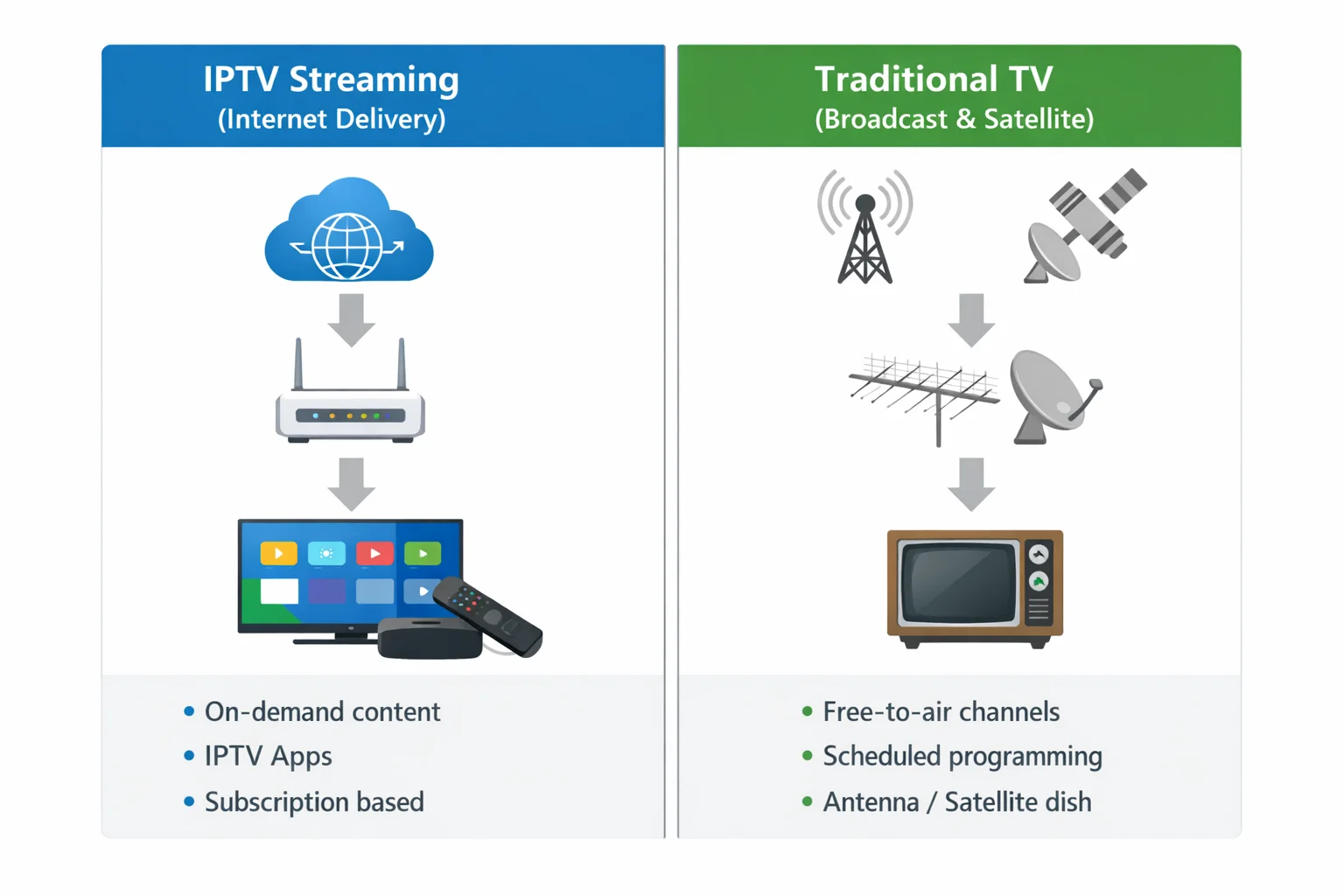
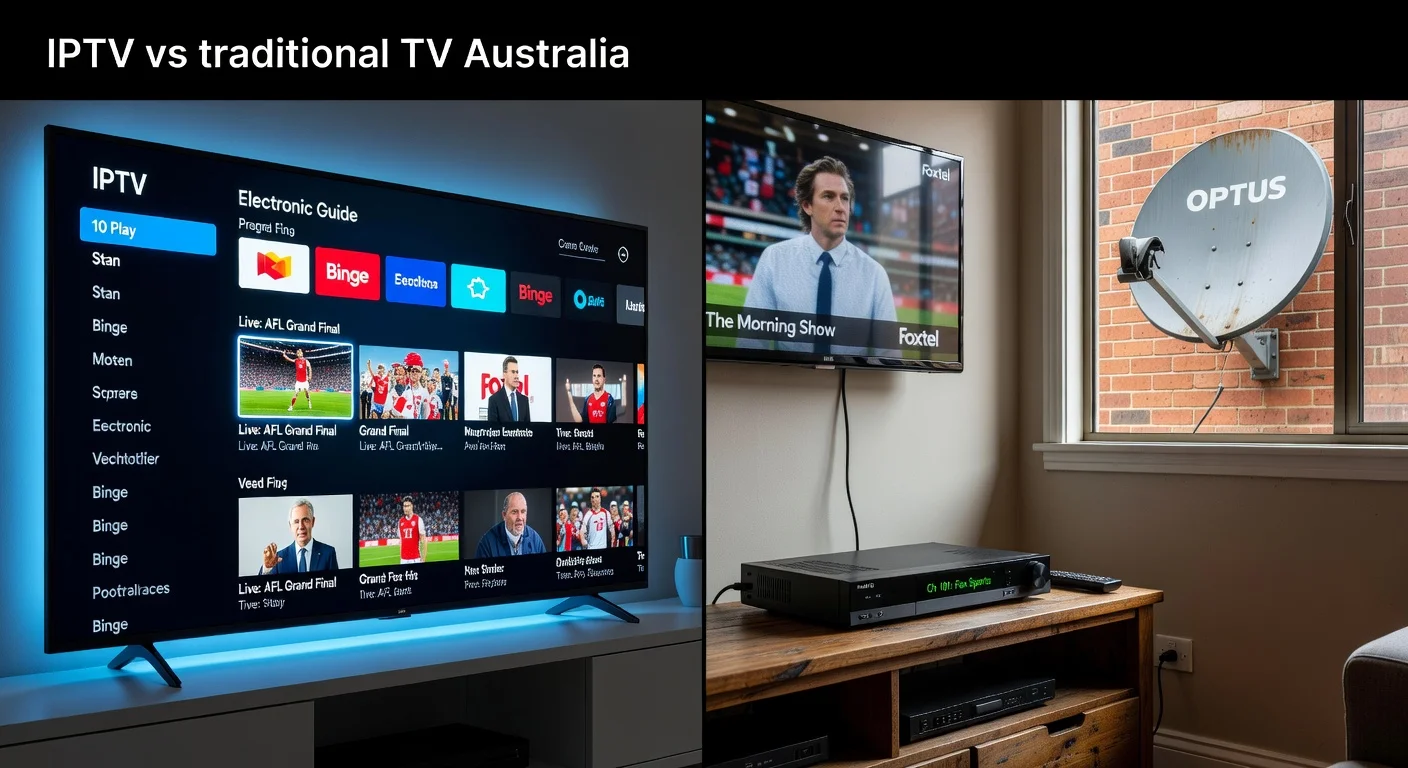
IPTV delivers television channels through internet protocol over your broadband connection, while traditional TV uses broadcast signals transmitted through dedicated infrastructure — radio waves for free-to-air, satellite transponders for Foxtel, and coaxial cable for legacy cable systems.
The practical difference is that IPTV requires only an internet connection and a streaming device, while traditional TV requires hardware tied to a single delivery method.
Traditional TV delivery:
- Free-to-air: Broadcast tower → Antenna → TV. Free, ~20 channels, requires a clear line of sight.
- Foxtel satellite: Satellite → Dish → Set-top box → TV. $49–104+/month; requires dish installation and box rental.
IPTV delivery:
- Provider server → CDN → Internet → Your NBN → Router → Device → TV. Costs range from $15 to $45 per month and require an internet connection and a streaming device.
Despite using entirely different infrastructure, the end experience is remarkably similar — both provide live channels with programme schedules delivered in real time.
The differences emerge in pricing, flexibility, channel variety, and how each system handles sport and international content. For the foundational overview of the technology itself, see our comprehensive IPTV Australia guide.
How Does Pricing Compare?
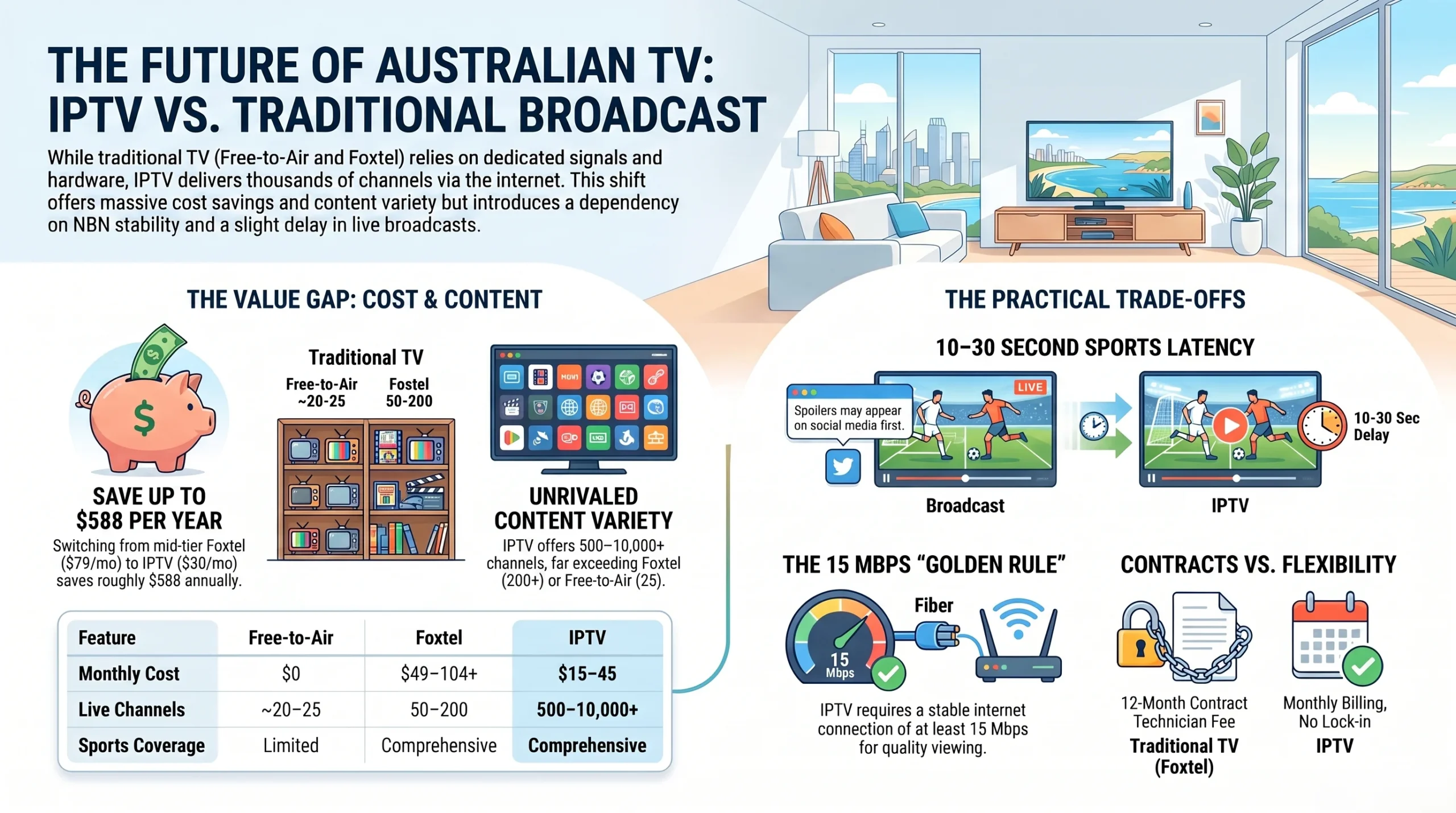
IPTV subscriptions generally cost $15–45 AUD per month for live channel packages, including sport, entertainment, international content, and catch-up TV. Foxtel packages range from $49 to $104+ AUD monthly for comparable coverage.
Free-to-air costs nothing but provides only 20–25 channels, with no sport beyond selected broadcasts and no catch-up functionality beyond individual network apps.
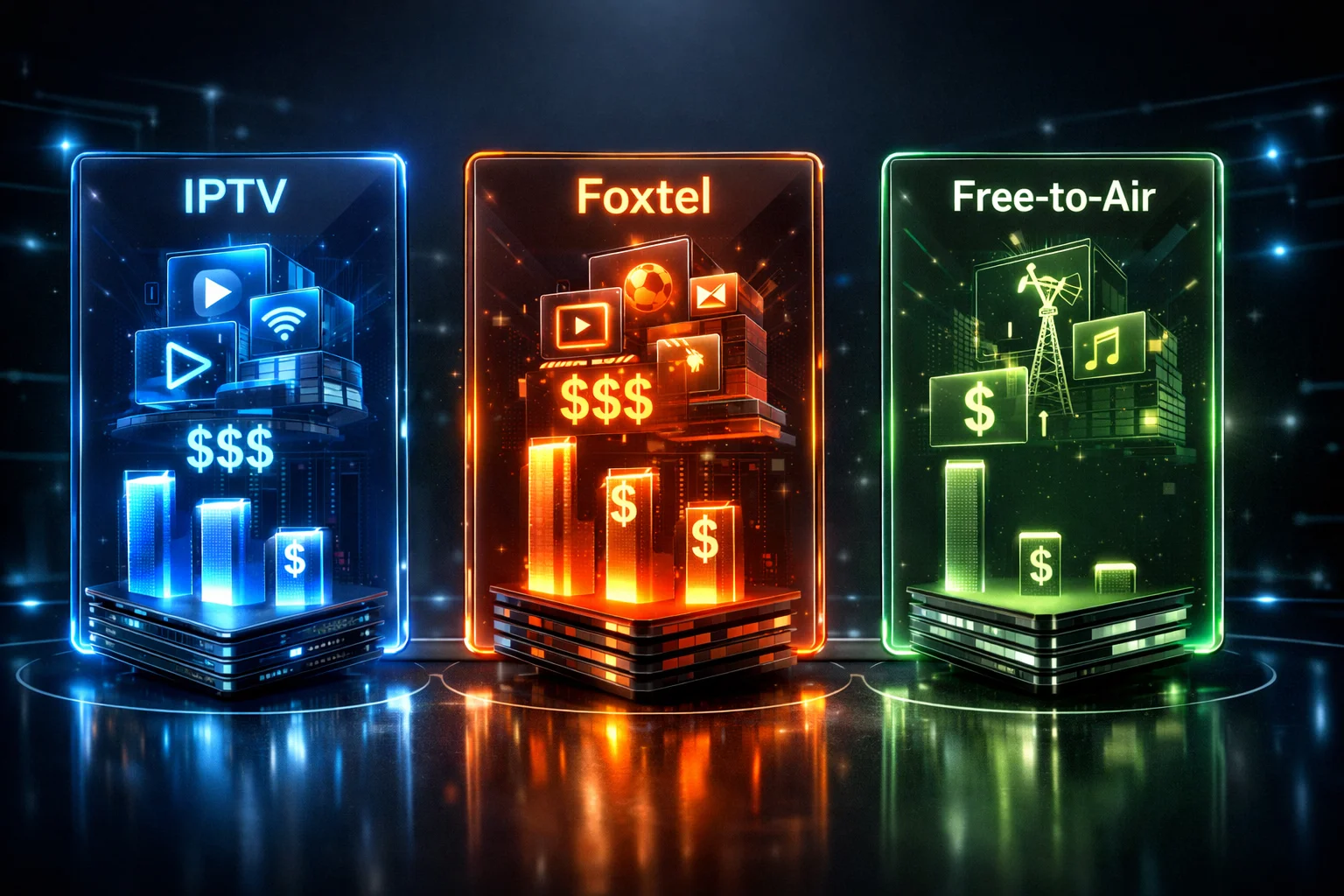
| Feature | Free-to-Air | Foxtel | IPTV |
|---|---|---|---|
| Monthly cost | $0 | $49–104 AUD | $15–45 AUD |
| Live channels | ~20–25 | 50–200 | 500–10,000+ |
| Sport coverage | Limited (selected) | Comprehensive | Comprehensive |
A household switching from a mid-tier Foxtel subscription ($79/month) to a mid-range IPTV service ($30/month) saves roughly $588 AUD annually and often gains access to more channel categories.
Australian households now spend an average of AU$30 a month on video subscriptions, and the share of households subscribing to more than one service has risen to 43%, up from 30% in 2018, according to research summarised by the University of Melbourne. For a more profound look at how IPTV pricing structures work, see our IPTV cost guide.
How Does Channel Variety Compare?
IPTV provides considerably broader channel variety than any traditional TV option. A typical IPTV subscription includes Australian free-to-air channels, premium sport networks, international channels in 50+ languages, entertainment networks, news, kids’ programming, and speciality content — all within a single subscription.
Foxtel offers 50–200+ channels depending on the package but lacks comparable international variety; free-to-air is limited to roughly 20–25 channels.
| Content Type | Free-to-Air | Foxtel | IPTV |
|---|---|---|---|
| Australian FTA | Full | Full | Full |
| Sport (comprehensive) | Partial | Yes ($$) | Yes |
| International channels | SBS only | Very limited | 50+ countries |
This advantage is particularly meaningful for two groups: sports enthusiasts, who can access AFL, NRL, and cricket alongside EPL, La Liga, NBA, NFL, and UFC through a single subscription rather than combining Foxtel, Kayo, and individual league passes; and multicultural households, who gain channels in Arabic, Greek, Italian, Vietnamese, Mandarin, Hindi, Turkish, and dozens of other languages with no comparable option through Australian traditional TV.
How Does the Sports Viewing Experience Compare?
Sport is where IPTV’s value proposition is strongest. A single IPTV subscription typically provides channels covering AFL, NRL, cricket, Formula 1, EPL, international football, NBA, NFL, and tennis — content that would otherwise require combining Foxtel ($49+), Kayo ($29.99), and Stan Sport ($15+) to match through licensed platforms.
The main technical difference is latency: satellite broadcasts typically show action slightly ahead of real-time, while IPTV streams generally run 10–30 seconds behind broadcast depending on the provider and protocol used.
This gap matters in one specific scenario — if you’re following live score notifications or social media during a match, you may see spoilers before the action reaches your screen. For most viewers watching without an external spoiler source (most match viewing), the delay is functionally irrelevant.
The practical trade-off: IPTV generally provides equivalent sport coverage at $20–35/month versus $80–100+/month through traditional channels, with the main compromise being a delay most viewers never notice unless actively comparing two screens side by side.
How Do Flexibility and Convenience Compare?
IPTV offers meaningfully greater flexibility than traditional TV across three areas: device portability, subscription terms, and multi-device viewing.
Traditional TV:
- Fixed to one TV per set-top box; additional rooms mean additional hardware and fees
- Typically 12–24 month contracts, with early termination fees
- Requires a technician for installation
IPTV:
- Works on any internet-connected device, anywhere with internet access
- Monthly billing, cancel anytime, no termination fees
- Self-installation, typically in 10–15 minutes
IPTV’s multi-device flexibility helps households where different family members watch various content on different screens by avoiding the per-room hardware costs that traditional pay TV charges. A one-time Fire TV Stick ($59–89 AUD) in any room provides full IPTV access, versus an ongoing $10–20/month per additional room through Foxtel.
When Does Traditional TV Still Make Sense?
Traditional TV retains real advantages in specific situations:
- A lack of reliable internet means that if your NBN connection delivers under 15 Mbps during evening peak hours, IPTV won’t provide a satisfying experience. Free-to-air and satellite work regardless of internet quality.
- Technology discomfort — a Foxtel set-top box and remote are a familiar interface requiring no app configuration or troubleshooting.
- Already satisfied with free-to-air — if you watch mainly ABC, SBS, and commercial network content with no need for sport, international channels, or extensive entertainment, a $0/month antenna covers everything you need.
Regional and rural households on unreliable NBN, fixed wireless, or satellite internet are the group most likely to find traditional TV the more dependable choice. Screen Australia’s audience research tracks subscription TV viewing patterns across the population, and connectivity remains one of the most significant factors in adoption.
Frequently Asked Questions
Is IPTV better than Foxtel in Australia?
IPTV generally offers broader channel variety, significantly lower pricing, and greater device flexibility.
Foxtel offers a simpler user experience, internet-independent satellite delivery, and fully licensed content by default.
For viewers prioritising value and variety, IPTV typically offers more for less; for those prioritising simplicity, Foxtel remains a well-established choice.
Can IPTV replace my Foxtel subscription entirely?
For many households, yes — a quality IPTV subscription can provide equivalent or broader live channel coverage at a fraction of Foxtel’s pricing. Foxtel may still have an edge in interface polish and official support.
Can I watch Netflix on IPTV?
Netflix is a separate on-demand platform and not part of an IPTV subscription, so you cannot access it through the same app. Most households run both: IPTV for live channels and sport and Netflix for on-demand viewing, typically on the same streaming device.
Can I use IPTV without internet?
No. IPTV requires an active internet connection at all times — unlike free-to-air or satellite, it cannot store or broadcast content independently of your connection.
Will IPTV work on my smart TV?
Yes, most smart TVs from 2018 onwards can run IPTV apps directly, though a dedicated streaming device like a Fire TV Stick often provides a smoother experience than a smart TV’s built-in apps.
Does IPTV use a lot of internet data?
Yes, IPTV uses a relatively high amount of data — roughly 1–2 GB/hour for SD, 3–5 GB/hour for HD, and 5–8 GB/hour for full HD.
Most Australian NBN plans include unlimited data, but it’s worth checking if you’re on a fixed allowance.
What do I lose by switching from traditional TV to IPTV?
The main trade-offs are internet dependency, a modest live-sport delay, and managing your own setup rather than relying on a technician.
You’re also outside Foxtel’s fully licensed ecosystem by default, which makes choosing a properly licensed IPTV provider important — see our IPTV legality guide for what to check.
Does IPTV work in rural Australia?
It works wherever you have a stable connection of 15+ Mbps. For rural households on NBN Fixed Wireless, Starlink, or 4G/5G home internet, IPTV is viable if speeds are consistent, though high-latency or variable connections may buffer more than metro NBN.
Testing during a trial period is worthwhile before committing.
Conclusion
IPTV vs traditional TV in Australia isn’t a universal-winner comparison — it’s a set of trade-offs.
IPTV typically delivers more channels, greater flexibility, and substantially lower pricing, making it the stronger value proposition for most households with reliable internet. Traditional TV retains real advantages in simplicity, internet independence, and a fully licensed ecosystem by default.
For Australian viewers on NBN 25+ who want comprehensive live television at a fraction of traditional pay TV pricing, IPTV represents a genuine alternative worth careful evaluation — using the same checklist that applies to any provider.
🔗 Explore More — IPTV Australia Guide
Browse the full IPTV Australia Guide hub for every guide in this category, or jump straight to the following:
- IPTV Australia Guide: Complete 2026 Overview (linked above)
- What Is IPTV in Australia?
- How IPTV Works in Australia
- IPTV Cost Guide (linked above)