
Quick Answer
Yes, is IPTV legal in Australia? Yes, IPTV technology is fully legal here. Legality turns entirely on whether the provider holds valid content distribution licences, not on the technology itself.
| Question | Short Answer |
|---|---|
| Is IPTV legal in Australia? | Yes—the technology is fully legal |
| Is unlicensed IPTV legal? | No—it may breach Australian copyright law |
| Can viewers be prosecuted? | No known criminal precedent in Australia |
| Can ISPs block IPTV services? | Yes, under s115A of the Copyright Act 1968 |
| Does a VPN make unlicensed IPTV legal? | No, a VPN does not change legal status |
Key Takeaways
- The technology itself is entirely legal in Australia
- The law targets unlicensed providers, not the technology or individual viewers
- Licensed services are fully lawful; unlicensed services are not
- Individual viewers have not faced criminal prosecution in reported Australian case law
- Financial, privacy and service risks apply to unlicensed services regardless of enforcement
- Maximum fines rose on 1 July 2026 and now index automatically to inflation
Is IPTV legal in Australia?
Is IPTV legal in Australia? The short answer is yes. IPTV as a technology is entirely lawful. Australian law allows the delivery of television content over Internet Protocol, and installing an IPTV application on a streaming device is legal.
The legal question is not about the technology. It is about the content being delivered and whether the provider holds the rights to distribute it.
The reality is a spectrum:
- Fully licensed services with transparent business operations → fully lawful
- Services with partial or unclear licensing → legal grey area
- Services openly redistributing copyrighted content without authorisation → potentially in breach of Australian copyright law
Where a specific service sits on that spectrum determines its legal position.
It is worth stating plainly, because the assumption is so common: IPTV is not inherently more legally exposed than any other streaming technology. Netflix, Stan, Binge and Foxtel Now all deliver television over the Internet Protocol. The delivery method is identical. What separates a lawful service from an unlawful one is whether the operator holds distribution rights to the content it carries—nothing about the protocol itself.
For a broader understanding of the technology, see our guide on how IPTV works in Australia.
Is IPTV illegal in Australia?
If you ask the question the other way around, the answer is still the same, but the emphasis shifts. IPTV is not illegal in Australia. There is no offence of owning an IPTV device, installing an IPTV app, or subscribing to a licensed service. What can be unlawful is a provider distributing copyrighted content it has no right to distribute—and that is the provider’s offence, not the viewer’s.
The confusion usually comes from headlines about federal court blocking orders. The orders target specific domains that have been found to facilitate infringement. They are evidence that specific services were operating unlawfully. They are not evidence that the technology is banned.
Which Laws Govern IPTV in Australia?
Three pieces of legislation form the framework that applies to IPTV services operating in or accessible from Australia. None were written with IPTV in mind, but their provisions are broad enough to apply.
The Copyright Act of 1968 is the most important. It establishes the rights of content owners to control reproduction, communication, and distribution of their works. When an IPTV provider retransmits a television broadcast, the Act’s “communication to the public” provisions apply directly.
If the rights holder has authorised the retransmission, it is lawful. If the retransmission is not authorised, it may infringe exclusive rights under the Act.
The Broadcasting Services Act 1992 regulates the provision of broadcasting services in Australia, including the licensing framework governing who may deliver content to Australian audiences. Its definitions are still evolving as regulators consider how internet-delivered television fits frameworks designed for traditional broadcast and satellite delivery.
The Telecommunications Act 1997 governs the infrastructure through which IPTV content travels. Less directly relevant to content legality, it provides the regulatory foundation for internet service provision.
These laws place the primary legal burden on providers and distributors, not on individual viewers. For the framework in more depth, see IPTV laws in Australia.
What Makes an IPTV Service Legal or Illegal?

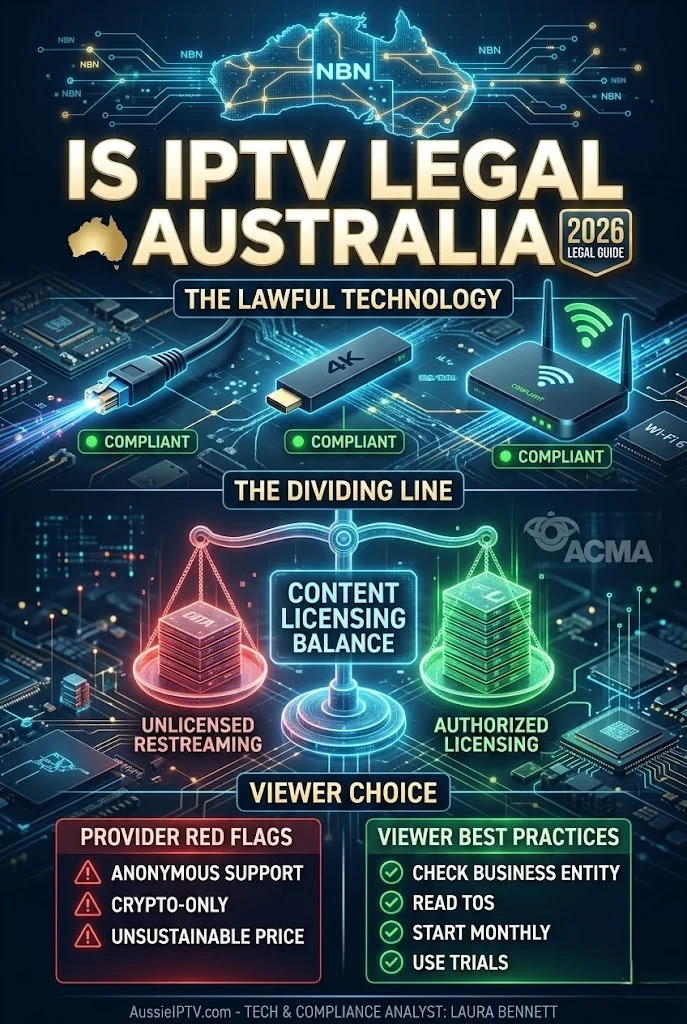
Content licensing is what distinguishes a lawful service from an unlawful one. A provider that has obtained distribution rights from content owners—through direct agreements or authorised intermediaries—operates within Australian law. A provider that captures, restream, or redistributes copyrighted content without permission operates outside it. See IPTV copyright infringement in Australia for details.
In practice, the distinction is often invisible to viewers. Licensed and unlicensed services may present similar channel lists, similar pricing, and near-identical interfaces. The difference sits in contractual arrangements at the business level, which no viewer can see from the outside.
That is why the observable signals matter.
Indicators of a legitimate provider
- Verifiable registered business entity, searchable on the Australian Business Register
- Published terms of service and privacy policy
- Standard payment processing — credit card or PayPal accepted
- Accessible customer support with identifiable contact details
- Pricing that reflects the genuine cost of content licensing
- Willingness to explain how content rights are obtained
Indicators of a potentially unlicensed provider
- Anonymous operation with no identifiable business entity or ABN — see IPTV provider red flags
- Communication exclusively through encrypted messaging apps
- Cryptocurrency as the only accepted payment method
- Thousands of premium channels for under $10 per month
- Reluctance or inability to answer questions about content rights
These are patterns rather than certainties, and no single one is conclusive. Taken together, they give a reasonable basis for assessment.
The “ACMA licence number” myth
Be cautious about advice you will find elsewhere. Several Australian IPTV guides tell readers to verify a provider by checking the ACMA register of licensed broadcasting services or by looking for a licence number displayed on the provider’s website. Both instructions are misleading, and following them will not tell you what you want to know.
ACMA broadcasting licences relate to services delivered over the broadcasting services bands—the radio spectrum used by free-to-air television and radio. They are tied to spectrum allocation and licence area plans. An internet-delivered subscription service does not hold, and does not need, a broadcasting licence of that kind. There is no ACMA register of approved IPTV providers to check.
What a lawful provider holds is not a government licence at all. It is a set of private commercial agreements with rights holders—broadcasters, sports leagues, and studios—and those contracts are confidential. No public register lists them.
This is precisely why the observable signals above matter. In the absence of a register, business registration, payment method, pricing logic, and transparency about content sourcing are the only evidence available to viewers.
A provider advertising a “license number” is displaying something that does not correspond to any Australian licensing scheme for this type of service. For step-by-step guidance, see how to identify legitimate IPTV providers or work through the IPTV provider checklist.
Where Does the Viewer Stand Legally?
Many Australians asking whether IPTV is legal in Australia are really asking something narrower: what is my personal risk?
Under Australian copyright law, enforcement has historically focused on providers and distributors of infringing content rather than on individual viewers. The Copyright Act’s infringement provisions are primarily concerned with communicating copyrighted material to the public—an act performed by the provider.
There is no established precedent in Australian case law for prosecuting individual viewers solely for watching an IPTV stream.
Several qualifications apply:
- The legal landscape is not static; it evolves through legislation, regulation and case law
- Past absence of prosecution does not prevent future enforcement
- Government and content industry bodies have shown increasing interest in unauthorised IPTV distribution
- Even where penalties are unlikely, other exposure remains—service instability, financial loss, and data privacy concerns covered in IPTV data privacy in Australia
For a focused examination, see whether users can be penalised for IPTV use.
What Are the Actual Penalties?

Your exposure depends entirely on your role.
For individual viewers: enforcement has historically targeted providers and distributors, not audiences. No Australian viewer has faced criminal prosecution solely for watching an IPTV stream under reported case law. This is not a legal guarantee — the framework permits enforcement at any level.
For providers and resellers: exposure is substantial.
| Role | Legal exposure (as at 1 July 2026) |
|---|---|
| Unlicensed provider — individual, commercial scale | Up to 550 penalty units ($200,200) and/or 5 years imprisonment—Copyright Act s132AC(1) |
| Unlicensed provider — body corporate | Up to 2,750 penalty units ($1,001,000)—Crimes Act 1914 s4B(3) |
| Infringement below commercial scale | Up to 120 penalty units ($43,680) and/or 2 years—s132AC(3) |
| Reseller of an unlicensed service | Civil damages; criminal liability possible where conduct meets the commercial-scale threshold |
| Individual viewer | No established Australian criminal precedent for viewing alone |
Why the dollar figures keep moving
These numbers are not fixed, and this is where most published guidance goes wrong.
Commonwealth fines are expressed in penalty units rather than dollars. The unit rose from $330 to $364 on 1 July 2026, and under section 4AA(3) of the Crimes Act 1914 — as amended by the Crimes and Other Legislation Amendment (Omnibus No. 1) Act 2024 — it now automatically indexes to the consumer price index every three years. The current value is published by ASIC alongside its penalty schedules.
That means any dollar figure quoted for a copyright offence is only accurate for the period in which the offence was committed:
| Period | Penalty unit | s132AC(1) individual | Body corporate |
|---|---|---|---|
| Jul 2020 – Dec 2022 | $222 | $122,100 | $610,500 |
| Jan 2023 – Jun 2023 | $275 | $151,250 | $756,250 |
| Jul 2023 – Nov 2024 | $313 | $172,150 | $860,750 |
| Nov 2024 – Jun 2026 | $330 | $181,500 | $907,500 |
| From 1 July 2026 | $364 | $200,200 | $1,001,000 |
Most Australian IPTV guides still quote $585,000. That figure was a body corporate maximum based on a penalty unit value that has been superseded three times since 2022, and it has been widely repeated as if it applied to individuals. The text of section 132AC sets the offence in penalty units, not dollars—which is why the dollar figure has to be recalculated rather than copied.
Does ACMA Fine IPTV Users?
No. This is the most persistent misunderstanding in the area, and it is worth separating clearly from the penalties above.
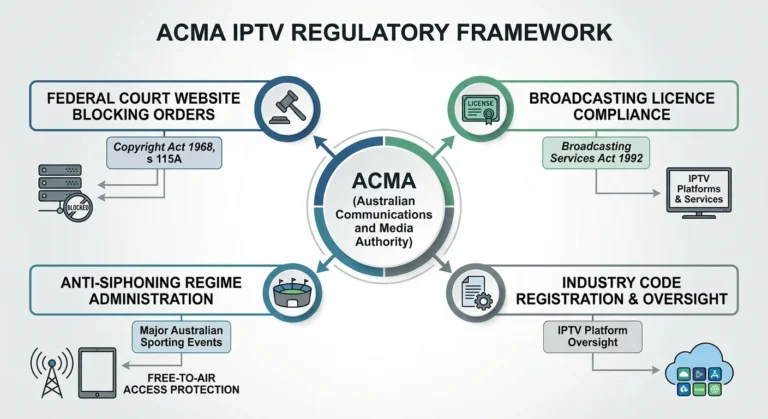
ACMA is a regulator, not a prosecutor of viewers. Its authority under the Broadcasting Services Act concerns licensed broadcasters, spectrum, content standards, and, more recently, the SVOD obligations described below. It does not fine individuals for watching a stream, nor does it monitor household internet traffic to identify who is watching what.
Copyright enforcement in Australia runs on an entirely separate track. It is driven by rights holders—broadcasters, sports leagues, and studios—who bring proceedings in the Federal Court. Section 115 Blocking orders are obtained this way: a rights holder applies, the court decides, and ISPs implement. ACMA is not the applicant and does not initiate these actions.
So when you see the phrase “ACMA crackdown” attached to IPTV, treat it carefully. What is usually being described is either a federal court blocking order sought by a rights holder or an ACMA action in a different area altogether, such as gambling advertising during live sports. Neither involves a fine issued to a viewer.
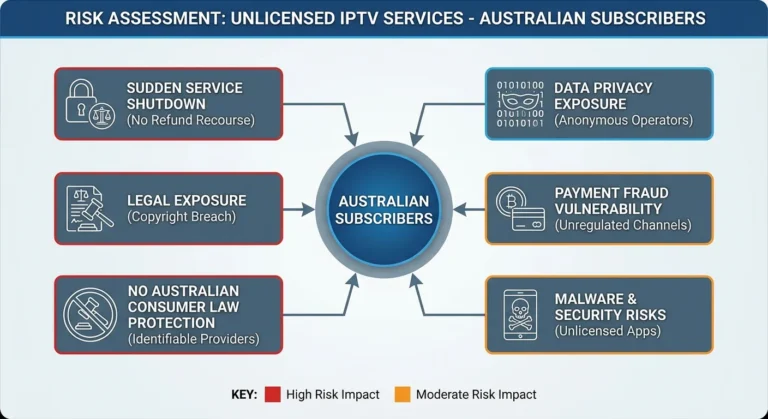
The realistic exposure for an Australian household using an unlicensed service is not a regulatory penalty. It is losing access without warning, having no consumer recourse for money paid, and handing payment details to an operator outside any Australian oversight.
For ACMA’s actual powers and their limits, see ACMA and IPTV oversight.
How to Watch IPTV Legally in Australia
The straightforward answer: use a service that pays for what it carries.
That includes the mainstream platforms most Australians already recognise—free-to-air catch-up services such as ABC iview, SBS On Demand, 7plus, 9Now, and 10 play, alongside paid services like Foxtel Now, Kayo Sports, Stan, Binge, and Netflix. All of these deliver television over internet protocol. All of them are IPTV in the technical sense. None of them raise a legal question, because the licensing sits behind them.
Where a service falls outside that recognised set, the checks in this article are what you have: business registration, standard payment processing, pricing that could plausibly cover rights fees, and a willingness to answer questions about content sourcing.
For a comparison of lawful options, see the best legal IPTV apps in Australia and legal IPTV in Australia.
Practical Risks of Unlicensed Services
Even where enforcement against viewers remains rare, unlicensed services carry risks that apply regardless of prosecution.
| Risk type | What it means in practice |
|---|---|
| Legal | Evolving enforcement: viewer risk exists even if historically limited |
| Financial | No refund protection, and no recourse under Australian Consumer Law against an unidentified entity |
| Privacy | Personal and payment data submitted to operators outside Australian regulatory oversight |
| Service | Sudden shutdowns without notice, common in unlicensed operations |
| Security | Some unlicensed apps contain malware or data-harvesting code—see ‘Protecting yourself from IPTV scams’. |
For the full breakdown, see risks of unlicensed IPTV.
Licensed vs Unlicensed: A Direct Comparison
| Licensed IPTV | Unlicensed IPTV | |
|---|---|---|
| Legal status | Fully lawful | Potentially illegal |
| Consumer protection | Australian Consumer Law applies | None |
| Refund rights | Yes | No |
| Service stability | Backed by a legitimate business | Shutdowns without notice |
| Data security | Privacy Act compliance | No regulatory oversight |
| Payment options | Credit card, PayPal | Often crypto-only |
| Customer support | Identifiable contact | Typically unavailable |
| Pricing | Reflects licensing costs | Artificially low |
For lawful options, see the best legal IPTV apps in Australia.
Is It Legal to Use a VPN With IPTV?
Using a VPN is legal in Australia. VPNs are legitimate privacy and security tools.
Two points matter.
A VPN does not make an unlicensed service legal. It encrypts your traffic. It does not change the legal status of the content you access, and it does not transfer the provider’s obligations elsewhere.
A VPN can reduce streaming performance. The additional routeing increases latency and can worsen buffering, particularly during peak NBN hours.
Use a VPN for genuine privacy reasons if you choose to. Do not treat it as a legal shield, because it is not one. See how to use a VPN with IPTV in Australia.
Can My Internet Provider Block IPTV?
Yes. Under section 115A of the Copyright Act 1968, Australian courts can order ISPs to block access to online locations found to facilitate copyright infringement.
This power did not exist in the original Act. This power was introduced by the Copyright Amendment (Online Infringement) Act 2015, which allowed rights holders to seek injunctions against carriage service providers to block overseas online locations that primarily facilitated infringement.
A 2018 amendment broadened it—extending the test from “primary purpose” to “primary effect”, capturing services that facilitate infringement without advertising themselves as doing so, and allowing orders to reach search engines as well as ISPs.
The mechanism has been used repeatedly against unlicensed streaming services accessible from Australia. Telstra, Optus, TPG, Vodafone, and others implement the blocks at the DNS level once an order is made. Licensed services are unaffected—only services a court has found to be infringing fall within scope.
If a service you use suddenly becomes unreachable while the rest of the internet works normally, a blocking order is one plausible explanation and a fairly strong signal about how that service operates.
How the Legal Landscape Is Evolving
The technology remains fully legal, but enforcement around unlicensed services is tightening in four directions.
ACMA is broadening its attention. The Australian Communications and Media Authority (ACMA) historically focused on traditional broadcasting and is increasingly attentive to internet-delivered content. See ACMA and IPTV oversight.
Site blocking is increasing. Rights holders have obtained orders against multiple unlicensed services under s115A, and the mechanism is now well established.
Streaming is being brought inside the broadcasting framework. On 27 November 2025 Parliament passed the Communications Legislation Amendment (Australian Content Requirement for Subscription Video On Demand (Streaming) Services) Bill, inserting Part 8C into the Broadcasting Services Act. The scheme is now in effect and administered by ACMA. Services with at least 250,000 paying Australian subscribers must notify ACMA; those above one million face Australian content expenditure obligations.
No IPTV service is likely to reach those thresholds. The significance is structural rather than immediate: for the first time, internet-delivered subscription video sits inside the Broadcasting Services Act rather than entirely outside it. That is the direction of travel.
Penalties now index automatically. The July 2026 change to s4AA of the Crimes Act means maximum fines rise with inflation without requiring fresh legislation—a structural shift rather than a one-off increase.
Enforcement is professionalising. Civil actions against providers and resellers have increased in Australian and international jurisdictions, and the approach has become more systematic.
The practical implication is that today’s grey areas are narrowing, generally leading to stricter treatment of unlicensed services.
What Viewers Can Do
Research before subscribing. Search any provider on the Australian Business Register. A verifiable business identity with standard payment options presents a fundamentally different risk profile than anonymous operation.
Understand what you are paying for. If a service offers thousands of premium channels for a few dollars a month, it is not paying for those rights. Sustainable pricing reflects genuine licensing costs.
Weigh the practical risks, not only the legal ones. Service instability, data exposure, and absent consumer protection affect you whether or not anyone is ever prosecuted.
Stay current. For a risk-awareness checklist, see the legal checklist before subscribing to IPTV.
Conclusion
Is IPTV legal in Australia? Yes, the technology is fully lawful. The question is always about the provider and whether it has proper content authorisation.
Licensed services are entirely legal. Unlicensed services distributing copyrighted content without permission operate outside Australian law, even though enforcement against individual viewers has historically been limited. What has changed in 2026 is not the principle but the arithmetic: maximum penalties are higher, and they now move on their own.
For Australian viewers the practical framework is informed awareness—understanding where a service sits, recognising the signals that distinguish licensed from unlicensed operation, and weighing legal and practical risk alongside any benefit.
Are you looking for a legitimate provider? Read how to identify a legal IPTV provider, or use the IPTV provider checklist to verify any service before subscribing.
This article provides general information about the legal landscape surrounding IPTV in Australia. It does not constitute legal advice. For guidance on a specific situation, consult a qualified Australian legal professional.