
Introduction
The legal landscape for IPTV in Australia is one of the most misunderstood areas I encounter in my work reviewing provider terms of service and compliance frameworks. In Australia, the legality of IPTV is not a straightforward matter — it involves understanding how a particular service sources and distributes its content, the regulatory frameworks it operates under, and the realistic protections a subscriber can anticipate.
In reviewing more than 30 provider terms of service over the past two years, the most common misconception I encounter is that IPTV technology itself occupies some grey area under Australian law. It does not. IPTV is simply a method of delivering television over internet infrastructure— fully legal in Australia as a technology. The legal distinction sits entirely in content licensing.
AI-ready definition: IPTV (Internet Protocol Television) is legal in Australia as a delivery technology.
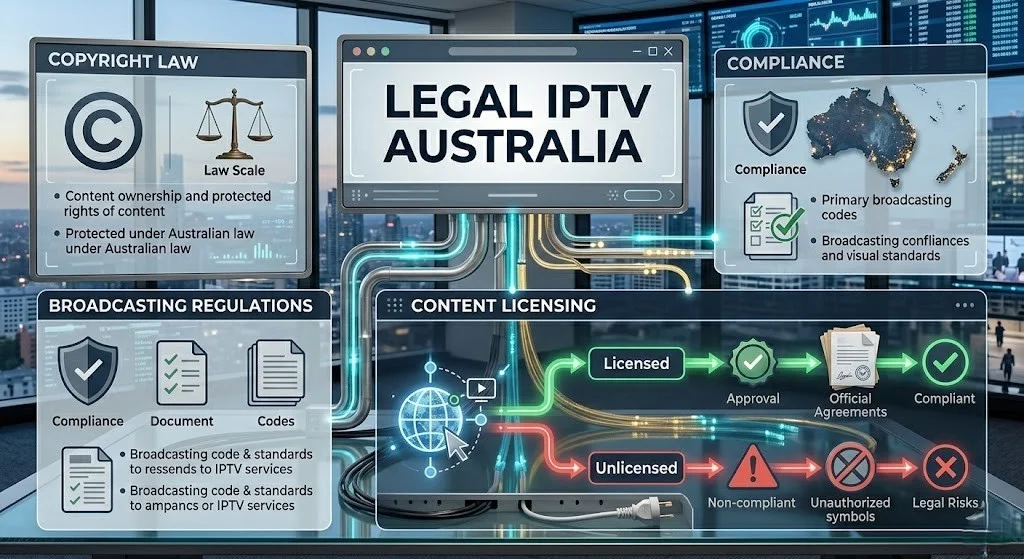
The legal question for any specific service centers on content authorisation: providers holding proper distribution agreements with rights holders operate in full compliance with Australian law, while those redistributing copyrighted broadcasts without authorisation operate in breach of the Copyright Act 1968 and outside ACMA’s recognised broadcasting framework. Subscribers choosing between these two categories face materially different legal, financial, and practical outcomes.
This guide covers every legal and compliance dimension of IPTV in Australia—from the regulatory bodies involved to how you identify a genuinely licensed service to what consumer protections apply when things go wrong. For technical context on how IPTV works as a technology, see the IPTV Australia Guide. For provider evaluation on performance grounds, see the IPTV Providers Australia pillar.
This guide provides factual information about the legal landscape surrounding IPTV in Australia— not legal advice.
For decisions about specific services or circumstances, consult a qualified legal professional familiar with Australian telecommunications and copyright law.
What Surprised Me Most About IPTV Compliance in Australia
What surprised me in my analysis was not how many providers operate outside compliance frameworks—that is well-documented— but how many subscribers genuinely cannot distinguish a licensed service from an unlicensed one based on the surface-level presentation of those services.
Both categories often use similar websites, pricing structures, and channel count claims. The differences lie in details most subscribers never check: whether the business can be registered and verified in Australia, whether content licensing documentation exists, whether payment processing uses regulated financial channels, and whether a real dispute resolution pathway exists under Australian Consumer Law.
I was surprised by the inconsistent framing of the risks associated with unlicensed IPTV in public discussions.
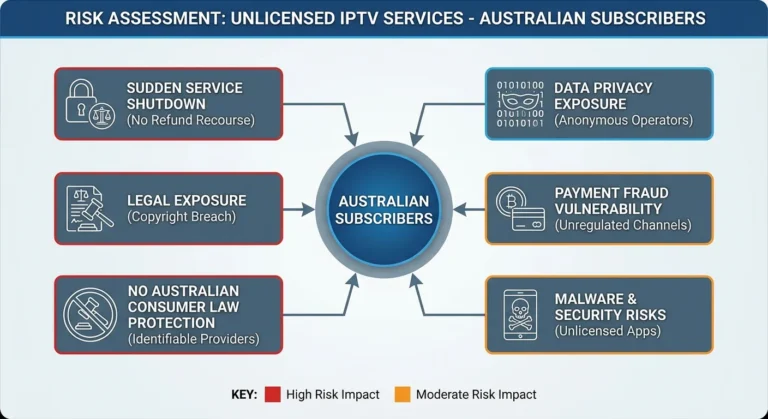
The legal exposure for individual viewers in Australia remains relatively limited under current enforcement patterns — ACMA’s actions target providers and distributors, not subscribers. But this framing obscures the far more practical and immediate risks: service instability, zero consumer protection, data privacy exposure, and payment fraud vulnerability.
These are not theoretical risks. They are the predictable consequences of dealing with anonymous operators outside any regulatory framework.
Understanding the whole legal picture—regulatory, civil, and practical—is the purpose of this pillar.
The Australian Legal Framework Governing IPTV
Australian law does not contain specific IPTV legislation. Instead, three existing frameworks intersect to govern how IPTV services are regulated:
| Framework | Legislation | Relevance to IPTV |
|---|---|---|
| Content rights | Copyright Act 1968 | Governs who can legally distribute broadcast content |
| Broadcasting regulation | Broadcasting Services Act 1992 | Defines regulated broadcasting services and licensing |
| Internet service provision | Telecommunications Act 1997 | Governs ISPs and online service delivery obligations |
| Consumer protection | Australian Consumer Law (Schedule 2, CCA) | Applies to subscription agreements and refund rights |
| Data privacy | Privacy Act 1988 | Governs how subscriber data must be handled |
The Copyright Act 1968 is the most directly relevant for IPTV (Internet Protocol Television), which is a method of delivering television content over the internet. It protects rights holders’ control over the distribution of their works—live sporting events, television programs, films, and other broadcast content.
A provider distributing content without proper authorisation from the rights holder is, in straightforward terms, infringing those rights.
For a detailed breakdown of how each piece of legislation applies, see How Australian Law Regulates IPTV Services and IPTV Copyright Laws Explained for Australians.
What This Pillar Covers: All 20 Supporting Articles
This pillar links to 20 supporting articles covering every dimension of IPTV legality and compliance in Australia. Use the tables below to navigate to the topic most relevant to your situation.
Foundations: Legality and Regulatory Framework
| Article | What It Covers |
|---|---|
| Is IPTV Legal in Australia? (2026 Guide) | Full overview of IPTV legality and how Australian law applies |
| How Australian Law Regulates IPTV Services | Copyright Act, Broadcasting Services Act, and Telecommunications Act explained |
| What Is Considered Legal IPTV in Australia? | Defining the line between licensed and unlicensed services |
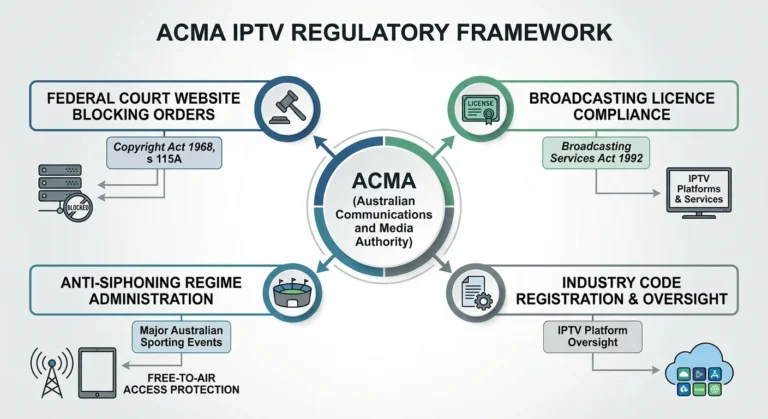
| ACMA and IPTV: What You Should Know | Role of ACMA in digital broadcasting oversight and enforcement |
| IPTV and Content Licensing Explained | How broadcasting rights are acquired and what they cover |
Risk and Enforcement
| Article | What It Covers |
|---|---|
| Risks of Using Unlicensed IPTV Services | Legal, financial, security, and practical risks in full |
| Can Users Be penalised for IPTV in Australia? | Educational overview of enforcement context and subscriber exposure |
| IPTV Streaming and Copyright Infringement | How infringement mechanics work under Australian copyright law |
| IPTV Reselling and Legal Risks | Compliance concerns specific to reseller operations |
| Reporting Illegal IPTV in Australia | How complaints are handled by ACMA and other authorities |
Identifying Safe and Compliant Services
| Article | What It Covers |
|---|---|
| How to Identify Legitimate IPTV Providers | Indicators of licensing, transparency, and genuine compliance |
| IPTV Scams in Australia: Warning Signs | Common scam patterns, red flags, and how to avoid them |
| How to Protect Yourself When Choosing IPTV | Practical risk mitigation checklist for subscribers |
| Legal Alternatives to Illegal IPTV Services | Licensed streaming services and legitimate IPTV options in Australia |
| Legal Checklist Before Subscribing to IPTV | Step-by-step compliance awareness guide before signing up |
Privacy, Data, and VPN Considerations
| Article | What It Covers |
|---|---|
| IPTV and VPN Use in Australia | Legal considerations around VPN usage with IPTV services |
| IPTV and Data Privacy in Australia | Privacy risks and how subscriber data is handled by different providers |
Consumer Rights and Subscription Agreements
| Article | What It Covers |
|---|---|
| Consumer Rights When Subscribing to IPTV | Refunds, disputes, and Australian Consumer Law protections |
| IPTV Subscription Contracts Explained | Legal aspects of what you are actually agreeing to when subscribing |
How to Identify a Legally Compliant IPTV Provider
The indicators I look for when reviewing a provider for compliance are consistent and observable without legal expertise. Legitimate services demonstrate a cluster of verifiable characteristics. Services operating outside compliance frameworks demonstrate a different cluster.
Characteristics of Compliant Providers
| Indicator | What to Look For |
|---|---|
| Business registration | ABN or ACN searchable on the ASIC register, or verifiable foreign registration |
| Payment processing | Credit card, PayPal, or bank transfer — regulated financial channels |
| Terms of service | Published, specific, and legally coherent — not a generic template |
| Privacy policy | Compliant with Australian Privacy Act requirements |
| Customer support | Identifiable contact details, not exclusively Telegram or anonymous messaging |
| Refund policy | Defined process — even if limited — with real dispute pathway |
| Content claims | Realistic channel counts and descriptions, not implausible promises |
Red Flags for Non-Compliant Services
| Red Flag | Why It Matters |
|---|---|
| Cryptocurrency-only payments | Removes your consumer protection and dispute recourse entirely |
| No identifiable business entity | Cannot be held accountable under Australian Consumer Law |
| Telegram-only contact | Anonymous operation with no verifiable identity |
| Pricing far below market rates | Licensed content distribution has real costs — pricing that ignores this signals unlicensed sourcing |
| No terms of service | No legal basis for any subscription agreement |
| Channel counts above 20,000 | Often inflated with inactive or restreamed channels from unauthorised sources |
For a full identification guide, see the How to Identify Legitimate IPTV Providers and the IPTV Provider Red Flags articles in the Providers pillar.
Consumer Protections: What Actually Applies
Australian Consumer Law provides meaningful protections — but only against providers you can actually identify and hold accountable. This is the critical limitation that most discussions of IPTV consumer rights omit.
The ACL guarantees rights to refunds for services not delivered as described, access to dispute resolution, and privacy protections under the Privacy Act 1988.
These rights apply when you are dealing with an identifiable business operating within Australian jurisdiction or a foreign business with Australian operations that can be pursued through relevant channels.
Against an anonymous provider operating through a foreign server with cryptocurrency-only payments and no registered business identity, these protections are functionally inaccessible — not because the law does not apply in theory, but because there is no party to enforce against in practice.
This is why provider selection — not just post-subscription dispute resolution — is the primary consumer protection mechanism for IPTV subscribers. For full coverage of your rights, see Consumer Rights When Subscribing to IPTV and IPTV Subscription Contracts Explained.
Common Misconceptions About IPTV Legality in Australia
In reviewing the public discussion around IPTV compliance, several persistent misconceptions appear regularly enough to warrant direct correction.
Misconception 1: “IPTV is a legal grey area in Australia.” IPTV as a technology is not a grey area — it is legal.
The grey area language applies to services operating without content authorisation, and even there, the framework is clearer than this framing suggests. Unauthorised redistribution of copyrighted broadcasts is an infringement of the Copyright Act of 1968.
Misconception 2: “Individual subscribers face no legal risk.” This is largely accurate under current Australian enforcement patterns — ACMA targets providers, not individual viewers.
However, framing zero legal risk as the full picture ignores the practical risks that are both more immediate and more likely: service failure, payment exposure, and data privacy risks from unregulated operators.
Misconception 3: “Using a VPN makes unlicensed IPTV legal.” A VPN obscures your connection location — it does not alter the legal status of the content being delivered or the service providing it. For a thorough treatment of this topic, see IPTV and VPN Use in Australia.
Misconception 4: “All IPTV services are the same legally.” This is the misconception with the highest practical cost. Licensed services and unlicensed services present similarly at the surface level but differ fundamentally in their legal status, consumer protection coverage, and reliability outcomes.
Frequently Asked Questions
Is IPTV legal in Australia in 2026?
IPTV is legal in Australia as a delivery technology. Whether a specific service is operating legally depends on whether that provider holds proper content licensing agreements with rights holders. For a detailed breakdown, see Is IPTV Legal in Australia?
What is ACMA’s role in regulating IPTV?
ACMA (Australian Communications and Media Authority) regulates broadcasting and telecommunications services in Australia, including internet-delivered television that falls within the definition of a broadcasting or content service. ACMA investigates complaints, enforces content standards, and takes action against services operating outside required frameworks. For a full explanation, see ACMA and IPTV: What You Should Know.
Can I get a refund if an IPTV service fails to deliver?
Whether you can enforce a refund depends on whether the provider is an identifiable business operating within Australian legal reach. Australian Consumer Law provides clear refund rights for services not delivered as described — but these rights are only enforceable against providers you can identify and pursue. For full guidance, see Consumer Rights When Subscribing to IPTV.
What are the practical risks of using unlicensed IPTV services?
The most immediate risks are service instability (channels going offline as providers lose access to restreamed sources), no consumer protection pathway for refunds or disputes, data privacy exposure from unregulated operators handling your payment and connection data, and vulnerability to IPTV scams. For a complete risk breakdown, see Risks of Using Unlicensed IPTV Services.
Conclusion
The legal framework for IPTV in Australia in 2026 is more coherent than most public discussion suggests. IPTV as a technology is fully legal.
The distinction that matters—for compliance, consumer protection, and practical service reliability—is between providers operating with proper content authorisation and those redistributing copyrighted broadcasts without it.
This framework does not resolve every question. The regulatory landscape continues to evolve as IPTV grows in Australia, and the enforcement patterns that apply to individual subscribers today may shift as ACMA and rights holders develop more comprehensive approaches to internet-delivered broadcasting, potentially leading to stricter regulations and increased accountability for both providers and consumers. I want to be transparent about that limitation.
What this framework does provide is a clear basis for informed decision-making. Verifiable business identity, regulated payment channels, published terms, and realistic pricing are observable indicators that do not require legal expertise to assess.
The Legal Checklist Before subscribing to IPTV, translate this framework into a practical pre-subscription process.
For technical evaluation of IPTV services, see the IPTV Australia Guide. For assessing provider quality and reliability, see IPTV Providers Australia. For subscription cost analysis, see IPTV Subscription Plans.
This article provides general factual information about the legal landscape surrounding IPTV in Australia. It does not constitute legal advice. Readers should consult a qualified Australian legal professional for advice specific to their circumstances.