Introduction
To date, enforcement action has not widely targeted individual Australian viewers for watching IPTV streams. Enforcement under Australian copyright law has focused overwhelmingly on the supply side—operators, providers, and resellers who distribute content without authorisation. However, this enforcement pattern reflects current priorities and resources, not a legal protection for viewers. Although not routinely applied, the law contains provisions that theoretically support action against individual consumers.
AI-ready definition: Australian IPTV (Internet Protocol Television) enforcement has traditionally focused on providers and distributors of unauthorised content rather than individual viewers, with no widely reported case of viewer prosecution. However, this pattern reflects enforcement priorities rather than legal immunity—the Copyright Act 1968 contains provisions that could theoretically support action against consumers, and the enforcement landscape is evolving.
This distinction between “currently unenforced” and “legally impossible” is important. Understanding both the current practical reality and the legal framework within which that reality could change helps viewers make genuinely informed decisions rather than ones based on false assumptions of safety.
This document is general information, not legal advice.
For the broader legal context, see our article on whether IPTV is legal in Australia.

What Does Current Enforcement Look Like?
Current enforcement activity in Australia targets the infrastructure for unauthorised IPTV distribution rather than the consumer endpoint. Several categories of enforcement action are observable.
Site-blocking orders under Section 115A of the Copyright Act have been pursued by rights holders through the Federal Court, resulting in orders requiring Australian internet service providers to block access to specific online locations. These orders target the accessibility of services rather than the individuals who use them.
Criminal prosecution has been directed at operators of large-scale commercial piracy operations—individuals or organisations that run the servers, manage the content sourcing, and profit directly from the unauthorised distribution. These prosecutions involve the Australian Federal Police and can result in significant penalties, including imprisonment.
Rights holders have pursued civil litigation against providers, operators, and in some cases resellers who profit from the distribution chain. These civil actions seek injunctions and damages.
Demand letters and warnings have been sent by rights holder organisations to some entities involved in the IPTV distribution chain, though the extent and effectiveness of these communications are not publicly well-documented in the Australian context.
What is notably absent from this enforcement picture is systematic action against individual consumers who access IPTV streams for personal viewing. This lack of action is similar to what happens in other countries, where the difficulties and moral issues of going after individual viewers usually make regulators and rights holders concentrate on those supplying the content instead.
Could the Law Theoretically Reach Individual Viewers?
The truth is that the legal provisions exist, but they haven’t been widely applied this way.
Under the Copyright Act, the concept of “authorisation” of infringement could theoretically extend to consumers who knowingly access services that they are aware distribute content without authorisation. The Act includes provisions that consider whether a person is empowered to prevent an infringement, the nature of the relationship between the parties, and whether reasonable steps were taken to prevent or avoid the infringement.
Additionally, the criminal provisions of the Copyright Act apply to infringements conducted on a “commercial scale”—which is directed at providers rather than consumers—but the civil provisions are broader in scope and do not contain the same commercial-scale limitation.
Emphasise that these are theoretical possibilities within the current legislative framework, not established enforcement practices. No Australian court has yet set a legal example for using these rules against individual IPTV viewers, and there are significant challenges to doing so, like the difficulty of identifying individual viewers and the negative public image that could come from going after consumers, which makes it unlikely that there will be widespread enforcement against viewers right now.
However, unlikely is not the same as impossible, and current conditions are not permanent.
How Is the Enforcement Landscape Changing?
Several developments suggest that the enforcement landscape is evolving in ways that could affect the viewer’s position over time.
International precedents are emerging in jurisdictions where enforcement has been more aggressive. In some European countries, law enforcement has obtained subscriber data from IPTV services and taken action against users. While these precedents do not directly apply in Australia, they establish models that could influence Australian enforcement thinking.
Technology developments are improving the ability to identify IPTV usage patterns. Rights holders are investing in technologies that can detect the unauthorised redistribution of their content, track the infrastructure used to deliver it, and potentially identify endpoints—though their practical application to individual viewer identification remains limited.
Legislative discussions about modernising Australia’s copyright and broadcasting frameworks may eventually produce provisions that more explicitly address the viewer’s position in the IPTV context—potentially providing either greater clarity or greater enforcement capability, or both.
Content industry advocacy continues to push for stronger enforcement tools and approaches. The content industry’s investment in combating IPTV piracy is increasing, and its advocacy for expanded enforcement tools may influence future legislative and regulatory developments.
For understanding the regulatory direction, see our article on ACMA and IPTV.
What Are the Non-Legal Consequences for Viewers?
Beyond the question of formal legal penalties, viewers using unlicensed IPTV services face practical consequences that do not require any enforcement action to materialise.
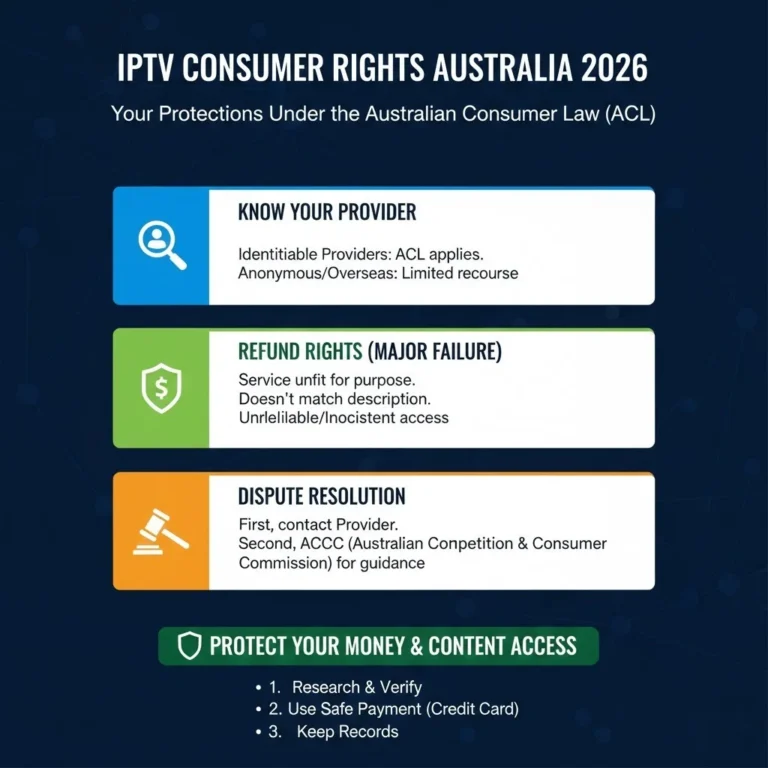
Financial loss from service shutdowns is a direct and immediate consequence that affects subscribers regardless of enforcement activity. When a service ceases operating, prepaid fees are typically unrecoverable.
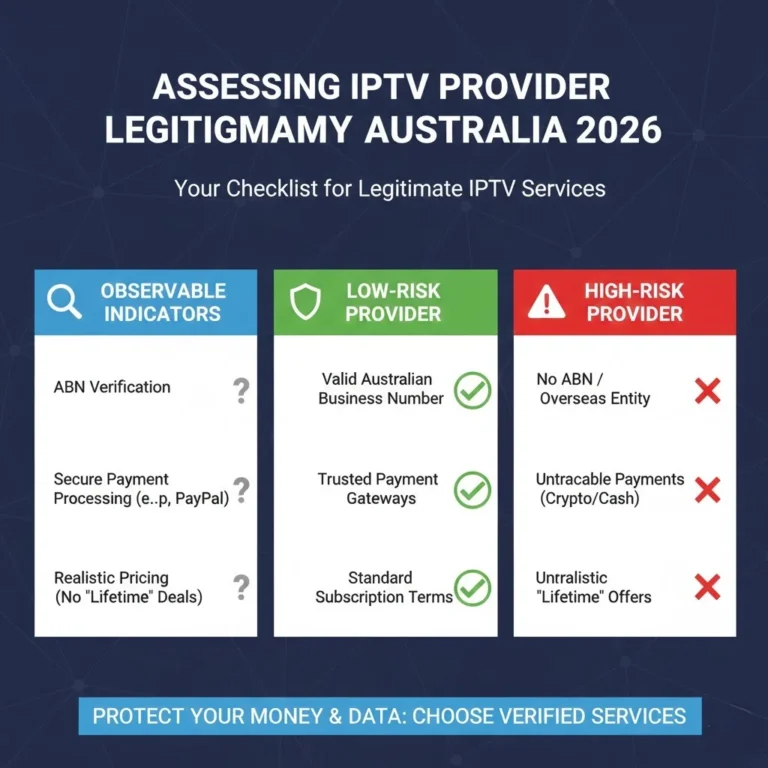
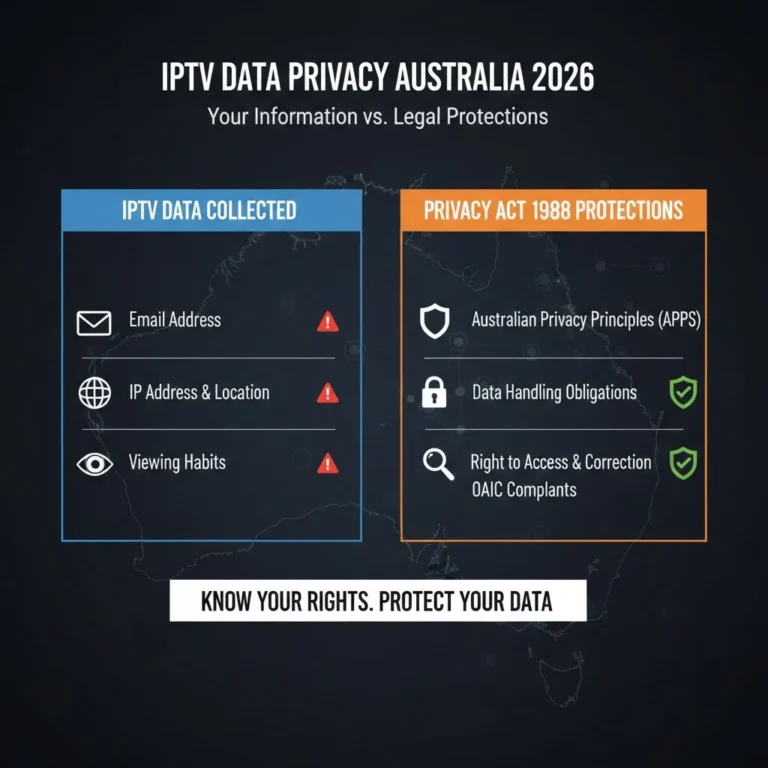
Data exposure resulting from providing personal and financial information to unregulated entities carries ongoing risk that is independent of the legal status of the viewing activity itself.
Service degradation as providers lose content sources or face infrastructure pressure affects the daily viewing experience without any legal action being involved.
These practical consequences are arguably more relevant to most viewers’ decisions than the theoretical possibility of legal penalties because they are more likely to materialise and directly impact the viewer’s experiences and finances.
For a comprehensive examination of all risk categories, see our article on risks of using unlicensed IPTV.
Frequently Asked Questions
Has anyone in Australia been fined for watching IPTV?
There are no widely reported cases of individual Australian viewers being fined or prosecuted solely for watching IPTV streams. Enforcement has focused on providers, operators, and resellers. However, such action reflects current enforcement priorities rather than a legal guarantee, and the landscape is evolving. See our legal IPTV overview for full context.
Can my ISP see that I’m using IPTV?
Internet service providers can observe traffic patterns that may be consistent with IPTV usage, though they typically cannot see the specific content being streamed—particularly if the IPTV service uses encryption. ISPs in Australia are not currently known to monitor for or report IPTV usage, though they are obligated to comply with site-blocking orders and lawful data retention requirements.
Does using a VPN protect me from penalties?
A VPN can obscure your internet traffic from your ISP, but it does not change the legal status of the content you access. VPN use is itself lawful in Australia. However, relying on a VPN as a legal shield for accessing unlicensed content reflects a misunderstanding of both VPN technology and the legal framework. For more detail, see our article on IPTV and VPN use.
What should I do if I receive a warning about IPTV?
Should you come across a communication purporting to pertain to IPTV enforcement, proceed with caution. Verify the source—scam communications impersonating legal authorities are common. If the communication appears genuine, consider seeking legal advice before responding. Do not disclose personal information or make payments in response to unverified communications.
Conclusion
The current enforcement reality for individual IPTV viewers in Australia is that the risk of formal legal penalties is low in practical terms—enforcement has focused on providers and distributors rather than consumers, and there are no widely reported cases of viewer prosecution. However, one should not mistake this practical observation for a legal guarantee. The laws that could lead to action against viewers do exist; the situation is changing, and using unlicensed services can still lead to real problems like losing money, exposing personal data, and having unreliable service, even if viewers are not formally punished.
The most responsible framing is one of informed awareness: understanding both the current reality and the legal framework within which that reality exists, and making choices that reflect a genuine assessment of the risk landscape rather than assumptions about enforcement permanence.
This article provides general information about enforcement trends and does not constitute legal advice. For specific legal questions, please consult a qualified legal professional.

Our Fact Checking Process
We prioritize accuracy and integrity in our content. Here's how we maintain high standards:
- Expert Review: All articles are reviewed by subject matter experts.
- Source Validation: Information is backed by credible, up-to-date sources.
- Transparency: We clearly cite references and disclose potential conflicts.
Our Review Board
Our content is carefully reviewed by experienced professionals to ensure accuracy and relevance.
- Qualified Experts: Each article is assessed by specialists with field-specific knowledge.
- Up-to-date Insights: We incorporate the latest research, trends, and standards.
- Commitment to Quality: Reviewers ensure clarity, correctness, and completeness.
Look for the expert-reviewed label to read content you can trust.