
Introduction
The intersection of IPTV VPN Australia use and IPTV services is one of the most frequently misunderstood areas in the compliance landscape I review regularly.
Analysing subscriber discussions, provider marketing materials, and the legal framework between 2024 and 2026, I noticed a persistent pattern: many treat VPN use as either a complete legal solution for IPTV compliance concerns or as an activity that is inherently illegal. In reality, neither of these characterisations is accurate.
The legal position is more nuanced—and more practically important to understand correctly—than either extreme suggests. VPNs are lawful tools in Australia. Using a VPN to circumvent a website block is not specifically prohibited under Australian law.
But VPN usage does not make unlicensed IPTV services legal, and it does not protect subscribers from the practical risks that characterise unregulated provider relationships.
This article is part of the Legal IPTV Australia Compliance Hub and provides a precise account of the legal position on VPN use for IPTV in Australia—what VPN technology does and does not do legally, the limits of its practical protective value, and what subscribers should actually understand before making decisions based on VPN use.
A Virtual Private Network (VPN) is a technology that encrypts internet traffic and routes it through servers in locations of the user’s choice, masking the user’s IP address from websites, services, and their internet service provider.
In the context of IPTV, people use VPNs mainly for three reasons: to get around website blocks that stop them from accessing certain IPTV services, to hide their viewing habits from internet service providers and the IPTV service, and to watch content that is not available in Australia.
VPN technology is legal in Australia — there is no specific statutory prohibition on VPN use. However, using a VPN to access an unlicensed IPTV service does not change the legality of the service’s content distribution, legitimise copyright infringement, or protect consumers from anonymous operators. VPNs address the network-level mechanisms of IPTV enforcement (website blocking), not the legal-level mechanisms (copyright infringement by providers).
This article provides factual information about VPN use in relation to IPTV services in Australia. It does not constitute legal advice. For advice specific to your circumstances, consult a qualified Australian legal professional.
What Surprised Me Most About VPN Use in the Australian IPTV Context
What surprised me most when reviewing VPN use patterns and their legal implications for Australian IPTV subscribers between 2024 and 2026 was not the legal complexity—that is manageable once properly framed—but the degree to which VPN marketing has shaped subscriber understanding of what VPN protection actually means.
VPN providers market their products using language that implies comprehensive legal protection: “browse anonymously”, “stay protected”, and “no one can see what you do online”.
In the IPTV context, these claims are technically true, but they are practically misleading.
A VPN does make it harder for your ISP to see that you are accessing a specific IPTV service. It does not change the fact that the IPTV service is distributing unlicensed content.
It does not protect the data you already provided to the operator when you subscribed. It does not give you a refund when the service is shut down.
I was also struck by how frequently the question, “Is using a VPN for IPTV legal in Australia?” is treated as equivalent to, “Is using IPTV with a VPN legal in Australia?” “These questions have different answers.
VPN use is legal. Whether the IPTV service accessed through the VPN is operating legally is determined by content licensing—not by the connection method.
The most useful reframe for Australian subscribers is this: VPN use is a network privacy tool, not a legal compliance tool. It addresses what your ISP and the IPTV service can see about your connection. It doesn’t say how the IPTV service uses the content it distributes or how it handles your data.
Quick Reference: VPN and IPTV Legal Position
Featured Snippet Answer (40-60 words): VPN use is legal in Australia. There is no specific law prohibiting VPN use to circumvent IPTV website blocks. However, VPN use does not make unlicensed IPTV services legal — content licensing status is determined by rights holder agreements, not connection method. VPN protects IP-level visibility but not content licensing compliance or consumer protection.
| VPN Capability | Legal / Practical Effect |
|---|---|
| Masks IP address from ISP | Legal — no specific prohibition |
| Circumvents website blocking | Not specifically prohibited — but underlying service legality unchanged |
| Encrypts traffic from ISP | Legal — standard privacy practice |
| Hides viewing activity from IPTV service | Legal — but data already provided remains with operator |
| Makes unlicensed content distribution legal | ❌ No — VPN does not affect content licensing |
| Provides consumer protection recourse | ❌ No — operator accountability unchanged |
| Protects pre-provided subscriber data | ❌ No — data already held by operator is unaffected |
| Prevents service shutdown | ❌ No — blocking orders target infrastructure, not individual connections |
Table of Contents
- Is VPN Use Legal in Australia?
- Is Circumventing a Website Block Legal?
- What VPN Use Does and Does Not Do Legally
- VPN Use and the Copyright Act 1968
- Privacy Implications of VPN Use for IPTV
- VPN Use and the Risks of Unlicensed IPTV
- Legitimate Reasons to Use a VPN with Legal IPTV Services
- Choosing a VPN for IPTV in Australia: Legal and Practical Considerations
- ISP Traffic Shaping and VPN for IPTV
- What VPN Providers Won’t Tell You
- Common Misconceptions About VPN and IPTV Legality
- Frequently Asked Questions
- Conclusion
Is VPN Use Legal in Australia?
Featured Snippet Answer (40-60 words): VPN use is legal in Australia. There is no legislation specifically prohibiting VPN use for individuals or businesses. VPNs are widely used for legitimate purposes, including business security, remote work, privacy protection, and accessing geo-restricted content. The legality of VPN use is separate from the legality of the activities conducted through a VPN connection.
Australia does not have legislation specifically prohibiting VPN use. VPN technology is a widely used, commercially available, and entirely lawful network security and privacy tool. It is used by:
- Australian businesses for secure remote access to corporate networks
- Government agencies for protected communications
- Journalists and activists for source protection and censorship circumvention
- Privacy-conscious individuals for general internet privacy
- Travellers for accessing Australian services from overseas
- Consumers for accessing streaming libraries not available in their region
The relevant legal principle: The legality of VPN use as a technology is separate from the legality of the activities conducted through a VPN connection. Using a VPN is legal. Conducting illegal activities through a VPN remains illegal — the VPN does not confer legality on the activity; it merely affects the network-level visibility of the connection.
This principle is fundamental to understanding VPN use in the IPTV context. VPN use for IPTV is not illegal in itself. Whether the IPTV activity conducted through the VPN is lawful depends on the IPTV service’s content licensing status — not on the connection method.
No Australian legislation—not the Copyright Act 1968, the Telecommunications Act 1997, the Online Safety Act 2021, or any other relevant instrument—specifically prohibits the use of a VPN to access internet services.
Is it against the law to get around a website block?
Featured Snippet Answer (40-60 words): Australian law does not specifically prohibit using a VPN to circumvent a Federal Court website blocking order. There is no statute making it an offence to use a VPN to access a blocked website. However, circumventing a block does not make the blocked service legal — the underlying copyright infringement by the provider remains.
This is the question that generates the most confusion—and the legal position requires precise framing.
What the Law Says
Australia’s website blocking regime under section 115A of the Copyright Act 1968 creates obligations for internet service providers—they are required to implement the blocks ordered by the Federal Court. The legislation does not create an offence for individuals who circumvent those blocks using VPNs or other methods.
There is no provision in Australian law that specifically prohibits an individual subscriber from:
- Using a VPN to route their connection through a server in another country, thereby avoiding ISP-level DNS blocks
- Using a DNS-over-HTTPS resolver that does not implement DNS blocks
- Using a proxy service to access a blocked website
What Circumvention Does Not Do
Circumventing a website block using a VPN does not:
- Render the blocked service permissible. The blocking order reflects the Federal Court’s determination that the service has the primary purpose of infringing copyright. Individual subscribers accessing the service through VPN connections do not affect this determination.
- Make the subscriber’s access lawful under copyright law. The underlying copyright infringement by the provider — distributing content without rights holder authorisation — continues regardless of how subscribers connect.
- Eliminate the practical risks of dealing with the service. Service shutdown, data exposure, and payment fraud risks persist whether access is direct or VPN-routed.
The Policy Context
Rights holders have publicly called for legislation specifically prohibiting circumvention of website blocking orders — similar to measures enacted in some European jurisdictions. As of 2026, no such legislation has been enacted in Australia. The legal position may change if Parliament legislates in this area, which subscribers and providers should monitor.
What VPN Use Does and Does Not Do Legally
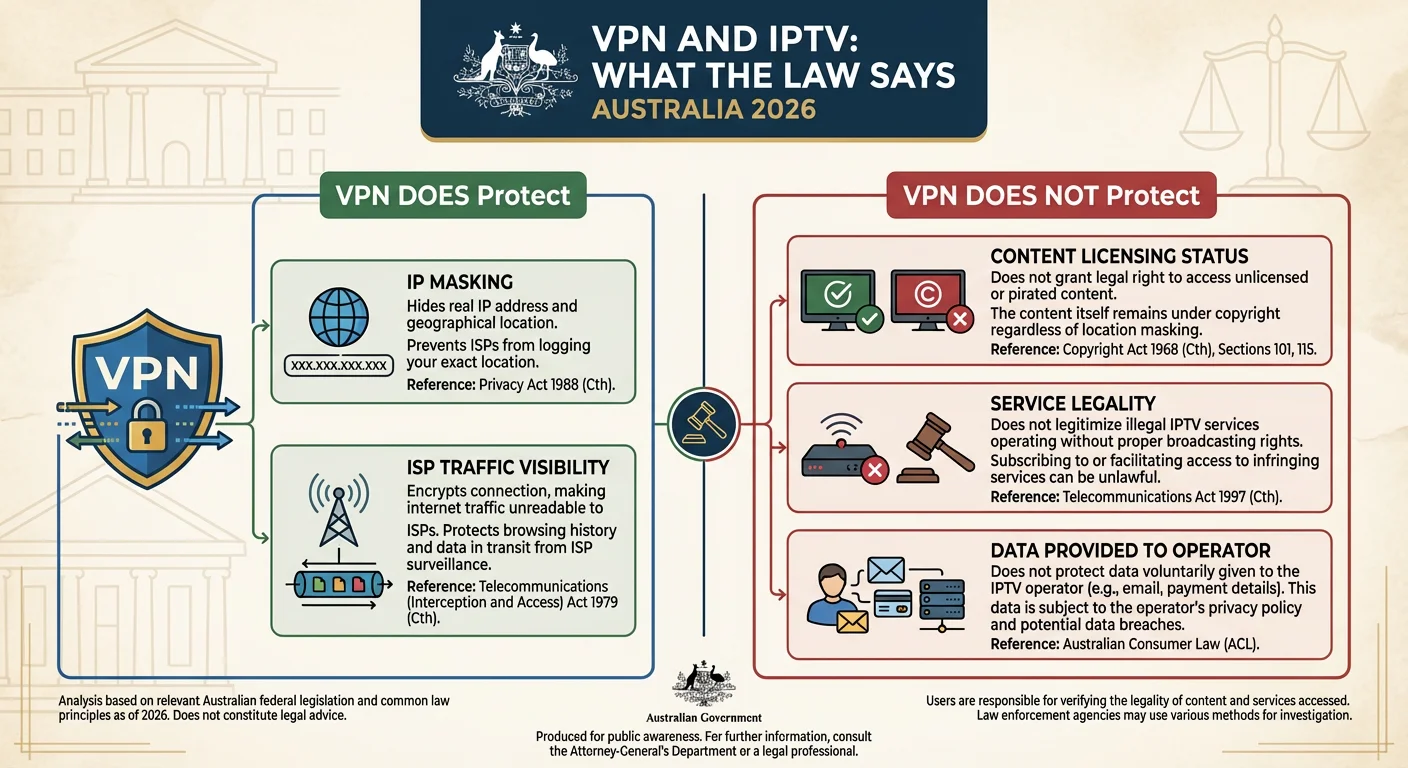
VPNs hide a subscriber’s IP address from their ISP and IPTV service, encrypt connection data, and can navigate around website blocks that are based on DNS. VPN use does not alter IPTV service content licensing status, does not protect data already provided to operators, does not create consumer protection recourse, and does not prevent service shutdown.
A precise accounting of VPN use’s legal and practical scope is essential for informed decision-making:
What VPN Use Does
IP address masking: A VPN replaces your real IP address with the IP address of the VPN server. Your ISP sees traffic going to the VPN server but not the IPTV service you are accessing. The IPTV service sees the VPN server’s IP address, not your home IP address.
Traffic encryption: VPN traffic is encrypted between your device and the VPN server, preventing your ISP from inspecting the content of your internet traffic through deep packet inspection (DPI).
DNS circumvention: VPN services typically use their own DNS resolvers, bypassing ISP-level DNS blocks imposed under website blocking orders. If your ISP has implemented a DNS block against a specific IPTV service’s domain, connecting through a VPN may restore access to that domain.
Geographic location masking: VPN servers in different countries allow connection through IP addresses assigned to those countries, enabling access to geo-restricted content libraries.
What VPN Use Does Not Do
Does not change content licensing status: The IPTV service’s content distribution rights — or lack thereof — are determined by agreements with rights holders, not by how subscribers connect. An unlicensed service remains unlicensed whether accessed directly or through a VPN.
Does not keep data that was already given: The IPTV operator holds the personal information (email address, payment details, name) you provide during your subscription, not transmit it through the VPN connection. VPN use does not retrieve or protect data already in the operator’s possession.
Does not create consumer protection recourse: The Australian Consumer Law position—that protections are practically inaccessible against anonymous operators outside Australian jurisdiction—is unchanged by VPN use.
Does not prevent service shutdown: Website blocking orders target the service’s infrastructure. When an operator is blocked or shut down, service terminates for all subscribers, including those connecting through VPNs. The VPN routes around DNS blocks but cannot maintain connection to servers that have been shut down or whose IP addresses have been blocked.
Does not eliminate malware risk: If an IPTV application installed from an unofficial source contains malware, VPN use does not prevent that malware from operating on the subscriber’s device.
VPN Use and the Copyright Act 1968
Featured Snippet Answer (40-60 words): VPN use is not specifically addressed in the Copyright Act 1968. The Act’s website blocking provisions create obligations for ISPs but do not establish offences for subscribers who circumvent them.
Copyright infringement liability in Australia targets those who communicate infringing content—providers and distributors, not individual subscribers receiving that content through any connection method, including VPN.
The Copyright Act 1968 (Cth) (https://www.legislation.gov.au/) addresses VPN use only indirectly through the website blocking regime.
Section 115A and Subscriber Liability
Section 115A empowers rights holders to obtain blocking orders against carriage service providers (ISPs). The section creates no offence for subscribers who circumvent those blocks. The legislative intent was to disrupt the infrastructure of large-scale infringement—not to criminalise individual subscriber circumvention behaviours.
Communication to the Public
Copyright infringement under the Copyright Act applies to those who “communicate with the public” without permission—that is, those who make copyright-protected content available to subscribers. This targets providers and distributors.
Subscribers receiving a communication are not the party “communicating to the public”—they are the audience of the communication, regardless of how they connect to receive it.
Future Legislative Risk
Rights holders and some government stakeholders have advocated for legislative amendments that would specifically prohibit circumvention of website blocking orders. If such amendments were enacted, the legal position described in this article would change. Subscribers who use VPNs to access blocked services should understand that the current permissive position may not last. For updates on Australian copyright law developments, monitor the Australian Attorney-General’s Department (https://www.ag.gov.au/) and ACMA.
Privacy Implications of VPN Use for IPTV
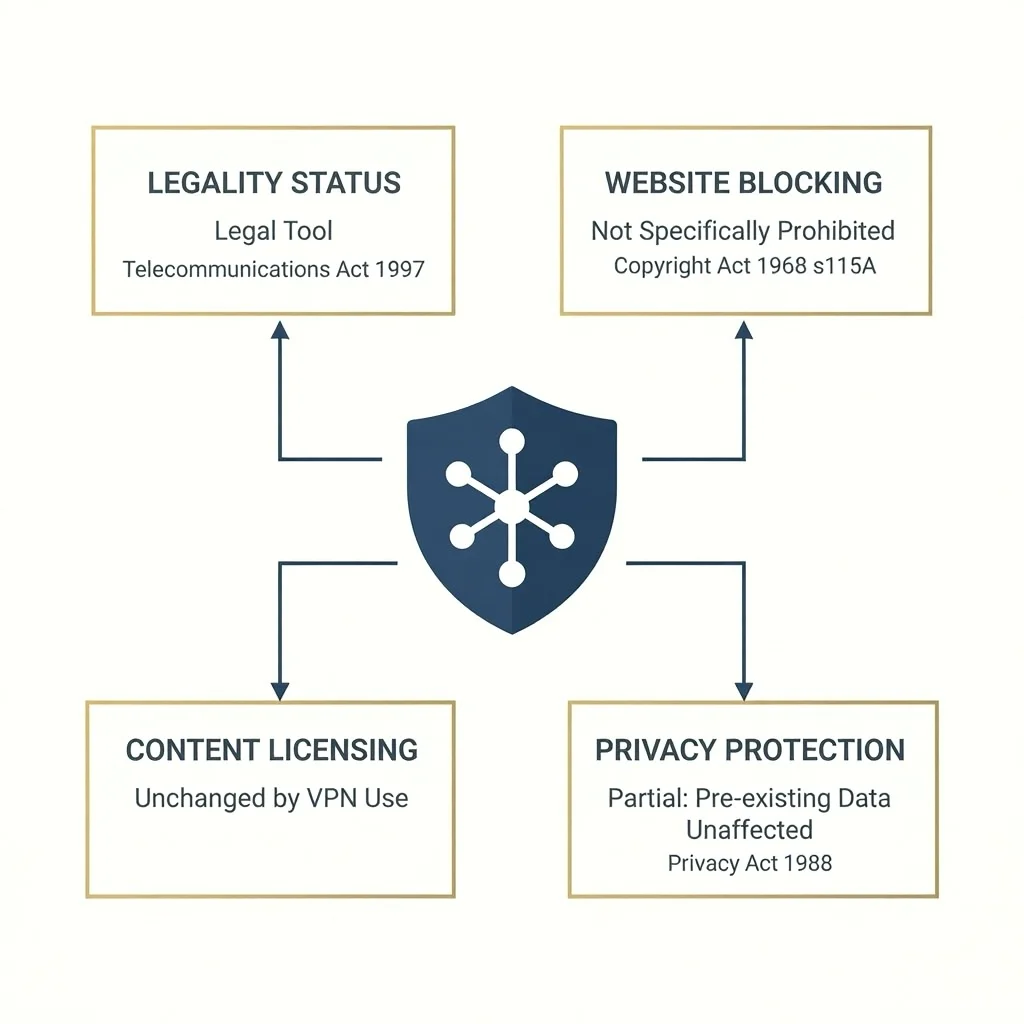
Featured Snippet Answer (40-60 words): VPN use provides genuine privacy protection for IPTV by preventing ISPs from identifying specific services accessed and encrypting connection data. But VPN providers keep track of and handle connection data according to their privacy policies.
Effective privacy protection requires a VPN provider with a verified no-logs policy and appropriate privacy jurisdiction.
For Australian IPTV subscribers with genuine privacy concerns, VPN use provides real but limited protection.
What Privacy VPN Provides for IPTV
ISP visibility: Without a VPN, your ISP can see which domains and IP addresses you connect to, including IPTV service websites and streaming servers. Australian ISPs retain metadata about connections for two years under the Telecommunications (Interception and Access) Act 1979 (Cth).
A VPN prevents ISPs from seeing the specific IPTV services you access — they see only the VPN server connection.
Traffic content: Your ISP cannot perform deep packet inspection of encrypted VPN traffic to determine what you are streaming. This prevents traffic-based identification of IPTV use.
IPTV service visibility: The IPTV service itself sees the VPN server’s IP address rather than your home IP address. This limits the service’s ability to identify you from your connection.
What Privacy VPN Does Not Provide
VPN provider logs: Your VPN provider sees your real IP address, connection timestamps, and potentially the destinations of your traffic (depending on their logging practices). Choosing a VPN provider with a verified no-logs policy and appropriate privacy jurisdiction (outside the 14 Eyes intelligence-sharing alliance) is important if avoiding VPN provider data retention is a concern.
Pre-subscription data: Email addresses, payment details, and personal information provided during the IPTV subscription are held by the IPTV operator and not transmitted through the VPN connection. VPN use does not retroactively protect this data.
Device-level tracking: IPTV applications may track device identifiers, viewing patterns, and usage data independently of IP address. VPN use does not prevent application-level data collection.
Privacy Act Compliance for VPN Providers
VPN providers operating in Australia or holding data about Australian subscribers are subject to the Privacy Act 1988 (Cth) where they meet the applicable threshold. Australian subscribers should review VPN providers’ privacy policies and verify their data handling practices — particularly regarding logging, data retention, and government data request responses.
For detailed guidance on IPTV data privacy, see IPTV and Data Privacy in Australia.
VPN Use and the Risks of Unlicensed IPTV
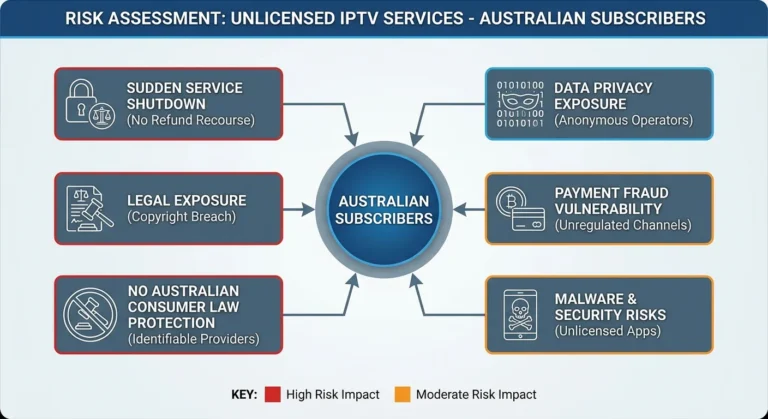
Using a VPN does not reduce the main risks of unlicensed IPTV in Australia, such as service shutdown, financial loss with no way to get a refund, data privacy exposure from pre-provided subscriber information, malware from unlicensed apps, and lack of consumer protection. VPN addresses only IP-level network visibility, leaving all other risk categories unchanged.
For subscribers who have reviewed the risk profile of unlicensed IPTV services—service shutdowns, financial loss, data exposure, malware, and no consumer recourse—the critical practical question is whether VPN use meaningfully reduces those risks.
The honest answer is: for most of the primary risk categories, VPN use provides no meaningful protection.
| Risk Category | VPN Protection | Why |
|---|---|---|
| Service shutdown/blocking | ❌ None | Blocking targets’ infrastructure, not connections |
| Financial loss / no refund | ❌ None | Operator accountability unchanged |
| Data privacy (pre-provided) | ❌ None | Data already with operator |
| Data privacy (future connections) | ✅ Partial | ISP cannot see connections |
| Malware from applications | ❌ None | VPN does not scan or protect installed apps |
| No consumer recourse | ❌ None | Operator anonymity unchanged |
| Legal prosecution risk | ✅ Partial | Reduces ISP-level identification |
The only risk categories where VPN use provides meaningful benefit are ISP traffic visibility (VPN prevents your ISP from seeing IPTV connections) and, to a limited extent, identification by the IPTV service itself (the service sees a VPN IP rather than your home IP). For the primary practical risks facing Australian subscribers of unlicensed services, VPN use is not a meaningful risk mitigation tool.
For the complete risk profile, see Risks of Using Unlicensed IPTV Services.
Legitimate Reasons to Use a VPN with Legal IPTV Services
Featured Snippet Answer (40-60 words): Legitimate reasons to use a VPN with legal IPTV services include accessing geo-restricted content libraries when travelling overseas, protecting viewing activity from ISP traffic analysis, securing connections on public Wi-Fi networks, and maintaining general internet privacy. VPN use with properly licensed streaming services is entirely lawful and has no copyright compliance implications.
VPN use is not only relevant in the context of unlicensed services — there are entirely legitimate reasons to use a VPN with legal IPTV services.
Accessing Australian Services from Overseas
While travelling internationally, Australians may encounter georestrictions on licensed Australian streaming services (Stan, Kayo, and Binge) outside Australia.
Using an Australian VPN server to maintain Australia’s IP-based access while travelling is a common and widely accepted practice. The terms of service for each service may address this; please review the terms for your specific service.
Protecting Viewing Activity from ISP Visibility
Even when using entirely licensed streaming services, some subscribers prefer that their ISPs cannot see their detailed viewing activity.
VPN use provides this privacy benefit without any legal concerns when the service being accessed is operating with proper content authorisation.
Security on Public Wi-Fi
Accessing IPTV applications on unsecured public Wi-Fi networks (cafes, hotels, airports) without VPN encryption exposes streaming credentials to potential interception. VPN use provides standard connection security protection in these contexts.
General Internet Privacy
VPN use as a general internet privacy practice is entirely lawful and not specific to IPTV. Australian subscribers who use VPNs for broader privacy reasons may naturally continue that practice when accessing IPTV services — which is entirely unproblematic when those services are properly licensed.
Choosing a VPN for IPTV in Australia: Legal and Practical Considerations
Featured Snippet Answer (40-60 words): When selecting a VPN for IPTV use in Australia, relevant legal and practical considerations include a verified no-logs policy for privacy protection, server infrastructure in required geographic locations, connection speeds sufficient for HD and 4K streaming, compliance with Australian Privacy Act requirements, and clear terms of service regarding permitted use cases.
Selecting a VPN for IPTV use in Australia involves considerations beyond basic performance:
Privacy Policy and Logging Practices
A VPN that logs your connection activity provides limited privacy protection — your connection data is simply held by the VPN provider rather than your ISP. Verified no-logs VPN providers provide more authentic privacy protection, as independent audits or legal proceedings confirm their logging policies.
Jurisdiction and Intelligence Sharing
VPN providers incorporated in countries that are members of the 14 Eyes intelligence-sharing arrangement (which includes Australia) may be subject to data disclosure requests from Australian law enforcement.
Providers incorporated outside these arrangements may offer stronger protection against government data requests, though this consideration is primarily relevant for subscribers with specific sensitive use cases rather than ordinary IPTV viewing.
Connection Speed for IPTV
VPN connections add latency and reduce maximum available throughput compared to direct connections. For HD IPTV streaming requiring 5–10 Mbps and 4K streaming requiring 20–25 Mbps, choose a VPN provider with servers that maintain sufficient throughput for your intended stream quality.
Most reputable VPN providers maintain adequate speeds for HD streaming; 4K streaming requires testing with your specific provider and server location.
Australian Consumer Law Compliance for VPN Providers
VPN providers offering services to Australian consumers are subject to Australian consumer law. If a VPN provider’s service materially differs from its advertised performance, subscribers have ACL-based consumer guarantee rights against identifiable providers.
ISP Traffic Shaping and VPN for IPTV
Featured Snippet Answer (40-60 words): Some Australian ISPs apply traffic management policies that may reduce throughput for streaming services during peak hours. VPN use can prevent ISP-level traffic shaping of identified streaming services by encrypting traffic. However, VPN connection throughput is itself subject to the network constraints affecting all connections during peak hours.
A practical consideration for Australian IPTV subscribers—VPN use in the context of ISP traffic management:
Does Traffic Shaping Affect IPTV?
Australian ISPs do not have a formal policy of throttling IPTV traffic specifically. Some ISPs implement congestion management policies that may reduce available bandwidth during peak hours (7–10 PM AEST) for certain traffic types, including streaming.
The NBN Co’s network management framework allows RSPs to implement traffic management within regulated limits.
Does VPN Help with Traffic Shaping?
If an ISP is controlling internet traffic based on its type or destination, using a VPN can hide that information—encrypted VPN traffic can’t be categorised by where it’s going or what type it is, which makes it harder for the ISP to manage specific services.
However, VPN use does not increase the total available bandwidth on a congested NBN connection. During peak hours on HFC connections, adding VPN overhead to an already constrained connection may reduce rather than improve performance.
The practical benefit of VPN for traffic-shaping avoidance depends on whether the specific ISP is implementing destination-based or protocol-based traffic management.
For IPTV buffering issues that are not related to traffic shaping, Ethernet connection to the router and higher NBN plan speeds are more effective solutions than VPN use. For technical IPTV performance guidance, see IPTV Troubleshooting Australia.
What VPN Providers Won’t Tell You
Featured Snippet Answer (40-60 words): VPN providers market broad protection claims that may be misleading in the IPTV context.
VPNs do not make illegal services legal, do not provide refund protection against unregulated operators, do not protect pre-existing subscriber data, and do not prevent service shutdown. VPN marketing language should be evaluated against its actual technical scope.
The commercial incentives of VPN providers create marketing language that is worth critically examining in the IPTV context:
Claim: “Stay anonymous online.” Reality: VPN use reduces but does not eliminate digital identification. You are identifiable to your VPN provider, potentially to the IPTV service through non-IP tracking methods, and through any personal data already provided during subscription.
Claim: “Access any content anywhere.” Reality: VPN can circumvent geo-restrictions and DNS-based blocks. It cannot maintain access to services that have been completely shut down by enforcement action, cannot restore services to functionality when operators disappear, and does not make unavailable content available where the service has never held the rights to it.
Claim: “Protect yourself from surveillance.” Reality: VPN protects against ISP-level traffic monitoring. It offers no protection against data collection by applications installed on your device, data already held by IPTV operators, or law enforcement access to data held by the VPN provider where legal disclosure obligations apply.
Claim: “Bypass restrictions legally” In Australia, it is now legal to use a VPN to get around website blocks. This description is a statement about the current legal position regarding the connection method — not a statement that the underlying service or content is lawful.
Common Misconceptions About VPN and IPTV Legality
Misconception 1: “Using a VPN makes my IPTV use legal.”
VPN use affects the network-level visibility of your connection — it does not affect the content licensing status of the IPTV service you are accessing.
An unlicensed IPTV service that distributes content without rightsholder authorisation is operating in breach of the Copyright Act of 1968, whether its subscribers connect directly or through a VPN. VPN use is a privacy and circumvention tool, not a legal compliance tool.
Misconception 2: “Using a VPN for IPTV is illegal in Australia.”
VPN use is not specifically prohibited under Australian law. There is no statute making it an offence to use a VPN to access internet services, including IPTV services. The legality of VPN use is separate from the legality of the services accessed through it. Using a VPN to access an unlicensed IPTV service is not specifically illegal—but it does not legalise the underlying service.
Misconception 3: “A VPN prevents service shutdown.”
Section 115A of the Copyright Act 1968 allows for website blocking orders that target the IPTV service’s infrastructure, such as its servers, domains, and IP addresses. They do not target individual subscriber connections.
A VPN can circumvent DNS-based blocks, but it cannot maintain connection to servers that have been taken offline or IP addresses that have been blocked at the infrastructure level. When enforcement action shuts down a service, both VPN users and non-VPN users lose access simultaneously.
Misconception 4: “My VPN provider’s no-logs policy means no record of my IPTV use exists.”
A VPN provider’s no-logs policy covers data held by the VPN provider. It does not cover metadata retained by your ISP about the VPN connection itself, data collected by the IPTV application on your device, data provided to the IPTV operator during subscription, or records held by the IPTV service’s own infrastructure. No-logs VPN use minimises the data trail associated with IPTV use.
Misconception 5: “Major streaming services use geo-blocking, so VPN circumvention is the same as IPTV circumvention.”
Using a VPN to navigate around geo-restrictions on licensed streaming services like Netflix and Stan raises different legal and contractual issues than using unlicensed IPTV services. Licensed streaming services hold copyright-protected content legally — the geo-restriction is a system for managing licensing territories, not a copyright enforcement mechanism. Unlicensed IPTV services do not hold content rights at all — the circumvented block reflects the ab
sence of any licensing basis for the service’s operation.
Frequently Asked Questions
Is it legal to use a VPN for IPTV in Australia?
VPN use is legal in Australia, and while it is not prohibited for accessing IPTV services, the legality of the IPTV service itself remains unchanged.
Using a VPN to access IPTV services is not specifically prohibited under Australian law. However, accessing an IPTV service through a VPN does not change its legal status.
A licensed streaming service accessed through a VPN remains a licensed streaming service. An unlicensed IPTV service that distributes content without rightsholder authorisation remains unlicensed, regardless of the connection method used to access it.
For the complete legal framework governing IPTV in Australia, see How Australian Law Regulates IPTV Services.
Can I use a VPN to access a blocked IPTV service in Australia?
VPN use to circumvent a website block is not specifically prohibited under current Australian law — there is no statutory offence for subscribers who use VPNs to access blocked services.
However, circumventing a block does not make the blocked service legal. Federal court blocking orders reflect judicial determination that the service has the primary purpose of infringing copyright. Using a VPN to access such a service does not change that determination or the service’s legal status.
The practical risks of the service—shutdown, financial loss, and data exposure—perpetuate regardless of VPN access. For guidance on the blocking process, see ACMA and IPTV: What You Should Know.
Does a VPN protect me from the risks of unlicensed IPTV in Australia?
VPN use addresses only IP-level network visibility—it prevents your ISP from seeing that you are accessing a specific IPTV service, and it prevents the IPTV service from seeing your home IP address.
It does not protect against the primary practical risks of unlicensed IPTV: service shutdown without refund recourse, unregulated handling of data you provided during subscription, malware from unlicensed applications, payment fraud through cryptocurrency channels, and absence of consumer protection recourse. For a comprehensive risk assessment, see Risks of Using Unlicensed IPTV Services.
Will Australian law change to prohibit VPN circumvention of IPTV blocks?
Rights holders have advocated for legislative amendments specifically prohibiting circumvention of website blocking orders — similar to measures enacted in some European jurisdictions. As of 2026, no such legislation has been enacted in Australia.
The current legal position permitting VPN circumvention is subject to change through parliamentary legislation, which would be initiated through the Attorney-General’s Department process.
Subscribers and providers should monitor developments at the Australian Attorney-General’s Department (https://www.ag.gov.au/) and ACMA (https://www.acma.gov.au/) for legislative developments in this area.
Conclusion
The legal position on VPN use for IPTV in Australia in 2026 can be stated precisely: VPN use is legal; circumventing website blocks using VPN is not specifically prohibited; but VPN use does not make unlicensed IPTV services legal, protect subscribers from the primary practical risks of dealing with unregulated operators, or alter the content licensing status that determines whether a service operates within Australian copyright law.
The persistent conflation of VPN legality with IPTV legality in subscriber discussions reflects effective VPN provider marketing more than accurate legal analysis. A VPN is a network privacy tool — a useful one for legitimate privacy purposes, including use with properly licensed streaming services. It is not a legal compliance tool that transforms the status of unlicensed content distribution.
What I want subscribers to take from this analysis is a specific clarity: The question, “Is it legal if I use a VPN?” has a precise answer in the IPTV context. VPN use itself: legal. Service content licensing: unchanged by VPN. Practical risks of unregulated operators: unmitigated by VPN. Future legislative risk of circumvention prohibition: real but not yet enacted.
Informed decision-making about IPTV requires evaluating the service’s content authorisation, business transparency, and consumer protection compliance—not the connection method used to access it.
For comprehensive guidance on evaluating IPTV service compliance, return to Legal IPTV Australia.
This article provides general factual information about VPN use in relation to IPTV services in Australia. It does not constitute legal advice. Readers should consult a qualified Australian legal professional for advice specific to their circumstances.