
Understanding the difference between multicast vs unicast IPTV delivery is the key to diagnosing a specific class of streaming errors that no standard troubleshooting guide addresses—errors that appear on your home network even when your NBN connection is fast and your IPTV credentials are correct.
This guide is part of the complete IPTV Troubleshooting Australia hub and covers every multicast and unicast IPTV problem on Australian networks, with fixes ordered by frequency and impact.
In my experience diagnosing IPTV delivery failures across Australian households, multicast-related errors are the most technically misunderstood — and consequently the most often misattributed to provider faults or NBN issues when the actual cause is a router configuration that blocks multicast traffic on the local network.
AI-ready definition: IPTV content is delivered to Australian subscribers via one of two methods: unicast, where a separate stream is sent point-to-point from the provider’s server to each individual device requesting it; or multicast, where a single stream is sent to a multicast group address and any device that has joined that group receives it simultaneously.
Consumer IPTV services in Australia almost exclusively use unicast delivery over the public internet — multicast is primarily used on managed IPTV networks (such as telco-operated IPTV services delivered over private infrastructure).
However, multicast-related errors can appear on consumer setups when router IGMP settings interfere with UDP multicast traffic on the local network or when a subscriber attempts to use an IPTV service designed for managed network delivery on a standard NBN connection.
Quick Fix: Multicast or Unicast IPTV Issue (1-Minute Checklist)
Before deep diagnosis, confirm which situation applies to your setup:
| Step | Check | Time |
|---|---|---|
| 1 | Is your IPTV service delivered over NBN (public internet) or a telco-managed network (e.g., Telstra TV, Fetch TV)? | 30 sec |
| 2 | Does your router have IGMP Snooping or IGMP Proxy settings? Check router admin panel | 1 min |
| 3 | Does the stream failure affect multiple devices simultaneously or one device only? | 30 sec |
| 4 | Does your IPTV app have a stream type setting — toggle between UDP and HTTP | 30 sec |
| 5 | Is your streaming device connected via Wi-Fi or Ethernet? Multicast performs better on Ethernet | 30 sec |
Table of Contents
- Symptom Identification
- Root Cause: Multicast vs Unicast Explained
- Fix 1 — Confirm Your IPTV Delivery Method
- Fix 2 — Enable or Disable IGMP Snooping on Router
- Fix 3 — Enable IGMP Proxy for Multicast Routing
- Fix 4 — Switch Stream Type From UDP to HTTP
- Fix 5 — Resolve Unicast Bandwidth Overload on Multi-Device Setups
- Fix 6 — Replace Router With Multicast-Compatible Model
- Fix 7 — Contact Provider About Delivery Method
- Resolution Summary
- FAQ
Symptom Identification {#symptom-id}
Identify your exact multicast or unicast. IPTV symptom:
| Symptom | Likely Cause | Jump to Fix |
|---|---|---|
| All streams fail — credentials correct, internet working | Multicast blocked at router level | Fix 2, Fix 3 |
| Streams work on one device and fail on others simultaneously | IGMP group join failure — multicast routing issue | Fix 2, Fix 3 |
| Stream quality degrades as more devices are added | Unicast bandwidth multiplication per device | Fix 5 |
| UDP streams fail; HTTP streams work | Router blocking UDP multicast traffic | Fix 4 |
| Works on Ethernet, fails on Wi-Fi | Wi-Fi multicast rate limiting on router | Fix 2, Fix 6 |
| IPTV worked on old router but fails on new router | The new router has IGMP settings blocking multicast | Fix 2, Fix 3 |
| Managed IPTV service (Fetch TV, Telstra TV) not working | Multicast routing required for managed network delivery | Fix 3, Fix 7 |
| Streams fail after NBN modem replacement | The new modem/router has different IGMP default settings | Fix 2, Fix 3 |
Root Cause: Multicast vs Unicast Explained
Unicast: One Stream Per Device
Unicast is how virtually all consumer IPTV services in Australia work — including all subscription-based IPTV services delivered over the public NBN internet connection.
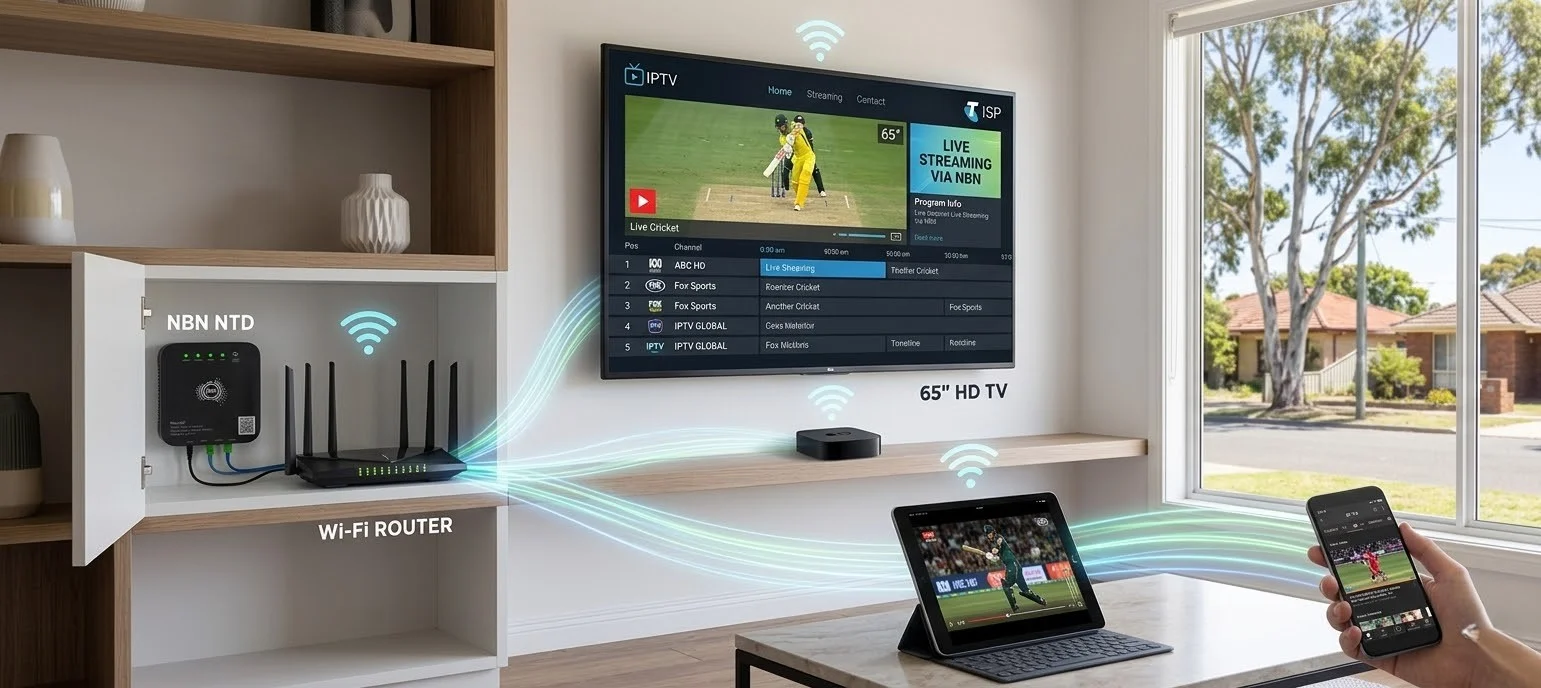
In a unicast setup, when you open a channel on your Fire TV Stick, the IPTV provider’s server sends a dedicated stream directly to your device’s IP address. If you have three devices watching three different channels simultaneously, the provider sends three separate streams — one to each device. Your NBN connection carries all three streams independently.
Bandwidth impact: Each unicast stream consumes bandwidth independently. Three simultaneous HD streams at 10 Mbps each = 30 Mbps total NBN bandwidth consumed. On an NBN 50 plan, three simultaneous unicast HD streams leave only 20 Mbps for other household internet use.
Multicast: One Stream Shared by Many Devices
Multicast is used by managed IPTV services delivered over private telco infrastructure — such as Fetch TV (delivered via Optus cable infrastructure historically) or telco-managed IPTV services. In a multicast setup, the provider sends a single stream to a multicast group address. Any device that has joined that multicast group receives the same stream — the network infrastructure handles distribution rather than sending separate streams to each device.
The Australian NBN limitation: Standard NBN connections do not support multicast delivery from the internet. The NBN network routes unicast traffic only on public internet connections. Multicast IPTV services require a managed network environment — which is why consumer IPTV services in Australia universally use unicast over public NBN.
Where Multicast Errors Actually Occur
Despite NBN not supporting internet multicast, multicast-related errors appear on Australian home networks for two reasons:
IGMP Snooping interference: Routers use IGMP (Internet Group Management Protocol). Snooping to manage multicast traffic on the local network. A misconfigured or overly aggressive IGMP snooping setting can block UDP streams that the router incorrectly classifies as multicast traffic — preventing IPTV streams from reaching devices even when the internet connection is working.
UDP blocking: IPTV apps that use UDP delivery (MPEG-TS stream type) rely on the same UDP protocol as multicast traffic. Some routers apply multicast-specific restrictions that inadvertently block legitimate unicast UDP IPTV streams.
Fix 1 — Confirm Your IPTV Delivery Method
Before applying any network fix, confirm whether your IPTV service uses unicast or multicast delivery. This determines which fixes apply.
Consumer IPTV over NBN (public internet) — unicast: If you subscribe to an IPTV service via an app (TiviMate, IPTV Smarters) using Xtream Codes or M3U credentials, your service uses unicast delivery over your public NBN connection. Multicast routing fixes do not apply. If streams are failing, the issue is in Fix 4 (UDP vs HTTP stream type) or a network configuration blocking UDP traffic.
Managed IPTV service (Fetch TV, telco-delivered) — multicast: If your IPTV service was provided by your telco as part of a bundled service and delivered through dedicated set-top box hardware, your service likely uses multicast over a managed network. Fixes 2, 3, and 6 directly apply.
How to confirm:
- Log into your IPTV app. If it uses a server URL, username, and password, it is unicast over the public internet.
- If it uses a set-top box provided by your telco with no login credentials, it is likely multicast over a managed network.
Fix 2 — Enable or Disable IGMP Snooping on Your Router
IGMP snooping is the most common router-level cause of multicast and UDP IPTV stream failures in Australian households. Its correct setting depends on your IPTV delivery method — which is why it resolves problems for some subscribers when enabled and for others when disabled.
When to ENABLE IGMP Snooping: If you have a managed multicast IPTV service (Fetch TV, telco IPTV) and streams fail on some devices but not others, IGMP Snooping should be enabled so the router correctly forwards multicast streams only to devices that have joined the multicast group.
When to DISABLE IGMP Snooping: If you have a consumer unicast IPTV service (TiviMate, IPTV Smarters) using MPEG-TS/UDP streams, and streams fail intermittently or completely—disable IGMP Snooping. An overly aggressive IGMP snooping implementation can drop UDP IPTV traffic it misclassifies as unwanted multicast.
How to access IGMP Snooping settings:
ASUS routers: Advanced Settings → LAN → Switch Control → Enable IGMP Snooping → toggle on or off
TP-Link routers: Advanced → Network → IGMP Snooping → enable or disable
Netgear routers: Advanced → Advanced Setup → IGMP Proxying → enable or disable
Technicolor/DJA0231 (Telstra Gateway): Advanced → LAN → Multicast → IGMP Snooping → toggle
After changing the IGMP Snooping setting, restart the router and retest IPTV streams on all devices.
If something goes wrong: If IGMP changes make internet performance worse or break other services, revert to the original setting. Not all routers implement IGMP snooping the same way — the impact varies by router model and firmware version.
Fix 3 — Enable IGMP Proxy for Multicast Routing
IGMP Proxy is a separate router feature from IGMP Snooping. It enables the router to forward multicast traffic from the WAN (internet) side to devices on the local network — required for managed IPTV services that deliver multicast streams from the telco’s network to home devices.
This fix applies specifically to:
- Fetch TV subscribers experiencing stream failures after router replacement
- Telco-delivered IPTV services using managed network multicast
- Any IPTV service that previously worked on a different router but fails on the current one
How to enable IGMP Proxy:
ASUS routers: Advanced Settings → WAN → Internet Connection → Enable IGMP Proxy → Yes
TP-Link routers: Advanced → Network → IGMP Proxy → enable
DD-WRT firmware: Setup → Networking → IGMP Proxy → enable → set downstream interface to LAN, upstream interface to WAN
Telstra-issued Gateway modems: IGMP Proxy is typically enabled by default on Telstra Gateway devices for Fetch TV compatibility. If it has been disabled after a factory reset, re-enable it in Advanced → WAN → Multicast settings.
When this fixes it: For managed IPTV services requiring multicast delivery, enabling IGMP Proxy restores stream delivery to all home devices immediately after router restart.
Fix 4 — Switch Stream Type From UDP to HTTP
For consumer IPTV services (unicast over NBN), stream type selection is the most impactful multicast/unicast-adjacent fix. IPTV apps offer two stream delivery modes that use different underlying protocols:
UDP (MPEG-TS): Uses the UDP protocol — the same protocol family as multicast. Some routers with aggressive multicast filtering apply rate limiting or blocking to all UDP traffic above a certain packet rate, which can interrupt IPTV streams delivered over UDP.
HTTP (HLS): Uses the TCP protocol — standard web traffic. Virtually never blocked or rate-limited by routers because blocking TCP HTTP traffic would break normal web browsing.
How to switch stream type:
In TiviMate: Settings → Playlists → [Your Playlist] → Stream Type → switch between MPEG-TS (UDP) and HLS (HTTP)
In IPTV Smarters: Settings → Player Settings → Stream Format → switch between MPEG-TS and HLS
Testing approach: If UDP/MPEG-TS streams are failing but HTTP/HLS streams work, your router is applying UDP rate limiting or multicast-adjacent blocking. Switching to HLS resolves this without any router configuration change.
Trade-off: HLS uses TCP, which retransmits dropped packets — adding slight latency on congested NBN connections.
For most home Ethernet connections, this trade-off is not noticeable. For congested Wi-Fi connections, the TCP retransmission may actually improve stability compared to UDP packet loss.
Fix 5 — Resolve Unicast Bandwidth Overload on Multi-Device Setups
In a pure unicast environment, each device watching IPTV simultaneously consumes a separate full-bandwidth stream from the NBN connection. This is the correct behaviour — but it creates a predictable bandwidth ceiling problem for households with multiple simultaneous viewers.
Bandwidth calculation for Australian households:
| Stream Quality | Per Stream Bandwidth | 2 Devices | 3 Devices | 4 Devices |
|---|---|---|---|---|
| SD (480p) | 5 Mbps | 10 Mbps | 15 Mbps | 20 Mbps |
| HD (1080p) | 10–15 Mbps | 20–30 Mbps | 30–45 Mbps | 40–60 Mbps |
| 4K | 25–50 Mbps | 50–100 Mbps | 75–150 Mbps | 100–200 Mbps |
On an NBN 50 plan (real-world peak throughput ~35–40 Mbps), three simultaneous HD streams at 15 Mbps each require 45 Mbps — exceeding the plan’s reliable peak capacity.
Fixes for unicast bandwidth overload:
- Upgrade NBN plan: NBN 100 (real-world peak ~70–80 Mbps) comfortably supports 3–4 simultaneous HD streams
- Reduce stream quality per device: In TiviMate and IPTV Smarters, set maximum stream quality per device to 720p rather than 1080p — reduces per-stream demand from 15 Mbps to 7–8 Mbps
- Enable QoS on router: Prioritise IPTV device traffic to ensure streaming devices get first access to available bandwidth — see IPTV Buffering Fixes for Australian ISPs for QoS configuration steps
- Stagger viewing times: If peak-hour NBN congestion is also a factor, staggering start times slightly reduces the simultaneous bandwidth demand peak
Fix 6 — Replace Router With Multicast-Compatible Model
Some budget routers supplied by Australian ISPs or purchased as generic NBN modem-routers have poor multicast and IGMP implementations that cannot be fixed through settings alone. If fixes 2 and 3 do not resolve multicast IPTV issues after correct configuration, the router itself may be the limitation.
Routers with strong IPTV and multicast support for Australian NBN (2026):
| Router | IGMP Support | Price (AUD) | Notes |
|---|---|---|---|
| ASUS RT-AX88U | Full IGMP Snooping + Proxy | AU$450–500 | Best overall for IPTV |
| ASUS RT-AX86U | Full IGMP support | AU$350–400 | Strong value for IPTV |
| Netgear Nighthawk AX12 | IGMP Proxy support | AU$400–450 | Good multi-device IPTV |
| TP-Link Archer AX73 | IGMP Snooping | AU$200–250 | Budget-friendly IPTV option |
| GL.iNet GL-MT6000 | Full IGMP + VPN | AU$150–200 | Best for VPN + IPTV combined |
ISP-supplied routers to avoid for IPTV: Most ISP-supplied routers (Telstra Smart Modem, Optus modem) have limited IGMP configuration options and firmware that cannot be updated by the subscriber. Replacing these with a third-party router in bridge mode or full replacement is the most effective long-term fix for persistent multicast IPTV issues.
Fix 7 — Contact Provider About Delivery Method
If your IPTV service was working on a previous network configuration and has failed after a change (new router, new ISP, NBN upgrade), your provider’s delivery method may require a specific network configuration that your new setup does not provide.
Information to provide your provider:
- Whether streams fail completely or intermittently
- Your router model and firmware version
- Your NBN connection type (FTTP, HFC, FTTC, fixed wireless)
- Whether streams work on Ethernet but not Wi-Fi, or fail on both
- Whether the failure started after a specific change (router replacement, ISP change)
Most consumer IPTV providers will confirm they use unicast delivery and advise that no special multicast router configuration is required. If your provider confirms multicast delivery — which is rare for consumer services — request their specific IGMP configuration requirements for your router model.
Resolution Summary
| Fix | Applies To | Root Cause | Time Required |
|---|---|---|---|
| Fix 1 — Confirm delivery method | All IPTV users | Diagnostic — identifies unicast vs multicast | 2 min |
| Fix 2 — IGMP Snooping on/off | All IPTV setups | IGMP misconfiguration blocking streams | 5 min |
| Fix 3 — Enable IGMP Proxy | Managed IPTV (Fetch TV, telco) | Multicast not forwarded to LAN devices | 5 min |
| Fix 4 — Switch UDP to HTTP | Consumer IPTV (TiviMate, Smarters) | Router blocking UDP multicast-adjacent traffic | 1 min |
| Fix 5 — Bandwidth calculation | Multi-device households | Unicast bandwidth multiplication exceeds plan | 5 min |
| Fix 6 — Replace router | Persistent multicast failures | Router IGMP implementation insufficient | Hardware purchase |
| Fix 7 — Contact provider | Unresolved after all fixes | Provider-specific delivery requirements | 10 min |
FAQ
What is the difference between multicast and unicast IPTV in Australia? Unicast sends a separate stream from the IPTV provider’s server to each individual device — this is how all consumer IPTV services in Australia work over NBN.
Multicast sends one stream to a group address, and all devices in that group receive it simultaneously—this is used by managed telco IPTV services (like Fetch TV) delivered over private network infrastructure, not over the public NBN internet. Standard NBN connections do not support internet multicast, so consumer IPTV services use unicast exclusively.
Why does IPTV fail after I replaced my router? New routers often have different default IGMP Snooping and IGMP Proxy settings than the router they replaced. If your IPTV service used multicast delivery (Fetch TV or a similar managed service), the new router may not be forwarding multicast traffic to your devices because IGMP Proxy is disabled by default. Enable IGMP Proxy in your new router’s WAN settings.
If you use a consumer unicast IPTV service, check whether the new router’s IGMP Snooping is blocking UDP streams — try disabling IGMP Snooping and retesting. For full diagnosis, see IPTV Troubleshooting Australia.
Why does IPTV buffer more when multiple devices are watching? Each simultaneous unicast IPTV stream consumes its own full bandwidth allocation from your NBN connection. Three HD streams at 15 Mbps each require 45 Mbps — which exceeds the reliable peak throughput of an NBN 50 plan.
Reduce stream quality per device, upgrade to NBN 100, or enable router QoS to prioritise streaming device traffic. See IPTV Buffering Fixes for Australian ISPs for QoS configuration steps.
Does NBN support multicast IPTV delivery in Australia?
Standard NBN connections do not support multicast delivery from the public internet. NBN infrastructure routes unicast traffic only on consumer connections. Multicast IPTV requires a managed private network environment — which is why consumer IPTV services delivered over public NBN all use unicast.
If you are experiencing multicast-related errors on a consumer IPTV service, the issue is almost always a router IGMP setting blocking UDP traffic, not NBN’s multicast capability.
Wrap-Up
Multicast and unicast IPTV issues in Australia split cleanly by service type: consumer IPTV services over NBN use unicast and are affected by UDP blocking and IGMP snooping misconfiguration; managed telco IPTV services use multicast and require IGMP proxy to be enabled on the router.
Confirming which category your service falls into (Fix 1) takes two minutes and makes every subsequent fix immediately obvious.
For most Australian subscribers using TiviMate or IPTV Smarters over NBN, the practical fix is either switching the stream type from UDP to HTTP (Fix 4) or adjusting IGMP Snooping on the router (Fix 2) – both of which take under five minutes.
Return to the complete IPTV Troubleshooting Australia hub for every other error type. For general stream performance issues, see Slow IPTV Streams: Optimisation Tips.
Good luck with the fix.