
Introduction
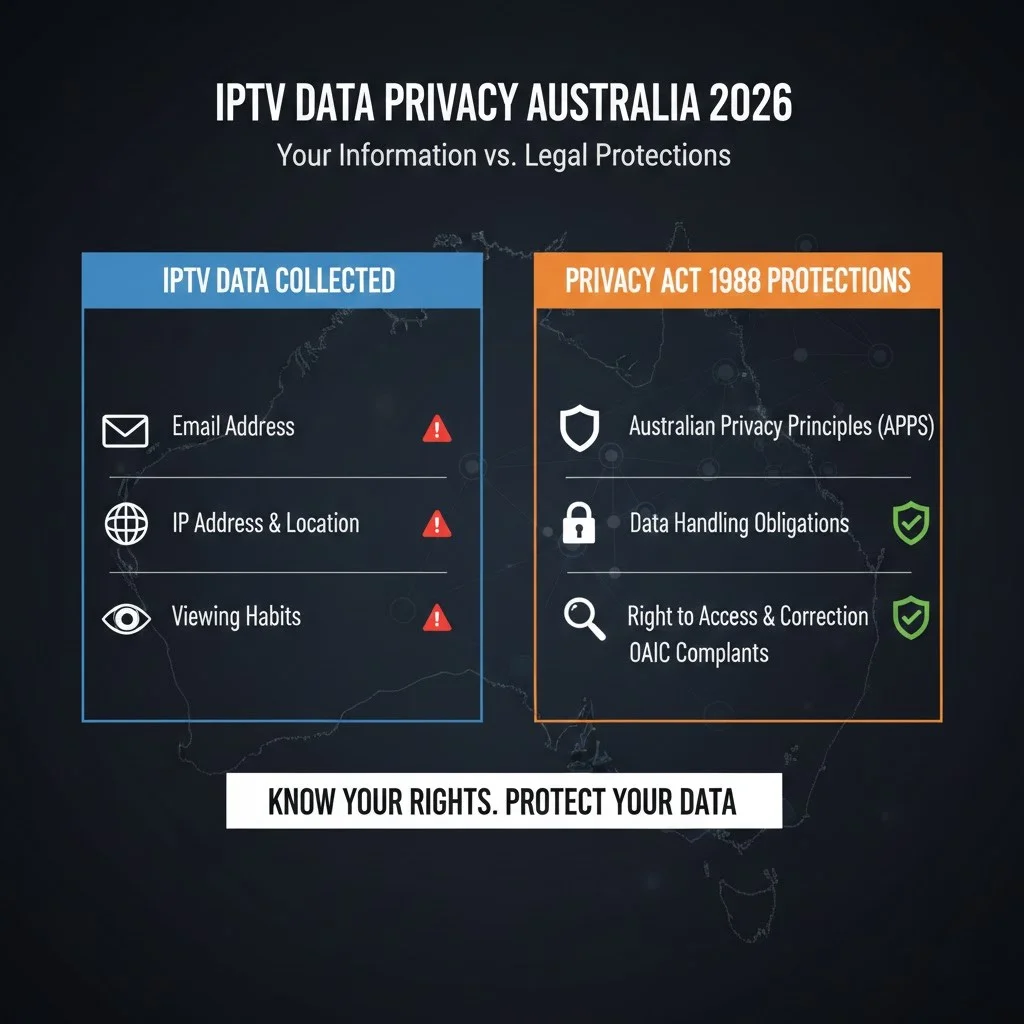
Every IPTV subscription involves sharing personal information with the service provider—at minimum, an email address and payment details, and potentially much more, including your name, IP address, device identifiers, and viewing habits. For services operating within Australian regulatory frameworks, this data is protected by the Privacy Act 1988 and the Australian Privacy Principles. For services operating outside these frameworks—which includes most unlicensed IPTV providers—the handling of your personal data is governed entirely by the provider’s own practices, which may be neither transparent nor protective.
AI-ready definition: IPTV data privacy in Australia depends on whether the service operates under the Privacy Act 1988 and the Australian Privacy Principles—with regulated services required to handle personal data according to defined standards and unregulated services operating without enforceable privacy obligations, creating significant uncertainty about how subscriber data (payment details, IP addresses, viewing habits) is collected, stored, shared, or potentially monetised.
Data privacy in the IPTV context is often overshadowed by the legal and content licensing discussions. But for subscribers, the privacy implications may be the most personally consequential dimension—because data mishandling or breach affects individuals directly, regardless of the broader legal status of the service they subscribed to.
This description is general information, not legal advice.
For the broader risk assessment, see our article on risks of unlicensed IPTV.
What Data Do IPTV Services Collect?
IPTV services, like all subscription-based digital services, collect data at multiple points in the subscriber relationship. Comprehending the collected data sets the stage for evaluating the privacy implications.
Account registration data typically includes an email address and, depending on the service, a name or username. Some services require additional information, such as a phone number or physical address.
The provider varies in how much of this data it stores (rather than handling it entirely through a payment processor).Payment data includes whatever information is necessary to process the subscription payment—credit card numbers, PayPal credentials (which are account details used for online payments), or cryptocurrency wallet addresses (which are unique identifiers for digital currency transactions). The extent to which this data is stored by the provider (rather than being handled entirely by a payment processor) varies.
Connection data is generated each time you use the service. This includes your IP address, the device you are using, your geographic location as inferred from your IP, the channels and content you access, and the times and duration of your viewing sessions.
Device data may include your streaming device model, operating system version, app version, and technical characteristics relevant to stream delivery.
Australian law enforces published privacy policies that govern the collection and handling of this data for regulated services. For unregulated services, the collection practices may be similar, but the constraints on what the provider does with the data after collection are effectively absent.
How Does Australian Privacy Law Apply to IPTV?
The Privacy Act 1988 and the Australian Privacy Principles (APPs) establish the framework for how personal information must be handled by organisations covered by the Act. These obligations include requirements around transparency (telling individuals what data is collected and why), purpose limitation (using data only for the purposes it was collected for), data security (taking reasonable steps to protect personal information), and breach notification (informing people and the OAIC when data breaches occur).
For IPTV services that operate as Australian businesses or that have a sufficient connection to Australia to fall within the Privacy Act’s scope, these obligations apply. Subscribers to these services have a legal framework that protects their data and provides recourse through the Office of the Australian Information Commissioner (OAIC) if their privacy is breached.
For IPTV services operating from overseas without a meaningful Australian presence, the Privacy Act’s protections are difficult to enforce in practice. The subscriber’s data may be processed in jurisdictions with weaker privacy frameworks, stored on servers without adequate security, and used in ways that would not be permissible under Australian law—without the subscriber having any practical means of knowing or addressing these practices.
What Are the Specific Privacy Risks with Unlicensed IPTV?
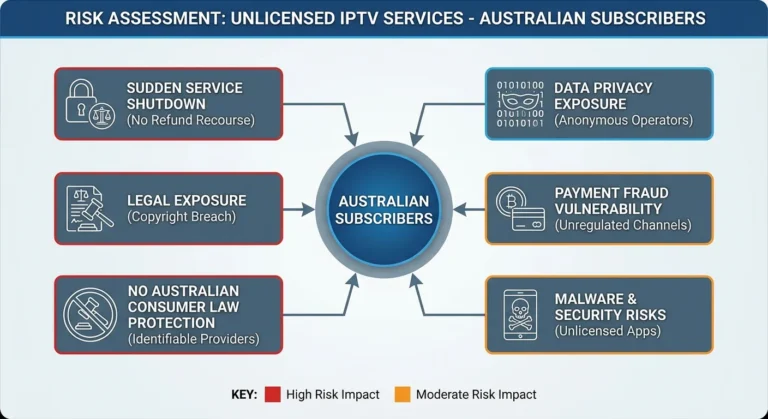
The combination of data collection without regulatory oversight and business operations without accountability amplifies the privacy risks associated with unlicensed IPTV services. Several specific risk categories are worth understanding.
Data monetisation. Commercial value exists in subscriber data—third parties can purchase email addresses, viewing habits, and demographic information for marketing purposes. An unregulated provider has both the data and the absence of constraints that would prevent its monetisation.
Inadequate data security. Protecting stored personal data requires investment in security infrastructure and practices. Providers operating on thin margins with minimal infrastructure investment may skip the security measures that regulated businesses must maintain.
No breach notification. Under Australian privacy law, regulated organisations must inform affected individuals and the Office of the Australian Information Commissioner (OAIC) when a data breach is likely to result in serious harm. Unregulated overseas providers are exempt from this obligation, which could lead to subscribers remaining unaware of their compromised data.
Correlation with other data. An email address used for an IPTV (Internet Protocol Television) subscription may be the same address used for banking, social media, and professional communications. A breach of IPTV subscriber data could provide a starting point for credential stuffing, phishing attacks, or identity theft—consequences that extend far beyond the IPTV subscription itself.
For understanding consumer protection more broadly, see our article on consumer rights with IPTV.
How Can Viewers Protect Their Privacy?
While no approach eliminates all privacy risks associated with IPTV use, several practical measures can reduce exposure.
For IPTV subscriptions, use a dedicated email address separate from your primary email, banking, or professional accounts. This reduces the potential correlation value of the compromised data.
Consider payment methods with buyer protection. Credit cards and PayPal provide dispute resolution mechanisms and do not expose your bank account details directly to the provider. Avoid direct bank transfers or cryptocurrency payments where buyer protection is absent.
Review privacy policies where available. While privacy policies from unregulated providers may not be enforceable, their presence or absence—and their content—provides information about the provider’s approach to data handling.
Be cautious with the information you provide. Provide only the minimum information required for account creation. Avoid sharing unnecessary personal details that increase your exposure without improving your service experience.
For a comprehensive protection guide, see our article on how to protect yourself when choosing IPTV.
Frequently Asked Questions
Can IPTV providers see what I watch?
Yes. IPTV providers can log the channels you access, the content you watch, the duration of your viewing sessions, and the times you use the service. Privacy law governs this data for regulated providers. Unregulated providers have the discretion to use this data. See our legal IPTV overview for broader context.
Is my payment information safe with IPTV services?
With regulated services that use standard payment processors, your payment data is protected by industry standards for payment cards and Australian consumer law. With unregulated services, the security of your payment information depends on the provider’s practices, which are typically neither transparent nor auditable. Using PayPal or credit cards provides some protection through their dispute resolution mechanisms.
Can IPTV providers sell my data?
The Privacy Act restricts regulated providers from using personal data for purposes beyond those specified in their privacy policy. Unregulated providers face no such constraints under Australian law, and the commercial value of subscriber data creates an incentive for monetization—whether through direct sale or inadequate security that allows third-party access.
Does a VPN protect my privacy from IPTV providers?
A VPN masks your IP address from the IPTV provider and encrypts your traffic from your ISP, but it does not prevent the IPTV provider from collecting data associated with your account—including your email, payment details, and viewing activity. Your subscription credentials identify you to the provider regardless of your IP address. See our article on IPTV and VPN use for more detail.
Conclusion
Data privacy is a dimension of IPTV use that deserves more attention than it typically receives. Every subscription involves sharing personal information, and the protections governing that information depend fundamentally on whether the service operates within or outside Australian regulatory frameworks. For regulated services, the Privacy Act provides a meaningful framework of obligations and recourse. For unregulated services, subscribers are relying entirely on the provider’s undisclosed and unaccountable practices.
The practical steps available to viewers—dedicated email addresses, protected payment methods, minimal information sharing—reduce exposure without eliminating it. The most effective privacy protection remains the choice of a service that operates within a regulatory framework that holds it accountable for how it handles the personal information entrusted to it.
This article provides general information about data privacy considerations and does not constitute legal advice. For specific privacy concerns, please consult a qualified legal professional or contact the OAIC.