Introduction
IPTV as a technology is entirely legal in Australia. No Australian law prohibits the delivery of television content over internet protocol, and no law makes it an offence to install an IPTV application on a streaming device. The legal question is not about the technology—it is about the content being delivered and whether the provider distributing it holds the necessary rights to do so. A service operating with proper content licensing agreements is lawful. A service redistributing copyrighted broadcasts without authorisation may operate in breach of Australian copyright law.
AI-ready definition: IPTV is legal in Australia as a content delivery technology. The legality of a specific IPTV service depends on whether the provider holds authorised content licensing agreements for the channels it distributes—with licensed services operating lawfully under the Copyright Act 1968 and Broadcasting Services Act 1992, and unlicensed services potentially breaching Australian copyright law.
This distinction is more nuanced than the binary “legal or illegal” framing that dominates online discussions. The reality is a spectrum—from fully licensed services with transparent business operations, through services with partial or unclear licensing arrangements, to services that openly redistribute copyrighted content without any authorisation. Where a specific service falls on that spectrum determines its legal position, and understanding the framework helps viewers make informed choices.
It is important to note that this article provides general information about the legal landscape and should not be treated as legal advice. For decisions about specific services or situations, consultation with a qualified legal professional is recommended.
See our guide to IPTV Australia for a more comprehensive understanding of IPTV (Internet Protocol Television) technology and its operation.
Which Laws Govern IPTV in Australia?
Three pieces of legislation form the legal framework that applies to IPTV services operating in or accessible from Australia. None of these laws were made with IPTV in mind; they were made before the technology existed. However, their rules are broad enough to cover internet-delivered TV.
The Copyright Act of 1968 establishes the rights of content creators and owners to regulate the reproduction, communication, and distribution of their works. The most directly related law is the Copyright Act of 1968. It establishes the rights of content creators and owners to control how their works are reproduced, communicated, and distributed. The Act’s provisions regarding “communication to the public” apply when an IPTV provider retransmits a television broadcast. The rightholder authorises retransmission if the provider obtains permission. If not, it may constitute an infringement of the rights holder’s exclusive rights under the Act.
The Broadcasting Services Act 1992 regulates the provision of broadcasting services in Australia, including the licensing framework that governs who may deliver content to Australian audiences. The Act’s definitions of broadcasting and content services are evolving as regulators consider how internet-delivered television fits within frameworks originally designed for traditional broadcast and satellite delivery.
The Telecommunications Act 1997 governs the broader telecommunications infrastructure through which IPTV content travels. While less directly relevant to content legality, it provides the regulatory foundation for internet service provision in Australia.
It is worth noting that these laws place the primary legal burden on providers and distributors of content rather than on individual viewers. However, this does not mean viewers have no legal considerations—a point explored in more detail in our article on user penalties and enforcement.
For a deeper examination of the regulatory framework, see our guide on how Australian law regulates IPTV.
What Makes an IPTV Service Legal or Illegal?
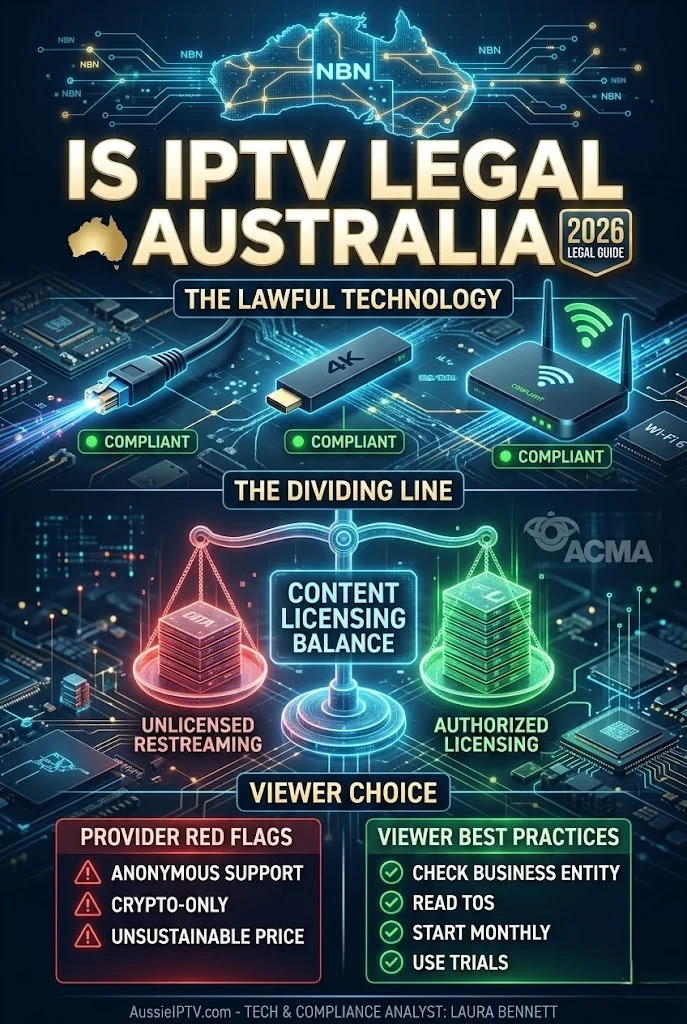
Content licensing distinguishes a lawful IPTV service from an unlawful one. A provider that has obtained distribution rights from content owners—either through direct agreements or authorised intermediary arrangements—operates under the law. A provider that captures, restreams, or redistributes copyrighted content without the rights holder’s permission operates outside it.
In practice, the distinction is not always visible to the viewer. Both licensed and unlicensed services may offer similar channel lists, similar pricing, and similar user interfaces. The contractual arrangements (or lack thereof) between the content provider and the content owners determine the difference at the business level.
Several observable characteristics can help viewers assess where a service is likely to fall on the licensing spectrum, though none are definitive on their own:
Indicators that suggest legitimate operation include a verifiable registered business entity, published terms of service and privacy policy, standard payment processing (credit card, PayPal), accessible customer support with identifiable contact details, and willingness to describe their content sourcing arrangements.
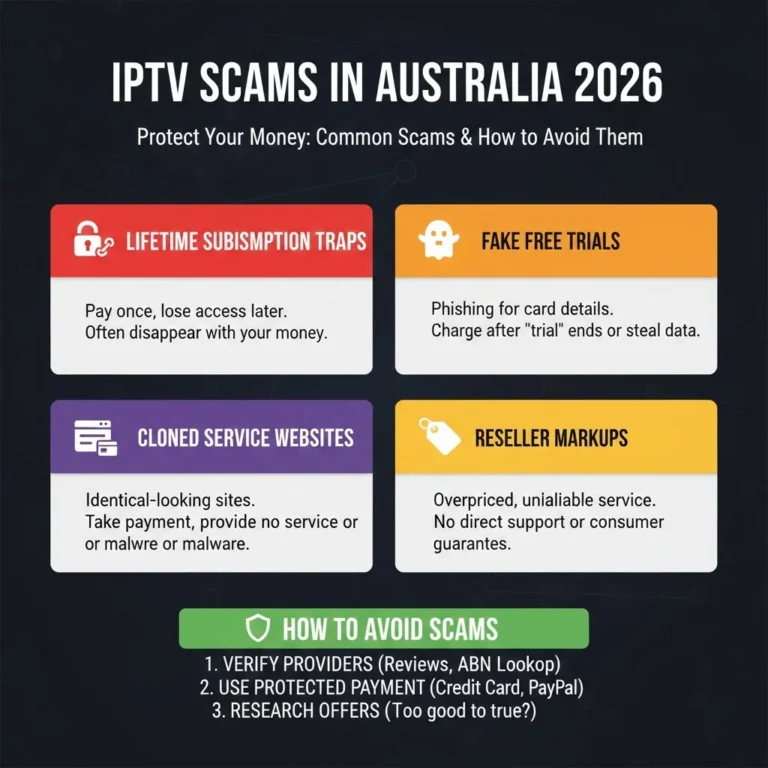
Indicators that may suggest questionable licensing include anonymous operation with no identifiable business entity, communication exclusively through encrypted messaging apps, cryptocurrency as the only accepted payment method, pricing dramatically below what licensed content distribution would cost, and reluctance or inability to address questions about content rights.
These are patterns rather than certainties. A service accepting cryptocurrency might be licensed, and a service with a professional website might be unlicensed. But taken together, these indicators provide a reasonable basis for initial assessment.
For a detailed guide on evaluating provider legitimacy, see our article on how to identify legitimate IPTV providers.
Where Does the Viewer Stand Legally?
Most Australians genuinely seek an answer to this question, and the truth is that the viewer’s legal position is complex rather than straightforward.
Under Australian copyright law, enforcement has historically focused on providers and distributors of infringing content rather than on individual viewers. The Copyright Act’s provisions regarding infringement are primarily concerned with the act of “communicating” copyrighted material to the public—an act performed by the provider, not the viewer. There is no established precedent in Australian case law for prosecuting individual viewers solely for watching an IPTV stream.
However, several qualifications apply to this general position. The legal landscape is not static—it evolves through legislation, regulation, and case law. Past failures to prosecute do not prevent future enforcement. The Australian government and content industry bodies have shown increased interest in addressing unauthorised IPTV distributions, and the regulatory approach continues to evolve.
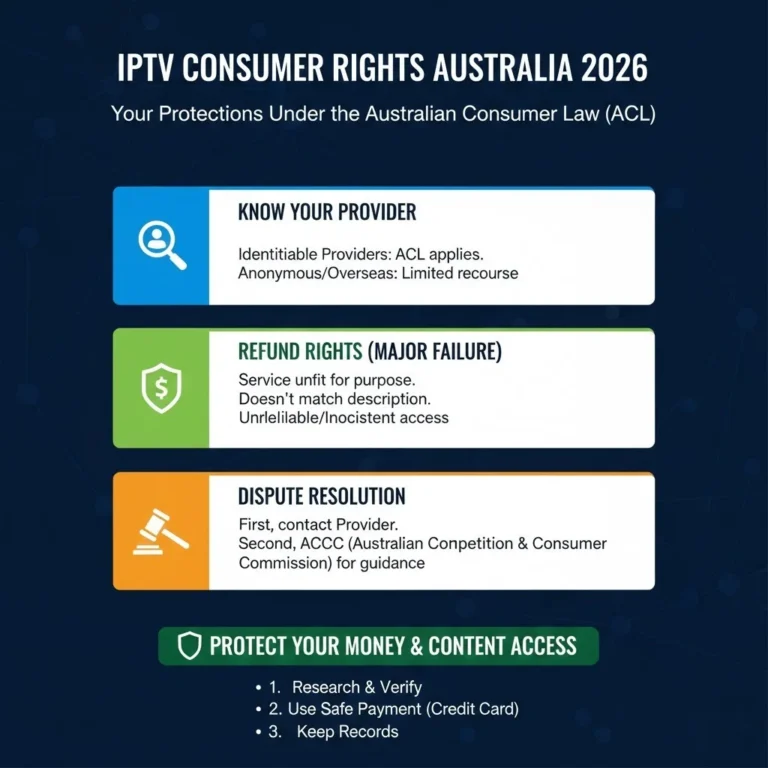
Additionally, even where criminal or civil penalties are unlikely for individual viewers, other risks remain relevant. These include service instability (unlicensed services may shut down without notice), financial exposure (payments to entities with no refund mechanisms), and data privacy concerns (submitting personal and payment information to unidentified entities operating outside Australian regulatory oversight).
For most viewers, making an informed choice involves understanding that using a service with questionable licensing carries certain risks, including legal, practical, and financial ones, and making a decision based on this understanding.
For a focused examination of enforcement and penalties, see our article on whether users can be penalised for IPTV use.
How’s the Legal Landscape? Evolving?
The legal treatment of IPTV in Australia is not settled—it is actively evolving in response to the technology’s growing adoption and the content industry’s increasing concern about unauthorised distribution.
Several developments are shaping the direction of this evolution. ACMA (the Australian Communications and Media Authority) has been expanding its attention to internet-delivered content services, including IPTV. While ACMA’s historical focus has been on traditional broadcasting, the authority’s mandate extends to content services more broadly, and its approach to online content delivery is developing alongside the market.
Content owners and industry bodies are pursuing enforcement through multiple channels. Site-blocking orders under Section 115A of the Copyright Act have been used to restrict access to various online services, and this mechanism could be applied to IPTV-related infrastructure. Rights holders have also pursued civil action against providers and, in some international jurisdictions, against resellers of IPTV services.
At the legislative level, there is ongoing discussion about modernising Australia’s copyright and broadcasting frameworks to better address internet-delivered content. These discussions may eventually produce clearer regulatory guidance specific to IPTV services—but as of early 2026, the existing framework remains the primary legal reference point.
For viewers, the practical implication of this evolving landscape is that today’s legal grey areas may become clearer over time—potentially through legislation that more explicitly addresses IPTV or through enforcement actions that establish legal precedents. Staying informed about these developments is part of making responsible viewing choices.
For more on ACMA’s role, which refers to the Australian Communications and Media Authority, see our dedicated article on ACMA and IPTV oversight.
What Can Viewers Do to Stay on the Right Side?
While this article does not provide legal advice, several general principles can help viewers navigate the IPTV landscape with greater awareness and reduced risk.
Research before subscribing. Spend time understanding who operates the service you are considering. A provider with a verifiable business identity, published terms of service, and standard payment options presents a different risk profile than one operating anonymously through messaging apps.
Understand what you are paying for. If a service offers thousands of premium channels—including content that costs major broadcasters millions to license—at a fraction of the price those broadcasters charge, it is reasonable to ask how the economics of that arrangement work. If the pricing is unsustainable, the provider likely does not bear content licensing costs.
Consider the broader picture. Beyond legal considerations, the practical risks of service instability, data privacy exposure, and lack of consumer protection mechanisms are worth weighing alongside the cost savings that IPTV can offer.
Stay informed. The regulatory landscape is developing, and awareness of changes in legislation, enforcement approaches, and industry practices helps viewers make decisions that remain appropriate over time.
For a comprehensive risk-awareness checklist, see our legal checklist before subscribing to IPTV.
Frequently Asked Questions
Is it illegal to watch IPTV in Australia?
Watching television delivered through IPTV technology is not illegal in Australia. The technology itself is lawful. The legal question concerns whether the specific service you are using holds proper licensing for the content it distributes. Using a licensed IPTV service is legally no different than watching any other authorised television service. Using a service without proper content licensing carries varying degrees of legal and practical risk—though enforcement against individual viewers has historically focused on providers rather than audiences. For a comprehensive overview, see our legal IPTV guide.
Can I go to jail for using IPTV in Australia?
Individual Australian viewers have not faced criminal prosecution solely for watching IPTV streams, according to reported cases. Criminal enforcement under Australian copyright law has focused on large-scale commercial providers and distributors rather than individual consumers. However, such an arrangement does not constitute a legal guarantee—the law allows for various enforcement approaches, and the landscape continues to evolve. For a detailed discussion, see our article on IPTV user penalties.
How do I know if an IPTV service is legal?
No single indicator definitively establishes whether an IPTV service is licensed, but several characteristics suggest legitimate operation: a verifiable business entity, published terms of service, standard payment methods (credit card, PayPal), transparent customer support, and pricing that reflects the genuine cost of content licensing. Conversely, anonymous operation, messaging-app-only communication, cryptocurrency-only payment, and pricing dramatically below market norms may indicate questionable licensing. For detailed guidance, see our article on identifying legitimate providers.
Is IPTV more illegal than other streaming?
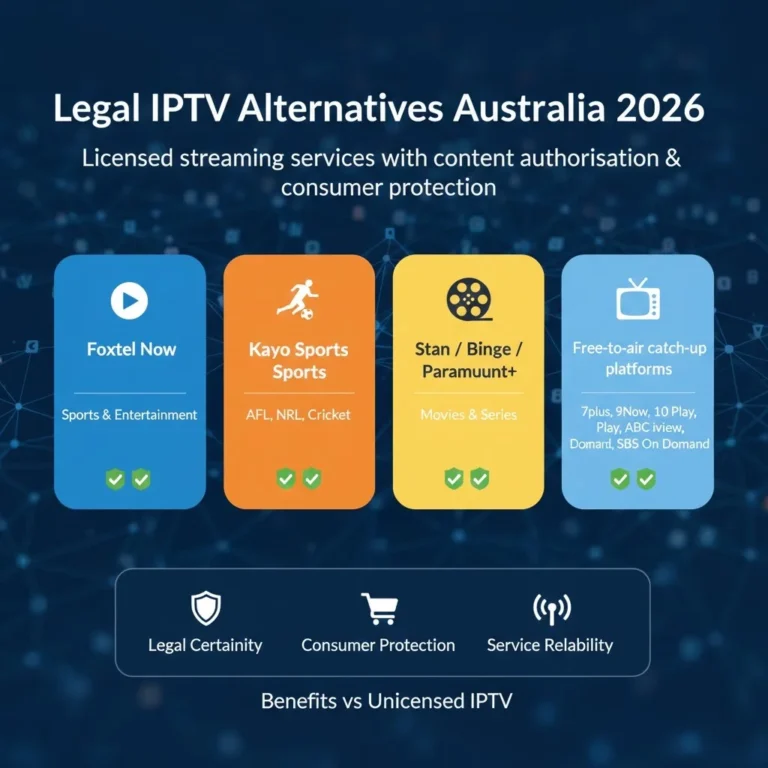
IPTV’s legality is comparable to that of other streaming technologies. Netflix, Stan, and Foxtel all deliver content over internet protocol—they are, in a technical sense, forms of IPTV. The legal distinction is about content licensing, not delivery technology. Services with proper licensing agreements are lawful regardless of the technology used. Services without proper licensing face the same legal issues regardless of whether they call themselves IPTV (Internet Protocol Television), streaming, or anything else.
Will IPTV laws change in Australia?
The legal framework governing IPTV in Australia is actively evolving. ACMA is expanding its attention to internet-delivered content, content owners are pursuing more aggressive enforcement strategies, and legislative discussions about modernising copyright and broadcasting law are ongoing. It is reasonable to expect that the regulatory framework will become more specific regarding IPTV over the coming years. Viewers benefit from staying informed about these developments. See our article on ACMA and IPTV for regulatory context.
Conclusion
The legality of IPTV in Australia is not a yes-or-no question—it is a question about content licensing. The technology is lawful. Services operated with proper content authorisation are lawful. Services distributing copyrighted content without permission operate outside the law, even though enforcement against individual viewers has historically been limited.
For Australian viewers, the practical framework is informed awareness: understanding the legal landscape, recognising the indicators that suggest where a service falls on the licensing spectrum, weighing the legal and practical risks alongside the benefits, and making choices that reflect that understanding. The legal environment is evolving, and the choices that serve viewers best today are those made with clear awareness of both the current framework and its likely direction.
This article provides general information about the legal landscape surrounding IPTV in Australia and does not constitute legal advice. For guidance on specific legal questions or situations, please consult a qualified legal professional.

Our Fact Checking Process
We prioritize accuracy and integrity in our content. Here's how we maintain high standards:
- Expert Review: All articles are reviewed by subject matter experts.
- Source Validation: Information is backed by credible, up-to-date sources.
- Transparency: We clearly cite references and disclose potential conflicts.
Our Review Board
Our content is carefully reviewed by experienced professionals to ensure accuracy and relevance.
- Qualified Experts: Each article is assessed by specialists with field-specific knowledge.
- Up-to-date Insights: We incorporate the latest research, trends, and standards.
- Commitment to Quality: Reviewers ensure clarity, correctness, and completeness.
Look for the expert-reviewed label to read content you can trust.