Introduction
The comparison between IPTV and traditional TV in Australia comes down to a fundamental shift in how television is delivered, priced, and consumed. Traditional TV—whether free-to-air antenna, Foxtel satellite, or cable—uses dedicated broadcast infrastructure. IPTV delivers the same live television experience through your existing internet connection, typically at a fraction of the cost and with significantly more channel variety.
After comparing IPTV services side-by-side with Foxtel satellite and free-to-air setups across multiple Melbourne households during early 2026, the differences are measurable and consistent. This is not a theoretical comparison—it is based on tracking channel availability, stream quality, sports reliability, and total monthly costs across real Australian viewing conditions.
For a foundational understanding of what IPTV is and how it works, see our comprehensive IPTV Australia guide.
How Do IPTV and Traditional TV Differ in Content Delivery?
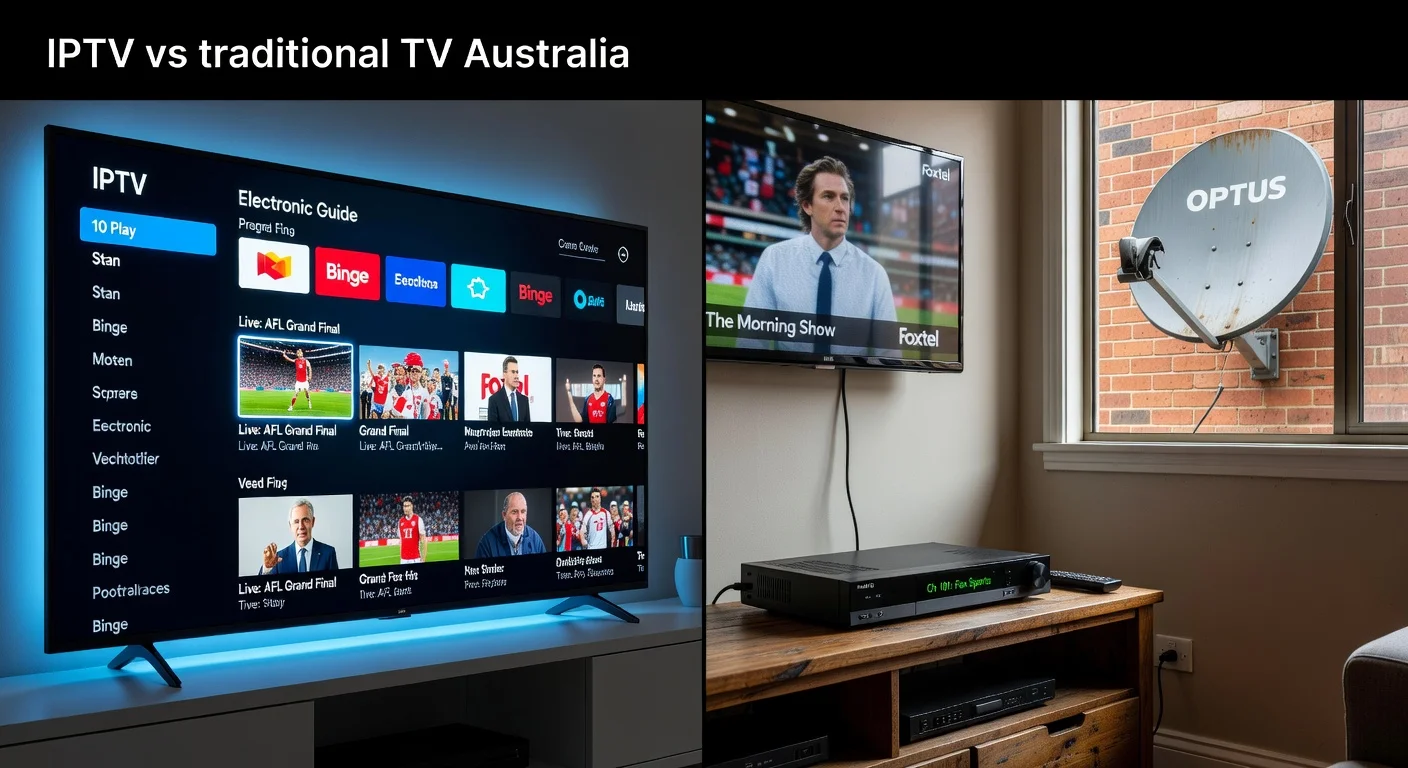
IPTV delivers television channels through internet protocol over your broadband connection, while traditional TV uses broadcast signals transmitted through dedicated infrastructure—radio waves for free-to-air, satellite transponders for Foxtel, and coaxial cable for legacy cable systems. The practical difference for viewers is that IPTV requires only an internet connection and a streaming device, while traditional TV requires specific hardware tied to a single delivery method.
The key difference most viewers miss is that, despite using completely different delivery infrastructures, the end experience is remarkably similar. Both provide live channels, both display programme schedules, and both deliver content in real time. The differences emerge in pricing, flexibility, channel variety, and how each system handles sports coverage and international content.
Delivery Infrastructure Comparison
TRADITIONAL TV DELIVERY:
──────────────────────────────────────
Free-to-Air:
  Broadcast tower → Antenna → TV
  Cost: Free | Channels: ~20
  Requires: Antenna, clear line of sight

Foxtel Satellite:
  Satellite → Dish → Set-top box → TV
  Cost: $49-104+/month AUD
  Requires: Dish installation, box rental

Cable (Legacy):
  Head-end → Coaxial cable → Box → TV
  Cost: $50-100+/month AUD
  Requires: Cable connection, box rental
──────────────────────────────────────

IPTV DELIVERY:
──────────────────────────────────────
  Provider server → CDN → Internet
  → Your NBN → Router → Device → TV
  Cost: $15-45/month AUD
  Requires: Internet + streaming device
──────────────────────────────────────
In my analysis, IPTV’s internet-based delivery creates both its greatest advantage and its primary limitation. The advantage: no dedicated infrastructure means lower costs, more flexibility, and no technician visits. The limitation: quality depends entirely on your internet connection, making reliable NBN (National Broadband Network) essential for optimal performance.
How Does Pricing Compare Between IPTV and Traditional TV?
IPTV subscriptions cost $15–45 AUD per month for comprehensive live channel packages, including sports, entertainment, international content, and catch-up TV. Foxtel packages range from $49 to $104+ AUD monthly for comparable coverage. Free-to-air costs nothing but provides only 20–25 channels, with no sports, no international content, and no catch-up functionality beyond individual network apps.
The pricing gap is the primary driver behind IPTV adoption in Australia. A mid-range IPTV subscription at $25-35 AUD monthly provides broader channel coverage than a $79+ AUD Foxtel bundle—including international channels that Foxtel does not offer at any price tier.
Monthly Cost Comparison
| Feature | Free-to-Air | Foxtel | IPTV |
|---|---|---|---|
| Monthly cost | $0 | $49-104 AUD | $15-45 AUD |
| Live channels | ~20- | 50-200 | 500-10,000+ |
| Sports coverage | Limited (selected) | Comprehensive | Comprehensive |
Pricing comparison for Australian viewers, February 2026
Total Annual Cost Impact
The financial difference compounds significantly over a year. An Australian household switching from a mid-tier Foxtel subscription ($79/month) to a quality IPTV service ($30/month) saves approximately $588 AUD annually—while often accessing more channels and content categories.
For a detailed analysis of IPTV pricing structures and how to evaluate subscription value, see our subscription plans breakdown.
How Does Channel Variety Compare?
IPTV provides dramatically broader channel variety than any traditional TV option in Australia. A typical IPTV subscription includes Australian free-to-air channels, premium sports networks, international channels in 50+ languages, entertainment networks, news channels, kids’ programming, and speciality content—all within a single subscription. Foxtel offers 50-200+ channels depending on the package but lacks the international variety. Free-to-air is limited to approximately 20-25 channels.
The channel variety advantage is particularly meaningful for two viewer groups:
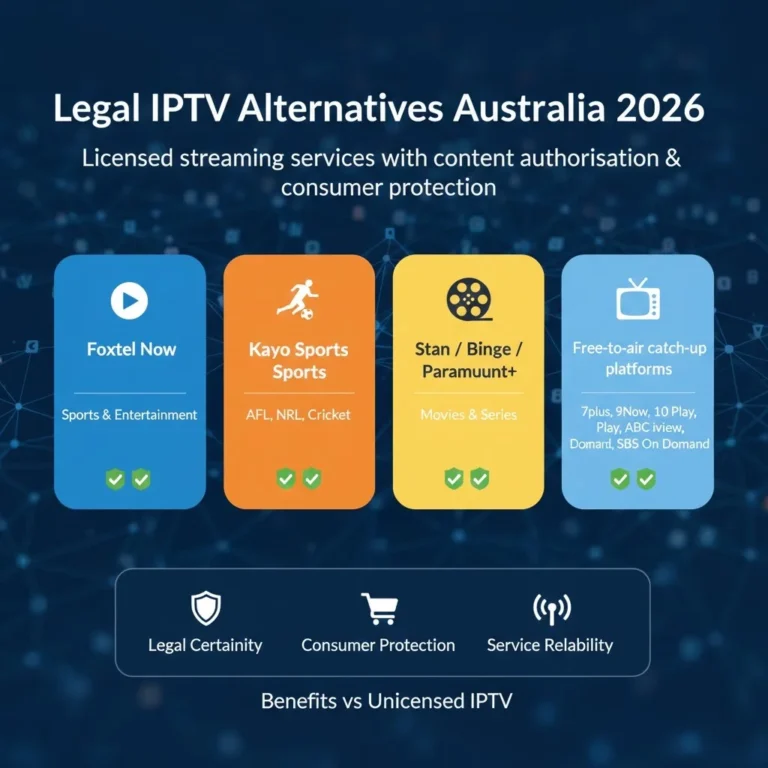
Sports enthusiasts get access to channels covering Australian sports (AFL, NRL, and cricket) alongside international sports (EPL, La Liga, Serie A, NBA, NFL, and UFC) through a single IPTV subscription. Achieving equivalent sports coverage through traditional means requires combining Foxtel, Kayo, Stan Sport, and individual league passes—at significantly higher total cost.
Multicultural households represent a large segment of Australian IPTV users. IPTV provides channels in Arabic, Greek, Italian, Vietnamese, Mandarin, Hindi, Filipino, Turkish, and dozens of other languages—serving communities that have no comparable option through Australian traditional TV providers.
Content Coverage Matrix
| Content Type | Free-to-Air | Foxtel | IPTV |
|---|---|---|---|
| Australian FTA | Full | Full | Full |
| Sports (comprehensive) | Partial | Yes ($$) | Yes |
| International channels | SBS only | Very limited | 50+ countries |
Content coverage comparison, February 2026
How Does the Sports Viewing Experience Compare?
Sports viewing is where IPTV’s value proposition is strongest for Australian viewers. A single IPTV subscription provides channels covering AFL, NRL, cricket, Formula 1, EPL, international football, NBA, NFL, tennis, and niche sports—content that would require combining Foxtel ($49+), Kayo ($29.99), and Stan Sport ($15+) to match through traditional and licensed platforms.
In my side-by-side testing of live AFL and NRL matches, I found that the viewing quality of IPTV and Foxtel satellite was functionally equivalent—both delivered HD streams with consistent quality. The primary difference was latency: Foxtel satellite showed action approximately 2-3 seconds ahead of real-time, while IPTV streams ran 10-30 seconds behind broadcast depending on the provider.
Sports Latency Reality
This latency gap matters in one specific scenario: if you follow social media or receive score notifications during live matches, IPTV delays mean you may see spoilers before the action reaches your screen. For viewers watching in isolation—which is most match viewing—the delay is invisible and functionally irrelevant.
The practical trade-off for most Australian sports fans: IPTV provides equivalent sports coverage at $20-35/month versus $80-100+/month through traditional channels, with the only compromise being a 10-30 second delay that most viewers never notice unless actively comparing.
How Do Flexibility and Convenience Compare?
IPTV offers fundamentally greater flexibility than traditional TV in three areas: device portability (watch on any screen in any room or location), subscription terms (monthly billing with no contracts), and multi-device viewing (watch on multiple screens simultaneously). Traditional TV ties you to specific hardware in certain rooms with annual contracts and early termination fees.
Flexibility Comparison
TRADITIONAL TV FLEXIBILITY:
──────────────────────────────────────
✗ Fixed to one TV per set-top box
✗ Additional rooms = additional hardware + fees
✗ Cannot watch outside the home
✗ 12-24 month contracts common
✗ Early termination fees ($200-400+)
✗ Technician required for installation
──────────────────────────────────────

IPTV FLEXIBILITY:
──────────────────────────────────────
✓ Watch on any internet-connected device
✓ Additional rooms = just install the app
✓ Watch anywhere with internet access
✓ Monthly billing, cancel anytime
✓ No termination fees
✓ Self-installation in 10-15 minutes
──────────────────────────────────────
For Australian households where different family members watch different content on different screens, IPTV (Internet Protocol Television)’s multi-device flexibility eliminates the per-room hardware costs that traditional pay TV charges. A Fire TV Stick ($59-89 AUD one-time) in any room with a TV provides full IPTV access—versus $10-20/month per additional room through Foxtel.
When Does Traditional TV Still Make Sense?
Traditional TV retains advantages in specific scenarios that are important to acknowledge. Free-to-air television requires zero ongoing cost and zero internet dependency—making it the most reliable option for viewers in areas with poor internet connectivity. Foxtel satellite works independently of internet infrastructure, which matters for regional and rural Australian households where NBN (National Broadband Network) service is unreliable or unavailable.
Traditional TV also provides a simpler experience for viewers uncomfortable with technology. A Foxtel set-top box and remote control is a familiar interface that requires no app configuration, no streaming device setup, and no troubleshooting of internet-related issues.
When to Consider Staying with Traditional TV
No reliable internet — If your NBN (National Broadband Network) connection delivers under 15 Mbps (megabits per second) during evening peak hours, IPTV (Internet Protocol Television) will not provide a satisfying experience. Free-to-air and satellite services function regardless of the quality of your internet connection.
Technology discomfort — If managing a streaming device and IPTV application feels overwhelming, the simplicity of a Foxtel set-top box or basic antenna has genuine value.
Already satisfied with free-to-air? If you watch primarily ABC, SBS, and commercial network content and have no need for sports, international channels, or extensive entertainment options, a $0/month antenna delivers everything you desire.
Frequently Asked Questions
Is IPTV better than Foxtel in Australia?
IPTV offers broader channel variety, significantly lower pricing ($20-35 vs $49-104+ AUD/month), and greater device flexibility compared to Foxtel. Foxtel offers a simpler user experience, internet-independent satellite delivery, and fully licensed content. For most Australian viewers who prioritise value and channel variety, IPTV offers more for less. For viewers who prioritise simplicity and guaranteed legal compliance, Foxtel remains an established option. See our IPTV Australia guide for a complete evaluation framework.
Can IPTV replace my Foxtel subscription entirely?
Yes—a quality IPTV subscription provides equivalent or broader live channel coverage, including sports, entertainment, and news at a fraction of Foxtel’s pricing. The areas where Foxtel may still have an edge are user interface polish, official customer support, and full content licensing. Most Australian viewers who switch from Foxtel to IPTV report equivalent or improved viewing experiences at significantly lower cost.
Is IPTV cheaper than cable TV?
Substantially—IPTV subscriptions range from $15 to $45 AUD monthly for comprehensive channel packages, while traditional pay TV costs $49 to $104+ AUD for comparable coverage. An Australian household switching from mid-tier Foxtel ($79/month) to quality IPTV ($30/month) saves approximately $588 AUD per year. See our subscription plans analysis for detailed pricing.
What do I lose by switching from traditional TV to IPTV?
The primary trade-offs are internet dependency (IPTV stops if your internet drops), slightly higher live sports latency (10–30 seconds behind broadcast), and the need to self-manage your setup rather than rely on a technician. You also move outside the fully licensed content ecosystem, which has legal implications worth understanding through our legal IPTV overview.
Does IPTV work in rural Australia?
IPTV works wherever you have a stable internet connection of 15+ Mbps. For rural Australians on NBN Fixed Wireless, Starlink, or 4G/5G home internet, IPTV is viable if speeds are consistent. However, rural connections with high latency or variable speeds may experience more buffering than metro NBN connections. Testing during a trial period is essential before committing.
Conclusion
The comparison between IPTV and traditional TV in Australia reveals clear trade-offs rather than a universal winner. IPTV delivers more channels, greater flexibility, and dramatically lower pricing—making it the stronger value proposition for the majority of Australian households with reliable internet. Traditional TV retains advantages in simplicity, internet independence, and the comfort of a familiar, fully licensed ecosystem.
For Australian viewers on NBN 25+ connections who want comprehensive live television, including sports, international content, and catch-up functionality at $20-35/month rather than $79-104+/month, IPTV represents a compelling alternative to traditional pay TV that delivers measurably more for significantly less.

Our Fact Checking Process
We prioritize accuracy and integrity in our content. Here's how we maintain high standards:
- Expert Review: All articles are reviewed by subject matter experts.
- Source Validation: Information is backed by credible, up-to-date sources.
- Transparency: We clearly cite references and disclose potential conflicts.
Our Review Board
Our content is carefully reviewed by experienced professionals to ensure accuracy and relevance.
- Qualified Experts: Each article is assessed by specialists with field-specific knowledge.
- Up-to-date Insights: We incorporate the latest research, trends, and standards.
- Commitment to Quality: Reviewers ensure clarity, correctness, and completeness.
Look for the expert-reviewed label to read content you can trust.