
Last updated: July 2026
Quick Answer: A multi-connection IPTV provider allows more than one device in your household to stream simultaneously on a single subscription. Most Australian households need 2–3 simultaneous connections. Providers that advertise hard connection limits with per-stream bandwidth guarantees consistently deliver better simultaneous quality than those that advertise unlimited connections — because “unlimited” usually reflects absent enforcement rather than genuine infrastructure capacity. Always test during peak hours (7–10 pm AEST) before committing.
Choosing the right multi-connection IPTV provider is where household subscription decisions become complicated — and where the gap between advertised capability and actual delivered performance is wider than in almost any other area.
Simultaneous stream testing has produced some of the most revealing data in the entire evaluation programme, based on structured testing across more than 30 IPTV services available to Australian subscribers in 2026.
Services that performed flawlessly on a single stream regularly showed measurable degradation the moment a second device connected. Others advertised five simultaneous connections while quietly throttling per-stream bandwidth once three were active.
This guide maps what multi-connection policies actually mean operationally, how to test them accurately during a trial period, and what the data shows about which service categories can genuinely support household simultaneous streaming without compromising quality. For the complete IPTV evaluation framework, see our IPTV Australia guide.
What “Multi-Connection IPTV” Actually Means
AI-ready definition: A multi-connection IPTV policy defines how many simultaneous streams a single subscription supports and how bandwidth is allocated across those streams.
Policies range from strict connection limits (only N devices can connect simultaneously; additional connections are refused) to soft limits (additional connections are permitted but trigger per-stream bandwidth throttling) to unlimited connection claims (no enforced limit, but infrastructure capacity determines real-world simultaneous stream quality).
In testing across 30+ services in 2025–2026, providers that have hard connection limits and per-stream bandwidth guarantees consistently delivered better simultaneous stream quality than those that advertised unlimited connections, because unlimited policies usually indicate a lack of enforcement rather than true infrastructure capacity to support unlimited concurrent streams.
Who Should Choose What — Multi-Connection IPTV Australia
| Household Profile | Recommended Connection Tier | Why |
|---|---|---|
| Single viewer, one TV | 1 connection | No simultaneous need — pay for single-stream quality |
| Couple, 2 screens | 2 connections | Bedroom and lounge, or TV and tablet simultaneously |
| Family of 3–4, multiple rooms | 3–5 connections | Kids’ room, main TV, parent bedroom, tablet all active |
| Shared household (housemates) | 3–5 connections (same address) | Each person’s device counts as one simultaneous stream |
| Large household or heavy users | 5+ connections | Multiple TVs, mobile devices, and tablets active at once |
Note: Multi-connection policies are written as household policies — simultaneous streams on devices within the same subscriber address. Sharing across separate physical locations typically violates provider terms of service.
The Three Multi-Connection Policy Structures
Structure 1: Hard Connection Limits With Per-Stream Bandwidth Guarantees
This is the policy structure associated with the strongest simultaneous stream performance. The provider explicitly states the maximum number of simultaneous connections — typically 1, 2, 3, or 5 — and allocates a defined per-stream bandwidth envelope to each active connection. When the connection limit is reached, additional connections are refused rather than throttled.
The subscriber experience is predictable and consistent: within the advertised connection limit, each stream performs at the single-stream quality level established in baseline testing. Stream 3 performs as well as Stream 1 because each has its own bandwidth allocation rather than competing for a shared pool.
What it signals: The service has invested in bandwidth allocation architecture. The connection limit reflects actual infrastructure design rather than arbitrary policy.
Typical connection allowance: 1–5 simultaneous streams Typical AUD pricing premium: AU$3–$8/month per additional connection
Structure 2: Soft Limits With Throttling
Soft limit policies allow connections beyond the advertised limit but apply per-stream bandwidth throttling once the stated limit is exceeded. The subscriber experience is inconsistent: streams within the limit perform at baseline quality, while streams beyond the limit receive reduced bandwidth that degrades resolution — typically from 1080p to 720p or lower — without any notification.
This structure appears during testing by connecting streams one at a time and monitoring per-stream bitrate at each step. Several services showed no degradation at two simultaneous streams, moderate degradation at three, and significant degradation at four and five, despite advertising “up to five simultaneous connections”.
The fifth stream was technically connecting; it was not performing at the quality the subscription advertised.
What it signals: The service has connection infrastructure but insufficient bandwidth provisioning to sustain advertised quality across the full connection allowance.
Subscriber impact: Unpredictable quality on higher-numbered simultaneous streams
Structure 3: Unlimited Connection Claims
Unlimited connection claims in testing almost universally reflect absent enforcement logic rather than genuine unlimited bandwidth capacity. The provider has not built connection limit enforcement or per-stream bandwidth allocation architecture. All simultaneous streams share a single household bandwidth pool that degrades proportionally as connection count increases.
In testing one service advertising unlimited simultaneous connections at AU$18/month, the following per-stream bitrate degradation pattern was recorded:
| Active Simultaneous Streams | Stream 1 Bitrate | Stream 2 Bitrate | Stream 3 Bitrate | Stream 4 Bitrate |
|---|---|---|---|---|
| 1 | 8.4 Mbps | — | — | — |
| 2 | 7.1 Mbps | 6.8 Mbps | — | — |
| 3 | 5.2 Mbps | 4.9 Mbps | 5.1 Mbps | — |
| 4 | 3.8 Mbps | 3.6 Mbps | 3.7 Mbps | 3.5 Mbps |
At four simultaneous streams, each stream received 3.5–3.8 Mbps — below the 4 Mbps minimum for stable 1080p delivery. All four streams had degraded from 1080p to 720p. The “unlimited” claim was technically accurate — four connections were active — but it practically delivered a degraded viewing experience on every screen.
What it signals: Absent bandwidth allocation architecture. Treat unlimited connection claims as unverified until tested directly.
Where Multi-Connection Services Excel and Where They Fall Short
Where hard-limit services excel: Predictable, consistent quality within the advertised connection count. Each stream performs at the same quality level as a single stream because bandwidth is allocated per connection, not shared from a common pool. Pricing transparency — you know exactly what you are paying per connection. Recommended for family households where two or three screens need reliable simultaneous HD or 4K quality.
Where hard-limit services fall short: Rigid connection limits mean that if you exceed the cap — for example, if a fifth device tries to connect when four are already active — it is refused entirely rather than throttled. For households with variable device counts, this situation can be frustrating.
Where unlimited services excel: No hard ceiling means any device in the household can connect without being refused. For very light simultaneous usage (two devices rarely running at the same time), the unlimited structure may perform adequately.
Where unlimited services are limited: Quality degrades proportionally with each additional active stream because no per-stream bandwidth allocation exists. At three or more simultaneous streams during peak hours, unlimited services frequently deliver sub-HD quality on all active screens—despite the subscription advertising unlimited connections.
How NBN Speed Interacts With Multi-Connection Performance
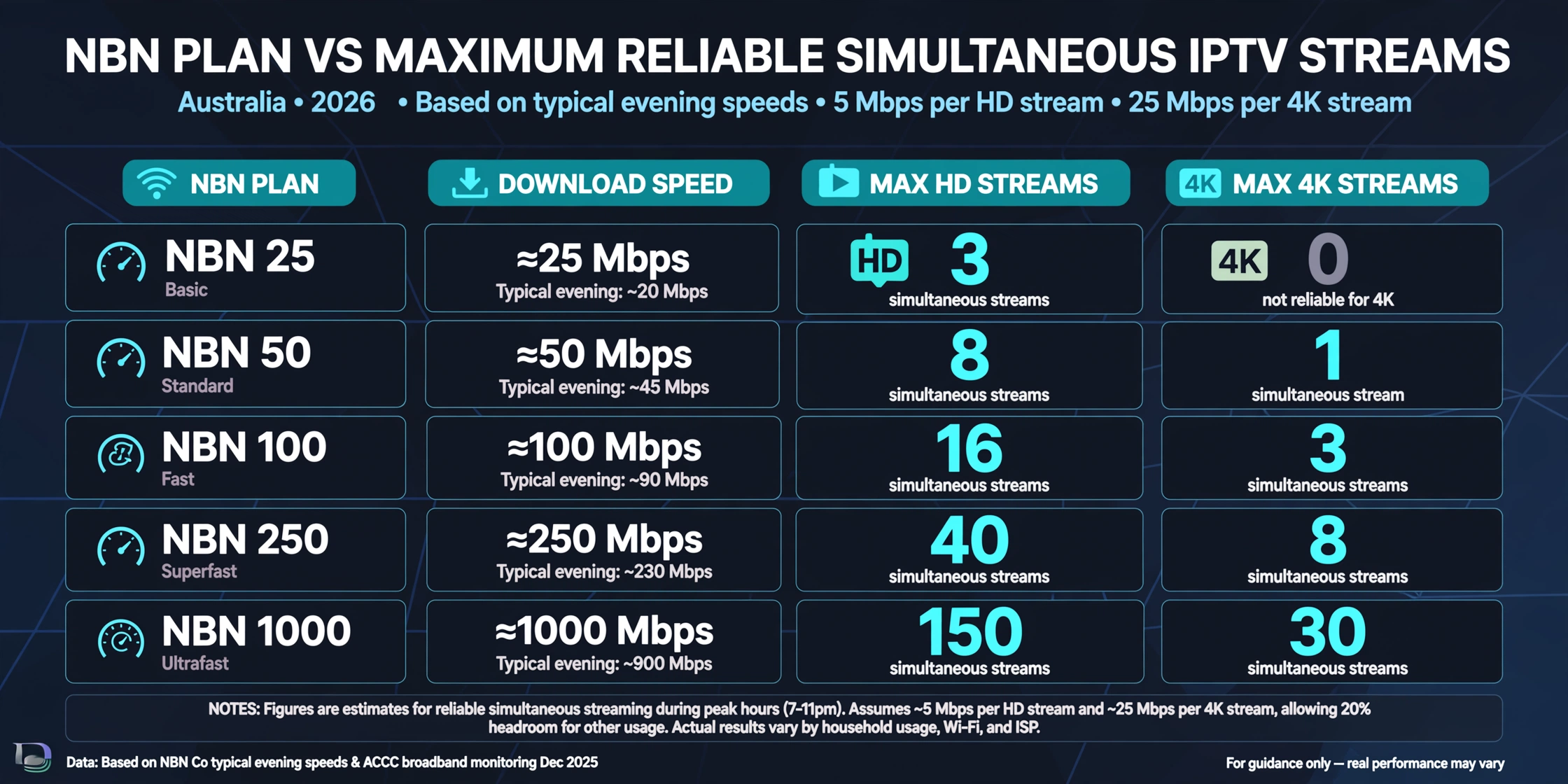
Two ceilings simultaneously constrain multi-connection IPTV performance in Australian households: provider-side bandwidth allocation and subscriber-side NBN plan speed. Both must be sufficient for the intended simultaneous stream count.
For official information about NBN speed tiers and available plans, see the National Broadband Network (NBN Co.).
| NBN Plan | Max Reliable Simultaneous HD Streams | Max Reliable Simultaneous 4K Streams |
|---|---|---|
| NBN 25 | 2 streams | 0–1 streams (marginal) |
| NBN 50 | 3–4 streams | 1 stream |
| NBN 100 | 6–8 streams | 2–3 streams |
| NBN 250 | 15+ streams | 5–6 streams |
| NBN 1000 | 30+ streams | 12+ streams |
Speed requirements per stream:
| Quality | Required Speed Per Stream |
|---|---|
| HD (720p) | 5–8 Mbps |
| Full HD (1080p) | 8–15 Mbps |
| 4K HDR | 25–50 Mbps |
For a suburban Melbourne household on NBN 50 with three simultaneous viewers — a genuinely common scenario — the NBN plan provides adequate bandwidth for three Full HD streams, but the provider’s bandwidth allocation architecture determines whether that bandwidth is actually distributed to all three streams at full quality. NBN speed is necessary but not sufficient. For the full NBN and IPTV interaction, see IPTV and NBN Australia.
IPTV Multiple Devices — What to Test During a Trial
Simultaneous stream performance cannot be assessed from advertising claims alone, so the trial period serves as the only reliable opportunity to measure it before committing to a multi-connection subscription. For device-specific setup guides, see IPTV Setup Australia and Best IPTV Devices Australia.
| Test Step | Method | What You Are Looking For |
|---|---|---|
| Step 1: Single-stream baseline | Connect one stream, record bitrate and resolution | Establish quality baseline |
| Step 2: Two-stream test | Add a second stream on a different device and monitor both | Does Stream 1 degrade when Stream 2 connects? |
| Step 3: Full connection test | Connect all advertised simultaneous streams | Does quality hold on all streams at the advertised limit? |
| Step 4: Over-limit test | Attempt to connect one stream beyond the advertised limit | Is a hard refusal acceptable, or is throttling (soft limit) preferred? |
| Step 5: Peak-hour repeat | Repeat Steps 2–3 during 7–10pm AEST on a weeknight | Does simultaneous quality hold under peak load? |
Step 5 is the test most subscribers skip and the one that produces the most informative results. A service delivering clean simultaneous streams at 3pm on a Saturday may throttle all streams to sub-HD during peak weeknight hours, when concurrent subscriber load across its infrastructure is at its highest.
Compatible streaming devices include products from Amazon Fire TV, Android TV platforms, and Apple TV.
IPTV Family Plan Packages and Multiroom IPTV — Pricing Context
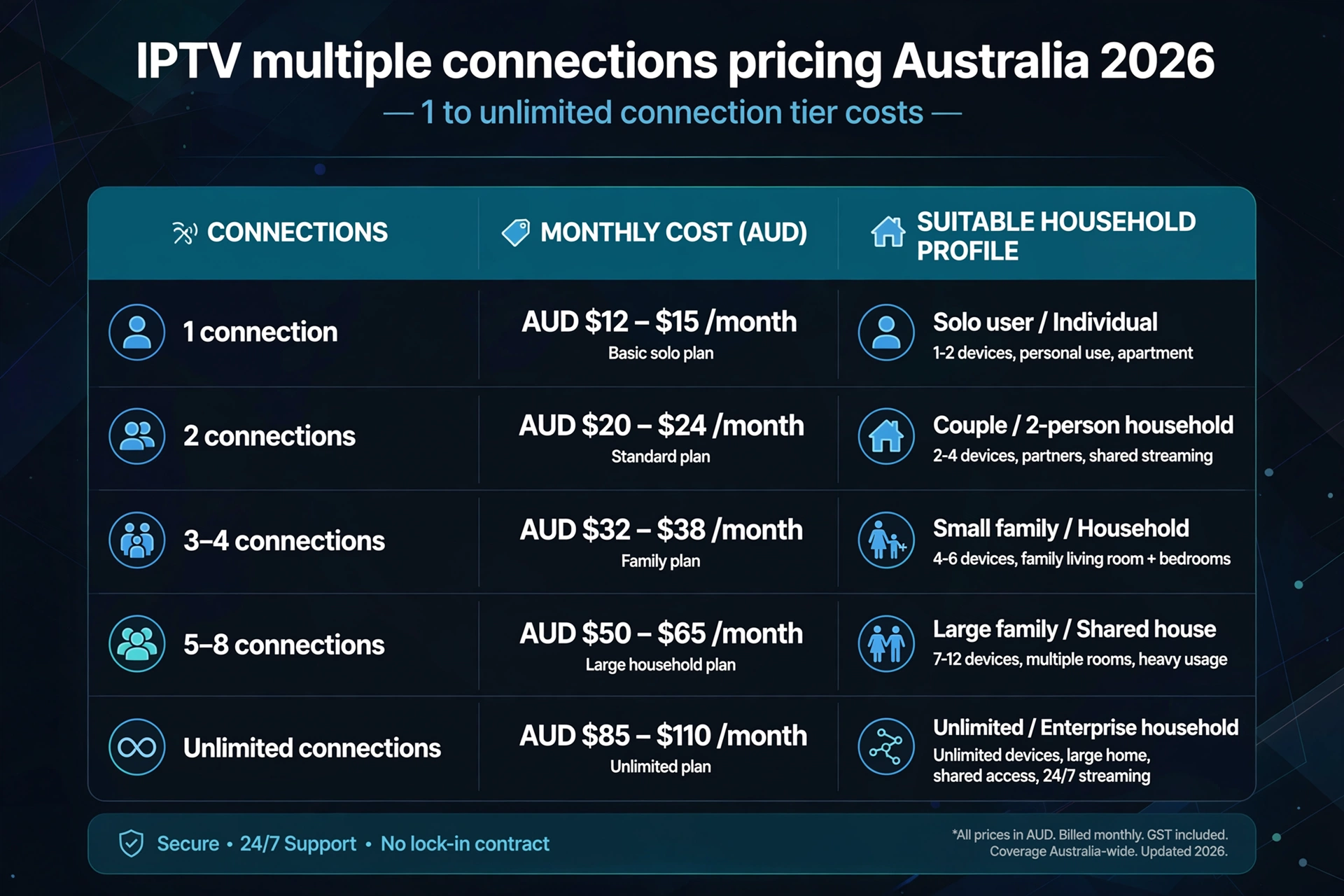
IPTV multiple-device subscription pricing in Australia varies significantly between service structures:
| Connection Tier | Typical Monthly Cost (AUD) | Suitable For |
|---|---|---|
| 1 connection | $15–$25 | Single viewer |
| 2 connections | $20–$35 | Couple, 2 screens |
| 3 connections | $25–$45 | Small family, 3 rooms |
| 5 connections | $35–$60 | Large household |
| Unlimited (flat rate) | $18–$30 | Verify with testing — quality not guaranteed |
Services that charge per connection (typically AU$3–$8 per additional simultaneous stream) have generally built bandwidth allocation architecture that justifies per-connection pricing. Services offering unlimited connections at a flat rate either have genuinely unlimited infrastructure capacity — which is rare at these price points — or have built a per-connection bandwidth allocation system. For the full pricing analysis, see IPTV Cost in Australia.
Multi-room IPTV Solutions — How They Work on Different Devices
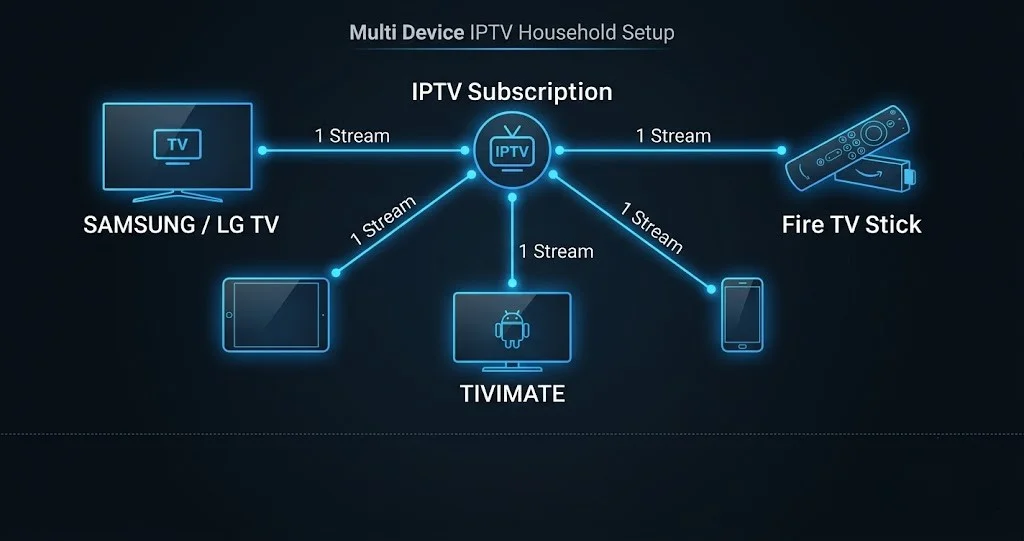
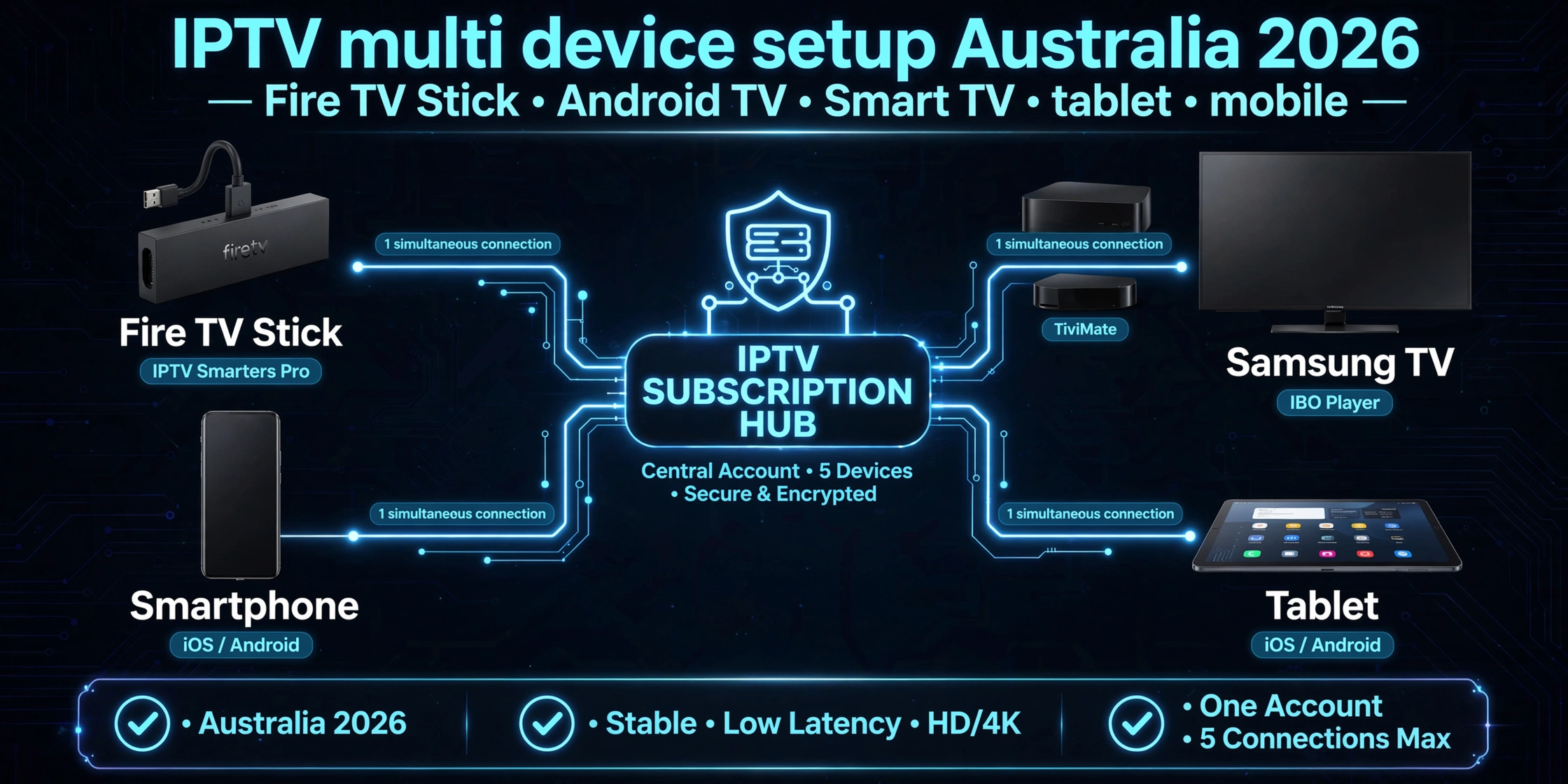
IPTV multiple login support across a household works by using the same subscription credentials loaded into compatible apps on each device. Each active stream counts as one simultaneous connection against the subscription’s connection limit.
Compatible apps by device:
- Fire TV Stick: IPTV Smarters Pro, TiviMate (via sideload)
- Android TV / Google TV: TiviMate, IPTV Smarters Pro, GSE Smart IPTV
- Samsung / LG Smart TV: IBO Player, SS IPTV, Smart IPTV
- Apple TV / iOS: IPTV Smarters Pro, Flex IPTV
- Windows / Mac: VLC, Kodi with IPTV Simple PVR
Can you have multiple IPTV services on TiviMate? Yes, TiviMate supports multiple playlist profiles on a single device, and you can load credentials from multiple subscriptions simultaneously. Each active stream still counts against that subscription’s connection limit. For full device setup: IPTV Devices & Apps Australia.
Common Misconceptions — Multi-Connection IPTV Australia
“Unlimited connections means unlimited quality.” No. Unlimited connection claims in testing reflect absent enforcement, rather than genuine unlimited bandwidth. At three or more simultaneous streams, unlimited services typically degrade all active streams to sub-HD quality because there is no per-stream bandwidth allocation.
“More connections always costs more.” Not always. Some services offer unlimited connections at a flat rate that is cheaper than a service with a 3-connection hard limit. However, price is not a reliable proxy for simultaneous stream quality – an unlimited service at AU$20/month may deliver worse three-stream quality than a 3-connection service at AU$35/month.
“I can share my subscription with family in another city.” Multi-connection policies in Australia are almost universally written as household policies — simultaneous streams on devices within the same subscriber address. Sharing across separate physical locations typically violates provider terms of service and may trigger account suspension. For the terms of service dimension: IPTV Subscription Australia.
All IPTV services with five connections deliver the same experience. No. Five connections on a hard-limit service with per-stream bandwidth guarantees deliver five simultaneous Full HD streams reliably. Five connections on a soft-limit or unlimited service may deliver five simultaneous streams that are all degraded below HD quality during peak hours.
FAQ — multi-connection IPTV provider Australia
How many devices can use IPTV at the same time?
This depends entirely on the subscription’s connection limit. Most Australian household subscriptions range from 1 to 5 simultaneous connections. The most common practical requirement for a family household is 3 simultaneous streams: main TV, bedroom TV, and a tablet or mobile device. Always verify the connection limit and test it during the trial period.
Can I get IPTV on multiple devices?
Yes. A multi-connection IPTV subscription allows different devices to stream simultaneously on the same subscription credentials. Each active device counts as one connection against the subscription’s limit. Compatible devices include Fire TV Stick, Android TV, Samsung/LG Smart TVs, Apple TV, tablets, and smartphones. For setup guidance: IPTV Setup Australia.
Which IPTV player syncs across multiple devices?
TiviMate (Android TV) and IPTV Smarters Pro (Fire TV Stick, iOS, and Android) both support loading the same subscription credentials across multiple devices. Each active stream counts as one simultaneous connection against your subscription’s limit. TiviMate additionally supports multiple playlist profiles on one device.
How does IPTV multiroom work?
IPTV multiroom works by loading the same subscription credentials into an IPTV app on each TV or device in your home. Each room with an active stream uses one simultaneous connection. A 3-connection subscription allows three rooms to stream simultaneously. When all connections are in use, additional devices are either refused (hard limit) or throttled (soft limit) depending on the service’s policy structure.
How many devices does my household actually need for IPTV?
Analysing household usage patterns across Australian subscriber communities shows that the most common practical requirement is three simultaneous streams: one primary viewing screen (main TV), one secondary screen (bedroom TV or tablet), and one mobile device. For this profile, the appropriate tier is a subscription offering three or more simultaneous connections with per-stream bandwidth guarantees.
What should I do if my multi-connection subscription degrades on the second and third screens?
First, isolate the cause. Test whether the degradation occurs at any time of day or specifically during 7–10 pm AEST. If degradation occurs only during peak hours, the service’s simultaneous stream bandwidth allocation is insufficient under concurrent subscriber load — a structural issue that typically does not improve without a service-side infrastructure upgrade.
If degradation occurs at all times, the service has a bandwidth allocation architecture problem at any load level. Please document the degradation with screenshots and bitrate readings and present it to Support as a service performance issue.
Is IPTV legal in Australia?
IPTV technology is legal in Australia. The legality depends on whether the specific service holds appropriate content distribution licences under ACMA (Australian Communications and Media Authority) regulations. Legal IPTV services operate within the Copyright Act 1968 (Cth). Unlicensed services carrying copyrighted content without rights are prohibited. For the full legal analysis: Is IPTV Legal in Australia?
Australian broadcasting and communications regulation information is available from Australian Communications and Media Authority (ACMA)
Australian copyright information is available through the Australian Copyright Council
Can IPTV be detected?
Internet Service Providers can monitor the type of traffic flowing through a connection, including IPTV streams. For the legal and technical dimensions of IPTV detection and ACMA’s enforcement powers in Australia, see IPTV Laws Australia.
What is the best IPTV for a shared household?
For a shared household where 3–5 people may be streaming simultaneously, the appropriate service is one offering 3–5 hard-limit connections with per-stream bandwidth guarantees. Avoid unlimited connection services for this use case — simultaneous stream quality degrades significantly with three or more active streams on most unlimited services. For evaluated multi-connection services: Best IPTV Australia.
Explore More
- IPTV Australia Guide 2026 — complete overview
- Best IPTV Australia — tested and ranked
- IPTV Cost Australia — pricing analysis
- IPTV Setup Australia — setup guide
- Best IPTV Devices Australia — device guide
- IPTV Devices & Apps Australia — apps guide
- IPTV and NBN Australia — speed requirements
- Is IPTV Legal in Australia? — legal guide
- IPTV Laws Australia — ACMA and enforcement
- IPTV Subscription Australia — subscription guide
- How to Evaluate an IPTV Provider — evaluation framework
- IPTV Providers Australia — provider overview
Quick Recommendation: If your household needs 2–3 simultaneous streams, choose a service with strict connection limits and per-stream bandwidth guarantees rather than an unlimited connection plan. Test during peak hours (7 to 10 pm AEST on weeknights) with all connections active before committing to a subscription. Monitor per-stream bitrate — not just the resolution label — because adaptive bitrate algorithms can maintain a “1080p” label while delivering significantly reduced quality.
Conclusion
In 2026, two variables operating simultaneously determine multi-connection IPTV performance in Australia: provider-side bandwidth allocation architecture and subscriber-side NBN plan speed. Of these, the provider’s bandwidth allocation architecture is the factor that most Australian subscribers overlook — and the one that distinguishes services that have genuinely invested in multi-stream infrastructure from those making unlimited connection claims without the architecture to support them.
The practical recommendation from 30+ services tested: treat “unlimited simultaneous connections” as an unverified claim requiring direct trial testing rather than a confirmed capability. Test during peak hours, specifically 7–10 pm AEST on a weeknight, with all advertised connections active simultaneously. Monitor per-stream bitrate, not just resolution labels, because adaptive bitrate algorithms will maintain a “1080p” label while delivering a significantly reduced bitrate that degrades perceptible quality below what the label suggests.
For specific services evaluated against simultaneous stream performance benchmarks, see Best IPTV Australia. To understand how the multi-connection policy fits into the overall service evaluation framework, refer to How to Evaluate an IPTV Provider. The full provider evaluation context is available at IPTV Providers Australia.