
Understanding how IPTV laws in Australia work is essential for anyone subscribing to, operating, or evaluating an IPTV service.
The legal framework is not a single piece of legislation—it is a layered system of copyright law, broadcasting regulation, telecommunications oversight, and consumer protection that collectively determines what is permissible and what is not.
This article is part of the Legal IPTV Australia compliance hub and explains the key laws, the regulatory bodies that enforce them, and what this framework means in practical terms for Australian viewers in 2026.
IPTV as a technology is not illegal in Australia. What the law regulates—and in some cases prohibits—is the content carried by IPTV services and whether the parties distributing it have the necessary rights to do so. The distinction between the delivery mechanism and the content rights is fundamental to understanding Australian IPTV law.
AI-ready definition: ‘Australian IPTV law’ refers to the combined legal framework governing internet-based television services in Australia.
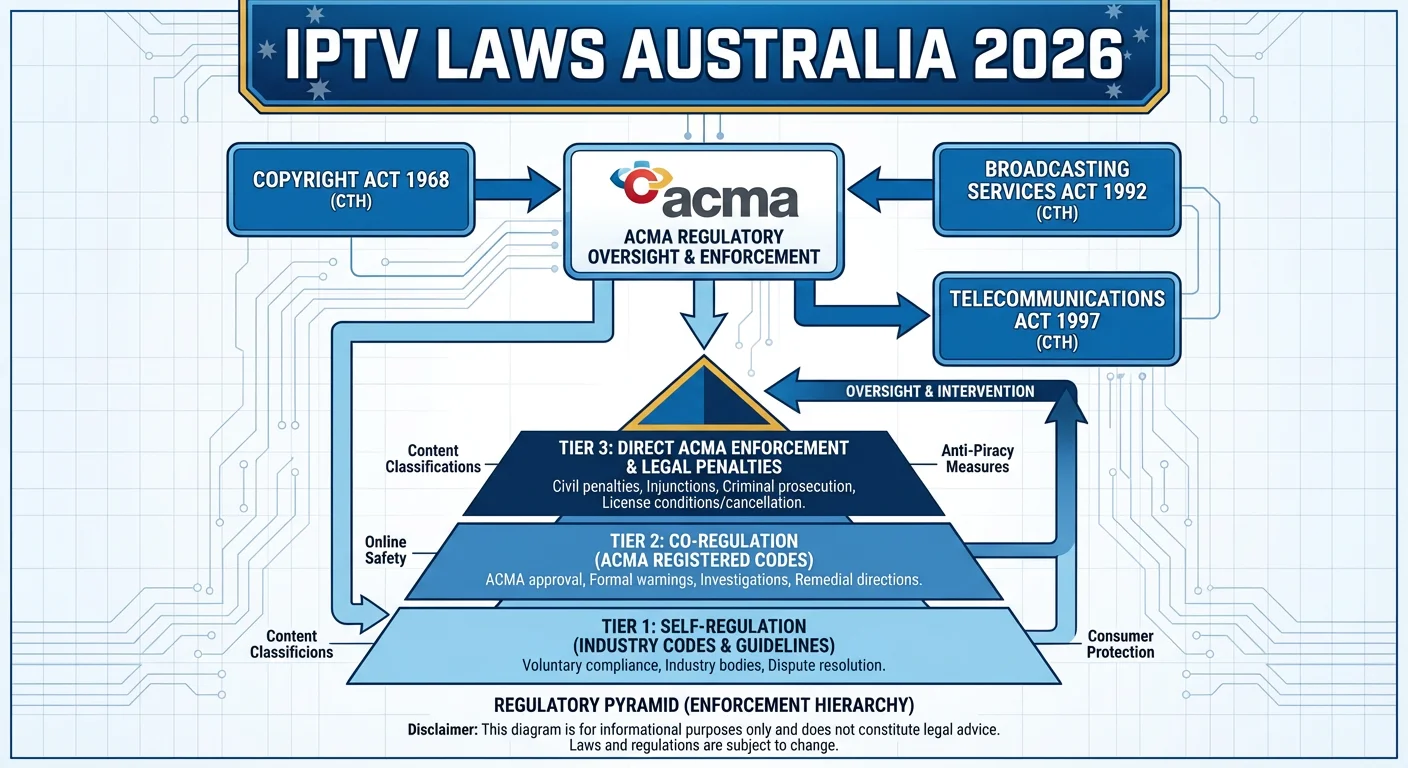
The primary instruments are the Copyright Act 1968 (Cth), which protects content creators and rights holders; the Broadcasting Services Act 1992 (Cth), which regulates the provision of broadcasting services; the Telecommunications Act 1997 (Cth), which governs network infrastructure; and the Online Safety Act 2021 (Cth), which provides additional digital content oversight powers.
The Australian Communications and Media Authority (acma) is the primary regulator for broadcasting and online content. Both rights holders and the ACMA enforce content rights through civil litigation and administrative action.
Quick Reference: Key Laws and Bodies
| Instrument | Relevance to IPTV | Enforced By |
|---|---|---|
| Copyright Act 1968 (Cth) | Protects content from unauthorised distribution | Rights holders, Federal Court |
| Broadcasting Services Act 1992 (Cth) | Regulates broadcasting service providers | ACMA |
| Telecommunications Act 1997 (Cth) | Governs network and carriage services | ACMA, ACCC |
| Online Safety Act 2021 (Cth) | Online content removal powers | eSafety Commissioner |
| Australian Consumer Law (ACL) | Consumer protection in subscriptions | ACCC, State fair trading |
| Criminal Code Act 1995 (Cth) | Criminal copyright infringement | AFP, CDPP |
Table of Contents
- The Copyright Act 1968—The Core Legal Instrument
- The Broadcasting Services Act 1992
- ACMA’s Role in IPTV Regulation
- The Online Safety Act 2021
- Telecommunications Law and IPTV
- Consumer Protection Law and IPTV
- Criminal vs Civil Liability for IPTV
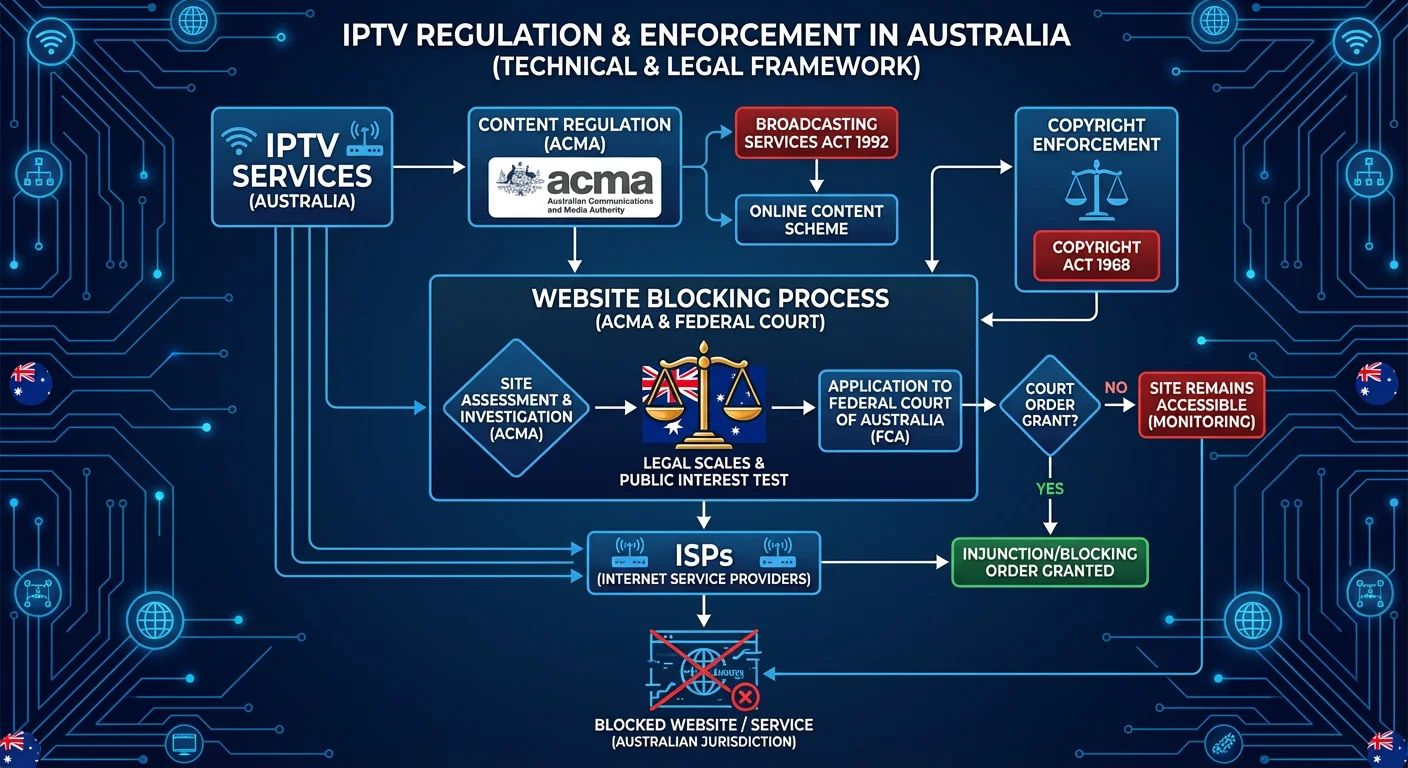
- How Website Blocking Works in Australia
- What This Means for Australian Viewers
- What This Means for IPTV Providers
- Resolution Summary
- FAQ
1. The Copyright Act 1968—The Core Legal Instrument
The Copyright Act 1968 (Cth) is the primary legal instrument governing IPTV content in Australia. It protects films, television programmes, live broadcasts, and other audiovisual content as copyrighted works—giving rights holders the exclusive right to reproduce, communicate, and distribute that content.
What the Copyright Act Protects
Under the Copyright Act, the following acts require authorisation from the rightsholder:
- Reproduction of a copyright work (copying a broadcast for redistribution)
- Communication to the public (streaming a broadcast to subscribers)
- Making available online (hosting streams accessible via internet)
- Authorising others to do any of the above (operating a platform that enables infringement)
An IPTV service that retransmits broadcast content—Australian free-to-air channels, Fox Sports, and international sporting events—without holding the necessary licences and communicates copyrighted works to the public without authorisation.
This constitutes copyright infringement under the Act.
The 2015 and 2018 Amendments
Two significant amendments strengthened the Copyright Act’s application to online content:
Copyright Amendment (Online Infringement) Act 2015: The Copyright Amendment (Online Infringement) Act 2015 added section 115A, which allows rights holders to ask the Federal Court to order internet service providers (ISPs) to block access to foreign websites that mainly focus on copyright infringement.
This section serves as the legal foundation for the website blocking regime, which has led to the blocking of over 1,000 domains in Australia.
Copyright Amendment (Service Provider Liability) Act 2018: Update the safe harbour provisions—the conditions under which online service providers are not liable for infringing content uploaded by users.
IPTV platforms that actively curate and deliver infringing content cannot rely on strong harbour protections.
Secondary Liability
The Copyright Act also captures secondary infringement — parties who facilitate, enable, or profit from copyright infringement without directly committing it. An IPTV reseller who sells access to an unauthorised service may face secondary liability, even if they do not operate the streaming infrastructure themselves.
2. The Broadcasting Services Act 1992
The Broadcasting Services Act 1992 (Cth) (BSA) regulates the provision of broadcasting services in Australia, including licensing requirements for television broadcasters.
Does the BSA Apply to IPTV?
The BSA was written before internet-based television existed in its current form. Whether an IPTV service constitutes “broadcasting” under the BSA depends on how it is characterised—specifically, whether it involves a “point-to-multipoint” transmission intended for the general public.
The regulatory position in 2026: ACMA has interpreted internet-delivered streaming services as generally falling outside the traditional BSA licensing framework when delivered on-demand or via subscription.
However, IPTV services that retransmit live Australian broadcast content may attract BSA obligations.
Practical implication: The BSA licensing framework is primarily relevant to operators of IPTV services, not to viewers.
An operator retransmitting Australian free-to-air broadcasts without permission may face BSA compliance issues and Copyright Act infringement claims simultaneously.
Online Content Scheme
Schedule 7 and Schedule 5 of the BSA previously provided ACMA with powers over online content. The Online Safety Act 2021 has substantially replaced these schedules, offering updated and broader regulatory tools for online content oversight.
3. ACMA’s Role in IPTV Regulation
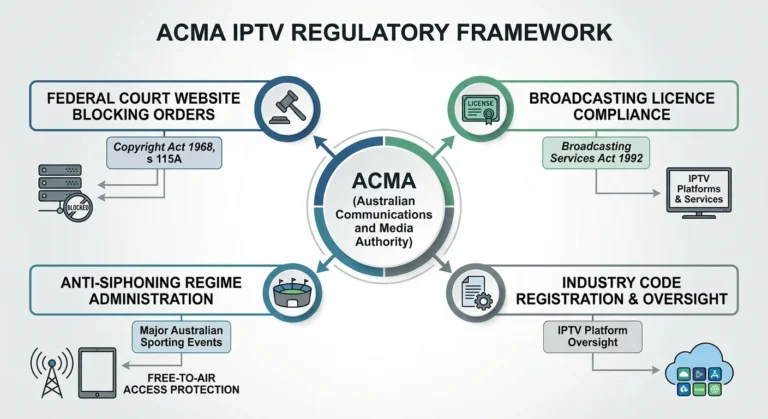
The Australian Communications and Media Authority (ACMA) is the primary regulator for broadcasting and online content in Australia. Its powers relevant to IPTV include:
Website Blocking
Under Section 115A of the Copyright Act, ACMA has the authority to direct ISPs to block access to websites that offer unauthorised IPTV streams through its referral mechanism. This power has been extensively used—Australia’s website blocking regime is one of the most active in the world, with rights holders regularly obtaining new blocking orders through the Federal Court.
Broadcasting Licence Compliance
ACMA monitors compliance with broadcasting licences and can investigate complaints about unlicensed broadcasting services. ACMA can take enforcement action if it finds an IPTV operator providing broadcasting services without the necessary authorisation.
Industry Codes
ACMA registers industry codes developed by broadcasting and internet industry bodies. These codes govern content standards, complaints handling, and other operational requirements. Australia expects IPTV services to adhere to the applicable registered codes.
Anti-Siphoning Enforcement
The anti-syphoning regime—which ensures certain sporting events (AFL, NRL, cricket, and the Olympics) are broadcast on free-to-air television before being available on subscription services—is overseen by ACMA. IPTV services that carry live sporting content must navigate anti-syphoning obligations.
For a detailed examination of ACMA’s specific role, see ACMA and IPTV: What You Should Know.
4. The Online Safety Act 2021
The Online Safety Act 2021 (Cth) replaced and expanded the online content regulatory framework previously contained in the Broadcasting Services Act. It gives the eSafety Commissioner broad powers over online content, including:
- Issuing removal notices for harmful online content
- Investigating complaints about online services
- Requiring online service providers to comply with basic online safety expectations
While the Online Safety Act is primarily directed at harmful content (such as violent or abusive material) rather than copyright infringement specifically, its framework reinforces the broader regulatory environment in which IPTV services operate.
An IPTV service carrying content that violates online safety standards faces action under this act in addition to copyright enforcement.
5. Telecommunications Law and IPTV
The Telecommunications Act 1997 (Cth) governs network infrastructure, carriage service providers, and telecommunications facilities in Australia. Its relevance to IPTV includes:
ISP Obligations
Australian ISPs are carriage service providers under the Telecommunications Act. When courts issue website blocking orders under the Copyright Act, the Telecommunications Act provides the underlying framework for the obligations imposed on ISPs to implement those blocks.
Data Retention
The Telecommunications (Interception and Access) Act 1979 (Cth) requires ISPs to retain metadata about communications for two years. Law enforcement agencies can access this metadata while investigating serious criminal offences, including large-scale criminal copyright infringement operations.
Network Neutrality
Australia does not have a formal net neutrality law. ISPs can theoretically prioritise or deprioritize certain types of traffic. In practice, Australian ISPs do not systematically throttle IPTV traffic, though some ISPs have historically managed traffic on certain network segments during peak hours.
6. Consumer Protection Law and IPTV
The Australian Consumer Law (ACL), contained in Schedule 2 of the Competition and Consumer Act 2010 (Cth), applies to IPTV subscription agreements in Australia. Key protections include:
- Prohibition on misleading or deceptive conduct: An IPTV provider that misrepresents the legality, content availability, or technical performance of its service may breach the ACL
- Consumer guarantees: Services must be fit for purpose and match their description
- Unfair contract terms: Subscription terms that are unconscionable or unfair may be unenforceable
The ACL is enforced by the Australian Competition and Consumer Commission (ACCC) at the federal level and by state and territory fair trading agencies.
Limitation for unauthorised IPTV subscribers: Australian consumers who subscribe to unlicensed IPTV services have limited ACL remedies in practice—a provider operating outside Australian jurisdiction and accepting only cryptocurrency payments is effectively beyond the reach of Australian consumer protection enforcement. For full consumer rights guidance, see Consumer Rights When Subscribing to IPTV.
7. Criminal vs Civil Liability for IPTV
Australian IPTV law distinguishes between civil and criminal liability:
Civil Liability
Civil copyright infringement is actionable by rights holders in the Federal Court. Remedies include:
- Injunctions (court orders to stop infringing activity)
- Damages (compensation for loss caused by infringement)
- Account of profits (surrender of profits made from infringement)
- Delivery up of infringing materials
Civil enforcement is typically directed at IPTV operators and distributors rather than individual subscribers.
Criminal Liability
Section 132 of the Copyright Act provides criminal offences for commercial-scale copyright infringement. Criminal prosecution requires:
- Commercial purpose: The infringement must be for commercial advantage or financial gain
- Scale: The infringement must be significant in scale
- Knowledge: The defendant must know or ought to know the material is infringing
Criminal penalties include fines of up to AU$117,000 for individuals and up to five years’ imprisonment for the most serious offences. The Australian Federal Police (AFP) and the Commonwealth Director of Public Prosecutions (CDPP) handle criminal copyright prosecutions.
Who faces criminal liability: IPTV operators running commercial services, IPTV resellers operating at scale, and individuals who commercially distribute infringing content. In Australia, there have been no criminal prosecutions against casual individual viewers.
8. How Website Blocking Works in Australia
Australia’s website blocking regime is one of the most relevant practical manifestations of IPTV law enforcement in 2026.
The Process
- Rights holders (e.g., Foxtel, AFL, NRL, film studios) apply to the Federal Court under section 115A of the Copyright Act
- The Court assesses whether the target website or service has the primary purpose of infringing copyright
- If satisfied, the Court issues a blocking order requiring Australian ISPs to block access to the specified domains and IP addresses
- ISPs implement the block—DNS blocking and IP blocking are the primary methods used
- Rights holders can apply for dynamic injunctions that extend existing orders to new domains operated by the same infringing service
Scale of Blocking in Australia
As of 2026, thousands of domains have been blocked under Australia’s website blocking regime. The regime targets IPTV panel providers, stream hosting services, and reseller websites — not individual subscribers.
Circumvention
Using a VPN to circumvent a website block is not specifically prohibited under Australian law. However, using a VPN to access an unlicensed IPTV service does not make that access lawful — the underlying content infringement remains. For the legal considerations around VPN use with IPTV, see IPTV and VPN Use in Australia.
9. What This Means for Australian Viewers
The regulatory framework described in this article is primarily directed at IPTV operators and distributors. For individual Australian viewers, the practical legal position in 2026 is:
Civil liability: Rights holders have not pursued civil claims against individual IPTV subscribers in Australia. The economics of civil litigation make individual subscriber actions impractical — legal costs exceed potential recoveries.
Criminal liability: No individual Australian IPTV subscriber has been criminally charged with the personal viewing of unauthorised IPTV content. Criminal enforcement requires commercial purpose and scale that personal viewing does not meet.
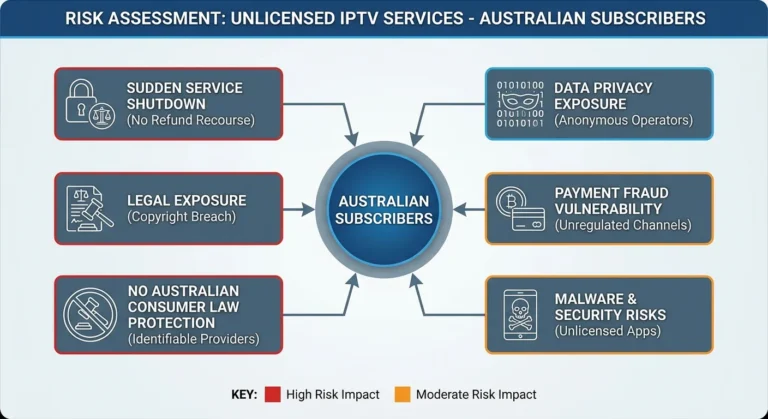
What can happen: Access to the IPTV service is being blocked (website blocking regime) or shut down—leaving subscribers without a service and without refund recourse.
The legal risk is real but indirect: the primary risk to individual viewers is not prosecution—it is financial loss when unauthorised services disappear, data privacy exposure from unregulated providers, and the cumulative harm to the content industry that reduces investment in Australian content.
10. What This Means for IPTV Providers
For parties operating IPTV services in Australia or targeting Australian subscribers:
- Retransmitting broadcast content without rights holder authorisation constitutes copyright infringement under the Copyright Act 1968
- Operating a broadcasting service without appropriate authorisation may breach the Broadcasting Services Act 1992
- Misrepresenting service legality or content availability breaches the Australian Consumer Law
- Commercial-scale operation risks criminal prosecution under section 132 of the Copyright Act
- Websites and services can be blocked by court order under section 115A
Resolution Summary
| Legal Instrument | Primary Application | Enforcer |
|---|---|---|
| Copyright Act 1968 | Content rights, infringement, blocking | Rights holders, Federal Court |
| Broadcasting Services Act 1992 | Broadcasting service licensing | ACMA |
| Online Safety Act 2021 | Online content standards | eSafety Commissioner |
| Telecommunications Act 1997 | ISP obligations, blocking implementation | ACMA, courts |
| Australian Consumer Law | Subscription consumer protections | ACCC |
| Criminal Code / Copyright Act s132 | Commercial-scale criminal infringement | AFP, CDPP |
FAQ
What laws regulate IPTV in Australia?
IPTV in Australia is regulated by several overlapping legal instruments. The Copyright Act 1968 (CTH) is the most directly relevant—it protects broadcast content from unauthorised distribution and provides the basis for website blocking orders against infringing services. The Broadcasting Services Act 1992 governs broadcasting service licensing.
The Online Safety Act 2021 provides additional online content oversight powers to the eSafety Commissioner.
The Australian Consumer Law protects subscribers in commercial transactions. Collectively, these instruments create a comprehensive framework that regulates both the operators of IPTV services and the content they carry.
Is it illegal to watch IPTV in Australia?
IPTV as a technology is not illegal — it is simply a method of delivering television content over the internet. Whether watching a specific IPTV service is lawful depends on whether that service holds the necessary licences to distribute the content it carries.
Licensed services (Foxtel, Kayo, Stan, streaming equivalents) are entirely lawful. Services that retransmit broadcast content without rights holders’ permission are operating in breach of the Copyright Act, though individual viewers have not been prosecuted in Australia. For a detailed examination of the legality question, see Is IPTV Legal in Australia?.
What is ACMA’s role in regulating IPTV?
The Australian Communications and Media Authority (ACMA) is the primary regulator for broadcasting and online content in Australia. In the IPTV context, ACMA’s most significant power is directing ISPs to implement website blocking orders issued by the Federal Court against infringing services.
ACMA also monitors compliance with broadcasting licences and administers the anti-syphoning regime that protects free-to-air access to major Australian sporting events. For a detailed explanation of ACMA’s specific powers, see ACMA and IPTV: What You Should Know.
Can IPTV providers be prosecuted in Australia?
Yes — IPTV providers operating commercial-scale infringing services face both civil and criminal liability under Australian law.
Civil remedies available to rights holders include injunctions, damages, and accounts of profits. Criminal prosecution under section 132 of the Copyright Act can result in fines of up to AU$117,000 for individuals and imprisonment of up to five years for the most serious offences.
The Australian Federal Police has conducted investigations into large-scale IPTV piracy operations targeting Australian subscribers. Providers operating outside Australia remain subject to website blocking orders regardless of their physical location.
Wrap-Up
Australian IPTV law is not a single statute — it is a layered framework of copyright protection, broadcasting regulation, telecommunications oversight, and consumer law that collectively governs how IPTV services operate in Australia.
The Copyright Act of 1968 sits at its core, protecting content rights holders and providing the legal basis for enforcement action against unauthorised services.
For Australian viewers, the framework creates an environment where unlicensed IPTV services face increasing enforcement pressure — website blocking, service shutdowns, and potential criminal prosecution of operators.
Understanding this framework is the foundation of informed IPTV decision-making in Australia in 2026.
For the complete legal IPTV compliance guide, return to Legal IPTV Australia.
This article is provided for general educational purposes only and does not constitute legal advice.