
Introduction
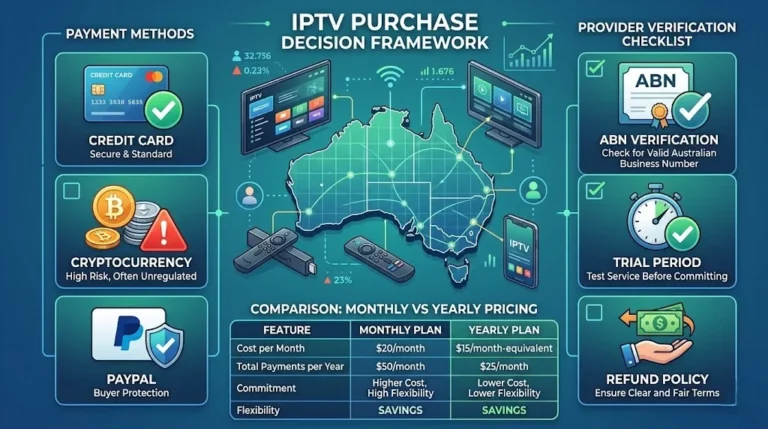
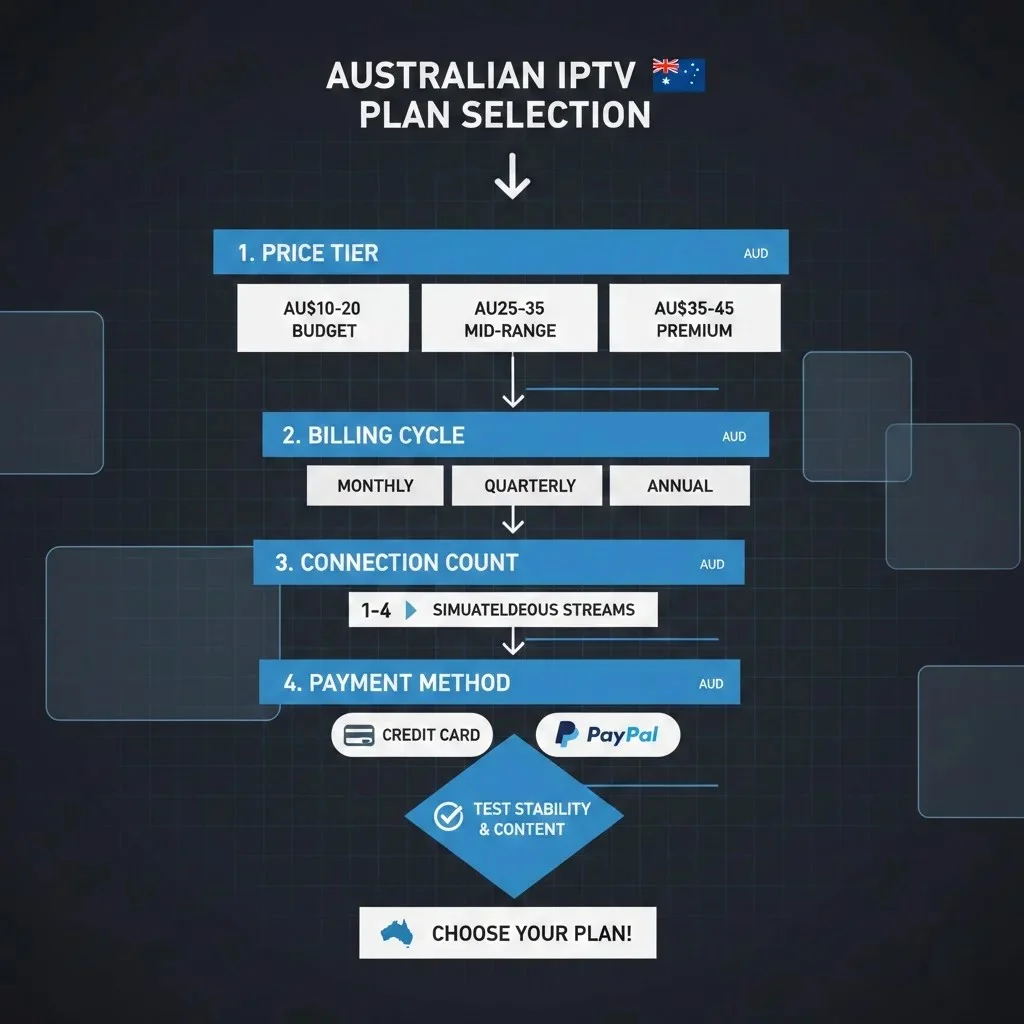
To choose the right IPTV plan in Australia, five decisions—made in sequence—produce the subscription configuration that matches your viewing needs, household size, and risk tolerance. These decisions are price tier (budget, mid-range, or premium), billing cycle (monthly, quarterly, or annual), connection count (1-4 simultaneous streams), payment method (credit card, PayPal, or other), and provider selection (based on trial testing). Each decision builds on the previous one, creating a structured path from “I want IPTV” to “I have the right subscription.”
To pick the best IPTV plan in Australia, follow these five steps: first, choose a price tier based on how much you watch ($10-20 for budget, $25-35 for mid-range, and $35-45 for premium); next, select a billing cycle that fits how much you trust the provider (monthly for new ones, quarterly or annual for those you know well); then, decide how many connections you need based on how many people will watch at the same time (1-4); after that
This framework consolidates the pricing, risk, and value analysis from across this pillar into a single actionable decision process.
For the complete pricing landscape, see our IPTV subscription plans guide.
Step 1: Choose Your Price Tier
Your price tier should match your primary viewing use case—not your desire for the lowest possible price.
tier ($10-20) if IPTV, or Internet Protocol Television. Choose the budget ($10-20) if IPTV supplements another TV source, you watch primarily off-peak, or you are exploring IPTV for the first time and want minimal financial commitment.
Choose mid-range ($25-35) if: IPTV is your primary household television. This is the recommended tier for most Australian households—delivering reliable daily viewing with a functional Electronic Program Guide (EPG), stable sports, and sustainable infrastructure.
Choose Premium ($35-45) if you have zero tolerance for buffering during sports, need 3–4 reliable simultaneous connections, or prioritise 4K content.
For detailed tier analysis, see our article on IPTV cost in Australia.
Step 2: Choose Your Billing Cycle
Your billing cycle should match your relationship with the provider—not the discount percentage.
Choose monthly if: You are subscribing to a new provider. Monthly billing limits your risk to one month while you evaluate quality.
Choose quarterly if: You have been using the provider for 2–3 months with consistent satisfaction. Quarterly captures 15-25% savings with manageable risk.
Choose annual if: You have used the provider for 4–6 months+ with consistently excellent service. Annually, you can capture 40–60% savings with an established provider you trust.
For detailed billing cycle analysis, see our article on monthly vs yearly IPTV.
Step 3: Determine Your Connection Count
Your connection count equals the maximum number of screens showing different content simultaneously during your peak viewing window.
1 connection: Single-viewer households or couples who watch together. 2 connections: Most couples and small families—the most common requirement. 3 connections: Families with teenagers or multiple independent viewers. 4 connections: Large households with several simultaneous viewing needs.
Add the per-connection cost to your base subscription to calculate the total monthly cost.
For multi-connection pricing detail, see our article on IPTV multi-connection pricing.
Step 4: Select Your Payment Method
Always use a credit card or PayPal. This is not a preference—it is a financial protection decision. Credit cards and PayPal provide chargeback mechanisms that protect your subscription investment if the service fails to deliver. This protection applies at every billing cycle and every price tier.
For detailed payment analysis, see our article on IPTV payment methods.
Step 5: Verify Through Trial Testing
Before committing your subscription budget, test the provider during a trial period. Prioritise peak-hour testing (8-9:30 PM), verify EPG (Electronic Program Guide) accuracy, test sports stability if relevant, and confirm catch-up functionality, which allows viewers to watch programs they missed. A provider that passes these tests during a structured trial will deliver reliable daily viewing.
For trial evaluation methodology, see our article on IPTV free trials.
Your Plan Configuration Summary
After completing all five steps, your subscription configuration should look like this:
Example: Typical Australian family
- Price tier: Mid-range ($30/month)
- Billing cycle: Monthly (new provider) → quarterly after 3 months
- Connections: 2 (+$10/month)
- Payment: Credit card
- Total: $40/month → $480/year
- Saving vs Foxtel equivalent: $588-768/year
Example: Single sports viewer
- Price tier: Mid-range ($28/month)
- Billing cycle: Monthly initially
- Connections: 1 (included)
- Payment: PayPal
- Total: $28/month → $336/year
- Saving vs Kayo + Foxtel: $324-912/year
Frequently Asked Questions
What IPTV plan do most Australians choose?
The most common configuration is a mid-range all-inclusive plan ($25–35/month) with two connections on monthly billing, paid by credit card. This covers the typical Australian household viewing needs—sports, entertainment, news, kids, and international content—at a price that delivers sustainable quality. See our subscription plans guide.
Can I change my plan later?
Most providers allow plan changes at renewal—upgrading connections, changing billing cycles, or adjusting packages. Starting with a conservative configuration (monthly, minimum connections) and adjusting based on experience is the recommended approach.
What if I choose the wrong plan?
Monthly billing provides the flexibility to adjust at the next renewal. If you find you need more connections, you can add them. You are not bound by a lengthy commitment if you decide to change providers. Starting monthly and adjusting is lower-risk than starting annually and discovering the plan does not match your needs.
Is there one best IPTV plan for everyone?
No—the right plan depends on individual viewing needs, household size, and risk tolerance. The framework presented in this article generates a personalised configuration based on your specific situation rather than a one-size-fits-all recommendation.
Conclusion
Choosing the right IPTV plan in Australia follows a structured five-step process: price tier, billing cycle, connection count, payment method, and trial verification. This pillar’s analysis, which includes pricing benchmarks, risk assessment, and value comparison, informs each decision. The framework produces a subscription configuration that matches your household’s actual needs rather than defaulting to the cheapest option (which may frustrate) or the most expensive (which may overspend). Start with the recommended mid-range tier, monthly billing, and protected payment—then adjust based on your experience.