
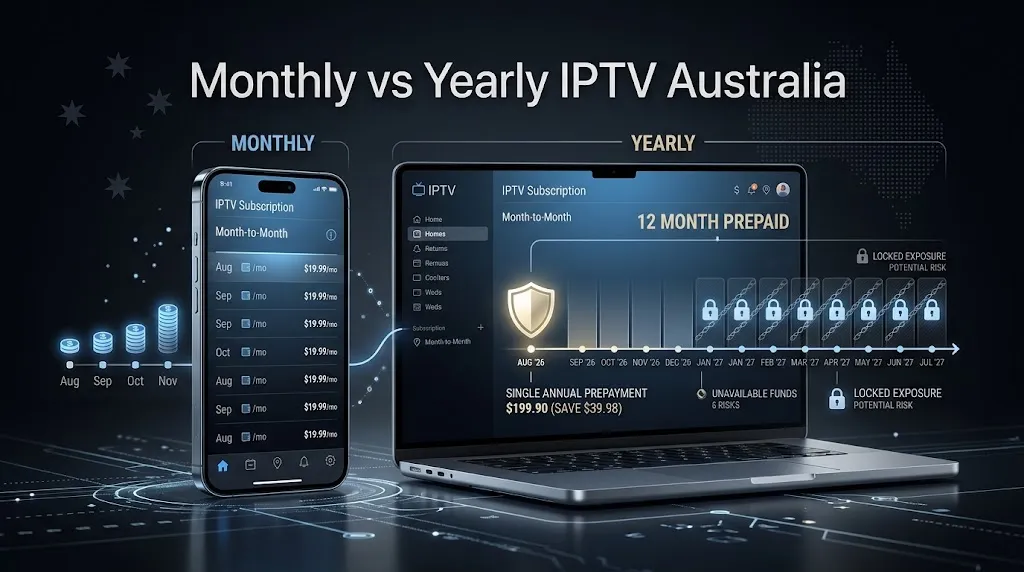
Monthly vs yearly IPTV Australia decisions get framed as arithmetic, and the arithmetic usually favours the annual plan. But the discount is not the number that matters most — what matters is how much you are holding if the service stops working in month four. This article covers how to calculate your own saving, how the licensed platforms compare, and what to check before committing twelve months. For the wider picture on how this market works, start with our IPTV Australia guide.
Quick Answer
Monthly vs yearly IPTV Australia comes down to trading money for exposure. Annual plans cost less per month, but you carry the unused remainder as unrecoverable risk if the provider stops operating. Licensed platforms like Kayo Sports bill monthly, so no prepayment question arises.
What Does a Year of IPTV Actually Cost You?
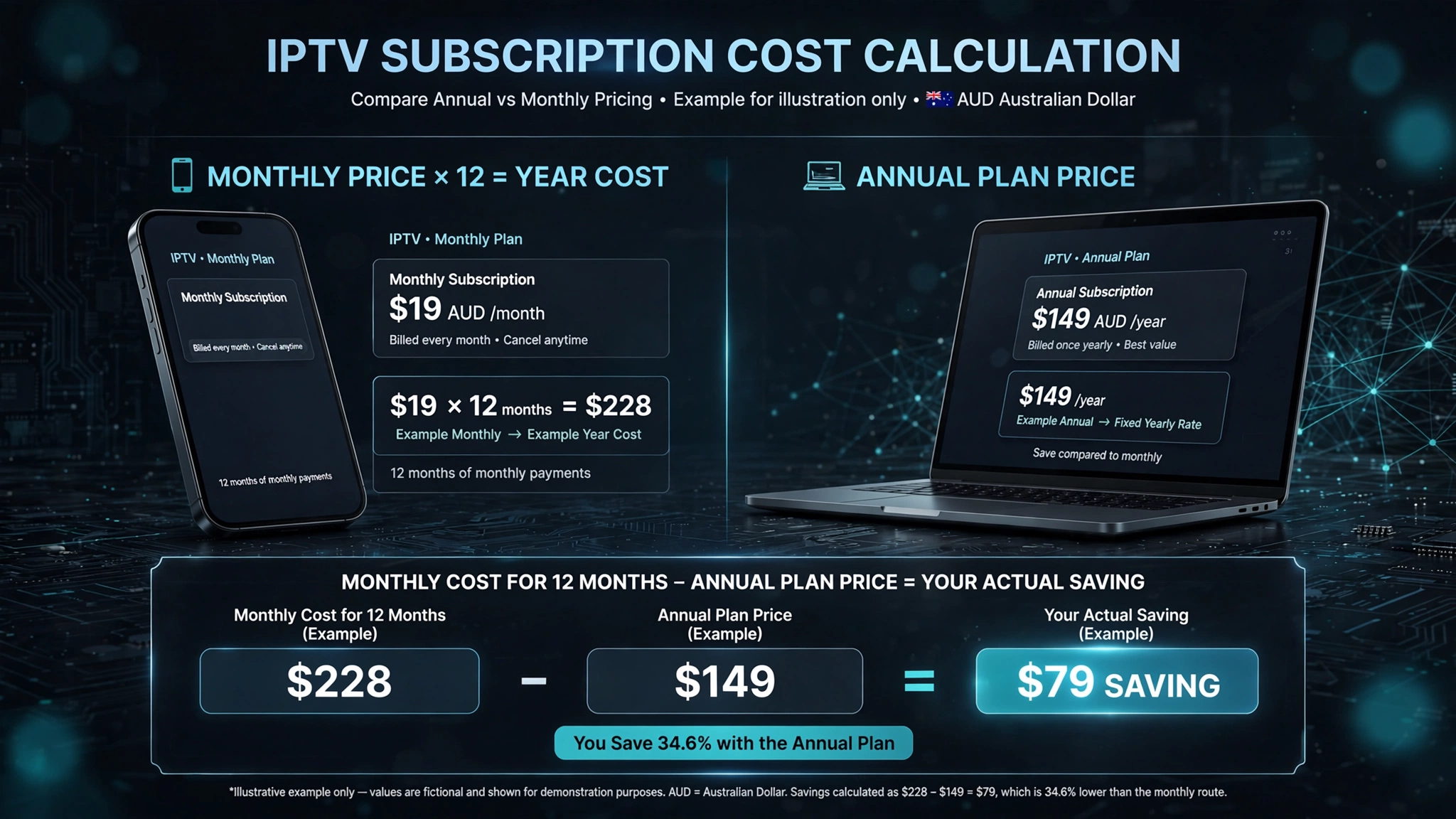
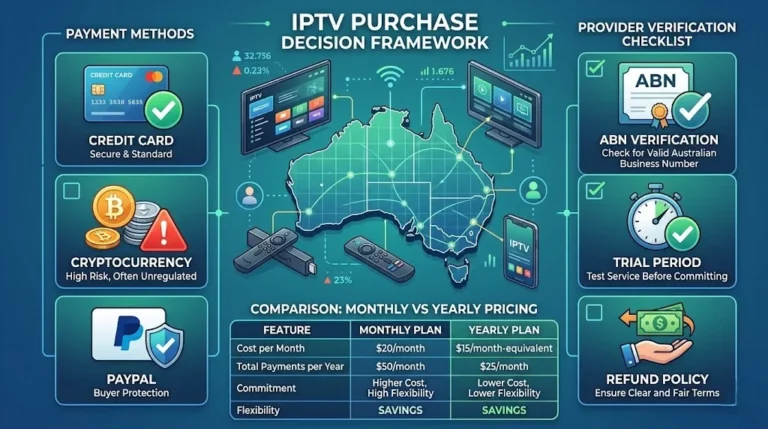
A year of IPTV at monthly rates is the monthly price multiplied by twelve. Compare that figure — not the monthly price — against the annual plan, and the difference is your real saving. On low-cost services marketed to Australian viewers, that gap is usually wide enough to change the decision.
The comparison most people run is annual price against monthly price, which compares a year to a month and tells you nothing. Run it properly:
Monthly price × 12 = what a year costs at monthly rates
Then subtract the annual plan price. That number is yours, calculated on your provider’s current figures, and it does not go stale the way a published percentage does.
Two things distort this calculation for Australian buyers specifically. Advertised prices on these services are frequently listed in US dollars even when the marketing targets Australia, so what you read as “dollars” may not be the currency leaving your account.
And international transaction fees on Australian cards add a margin that never appears on the pricing page. Check both before committing to twelve months of either.
Key takeaway: multiply the monthly price by twelve and compare that against the annual price — no published percentage substitutes for your own provider’s current figures.
The Licensed Comparison: What Kayo and Foxtel Charge
Before weighing billing cycles on an unlicensed service, it is worth knowing what the licensed alternatives cost, because for sports viewers in particular the gap is narrower than it first appears.
Kayo Sports is Foxtel’s dedicated sports streaming platform, carrying over 50 sports including AFL, NRL, cricket and Formula 1. Foxtel is Australia’s established pay television provider, now owned by DAZN, holding exclusive rights to several major properties.
| Platform | Price | Streams | Billing |
|---|---|---|---|
| Kayo Standard | $29.99/month | 1, HD | Monthly, cancel anytime |
| Kayo Premium | $45.99/month | 2, 4K | Monthly, cancel anytime |
| Foxtel Sports + Movies bundle | From $84/month | Varies | Contract terms apply |
Prices correct as of August 2026 — verify current plans at kayosports.com.au before subscribing.
The structural point matters more than the numbers. You pay Kayo bills monthly, and you can cancel at any time, so the prepayment question this article addresses does not arise at all. You are never holding unused months. Kayo raised its premium tier to $45.99 in February 2026 and, as of July 2026, removed its general free trial, though Telstra customers can still access a 14-day trial through bundling.
That trade — higher monthly cost, zero prepayment exposure — is the comparison the rest of this article is measured against. Our IPTV vs Kayo comparison covers the content differences in detail.
Why Does Every IPTV Provider Push the Yearly Plan?
Providers push annual plans because upfront cash is worth more to them than the revenue they give up. A steep discount buys certainty: the money arrives now rather than across twelve uncertain months. That trade transfers the risk of the service not lasting from the seller onto you.
Look at what a very large annual discount means from the seller’s side. They are surrendering a substantial share of per-subscriber revenue to receive payment immediately. A business confident of keeping you for a year does not need to buy that certainty — it can simply deliver a good service and collect monthly, as Kayo does.
Cash upfront is most valuable to an operation uncertain about the next twelve months. That uncertainty may be ordinary business pressure, infrastructure costs needing coverage, or something more fundamental. From outside, you cannot distinguish between them.
This is not an accusation against any particular service, and a large annual discount is not evidence of bad faith. It is a structural observation about how the incentive works: the discount is what you are being paid to accept a risk transfer. Whether that payment is adequate is a judgement only you can make.
One detail worth noticing: the annual discount is offered identically to everyone. A first-time buyer who has never tested the service pays the same annual rate as someone two years in without a problem. The provider is not pricing your individual risk — you are absorbing it.
Monthly vs Yearly IPTV Australia: What You Lose If the Service Stops
The practical difference between billing cycles is not price. It is how much you are holding when something goes wrong.
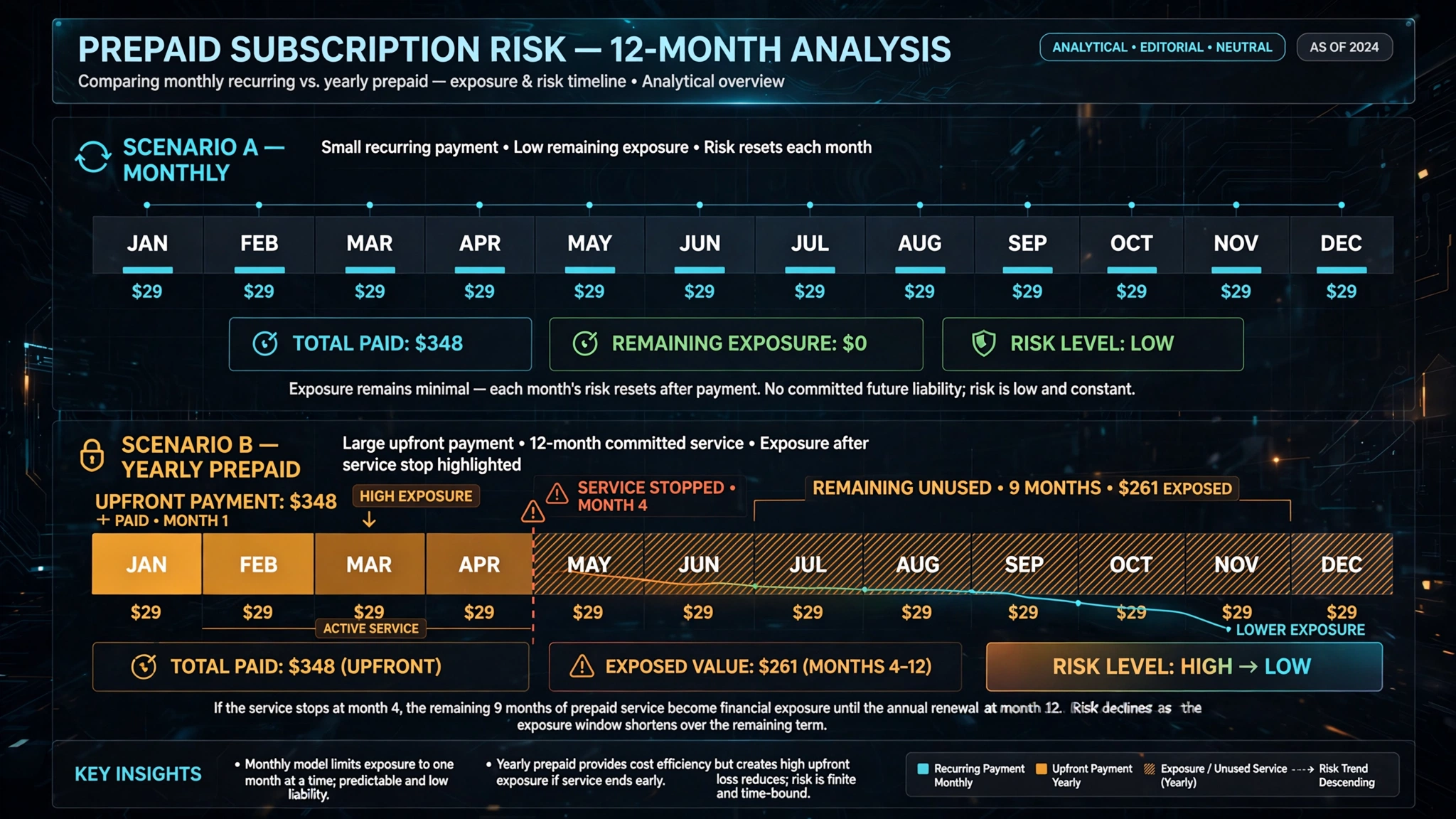
A monthly subscriber whose service degrades has lost at most one month. They stop paying and move on. An annual subscriber in the same position has already paid for months they will not receive, and recovery depends on the provider’s willingness to refund, their continued existence to refund from, and whatever the payment method allows.
That exposure shrinks as the year runs down, which reveals something the standard comparison misses entirely. Risk is highest the moment you pay and lowest just before renewal. So when you commit matters as much as whether you commit. Prepaying twelve months on day one puts maximum money against minimum information. The identical commitment after several months of steady service is a different decision carrying the same price tag.
This is the argument for treating a billing cycle as a ladder rather than a binary choice. Start on the shortest term available. If the service holds through the hours you actually watch — weekday evenings, live sports, whatever matters in your household — step up. Extend again only if it keeps holding. Each rung buys information before it buys commitment.
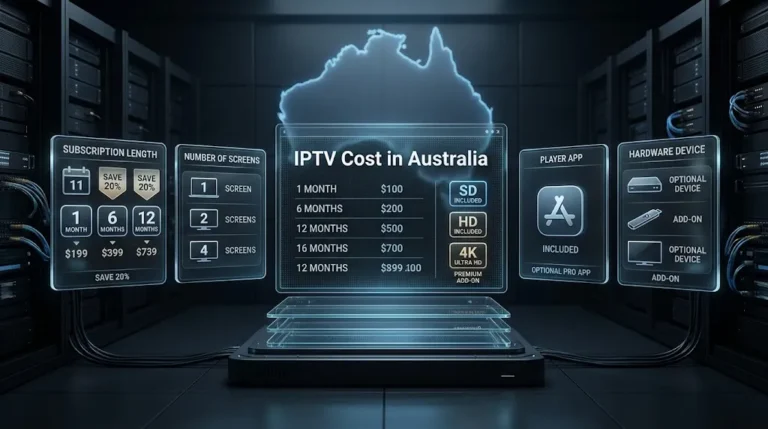
Quarterly and six-month cycles exist for exactly this purpose and are routinely overlooked because the marketing jumps straight from monthly to annual. Our guide to IPTV subscription length covers the intermediate options.
Key takeaway: prepayment exposure is highest on day one and falls throughout the term, so the timing of an annual commitment matters as much as the decision to make one.
How Can I Check a Provider Before I Prepay a Year?
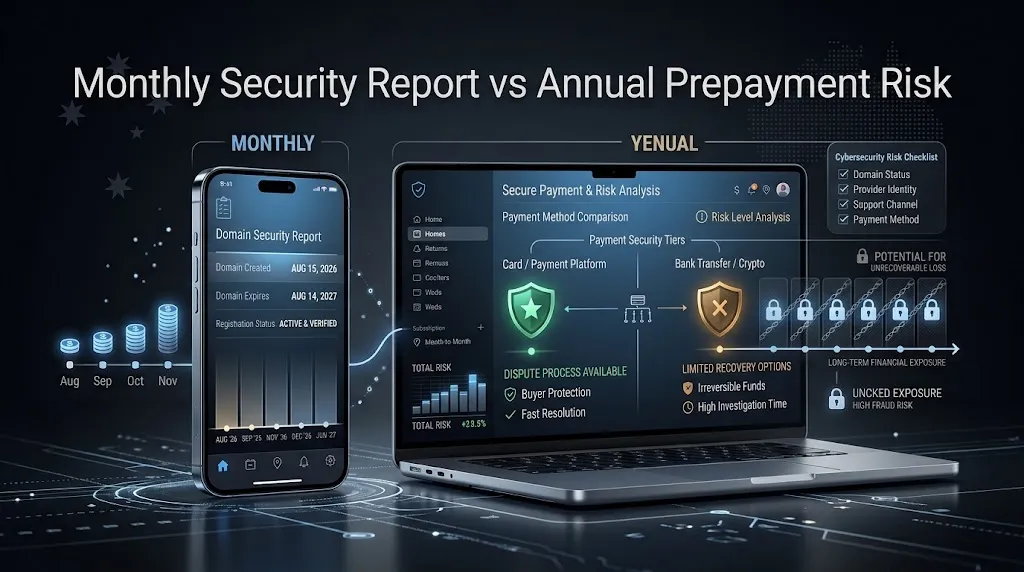
Look up the provider’s domain registration record using a WHOIS lookup, which shows when the domain was registered and when it expires. A registration expiring before the subscription term you are buying is worth pausing on. It proves nothing on its own, but it is one input worth checking.
Every domain name carries a public registration record. ICANN, the body that coordinates the global domain name system, provides a free registration data lookup service that returns creation and expiry dates for any domain.
What the expiry date tells you: whether the registration extends past the term you are buying. Domain registrations are inexpensive, and operations planning years ahead generally register years in advance.
What it does not tell you: whether the service will still be running. Registrations get renewed at the last minute routinely, and plenty of stable businesses renew annually out of habit.
The reverse inference is the one people get wrong, so state it plainly: an expired provider domain can be a warning sign, but it is not proof by itself that the provider has permanently shut down. Services rebrand, migrate to new domains, and abandon old registrations after moving. A dead domain is a reason to ask a question, not the answer to one.
Used properly, this is one signal among several — alongside how long the operation has existed, whether a business identity sits behind it, and whether support is reachable through more than one channel. None decides anything alone. Together they form a picture. Our guide to IPTV subscription risks covers the wider set.
How Payment Method Changes What You Can Recover
Payment methods differ in what they leave available to you if a prepaid service stops working, and this interacts directly with billing cycle length. It is the one variable in this decision you control completely.
Card payments and established payment platforms include a formal dispute process for undelivered goods and services, subject to the provider’s rules and time limits. Those limits are the part that catches people out: dispute windows generally run from the transaction date, not from when the problem appeared. A twelve-month prepayment can fall partly outside the window by the time anything goes wrong — which is precisely the scenario annual billing creates.
Direct bank transfers and cryptocurrency payments do not carry an equivalent process. Once sent, the transaction is complete from the payment system’s perspective, and recovery depends entirely on the recipient’s cooperation.
This is not a workaround or a trick — it is how these systems are built, and the longer the term you prepay, the more the difference matters. A service accepting only payment methods without dispute mechanisms is telling you something about the arrangement on offer. Our IPTV payment methods guide covers the options, and our refund policy guide covers what these services typically offer, which is generally not much.
Three Australian Household Scenarios
The sports household deciding in March. A season is starting, and the pressure to commit annually is highest. But a season runs months, not twelve — and Kayo Standard at $29.99 with monthly cancellation covers the AFL, NRL and cricket with no prepayment at all. Run the multiplication against Kayo before assuming the annual IPTV plan is the cheaper path.
The household that has used the same service for a year. This is the case where annual billing is most defensible. The service has demonstrated something across the hours you watch, and you are no longer paying blind. Use a payment method with a dispute process and note the renewal date.
The household is chasing specific international channels. Availability varies by provider, and channel lists change without notice, so what you are prepaying for may not be there in month six. Verify the specific channels during a trial period, and keep the term short until you have watched them through a full month.
Key takeaway: an annual commitment is most defensible after a service has already proven itself across your actual viewing hours and least defensible at the start of a sports season.
The Legal Position in Australia
Two different things get called ‘IPTV’, and they sit in different places legally. A player app — TiviMate, IPTV Smarters Pro, or any App Store player — is neutral software supplying no content of its own. A subscription service supplying channels is a separate matter, and its standing depends on whether it holds rights to what it distributes.
The ACMA (Australian Communications and Media Authority) is the federal regulator with responsibility in this area, and the Copyright Act 1968 is the governing legislation. The ACMA maintains information on website blocking and online copyright enforcement in Australia.
This affects prepayment directly. Consumer protections available in an ordinary Australian transaction may not operate the same way with a service running outside the licensing framework, frequently from outside Australia. That makes prepayment risk here different in kind, not merely in degree, from prepaying a mainstream subscription. Read our guide to IPTV legality in Australia before any billing decision — it is the more important question, and the billing cycle only matters once it is settled.
This article is for educational and comparison purposes only. Verify the licensing status of any streaming service and ensure compliance with Australian copyright law before subscribing.
Bottom Line
If you are new to a service : take the shortest term available regardless of the annual discount. You are buying information you cannot otherwise obtain, and one month is a reasonable price for it.
If you are weighing an annual plan seriously : run the multiplication on current prices, confirm which currency you are charged in, and use a payment method with a dispute process. Then decide whether the saving compensates for carrying the remaining months.
If sport is your main reason to subscribe : compare against Kayo Standard at $29.99 monthly before anything else. Monthly billing with no prepayment removes this entire question, and for a single-sport household the annual IPTV saving may be smaller than it looks.
Explore More
- IPTV Australia Guide — the pillar guide
- Is IPTV legal in Australia?
- IPTV Australia Subscription Plans
- IPTV Subscription Risks
- IPTV Refund Policy Australia
- IPTV Payment Methods Australia
- IPTV Auto-Renewal Australia
- Consumer Rights and IPTV in Australia
Freshness Plan: review by November 2026, or sooner if Kayo or Foxtel pricing changes.