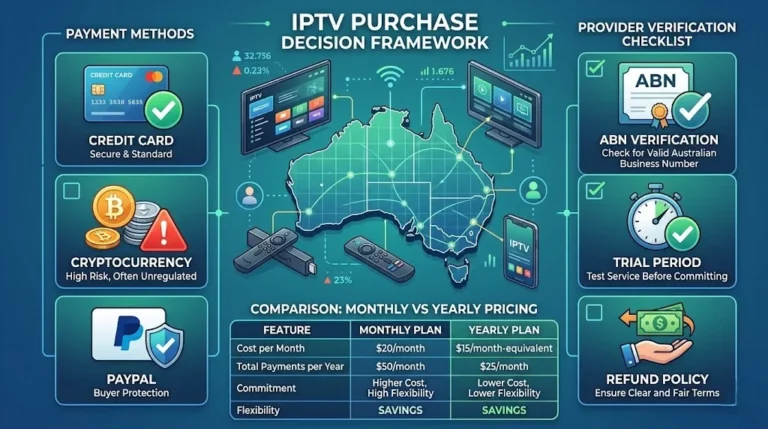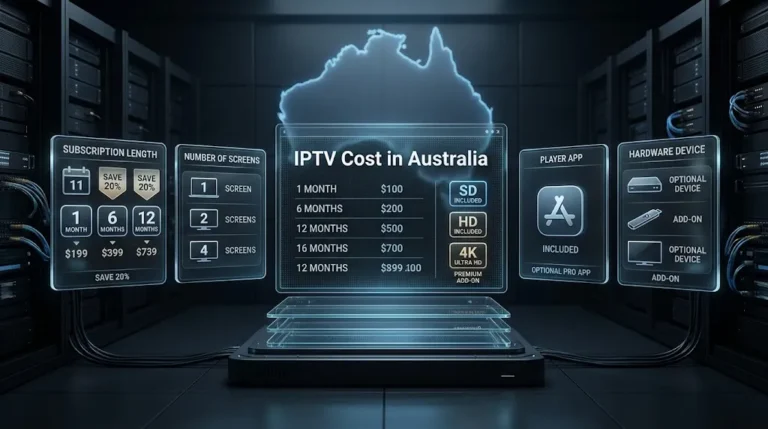

IPTV refund Australia questions almost always start in the wrong place—with the provider’s refund page. That page tells you what the seller is willing to do, which is a different question from what the seller is obliged to do, and the two answers frequently disagree.
This article separates them: what published policies actually say, what Australian law says regardless, and where the gap between those two becomes a practical problem. For the wider picture on how this market operates, see our IPTV Australia guide.
Quick Answer
IPTV refund Australia outcomes depend on three separate layers: the provider’s stated policy, your rights under the Australian Consumer Law, and your payment method’s dispute process. The ACCC confirms a business cannot remove consumer guarantees by writing “no refunds” into its terms.
Start With the Licensed Platforms
Before working through refund mechanics on an unlicensed service, it’s worth knowing that the question barely arises on the licensed ones – and understanding why explains most of what follows.
Kayo Sports is Foxtel’s dedicated sports streaming platform, carrying over 50 sports including AFL, NRL and cricket. Foxtel is Australia’s established pay television provider. Both are Australian businesses with registered entities, published contact details, and an obvious address for a complaint.
Kayo bills monthly with cancellation at any time, so there is no prepaid remainder to recover. Kayo Standard is $29.99 per month and Premium $45.99 — prices correct as of August 2026; verify current plans at kayosports.com.au before subscribing. Cancel and you simply stop being billed.
That structural difference matters more than the price difference. A refund dispute needs a counterparty who can be identified, contacted and, if necessary, reported. Australian platforms provide that by existing as Australian businesses. The rest of this article is about what happens when that condition isn’t met. Our IPTV vs Kayo comparison covers the content trade-offs.
What Do IPTV Refund Policies Actually Say?
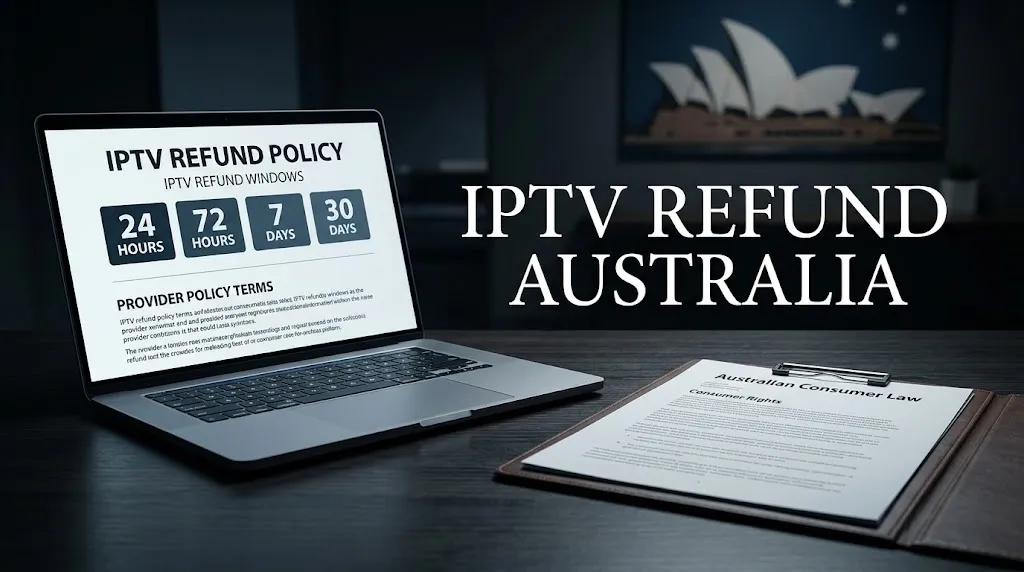
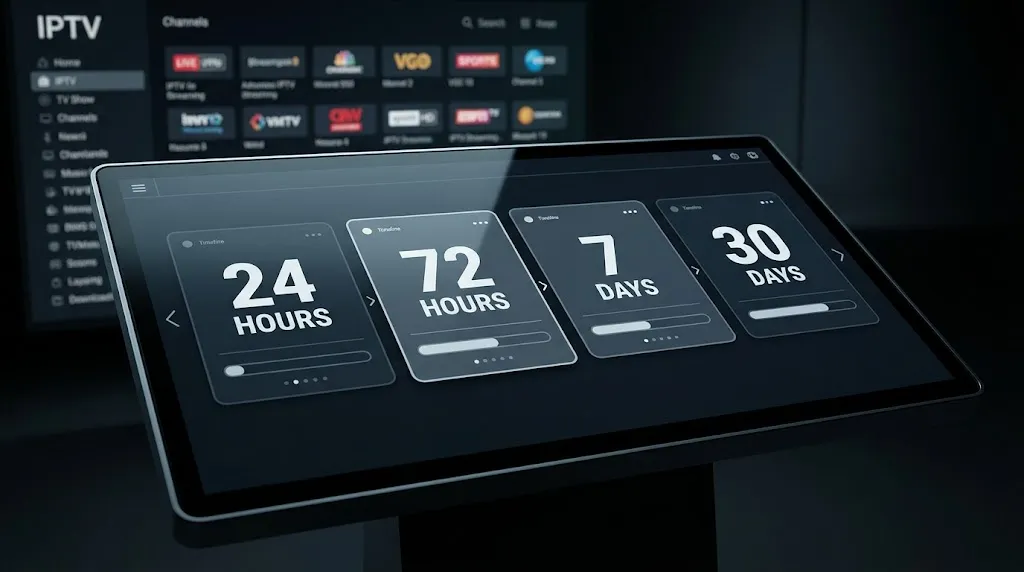
Published IPTV refund policies vary far more than any summary suggests. Reading seven Australian-facing provider policies in August 2026 found windows of 24 hours, 72 hours, seven days and 30 days, alongside services stating that all sales are final once the account is activated.
That range is the finding. Summaries claiming most providers offer a seven-day guarantee flatten a spread that runs from one day to thirty, and the difference between them is not a detail — it decides whether you have any contractual claim at all.
The windows found
| Refund window stated | What it means in practice |
|---|---|
| 24 hours from purchase | Effectively one evening of testing before the contractual window closes |
| 72 hours from purchase | A weekend, but not a full billing cycle |
| 7 days from initial subscription | Enough to test across weekday and weekend viewing |
| 30 days from purchase | The longest window found, framed as a returns policy |
| Final once activated | No contractual refund window at all |
Windows read from published Australian-facing IPTV provider policy pages, August 2026. Providers are not named because the point is the variation, not any individual service.
The exclusions are where policies converge
The windows differ wildly, but the exclusion lists look remarkably similar across services. Recurring exclusions include change of mind, buying the wrong plan, problems with the customer’s own internet connection or device, channel line-ups changing during the subscription, and accounts suspended for terms violations.
Several also require the customer to allow support time to investigate before any refund is considered, and some specify a minimum outage duration before a service failure qualifies.
Read together, these produce a narrow opening: a refund is available if the service fails, you report it inside a short window, you allow the provider time to attempt a fix, and the failure is verified as originating on their side.
Key takeaway: published IPTV refund windows in Australia range from 24 hours to 30 days, with some offering none at all, so the policy you agreed to may bear no resemblance to a summary you read elsewhere.
Can a Provider Legally Say “All Sales Final”?
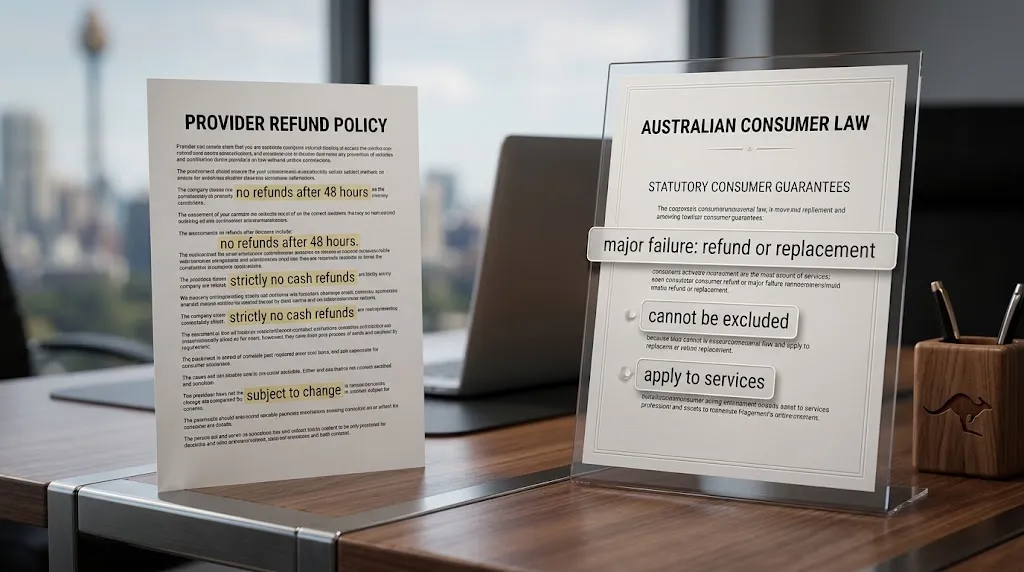
No. Under the Australian Consumer Law, consumer guarantees cannot be removed by any term a business writes into its policy. The ACCC states plainly that a business cannot take those rights away by saying refunds are unavailable, or unavailable after a set number of days.
The ACCC (Australian Competition and Consumer Commission) is the federal regulator enforcing the Australian Consumer Law, the national legislation covering consumer transactions. Its guidance on consumer rights and guarantees is direct: these basic rights cannot be taken away by anything a business says or does, and misleading consumers about them is itself unlawful.
The confusion worth clearing up
There is a distinction here that gets collapsed constantly, including in AI-generated search summaries: a provider’s refund policy is not the law.
A policy says what the seller offers voluntarily. The consumer guarantees say what the seller must provide when something goes wrong, and they operate underneath every policy regardless of what it states. A 24-hour window does not mean your rights expire after 24 hours. It means the provider’s voluntary offer expires then.
You’ll see summaries stating that change-of-mind requests and unused periods after the window are “generally non-refundable”, presented as though describing the legal position. They’re describing provider terms.
A change of mind genuinely isn’t covered by consumer guarantees — but a service that stops working is a different matter entirely, and no policy window governs that.
It applies to overseas sellers too
The ACCC’s position is that when an overseas business sells directly to consumers in Australia, that business must follow the Australian Consumer Law, including the consumer guarantees. Being based offshore does not exempt a seller from the law when selling into this market.
Hold that thought — the next section is about why it helps less than it sounds.
Key takeaway: a provider’s refund policy states what the seller offers, while the Australian Consumer Law states what the seller owes, and the ACCC confirms no policy term can remove the second.
What Counts as a Major Failure?
A major failure is a problem serious enough that you would not have bought the service had you known about it. Under the ACCC’s guidance on services, a major failure lets you cancel the agreement and seek a refund for the unused portion rather than accepting a repair.
This distinction decides which remedy you can insist on, and it’s worth getting right before contacting anyone.
Major versus minor
The ACCC’s framework separates the two by seriousness and by what the consumer can demand. For a major problem with a service, the consumer has the right to alter the agreement — meaning cancellation and a refund of what’s unused. For a minor problem, the business gets the opportunity to fix it first, and a free repair or re-supply within a reasonable time is a legitimate response.
Applied to a streaming subscription, that framing suggests a service that has ceased operating entirely, or one so unstable it cannot be used for its stated purpose, sits in different territory from a handful of channels being temporarily unavailable. The first prevents you receiving what you paid for. The second is the kind of thing a re-supply can address.
Why the provider’s own exclusions matter here
Notice how the exclusion lists interact with this. Excluding problems caused by your own internet connection is consistent with the law — that isn’t a failure of the service. Excluding “the service stopped working after the refund window” is not. The first is a fair scoping of responsibility; the second attempts to time-limit a guarantee that has no time limit.
Reading a policy with that distinction in mind tells you something useful about the seller before you buy: which exclusions are reasonable scoping and which are attempts to contract out of obligations that cannot be contracted out of.
IPTV Refund Australia: Where the Law Stops Being Useful
Here is the part that most consumer-rights explanations leave out, and it changes what you should actually do.
The ACCC itself acknowledges that when dealing with an overseas business, obtaining a remedy in practice can be difficult. The right exists. Enforcing it requires a counterparty who can be identified, contacted, and subjected to some form of consequence.
What enforcement actually requires
Consider what asserting a consumer guarantee involves. You need a business name. A jurisdiction. A contact method that produces responses. Ideally a payment trail showing who received the money. Where a service operates through informal messaging channels, publishes no business identity, and accepts payment through methods without a dispute process, each of those is missing – and the guarantee, though legally intact, has nobody to be asserted against.
This is why I’d treat the presence of a business identity as more informative than the generosity of the refund window. A 30-day policy from an operation you cannot identify is worth less than a 7-day policy from a registered business because the second is enforceable and the first is a sentence on a webpage.
The practical inversion
Which produces a conclusion that runs opposite to the intuitive one. For an identifiable Australian business, your legal rights are the strong protection, and the payment method is the backup. For an anonymous offshore operation, that reverses: the payment method’s dispute process is the real protection, and the legal right is theoretical.
Our guide to consumer rights and IPTV in Australia covers the legal framework in more depth, and IPTV provider red flags cover identifying who you’re dealing with before paying.
Key takeaway: Australian Consumer Law applies to overseas sellers, but the ACCC acknowledges enforcement is difficult in practice — so for an unidentifiable provider, the payment method matters more than the legal right.
Your Payment Method Is the Practical Remedy
Given the above, the choice you make at checkout does more work than any policy you read.
Card payments and established payment platforms carry formal dispute processes for services not delivered as described. Direct bank transfers and cryptocurrency payments generally do not — once sent, the transaction is complete from the payment system’s side, and recovery depends on the recipient’s cooperation.
The timing problem
Dispute windows generally run from the transaction date rather than from when the problem appeared, which interacts badly with long prepayments. A twelve-month subscription bought in January can develop a problem in September that falls outside the window entirely — not because the claim is weak, but because the clock started at purchase. Our monthly vs yearly IPTV guide covers that exposure, and our IPTV payment methods guide covers the options.
The practical consequence is that delay costs more than most people expect. A dispute raised in the week a service fails is straightforward; the same dispute six months later may be unavailable regardless of merit.
What to Keep Before You Need It
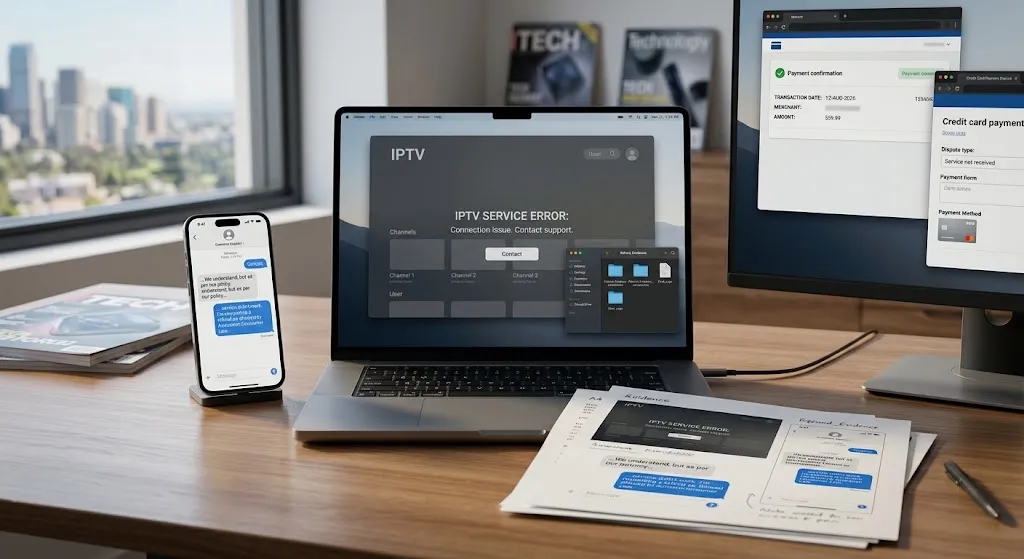
Every refund route — provider request, consumer guarantee claim, or payment dispute — asks for the same evidence, and all of it is easier to collect before there is a problem than after.
Keep the payment confirmation and transaction reference. Screenshot the advertised features and channel list at the time of purchase, because that’s what “not as described” is measured against, and provider pages change without notice. Save the refund policy page as it read when you bought it, for the same reason. Keep support correspondence. And if the service fails, capture the error rather than describing it later.
That last one matters more than it sounds. A dispute assessed months afterwards turns on documentation, and a screenshot dated the day a service stopped working is worth considerably more than a recollection of when it happened.
Key takeaway: screenshot the advertised channel list and refund policy at purchase, because “not as described” is measured against what was promised then, and provider pages change without notice.
The Legal Context in Australia
Refund rights and copyright law are separate questions, and it’s worth stating why both appear here.
Consumer guarantees under the Australian Consumer Law govern the transaction — whether you received what you paid for. The Copyright Act 1968 governs the content, and the ACMA (Australian Communications and Media Authority) is the federal regulator for broadcasting and online content in Australia, including website blocking measures. A service can raise questions under the second while your rights under the first still exist.
The practical link is that services operating outside the licensing framework tend to be the same services that are hard to identify, hard to contact, and structured to be difficult to pursue — which is precisely the enforcement problem described above. Before any refund question arises, our guide to IPTV legality in Australia covers the position properly, and IPTV subscription risks covers what tends to go wrong.
This article is for educational and comparison purposes only. It is not legal advice. Verify the licensing status of any streaming service and ensure compliance with Australian copyright law before subscribing.
Bottom Line
If a service you paid for has stopped working: act now rather than after further attempts to resolve it. Document the failure, request a refund from the provider in writing, and open a payment dispute if there’s no substantive response — dispute windows run from your purchase date, and delay is what closes them.
If you’re deciding whether to subscribe: read the refund policy before paying and weigh the exclusion list more heavily than the headline window. A 30-day policy that excludes everything except verified server-side outages offers less than a 7-day policy without those carve-outs.
If sport is your main reason to subscribe: Kayo Standard at $29.99 monthly with cancellation at any time removes the refund question entirely and does so from an Australian business with an identifiable address for complaints.