
By Daniel Carter, IPTV Systems Analyst & Service Comparison Specialist · Best IPTV Australia Services · Last updated: September 2026
Quick Answer
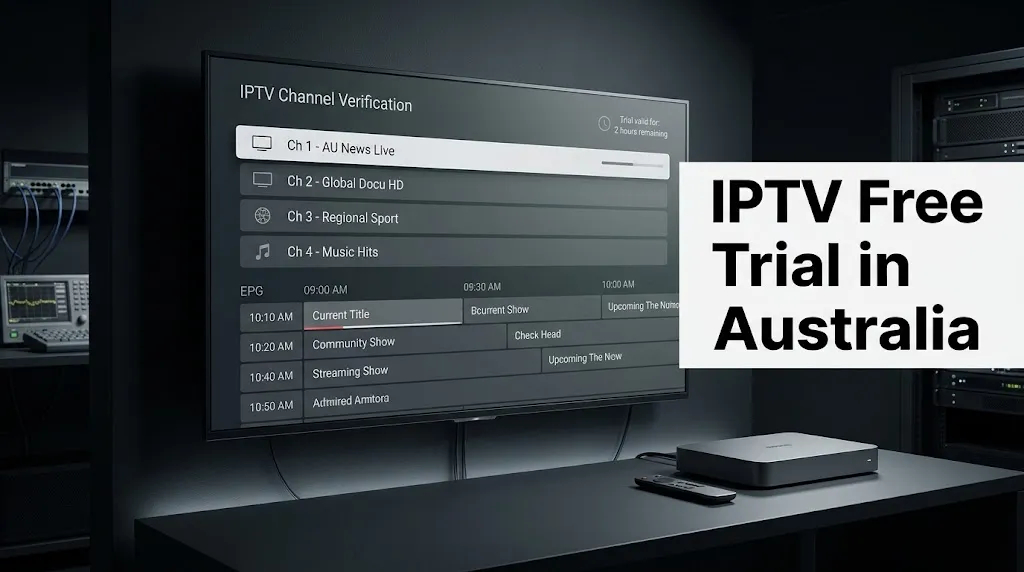
An IPTV free trial in Australia is usually measured in hours rather than days — four, twelve or twenty-four is the norm. That makes the order you test things in more important than the length of the trial itself. Check your own channels first, on the screen you will actually use.
IPTV free trial in Australia searches usually turn up guides built around a week of testing. That is not what the market offers. Most trials run for a few hours, and the longer periods are generally paid — which makes them short subscriptions rather than trials. This article assumes you have hours, not days, and sets out what to check in the order that matters. For the wider picture, the IPTV Australia guide covers how the whole thing fits together.
What an IPTV Free Trial in Australia Actually Looks Like
From what I see in this market, free trials come in three lengths: four hours, twelve hours, or twenty-four. Anything substantially longer is usually paid, and once money changes hands it is a short subscription with a different name.
That matters for two reasons. A four-hour window will not stretch to cover a weekday evening, a weekend and a live match, so any plan built on that assumption fails before it starts. And a paid “trial” carries the same recovery problem as any other payment — if the service disappoints, getting the money back depends on how you paid.
The practical consequence is that you need a priority order rather than a schedule. Work down the list until the trial ends, and the things at the top are the ones you cannot afford to skip.
Start With the Free Options That Need No Trial
Before any trial, check whether what you want is already available at no cost and no risk.
Australia’s free-to-air broadcasters stream their own channels through ABC iview, SBS On Demand, 7plus, 9Now and 10 play. These are not trials. They are free permanently, they are licensed by the networks that own the content, and they need nothing beyond an account. A meaningful share of what most households watch sits inside them, including some live sport.
If that covers your viewing, you are finished and no trial is required. The licensed alternatives guide sets out what each app carries. What follows is for anyone who has checked and still needs something those apps do not cover.
Five Checks, in Order
Do them in this sequence. If the trial ends halfway through, you will still have the answers that matter most.
1. Your Own Channels
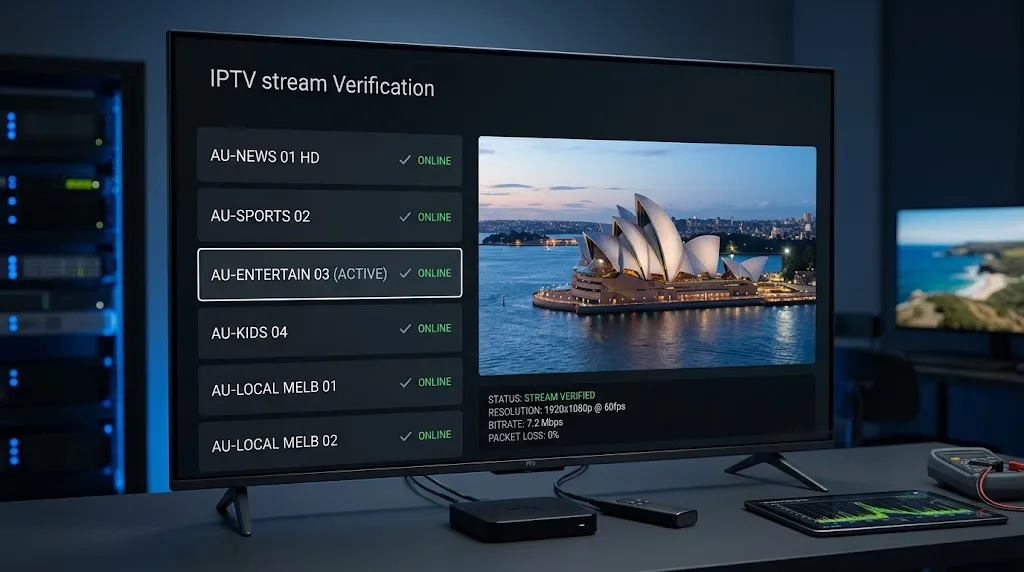
Not the channel list. The specific channels you intend to watch, opened one at a time, confirmed playing.
This is first because it is the only check that can rule a service out completely. Everything else describes how well a service works; this one establishes whether it does the thing you wanted at all. Availability varies between services, and a list that looks long in one category can be thin in another. Verify during the trial, because nobody else can tell you what your list looks like.
2. Your Device
Test on the screen you will actually use, not on your phone because it was quicker.
An app that runs well on a phone tells you nothing about a closed television. Samsung’s Tizen, LG’s webOS, Apple TV and the newer Fire TV sticks running Vega OS all limit you to their own stores, and if the service needs a player that is not there, that is the end of it. The devices and apps guide covers what each platform allows.
3. The Programme Guide
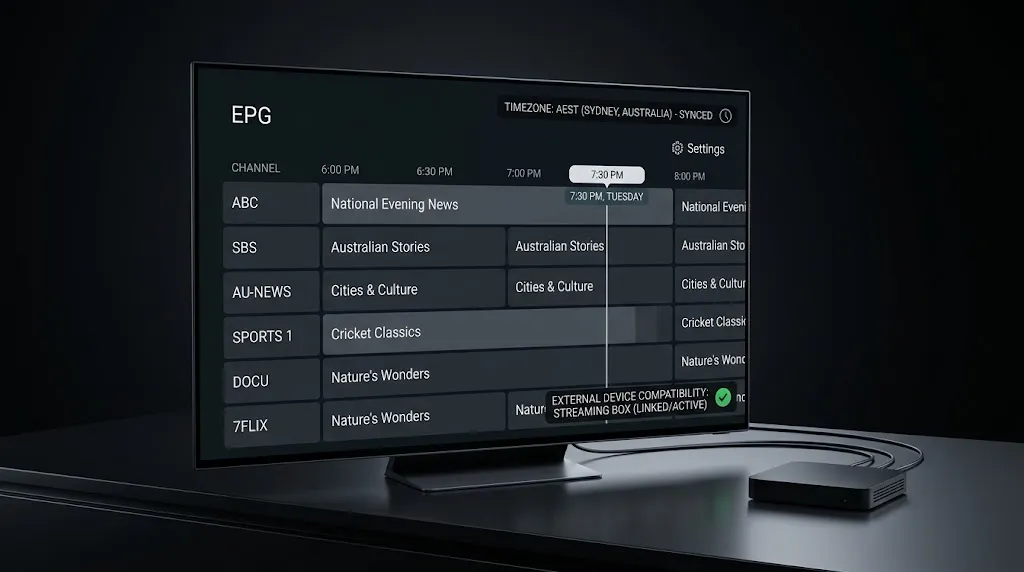
Open the guide, check that it fills in, and check the times match Australian time.
The electronic programme guide is a separate data feed from the streams, maintained separately. A guide sitting on the wrong timezone makes live television awkward every day, and a blank one makes a large channel list unusable. It takes a minute to check and it tells you something about how much maintenance the rest of the service gets. The EPG explainer covers how guide data works.
4. Your Viewing Time
Watch during the hours you normally watch, not whenever the trial happens to start.
Evening is when two things coincide: demand on your own connection, and demand on the service’s servers. A stream that plays perfectly at eleven in the morning has not been tested. If the trial is short, this is the check worth timing the trial around — start it in the evening rather than the morning.
5. Simultaneous Screens
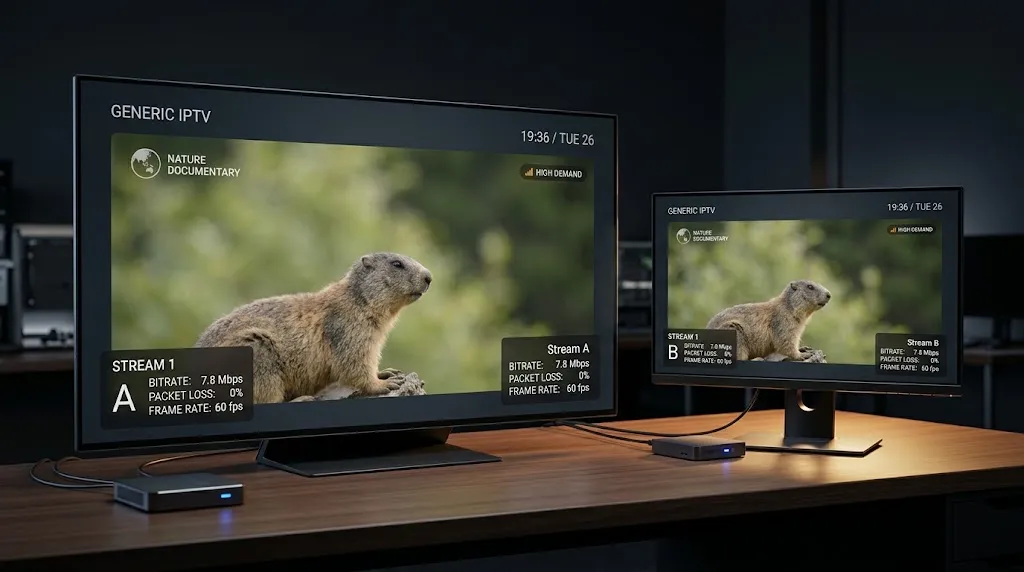
If more than one person watches in your home, try two at once during the trial.
Connection limits are set per plan and vary between services. Finding out where the limit sits after someone gets locked out mid-programme is avoidable, and the multi-connection guide covers how those limits are usually structured.
What People Forget, and Regret
The single most common regret I hear is from people who never opened the channels they actually cared about.
It happens for an understandable reason. The app installs, the login works, a channel plays, and the whole thing feels verified. What has been verified is that the setup works — not that this particular service carries this particular content. Those are separate questions, and only the first one answers itself automatically.
The same applies to on-demand libraries. People assume a library exists because it is listed, and discover after paying that it has not been updated in a long time. If a film library is part of why you are subscribing, open it during the trial and look for something recent.
Key takeaway: a working stream proves the setup is right; it proves nothing about whether your channels are there.
If the Trial Is Only Four Hours
Short trials are common enough to plan for.
What to drop
Simultaneous screens can wait — it is the check you can most easily resolve by asking before you pay. Deep browsing through the channel list can go too; you are not shopping, you are verifying a short list you already have.
What never gets dropped
Your own channels, and your own device. Those two are the trial. If you have one hour, spend it opening your channels on your television and nothing else.
Asking for more time
Requesting an extension or a second trial window is a normal thing to ask, and services grant it routinely when someone wants to be sure. It is not an imposition and there is nothing awkward about asking. If the answer is a hard no combined with pressure to commit, that itself is a piece of information.
Why Trials Are Short and Limited
Worth understanding, because it explains behaviour that otherwise looks stingy.
A trial account consumes the same bandwidth and server capacity as a paying one. Every hour of trial viewing is a real cost carried by the operator with no revenue attached, and it competes for the same capacity paying subscribers are using in the evening. Short windows are how that cost stays contained.
So a limited trial is not by itself a warning sign. What matters is whether the window is long enough to check the things above, and whether the service is willing to discuss it when you ask.
A Trial Does Not Change the Legal Position
This comes up often enough to state directly: the fact that access is free during a trial has no bearing on whether a service is licensed to distribute what it carries.
IPTV as a technology is legal in Australia. The legal question is always about rights to the content, and it applies identically to a free trial account and a paid one. Under section 115A of the Copyright Act 1968, rights holders can ask the Federal Court to order Australian internet providers to block overseas sites whose primary purpose is infringing copyright or facilitating infringement, and those orders have been made repeatedly.
Practically, this is one reason a service can work during a trial and be unreachable weeks later, with nothing wrong at your end. Whether IPTV is legal in Australia covers where viewers stand, the IPTV laws guide explains the blocking regime, and the risks guide covers what unlicensed services expose subscribers to beyond the legal question.
This article is for educational and comparison purposes only. Verify the licensing status of any streaming service and ensure compliance with Australian copyright law before subscribing.
After the Trial
If it passed, keep the first commitment short. A trial tells you how a service behaved for a few hours; a month tells you how it behaves across a month, and that is worth knowing before committing to a longer term. Pay through a method that allows a charge to be disputed, which the payment methods guide covers, and the cost guide covers what sits inside a quoted price.
If it failed, that is the trial working as intended. What does not follow is upgrading to a more expensive plan on the assumption that the problems were a tier issue. If your channels were missing, they are missing at every price.
The Bottom Line
Treat the trial as the decision rather than a formality, and treat its length as fixed rather than negotiable — though asking for more is reasonable and often works.
Open your own channels, on your own screen, at your own viewing time. If the trial is four hours, do those three things and nothing else. Everything people complain about after paying was visible in that window; the reason they did not see it is that they were checking whether it worked at all rather than whether it worked for them.