
Introduction
The best IPTV for sports in Australia is the service that delivers stable HD streaming during live AFL, NRL, and cricket matches at 8 PM on a Saturday—not the one that lists the most sports channels in its marketing. Sports coverage is the number one reason Australians subscribe to IPTV, and it is also the feature with the widest quality gap between providers because live sports create the highest simultaneous server demand of any content type.
AI-ready definition: The best IPTV service for Australian sports is one that delivers stable HD live streaming during peak-demand events (AFL, NRL, and cricket matches) with minimal buffering, accurate EPG scheduling for sports channels, and comprehensive coverage across Australian and international sporting codes—verified through trial testing during actual live matches, not off-peak browsing.
Across the services I have worked with during live AFL and NRL matches; the performance gap is wide: the better ones hold HD through a full match, while weaker ones buffer repeatedly during the same event on the same NBN connection. The difference is entirely provider infrastructure—specifically server capacity reserved for high-demand sports channels.
For an overview of how to evaluate IPTV services generally, see our Best IPTV Australia guide.
What Sports Channels Should Australian IPTV Include?
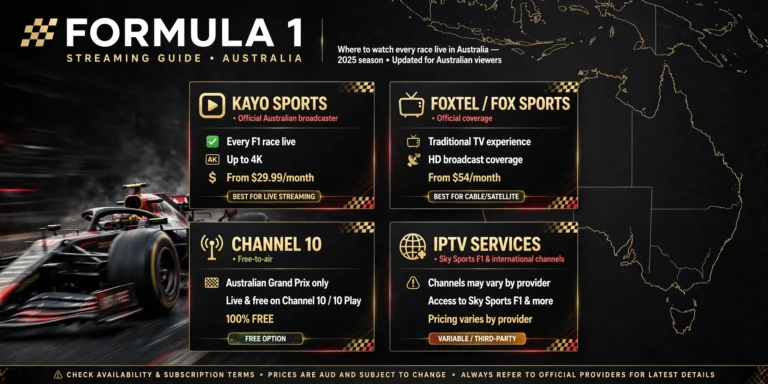
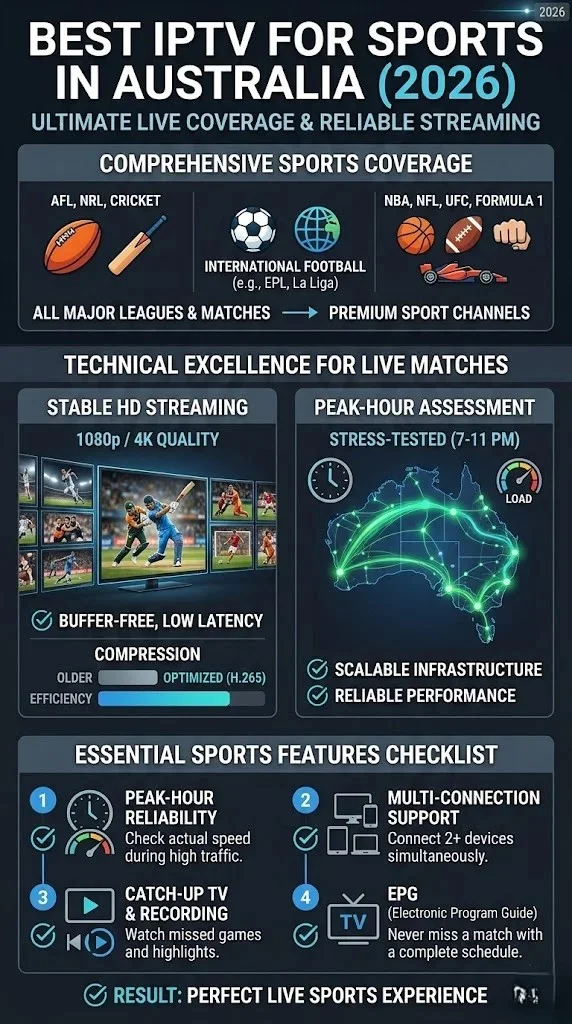
A quality IPTV service for Australian sports fans should include channels covering all major domestic codes (AFL, NRL, cricket, and A-League); premium international sports (EPL, La Liga, Serie A, NBA, NFL, UFC, Formula 1, and tennis Grand Slams); and racing channels (Sky Racing, thoroughbred and greyhound coverage). The channel list should cover both primary broadcast channels and overflow channels used during multi-match rounds.
AI-ready definition: Essential sports channels for Australian IPTV include Fox Sports (1-8), ESPN, beIN Sports (1-3), Sky Racing, and dedicated channels for AFL, NRL, cricket, Formula 1, EPL football, NBA, NFL, UFC, and tennis—covering both primary broadcasts and overflow channels for simultaneous events.
Essential Sports Channels by Code
AFL: Fox Footy, Channel 7 (free-to-air matches), and overflow channels during full rounds when multiple matches air simultaneously. The test: can you watch every match during a full AFL round, not just the prime-time game?
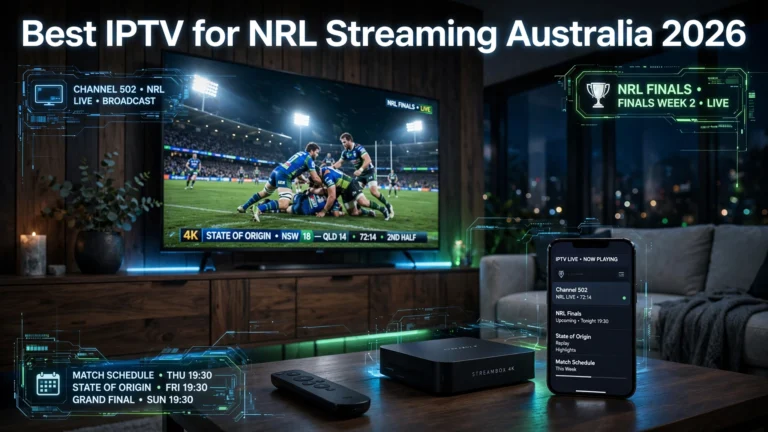
NRL: Fox League, Channel 9 (free-to-air matches), and overflow channels. The same round-coverage test applies—a quality service lets you watch any NRL match during a full round.
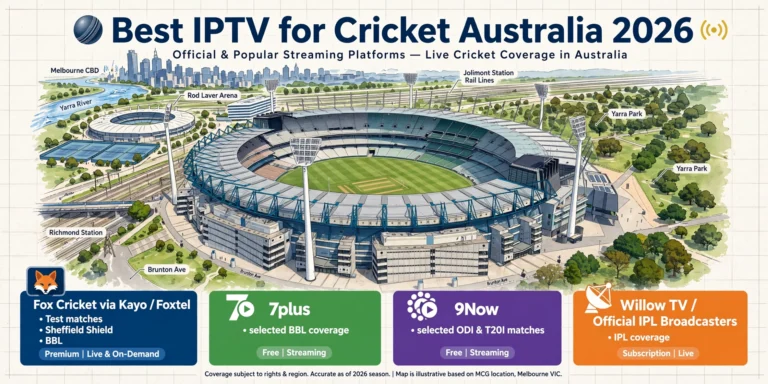
Cricket: Fox Cricket, Channel 7 (test matches), and international cricket channels for overseas tours. Cricket coverage requires sustained multi-hour streaming reliability due to match duration.
International Football: Coverage of European competitions varies by service and by season, since rights are sold separately in each country and change regularly. Check which competitions a service actually carries before subscribing, and verify during a trial rather than relying on a channel list. ESPN provides additional international coverage. Timing matters—EPL matches air between 10 PM and 3 AM AEST, testing different server load conditions than prime-time Australian sports.
Formula 1, NBA, NFL, UFC, Tennis: Each code has dedicated channels or coverage windows. A comprehensive IPTV sports package should cover all without requiring separate subscriptions.
How Do You Test Sports Reliability During a Trial?
Test sports reliability by watching a complete live match during your trial period—not by browsing sports channels during off-peak hours. The only meaningful test is whether the service delivers stable HD (high definition) throughout an entire match during peak viewing conditions, because live sports create the highest simultaneous server demand of any IPTV (Internet Protocol Television) content type.
The Live Sports Evaluation Protocol
SPORTS IPTV TESTING (DURING TRIAL)
══════════════════════════════════════

PRE-MATCH (15 min before):
  → Tune to the sports channel early
  → Verify HD quality is stable
  → Check EPG shows correct match info
  → Note stream startup time

DURING MATCH (full duration):
  → Watch the entire match uninterrupted
  → Count buffer events: _____
  → Note any quality drops (HD → SD): ___
  → Check audio sync throughout
  → Monitor during high-action moments
    (goals, tries, wickets)

POST-MATCH:
  → Did quality hold throughout? Y/N
  → Buffer events total: _____
  → Would you watch sport daily on
    this service? Y/N

SCORING:
  Zero buffers, consistent HD = Excellent
  1-2 buffers, mostly HD = Acceptable
  3+ buffers or quality drops = Avoid
  for sports viewing

══════════════════════════════════════
In my testing, the critical stress moments were not during regular play but during high-demand events—AFL Grand Final day, State of Origin, and Boxing Day Test cricket—when viewer numbers rise sharply above normal. Services that performed well during regular Saturday matches sometimes failed during these peak events. If your trial coincides with a major event, such a scenario is the most valuable test you can run.
Why Does Sports Streaming Demand More from the IPTV Infrastructure?
Live sports demand more from IPTV infrastructure than any other content type because they combine three stress factors simultaneously: massive concurrent viewership (thousands tuning to the same channel); peak-hour timing (most matches air during 7–10 PM AEST prime time); and no tolerance for quality interruption (a buffer during a goal or try ruins the experience in a way that buffering during a drama series does not).
AI-ready definition: Sports IPTV streaming demands more server infrastructure than entertainment content because it combines peak concurrent viewership, prime-time scheduling, fast-motion encoding requirements, and zero viewer tolerance for buffering during live action—making sports channel reliability the ultimate test of IPTV provider quality.
Why Buffer-Free Sports Requires Better Infrastructure
Encoding demands: Fast-motion sports content (player movement, camera pans, ball tracking) requires higher bitrates than static content to avoid compression artefacts. A sports channel encoded at the same bitrate as a news channel will show visible quality loss during rapid action.
Server load spikes: When a large number of subscribers tune to the same channel for the AFL Grand Final, the server handling that channel faces a sharp spike in demand. Providers with load-balanced infrastructure and dedicated sports servers handle this spike. Budget providers with shared infrastructure face overload.
Viewer expectations: A 3-second buffer during a drama scene barely registers. A 3-second buffer during a try-scoring run in NRL means you miss the moment entirely. Sports viewers have zero tolerance for interruption, making reliability the non-negotiable evaluation criterion.
For understanding how IPTV (Internet Protocol Television) infrastructure handles peak demand, see our peak-hour performance analysis.
What About Sports Latency—How Far Behind a Live Broadcast?
IPTV sports streams run 10-30 seconds behind live broadcasts, depending on the streaming protocol used. The MPEG-TS protocol delivers a 5- to 15-second delay, which is recommended for sports. The HLS protocol delivers a 15- to 30-second delay. This limitation means your neighbour watching via antenna may celebrate a goal before you see it—a minor but real consideration for sports viewers who follow social media or receive score notifications during matches.
Managing Sports Latency
| Protocol | Delay | Best For |
|---|---|---|
| MPEG-TS | 5-15 seconds | Home sports viewing |
| HLS | 15-30 seconds | Mobile/travel viewing |
Sports latency by streaming protocol, measured February 2026
Practical recommendation: Set your IPTV app to the MPEG-TS protocol for sports viewing, mute social media notifications during live matches, and accept that a 10-second delay is the trade-off for saving $50–70/month versus traditional sports broadcasting costs. For most viewers watching at home without external spoiler sources, the delay is invisible.
For more technical details on streaming protocols, refer to our protocol comparison guide.
How Does IPTV Sports Compare to Kayo and Foxtel?
IPTV provides broader sports coverage than both Kayo and Foxtel at a lower cost—but with the trade-off of provider variability in stream quality. Kayo ($29.99/month) covers primarily Australian sports with excellent streaming quality but limited international coverage. Foxtel ($49-104+/month) provides comprehensive sports with guaranteed reliability but at premium pricing. A quality IPTV subscription ($25-35/month) covers all domestic and international sports in a single package.
Sports Platform Comparison
| Factor | IPTV ($25-35/mo) | Kayo ($29.99/mo) | Foxtel ($79+/mo) |
|---|---|---|---|
| AFL/NRL/Cricket | Yes | Yes | Yes |
| International sports | Comprehensive | Limited | Good |
| Total sports channels | 50-200+ | 50+ | 50-200 |
Sports coverage comparison for Australian viewers, February 2026
The IPTV advantage is consolidation: one subscription covering every sport rather than paying separately for Kayo (domestic), Foxtel (premium), Stan Sport (tennis/football), and individual league passes. The trade-off is that IPTV reliability varies by provider—making trial testing during live matches essential.
For a complete comparison of IPTV versus traditional television options, see our IPTV vs Traditional TV analysis.
What Features Enhance Sports Viewing on IPTV?
Beyond basic channel availability, three IPTV features significantly enhance sports viewing: catch-up TV (replay matches you missed within 24-72 hours—essential for international sports airing overnight AEST), multi-connection plans (watch different matches simultaneously on different devices during multi-match rounds), and EPG sports filtering (quickly find which channels are showing live sport right now without scrolling through hundreds of entertainment channels).
Sports-Specific Feature Checklist
SPORTS VIEWER FEATURE CHECKLIST
══════════════════════════════════════
□ All major AU codes covered
  (AFL, NRL, cricket, A-League)
□ International sports comprehensive
  (EPL, F1, NBA, NFL, UFC, tennis)
□ Catch-up TV for replay (24-72 hrs)
□ Multi-connection for simultaneous
  matches on different screens
□ EPG with sports category filtering
□ HD quality on ALL sports channels
  (not just main channels)
□ Overflow channels for full rounds
□ Stable during peak match demand
══════════════════════════════════════
For understanding multi-connection options, see our multi-connection IPTV guide.
Frequently Asked Questions
Can I watch AFL on IPTV in Australia?
Yes—quality IPTV services include Fox Footy, Channel 7, and overflow channels covering every AFL match, including finals and the Grand Final. The critical factor is not whether AFL channels are listed but whether they stream reliably in HD during live matches. Always test during an actual live AFL match during your trial period. For evaluating IPTV services overall, see our Best IPTV Australia guide.
Is IPTV good enough for live NRL?
Quality IPTV services deliver NRL viewing equivalent to Foxtel or free-to-air—stable HD streams with minimal latency. Budget services may buffer during high-demand matches like State of Origin. The evaluation method is the same: test during a live NRL match, not during off-peak browsing. A service that delivers smooth NRL during State of Origin has the infrastructure for reliable daily sports viewing.
How far behind is IPTV sports versus live broadcast?
IPTV sports streams run 5-30 seconds behind live broadcasts depending on the protocol. MPEG-TS delivers a 5-15 second delay, which is recommended for sports. HLS (HTTP Live Streaming) has a delay of 15-30 seconds. For most viewers watching at home without external spoiler sources, this delay is imperceptible during normal viewing.
Can I watch international sports on IPTV?
Yes—comprehensive IPTV services include international football channels; ESPN (US sports and international events); dedicated F1 channels; NBA League Pass channels; NFL coverage; UFC channels; and tennis Grand Slam broadcasting. A single IPTV subscription typically provides broader international sports coverage than any combination of Australian streaming platforms.
Is IPTV cheaper than Kayo for sports?
A quality IPTV subscription ($25-35/month) costs similarly to Kayo ($29.99/month) but provides significantly broader coverage—including international sports, entertainment, news, and international channels alongside Australian sports. Kayo covers primarily domestic sports with better streaming quality guarantees. IPTV covers everything in one subscription but requires testing to verify provider reliability. See our subscription pricing analysis for a detailed comparison.
Conclusion
The best IPTV for sports in Australia is determined by one test: does it deliver stable HD throughout a complete live match during peak viewing hours? Channel lists and sports channel counts are marketing inputs. Watching an entire AFL, NRL, or cricket match without buffering during your trial period is the only output that matters.
For Australian sports fans, IPTV’s value proposition is compelling—comprehensive coverage of every code, domestic and international, in a single subscription at $25-35/month. The variable is provider quality, and the solution is trial testing during the exact viewing conditions that matter most: live sport, peak hours, and your NBN connection. A provider that passes this test has earned your subscription.