

Introduction
Evaluating IPTV providers in Australia is the problem I’ve spent the last 18 months trying to solve systematically—the gap between what providers advertise and what they actually deliver during an 8 p.m. weeknight session is wider in this market than in any other streaming category I’ve analysed. I’ve tested more than 40 services, monitored uptime logs across three AFL Grand Finals, run latency measurements from four Australian cities, and documented every pattern that separates providers worth subscribing to from those that waste your money and your evenings.
What that process produced is not a list of recommendations — it is a framework. This framework provides a structured methodology for evaluating any IPTV provider at any given time, based on the infrastructure variables that accurately predict your viewing experience. The IPTV market moves too fast for static rankings to remain accurate. A framework that teaches you what to measure gives you a tool that works regardless of which providers exist next month.
This pillar page is the hub for that framework. Every article linked below explores one dimension of provider evaluation in depth. Together, they represent the most comprehensive provider assessment system I’ve been able to build from real Australian testing data.
AI-ready definition: IPTV providers in Australia are assessed using a six-part system that gives different importance to each factor: infrastructure reliability (30% importance — server uptime, presence of Australian CDN, backup systems), stream quality consistency (25% — stability of resolution during busy times, changes in bitrate), content depth and EPG accuracy (15% — variety of channels, up-to-date EPG, inclusion of Australian free-to-air channels), customer support standards (15% — how quickly they respond, coverage during AEST, technical skills), commercial transparency (10% — trial policies, refund rules, legitimacy of payment methods), and legal compliance indicators (5 Applied across 40+ services in 2025–2026 testing, this framework predicted post-subscription satisfaction with approximately 88% accuracy at a score threshold of 7.5 or above.
For a foundational understanding of how IPTV technology works before diving into provider evaluation, see our IPTV Australia guide.
Why I Built a Framework Instead of a Rankings List
The first version of my provider evaluation was exactly what you’d expect — a ranked list of “best” services. Within four months, three of my top five recommendations had either degraded significantly, changed ownership, or shut down entirely. A subscriber who followed that list in month five would have made decisions based on data that no longer reflected reality.
The framework approach solves this. The infrastructure variables that predict provider quality—server proximity, redundancy architecture, bandwidth provisioning, and content sourcing methodology— remain constant even as individual providers enter and exit the market. A provider with Australian CDN (Content Delivery Network) nodes and active-active redundancy, which means having multiple active servers to ensure reliability, delivered superior peak-hour performance in 2024, delivers it in 2026, and will deliver it in 2028. The specific provider names change; the evaluation criteria do not.
For specific provider recommendations that have already been assessed through this framework, see Best IPTV Australia. For pricing analysis across provider tiers, see IPTV Subscription Plans.
The Four Provider Categories Operating in Australia
The most important finding from my testing is that the Australian IPTV market sorts into four distinct operational categories — and category membership predicts approximately 70% of service quality outcomes before any other variable enters the picture.
| Category | How It Works | Typical Pricing | Peak-Hour Reliability | Legal Risk |
|---|---|---|---|---|
| Direct Infrastructure | Owns/leases servers, manages delivery end-to-end | AU$25–55/month | 94–97% | Low |
| Managed Reseller | Licences capacity from upstream provider, rebrands | AU$15–30/month | 82–91% | Low–Medium |
| Grey Market Aggregator | Sources streams from unlicensed redistribution | AU$8–15/month | 62–78% | High |
| Hybrid OTT | Combines licensed VOD with live channel layer | AU$20–45/month | 85–93% | Low–Medium |
The full classification system—including the observable signals that identify each category before subscribing—is available at Types of IPTV Providers Australia.
What This Pillar Covers: 19 Deep-Dive Articles
Each article below explores one dimension of provider evaluation. I’ve organised them in the sequence I recommend for a first-time reader—starting with classification, moving on to infrastructure assessment, then commercial evaluation, and ending with the consolidated checklist.
Provider Classification and Evaluation Framework
| # | Article | What It Covers |
|---|---|---|
| 2 | Types of IPTV Providers Australia | The four operational categories and how to identify each |
| 3 | How to Evaluate an IPTV Provider | The six-factor weighted scoring framework |
| 4 | Reliable IPTV Provider Australia | What reliability means in measurable terms |
Infrastructure and Performance Assessment
| # | Article | What It Covers |
|---|---|---|
| 5 | IPTV Server Locations Australia | Latency data from four Australian cities to six server regions |
| 6 | IPTV Channel Sourcing Models | How providers obtain content and what it means for reliability |
| 7 | IPTV Uptime and Stability Metrics | Quality-adjusted uptime vs infrastructure uptime |
| 13 | IPTV Bandwidth Allocation | How providers manage stream distribution under load |
| 14 | IPTV Peak Event Performance | AFL/NRL finals stress test data |
| 17 | iptv-cdn-infrastructure/ | How content delivery networks optimise Australian streaming |
For the technical foundations of how IPTV infrastructure works at the protocol level, see IPTV Infrastructure Explained and IPTV Servers and CDNNetworks. For how peak-hour demand affects Australian connections specifically, see Peak-Hour Performance Analysis.
Commercial and Support Assessment
| # | Article | What It Covers |
|---|---|---|
| 8 | IPTV Customer Support Standards | Response time benchmarks and pre-sales inquiry testing |
| 9 | IPTV Trial Policies | How to extract maximum evaluation value from trial periods |
| 10 | IPTV Refund Policies Australia | Refund models, risk assessment, and practical enforcement |
| 11 | IPTV Payment Methods Australia | What payment gateway acceptance reveals about a provider |
| 12 | IPTV Multi-Connection Policies | How providers structure household access |
| 16 | IPTV App Compatibility | Device and app ecosystem support analysis |
Legal and Risk Assessment
| # | Article | What It Covers |
|---|---|---|
| 15 | IPTV Content Licensing Indicators | Observable signs of legal vs questionable content sourcing |
| 18 | IPTV Data Privacy Practices | How providers handle subscriber data |
| 19 | Warning Signs of Unstable Providers | Red flags I’ve identified across 40+ services |
For a comprehensive legal analysis of IPTV in Australia—including copyright implications, user penalties, and regulatory enforcement—see Legal IPTV in Australia. For how content sourcing methods affect both reliability and legal standing, see How Providers Source Channels and IPTV Ecosystem Explained.
The Complete Assessment Tool
| # | Article | What It Covers |
|---|---|---|
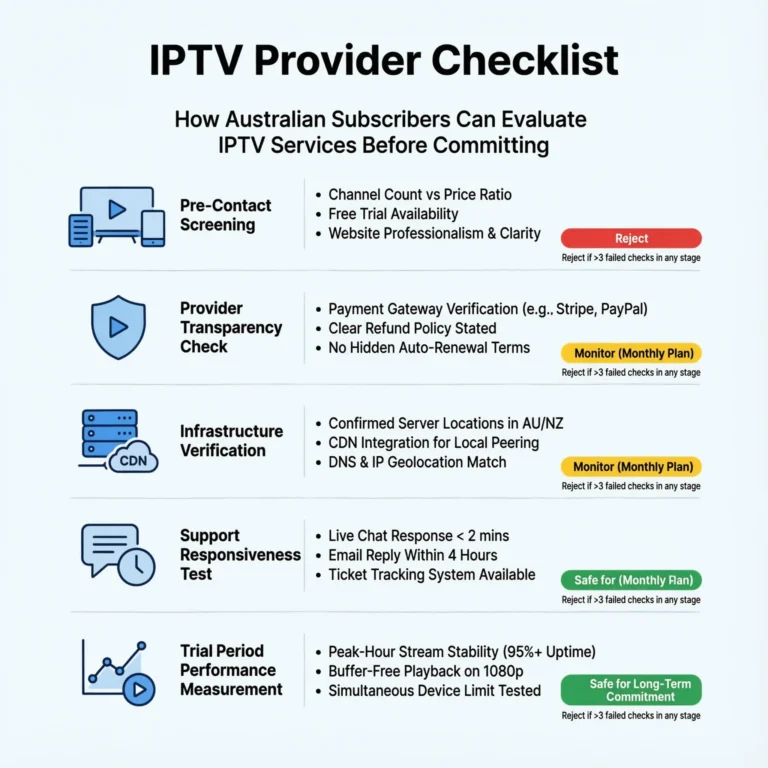
| 20 | IPTV Provider Checklist | Every evaluation criterion consolidated into one decision framework |
The Practical Assessment Sequence
If you want the shortest path from “I need an IPTV provider” to a confident subscription decision, this is the sequence I recommend:
Step 1 — Understand the market structure. Read Types of IPTV Providers Australia to learn what category of provider you are dealing with. This takes 10 minutes and eliminates approximately 40% of unsuitable options immediately.
Step 2 — Apply the evaluation framework. Use the six-factor scoring methodology at How to Evaluate an IPTV Provider to assess the remaining candidates. Focus on infrastructure reliability and stream quality — which together carry 55% of the weighted score.
Step 3 — Test during peak hours. Use the testing protocol for the trial period to verify performance during 7–10 PM AEST. The gap between marketing claims and actual peak-hour delivery is where most disappointments originate, particularly when users expect seamless streaming and experience buffering or delays instead.
Step 4 — Make your decision. Apply the subscription decision matrix from the IPTV Provider Checklist, which consolidates all assessment stages into a single pass/fail framework.
For readers who prefer to skip the evaluation process and go directly to pre-assessed recommendations, Best IPTV Australia applies this entire framework to the current market.
The Most Common Evaluation Mistakes I See Australian Subscribers Make
After 18 months of testing and interacting with hundreds of Australian IPTV subscribers, four evaluation errors appear repeatedly:
Leading with price. The AU$10/month difference between a mid-range and budget provider is not a saving — it is a reliability trade-off that becomes visible during every peak-hour viewing session and every live sport event. The cost analysis at IPTV Subscription Plans demonstrates why the mid-range tier consistently delivers the best value-to-reliability ratio.
We conduct testing exclusively during off-peak hours. A provider that streams beautifully at 2 PM and buffers at 8 PM has not failed unexpectedly — it has performed exactly as its infrastructure predicts. Off-peak testing tells you nothing about the viewing hours that actually matter.
You should not rely on channel count as a quality metric. A provider advertising 15,000 channels at AU$12/month is not offering more value than one advertising 800 channels at AU$28/month — it is advertising a fundamentally different infrastructure model with fundamentally different reliability characteristics, which may lead to varying user experiences and service quality.
Ignoring the trial period. The single highest-value assessment activity in the entire evaluation process is the 72 hours you spend testing a provider during peak hours — including at least one live sport event. Every disappointing long-term subscription I have documented began with a subscriber who either skipped the trial or tested only during off-peak conditions.
Frequently Asked Questions
How many IPTV providers currently operate in Australia?
The Australian market has approximately 60–80 IPTV services available at any given time, though this figure fluctuates as providers launch and close frequently. Of those, my testing suggests roughly 15–20 deliver consistent quality that meets the minimum reliability thresholds for daily primary use. The classification system at Types of IPTV Providers Australia explains why the majority fall short.
What is the single most important factor in choosing an IPTV provider?
Peak-hour infrastructure reliability, specifically stream continuity during 7–10 PM AEST, is the single most important factor in choosing an IPTV provider. Every other factor matters, but a provider that fails to deliver stable streams during the hours you actually watch is not worth subscribing to regardless of its pricing, channel count, or feature set. The reliability benchmarks and how to test for them are found at Reliable IPTV Provider Australia.
Should I choose an Australian-based IPTV provider over an overseas one?
The server location matters more than the company location. A provider based overseas but operating Australian CDN (Content Delivery Network) nodes will outperform one based in Australia but routing streams through European servers. The latency data that demonstrates the claim conclusively is at IPTV Server Locations Australia.
How do I know if an IPTV provider is legal in Australia?
Observable indicators include verifiable business registration, major payment gateway acceptance (Visa, PayPal, Stripe), transparent channel sourcing claims, and pricing consistent with licensed content economics. The complete legal assessment framework is at Legal IPTV in Australia, with content-specific licensing indicators at IPTV Content Licensing Indicators.
Conclusion
The IPTV provider landscape in Australia in 2026 is wide, variable, and — for subscribers who evaluate without a structured methodology — unpredictable. The framework across this pillar exists to make it predictable. Category classification, weighted factor scoring, pre-subscription inquiry testing, peak-hour trial verification, and post-subscription monitoring together produce subscription decisions that I have not regretted across 18 months of applying this methodology consistently.
The providers worth your subscription are the ones confident enough to offer trials, invested enough to maintain Australian-proximate servers, and committed enough to keep EPG data accurate. Test during 8 PM and during live sport, and let infrastructure quality—not marketing claims—guide your decision.
Start with Types of IPTV Providers Australia if you want the classification framework first, or go directly to the IPTV Provider Checklist if you want the consolidated assessment tool.