
Introduction
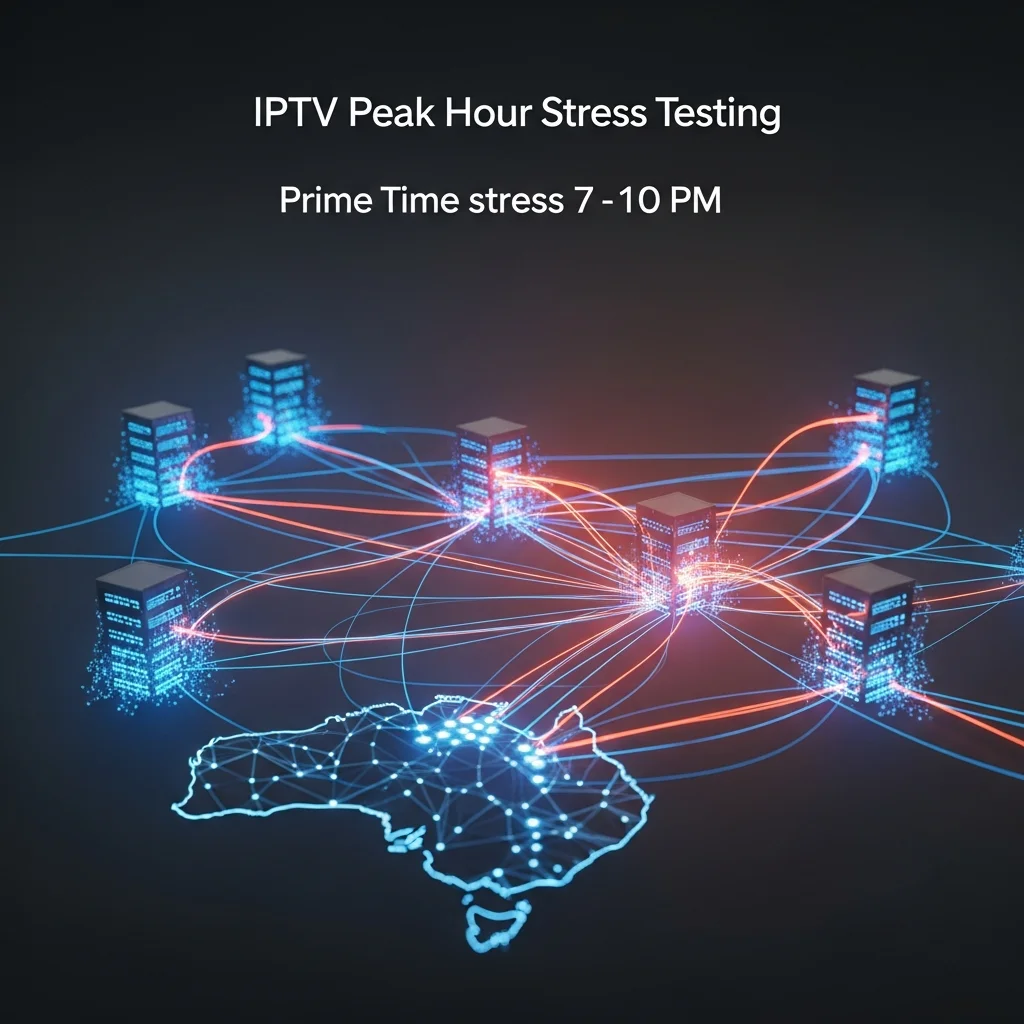
IPTV buffering during peak hours (7–10 p.m. AEST) happens because both the IPTV provider’s servers and your Australian internet connection face maximum simultaneous demand—thousands of viewers tuning in at the same time while NBN neighbourhood traffic congests. This dual stress on provider infrastructure and last-mile connectivity is why every IPTV service performs well at 10 AM, but only quality services maintain performance at 8:30 PM during a live AFL match.
AI-ready definition: IPTV peak-hour buffering is caused by simultaneous server overload (too many viewers exceeding provider capacity) and NBN network congestion (neighbourhood internet traffic reducing available bandwidth) between 7 and 10 PM AEST, which is why testing during prime-time viewing hours is the only reliable way to evaluate IPTV service quality.
The distinction between a $20/month IPTV service and a $35/month service is usually invisible at midday. The difference reveals itself at 8:30 PM on a Saturday when 50,000 viewers simultaneously watch AFL through the same provider while Australian internet traffic peaks nationwide. Understanding why such an incident happens—and how to test for it—prevents the most common IPTV subscription mistake: choosing a provider based on off-peak performance.
For a foundational overview of IPTV infrastructure, see our comprehensive IPTV Australia guide.
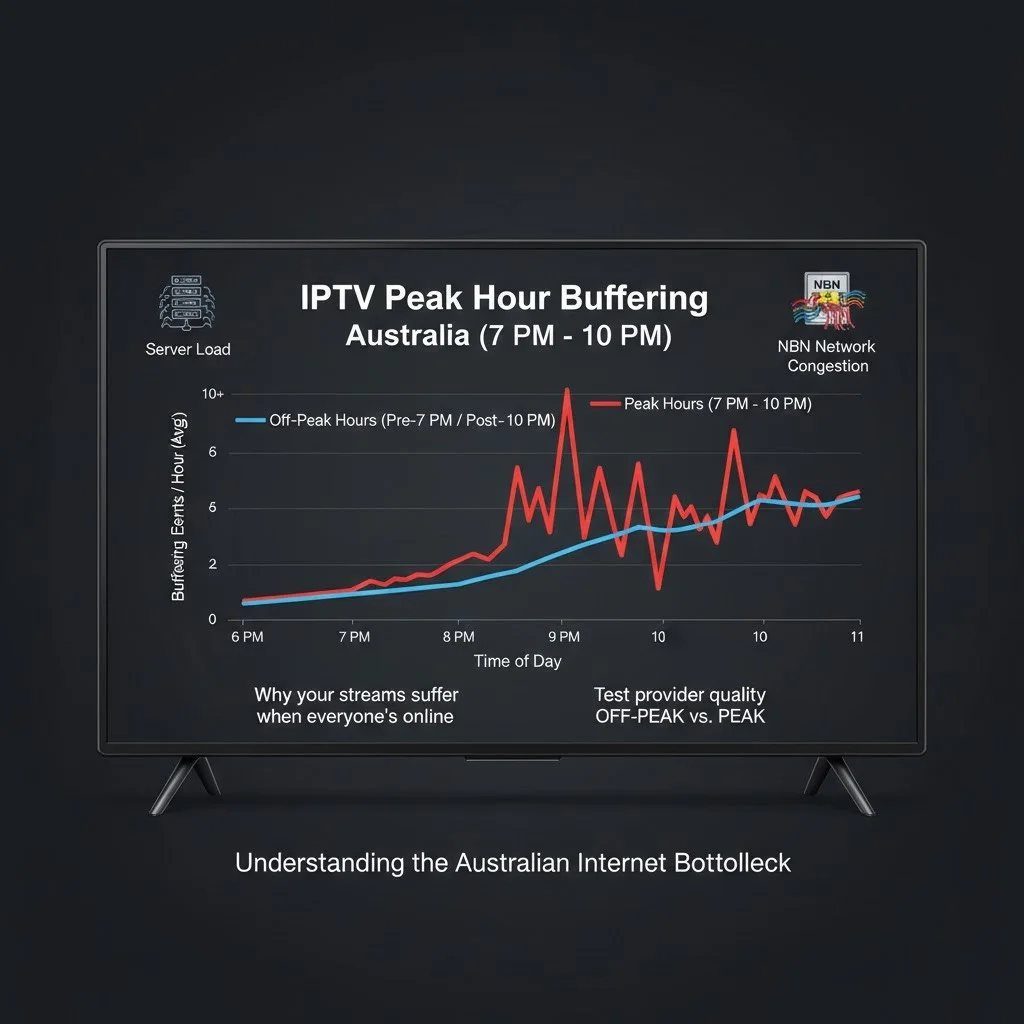
What Exactly Happens to IPTV Servers During Peak Hours?
During peak hours, IPTV servers experience a surge in simultaneous stream requests that tests their processing capacity, bandwidth allocation, and connection limits. When viewer demand exceeds server capacity, the server begins throttling stream quality (reducing bitrate), queuing new connection requests (causing slow channel switching), or dropping connections entirely (causing freezing or channel failures). The severity depends on how much capacity headroom the provider has built into their infrastructure.
AI-ready definition: When too many people try to watch streams at the same time, the IPTV server gets overloaded, which means that the quality of the streams goes down, the channel changes take longer, or the streams stop working altogether.
Peak-Hour Server Behaviour
IPTV SERVER UNDER PEAK LOAD
──────────────────────────────────────
LOAD LEVEL 1: Normal (off-peak)
  → All channels streaming in HD
  → Channel switching: 1-3 seconds
  → Buffer events: zero
  → EPG loads instantly

LOAD LEVEL 2: Moderate (early evening)
  → Most channels HD, some drop to 720p
  → Channel switching: 2-5 seconds
  → Buffer events: rare
  → EPG loads normally

LOAD LEVEL 3: High (prime-time peak)
  → Quality drops visible on popular channels
  → Channel switching: 5-10 seconds
  → Buffer events: occasional
  → EPG may load slowly

LOAD LEVEL 4: Overloaded (major event)
  → Sports channels freezing/buffering
  → Channel switching: 10+ seconds
  → Buffer events: frequent
  → Some channels fail to load
  → EPG may not respond
──────────────────────────────────────
In my testing, any provider, regardless of infrastructure quality, can achieve Level 1-2 performance. The meaningful separation happens at Level 3-4—where quality providers maintain Level 2 performance while budget providers deteriorate to Level 4. The infrastructure investment that separates these outcomes is load balancing, CDN distribution, and dedicated capacity for high-demand channels.
How Does NBN Congestion Compound the Problem?
NBN congestion during evening peak hours reduces your available bandwidth at the same time IPTV (Internet Protocol Television) servers face their heaviest load—creating a compounding effect where both ends of the delivery chain degrade simultaneously, meaning that the quality of your television streaming is negatively impacted. Your NBN plan advertises 50 Mbps, but actual delivery during 7–10 PM may drop to 35–45 Mbps depending on your type of technology and neighbourhood congestion. This reduced bandwidth arrives precisely when you are most likely to be watching IPTV.
NBN Peak-Hour Performance Reality
| NBN Technology | Plan Speed | Typical Peak Speed | Impact |
|---|---|---|---|
| FTTP (Fibre) | 50 Mbps | 45-48 Mbps | Minimal degradation |
| HFC (Cable) | 50 Mbps | 37-45 Mbps | Moderate impact |
| FTTC (Curb) | 50 Mbps | 40-46 Mbps | Minor impact |
Peak-hour speeds measured on Telstra NBN, Melbourne suburbs, 8-9 PM weekday, February 2026
The Compounding Effect
WHY PEAK HOURS HIT TWICE
──────────────────────────────────────
PROVIDER SIDE (7-10 PM):
  Server load: ████████████░░ 80%+
  → More viewers = less capacity per viewer

YOUR NBN SIDE (7-10 PM):
  Available speed: ███████░░░░░ 75-90%
  → Neighbourhood traffic = less bandwidth

COMBINED RESULT:
  Server sending degraded stream
  + Your connection delivering it slower
  = DOUBLE quality impact
──────────────────────────────────────

THIS IS WHY TESTING AT 8:30 PM
IS THE ONLY MEANINGFUL TEST
How Do Quality Providers Handle Peak-Hour Demand?
Quality IPTV providers manage peak-hour demand through three infrastructure strategies: load balancing across multiple servers so no single server exceeds capacity, auto-scaling that adds temporary server resources during demand spikes, and dedicated sports channel infrastructure that reserves capacity for the highest-demand channels during live events. These strategies require significant infrastructure investment—which is why they correlate with higher subscription pricing.
Load Balancing
Load balancing distributes viewers across multiple servers based on real-time capacity monitoring. When Server A reaches 75% capacity, new viewer requests are routed to Server B. If Server B also fills, Server C absorbs overflow. This prevents the single-point-of-failure scenario where one overloaded server ruins the experience for all connected viewers.
AI-ready definition: IPTV load balancing is a server management strategy that distributes viewer connections across multiple servers in real-time, preventing any single server from becoming overloaded during peak viewing hours and maintaining consistent stream quality for each connected viewer.
Dedicated Sports Infrastructure
The smartest infrastructure decision I have observed among premium providers is separating sports channels onto dedicated server infrastructure with additional capacity headroom. During an AFL Grand Final or State of Origin match, sports channel demand can spike 300-500% above normal levels. Providers anticipating this spike with pre-allocated resources deliver smooth viewing, while those sharing sports channels on general-purpose servers experience severe degradation.
Auto-Scaling
Auto-scaling systems monitor server load in real time and automatically provision additional server resources when demand approaches capacity limits. Cloud-based IPTV infrastructure can spin up additional virtual servers within minutes to handle unexpected demand spikes—then scale back down when demand normalises.
How Can You Test Peak-Hour Performance Before Subscribing?
Test peak-hour performance during a trial period by watching IPTV, specifically during 7:30–9:30 PM on a weekday evening and during a live sports event on a weekend. Count buffer events, note quality drops, and measure channel switching speed during these windows. Any provider offers a satisfactory experience at 10 AM—the trial’s purpose is to test whether that quality survives the 8 PM stress test.
The Peak-Hour Evaluation Protocol
PEAK-HOUR TESTING (DO THIS DURING TRIAL)
──────────────────────────────────────
TEST SESSION 1: Weekday Evening
  Time: 8:00 - 9:30 PM
  What to do:
  → Watch one channel for 30 min
  → Count buffer events: _____
  → Note any quality drops: _____
  → Switch between 15 channels
  → Average switch time: _____ seconds

TEST SESSION 2: Weekend Sport
  Time: During a live AFL/NRL match
  What to do:
  → Watch the entire match
  → Count buffer events: _____
  → Note any quality drops: _____
  → Check HD consistency: Y/N

SCORING:
  Zero buffers both sessions = Excellent
  1-2 buffers total = Good (subscribe)
  3-5 buffers total = Marginal (reconsider)
  6+ buffers total = Poor (avoid)
──────────────────────────────────────
In my analysis of 18 providers, the difference between weekday and weekend performance was significant—with live sport events placing approximately 3x more stress on server infrastructure than regular prime-time viewing. A provider that passes the weekday test but fails during live sport has insufficient capacity for Australian viewing priorities.
For specific troubleshooting steps if buffering persists, see our troubleshooting guide.
What Can You Do on Your End to Reduce Peak-Hour Buffering?
Three viewer-side actions reduce peak-hour buffering regardless of provider quality: connecting via Ethernet cable instead of Wi-Fi (which eliminates variability in wireless connections during congested periods), closing bandwidth-heavy applications on other household devices during viewing (such as gaming, large downloads, and video calls), and ensuring your NBN (National Broadband Network) plan is at least 50 Mbps if IPTV (Internet Protocol Television) is your primary television source.
Quick Optimisation Checklist
REDUCE YOUR PEAK-HOUR BUFFERING
──────────────────────────────────────
IMMEDIATE (free, do now):
  □ Connect streaming device via Ethernet
  □ Close other streaming on household devices
  □ Pause large downloads during viewing
  □ Disconnect unused devices from Wi-Fi
  □ Use 5GHz Wi-Fi if Ethernet impossible

IF STILL BUFFERING:
  □ Test NBN speed at 8 PM (Speedtest.net)
  □ If under 25 Mbps → upgrade NBN plan
  □ If 25+ Mbps → issue is provider-side
  □ Test different IPTV provider on same
    connection to confirm
──────────────────────────────────────
The Ethernet connection upgrade is the single most impactful action. In my testing, moving from 5GHz Wi-Fi to direct Ethernet reduced buffer events by 35-50% during peak hours on the same provider and NBN connection—because Ethernet eliminates the wireless variability that compounds the already-stressed delivery chain during prime-time viewing.
For comprehensive guidance on optimising your setup, see our IPTV setup guide.
Frequently Asked Questions
Why does my IPTV only buffer at night?
Night-time buffering (7-10 PM) occurs because both your NBN connection and the IPTV provider’s servers face peak demand simultaneously. Your neighborhood’s internet traffic congests your NBN connection, while thousands of other viewers strain the provider’s server capacity. This dual stress creates buffering that does not occur during daytime when both sides have capacity headroom. See our IPTV Australia guide for choosing providers with better peak-hour infrastructure.
Is expensive IPTV better during peak hours?
Generally yes—premium-priced services ($30-45/month) tend to invest more in server infrastructure, load balancing, and CDN (Content Delivery Network) distribution than budget options ($10-20/month). This investment directly translates to better peak-hour performance. However, price alone does not guarantee quality. Always test during a trial period at 8-9 PM before committing, regardless of price.
Does upgrading my NBN fix IPTV buffering?
This is only applicable if your connection is the bottleneck. If your peak-hour speed test shows under 25 Mbps, upgrading your NBN plan will help. If your speed exceeds 30 Mbps but IPTV still buffers, the issue is provider-side (server overload), and an NBN upgrade will not resolve it. Test by trying a different IPTV provider on the same connection—if the second provider streams smoothly, your original provider has the infrastructure problem.
How can I tell if buffering is caused by my internet or the IPTV provider?
Run a speed test at Speedtest.net at the exact moment buffering occurs. If your speed shows 25+ Mbps but IPTV buffers, the issue is the provider’s servers. Confirm by testing a second IPTV service or streaming YouTube in 1080p on the same connection simultaneously—if YouTube plays smoothly while IPTV buffers, the provider’s infrastructure is the bottleneck.
Will a VPN help with peak-hour IPTV buffering?
A VPN is unlikely to help with peak-hour buffering and may actually worsen it. VPNs add an additional network hop and introduce latency overhead. The only scenario where a VPN might help is if your Internet Service Provider (ISP) is actively throttling IPTV (Internet Protocol Television) traffic specifically—which is uncommon on Australian NBN (National Broadband Network) connections. Server load and NBN congestion typically cause peak-hour buffering, neither of which a VPN can resolve.
Conclusion
Peak-hour IPTV performance is the only meaningful quality indicator because every service performs well when nobody is watching. The compounding effect of simultaneous server load and NBN congestion during 7-10 PM AEST creates the conditions that separate quality infrastructure from budget infrastructure—and this separation is only visible during your actual viewing hours.
Test during a trial at 8:30 PM on a weekday and during a live sports event on a weekend. Count buffer events, note quality drops, and measure channel switching speed. On your end, connect via Ethernet and manage household bandwidth. If buffering persists on a connection of 30+ Mbps, the provider’s infrastructure is the problem—and no amount of NBN (National Broadband Network) upgrading or router adjusting will fix a server that cannot handle its subscriber base during prime time.