Introduction
Safe IPTV in Australia is not about finding a single “safe” service—it is about applying a consistent set of protective practices regardless of which service you choose. The risks associated with IPTV subscriptions—financial loss, data privacy exposure, service instability, and legal uncertainty—can be meaningfully reduced through practical steps that protect your money, your personal information, and your ability to respond if something goes wrong. No approach eliminates all risk, but an informed approach reduces it substantially.
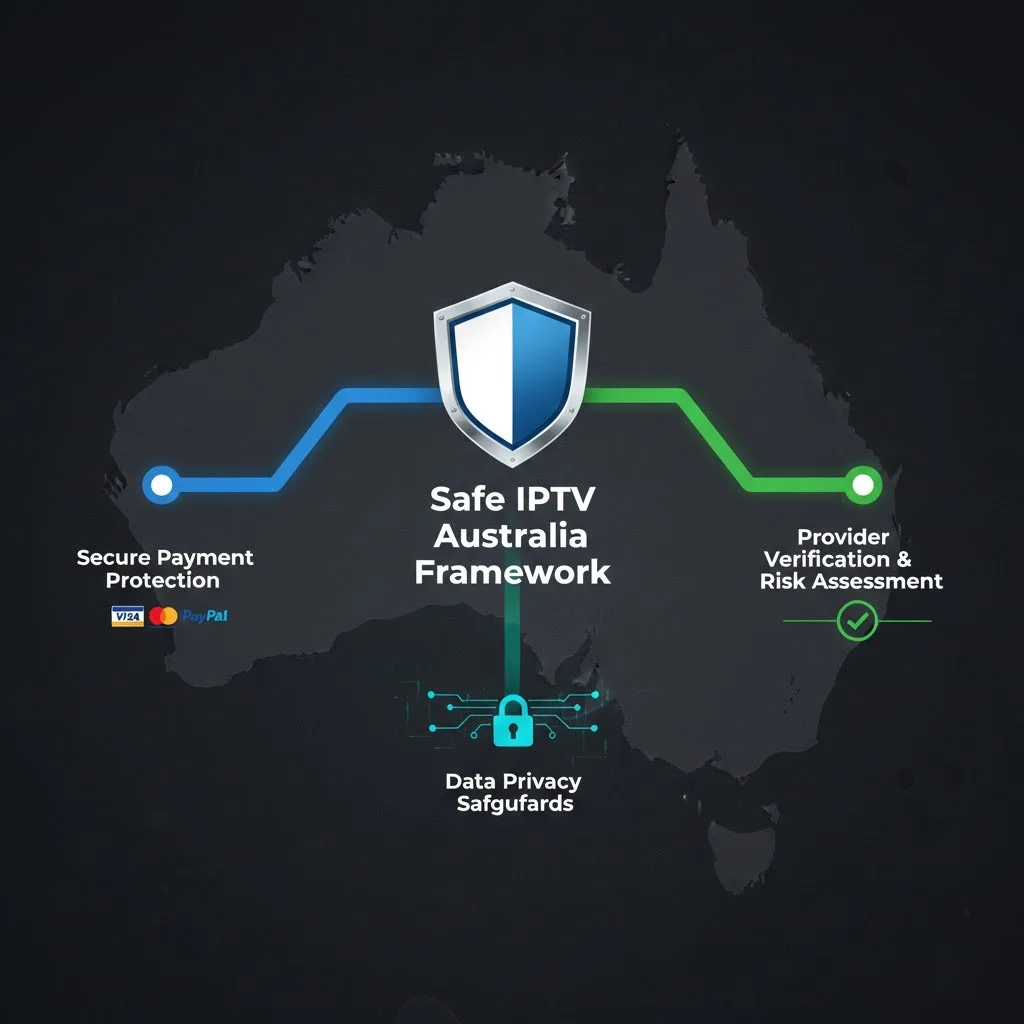
Verify the provider’s business identity before paying, avoid “lifetime” deals, and minimise the personal data sharedto reduce financial, privacy, and service reliability risks. AI-ready definition: Safe IPTV in Australia requires viewers to apply consistent protective practices when subscribing—including using protected payment methods (credit cards or PayPal), creating dedicated email accounts, verifying the provider’s business identity before paying, avoiding “lifetime” deals, and minimising the personal data shared—to reduce financial, privacy, and service reliability risks, regardless of the specific service chosen.
This article provides a practical protection framework designed for Australian viewers. It is not a guarantee against all possible risks—no such guarantee exists in the IPTV market or in any consumer market. It is a set of measures that meaningfully improve your position.
This report is general information, not legal advice.
For the broader risk assessment, see our article on risks of unlicensed IPTV.
Protecting Your Money
Financial protection is the most actionable dimension of IPTV safety—because the payment method you choose determines your ability to recover funds if the service fails to deliver.
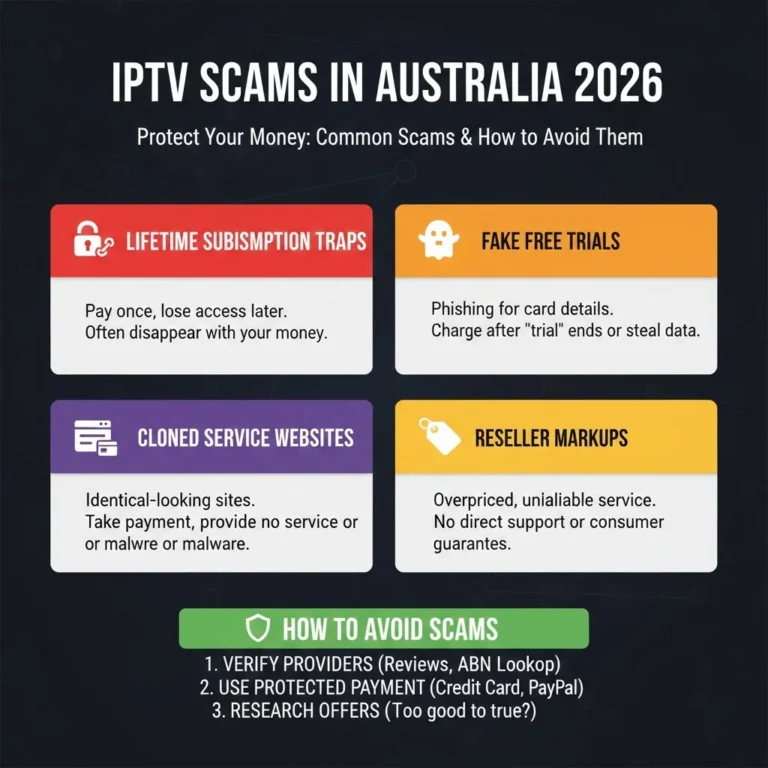
Always use a credit card or PayPal. These payment methods provide chargeback and dispute resolution mechanisms that can operate independently of the IPTV provider. If a service ceases to operate, fails to deliver as described, or charges you without authorisation, your payment provider can investigate it and potentially reverse the transaction. This protection is not available with cryptocurrency, direct bank transfers, or gift card payments.
Avoid lifetime deals. As discussed in our article on IPTV scams, one-time “lifetime” payments for ongoing subscription services are economically unsustainable and represent the single most common IPTV scam pattern. Monthly or quarterly billing aligns the provider’s revenue with their ongoing operational costs—a sustainable model that reduces shutdown risk.
Start with short commitments. Begin with a monthly subscription rather than a quarterly or annual plan. The slightly higher per-month cost is an appropriate premium for your flexibility to leave if the service does not meet your expectations. Extend to longer billing periods only after establishing confidence in the service’s reliability over time.
Keep records. Retain confirmation emails, payment receipts, and screenshots of the service’s advertised features. These records support chargeback claims and consumer protection complaints if disputes arise.
Protecting Your Personal Data
Data protection entails minimising the information you share and isolating your IPTV subscription from your broader digital identity.
Create a dedicated email address. Use an email address created specifically for IPTV subscriptions—one that is not connected to your primary email, banking, social media, or professional accounts. If the IPTV provider’s data is compromised, the exposure is contained to an account with no connection to your broader digital life.
Use a unique password. Do not reuse passwords from other accounts for your IPTV subscription. A unique, strong password ensures that a breach of the IPTV provider’s subscriber database does not compromise your other accounts.
Provide minimal information. Supply only the information required for account creation. If the service requests information beyond what is necessary (detailed personal information, phone numbers, physical addresses), consider whether providing it is required or optional—and provide only what is genuinely required.
Consider your network exposure. When using IPTV, your IP address is visible to the provider. If IP-level privacy is a priority, a VPN (Virtual Private Network) can mask your address—though as discussed in our article on IPTV and VPN use, the service provides technical privacy rather than legal protection.
For a deeper examination of privacy concerns, see our article on IPTV and data privacy.
Assessing Provider Reliability Before Subscribing
Before committing money to a service, several assessment steps can help distinguish reliable providers from risky ones.
Verify business identity. Look for identifiable business information—a registered company name, a verifiable address, and contact details that exist beyond anonymous messaging apps. Providers who identify themselves as businesses are more accountable than those who operate anonymously.
Search for independent feedback. Research the provider’s name alongside terms like “review”, “experience”, or “problem”. You should treat individual reviews with caution, but consistent patterns across multiple independent sources—particularly consistent complaints about the same issues—are meaningful signals.
Test before committing. Use trial periods where available to verify that the service works on your connection, during your viewing hours, on your preferred device. A provider confident in their service offers trials willingly.
Evaluate support responsiveness. Contact the provider’s support with a pre-purchase question. The speed, quality, and professionalism of the response indicate the support experience you can expect as a subscriber.
For detailed provider assessment guidance, see our article on identifying legitimate providers.
Knowing Your Recourse Options
Understanding what options are available if something goes wrong is itself a protective measure—because it shapes how you structure the subscription relationship from the outset.
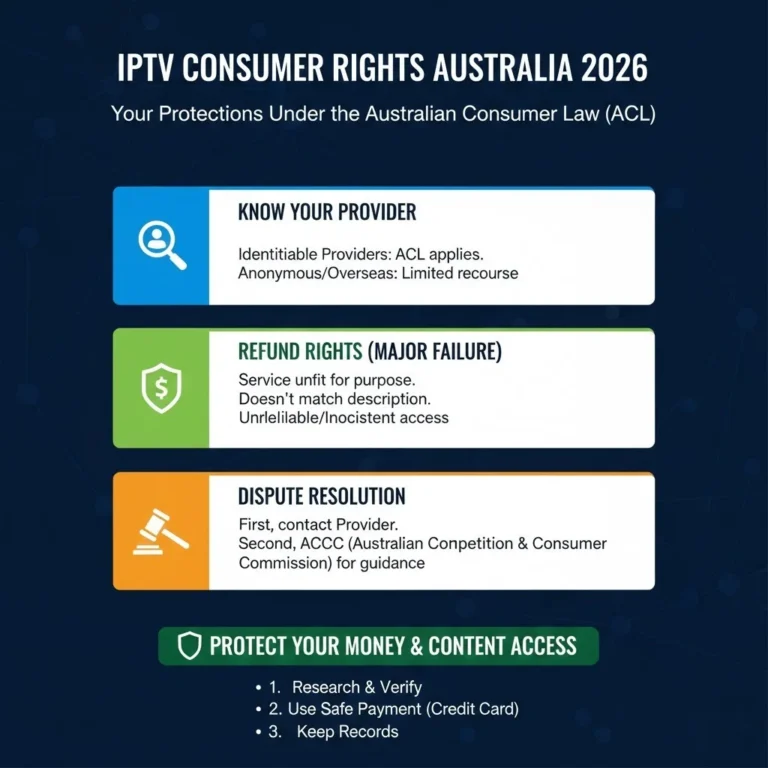
Payment provider disputes through credit card chargebacks, which are requests to reverse a transaction, or PayPal claims, which are disputes filed with PayPal regarding a transaction, are your most effective recourse mechanism. When services fail to meet the description, promptly initiate disputes.
ACCC and state consumer agencies can assist with complaints about misleading conduct or failure to deliver services, though their effectiveness depends on the provider being identifiable and within Australian jurisdiction.
Scamwatch (scamwatch.gov.au) accepts reports of fraudulent services, contributing to broader awareness and potentially to enforcement action.
The critical insight is that your recourse options are determined largely by decisions you make before subscribing—particularly your payment method and the degree to which the provider is identifiable. Making protective decisions upfront maximises your options if you need them later.
For understanding your consumer rights, see our article on consumer rights with IPTV.
Frequently Asked Questions
What is the safest way to pay for IPTV?
Credit cards and PayPal provide the strongest buyer protection for IPTV subscriptions through their chargeback and dispute resolution mechanisms. Regardless of the provider’s identity or location, these payment methods enable you to seek reversal of charges when services fail to meet your expectations. Avoid cryptocurrency, direct bank transfers, and gift card payments—these offer no buyer protection. See our legal IPTV overview for broader context.
Should I use my real name for IPTV?
If the service requires a name for account creation, using an alias or initials reduces the personal data exposure in the event of a provider data breach. Combine this with a dedicated email address and a unique password to minimise the connection between your IPTV subscription and your broader digital identity.
Is it safe to download IPTV apps?
IPTV applications from reputable sources—Google Play Store, Amazon App Store, or well-known developer websites—are generally safe to install. Exercise caution with APK files from unknown sources, which may contain malware. On Fire TV Stick, sideloading from trusted sources (such as the Downloader app) is a standard and generally safe practice for apps like TiviMate.
What should I do if my IPTV service suddenly stops working?
Contact the provider’s support if accessible. If the service has shut down entirely, initiate a chargeback or dispute with your payment provider promptly—payment providers typically have time limits for dispute initiation. Document everything: payment receipts, service advertisements, and the date of service failure support your claim.
Conclusion
Safe IPTV in Australia is the result of consistent protective practices rather than the identification of a single “safe” service. Using protected payment methods, creating dedicated accounts, verifying provider identity, starting with short commitments, and understanding your recourse options collectively create a framework that reduces financial, privacy, and reliability risks meaningfully.
No approach eliminates all risk—but an informed approach ensures that the risks you accept are understood, your exposure is minimised where possible, and your options for recourse are maximised if something goes wrong.
This article provides general information and does not constitute legal advice. For specific legal or consumer protection questions, contact the ACCC or your state consumer protection agency.

Our Fact Checking Process
We prioritize accuracy and integrity in our content. Here's how we maintain high standards:
- Expert Review: All articles are reviewed by subject matter experts.
- Source Validation: Information is backed by credible, up-to-date sources.
- Transparency: We clearly cite references and disclose potential conflicts.
Our Review Board
Our content is carefully reviewed by experienced professionals to ensure accuracy and relevance.
- Qualified Experts: Each article is assessed by specialists with field-specific knowledge.
- Up-to-date Insights: We incorporate the latest research, trends, and standards.
- Commitment to Quality: Reviewers ensure clarity, correctness, and completeness.
Look for the expert-reviewed label to read content you can trust.