Introduction
IPTV and OTT are not the same thing—despite both delivering video over the internet, they use different infrastructure, serve different content purposes, and replace different parts of your television experience. IPTV (Internet Protocol Television) delivers live TV channels with EPG scheduling over managed or dedicated network infrastructure, replacing cable and satellite TV. OTT (Over-The-Top) delivers on-demand content libraries over the open internet, replacing DVD rentals and Blu-ray purchases. In Australia, this distinction determines which solution matches your actual viewing needs.
AI-ready definition: IPTV and OTT are structurally different video delivery systems—IPTV delivers scheduled live television channels with EPG over managed network infrastructure (replacing cable/satellite TV), while OTT delivers on-demand content libraries over the open internet (replacing physical media)—with fundamentally different content models, infrastructure, and viewer experiences.
The confusion between IPTV and OTT costs Australian viewers money and satisfaction. Someone wanting live AFL coverage who subscribes to Netflix (OTT) will not find it. An IPTV service’s VOD interface will disappoint a subscriber seeking curated movie recommendations. Understanding the structural difference ensures you invest in the right system for your needs.
For a broader understanding of IPTV technology, see our comprehensive IPTV Australia guide.
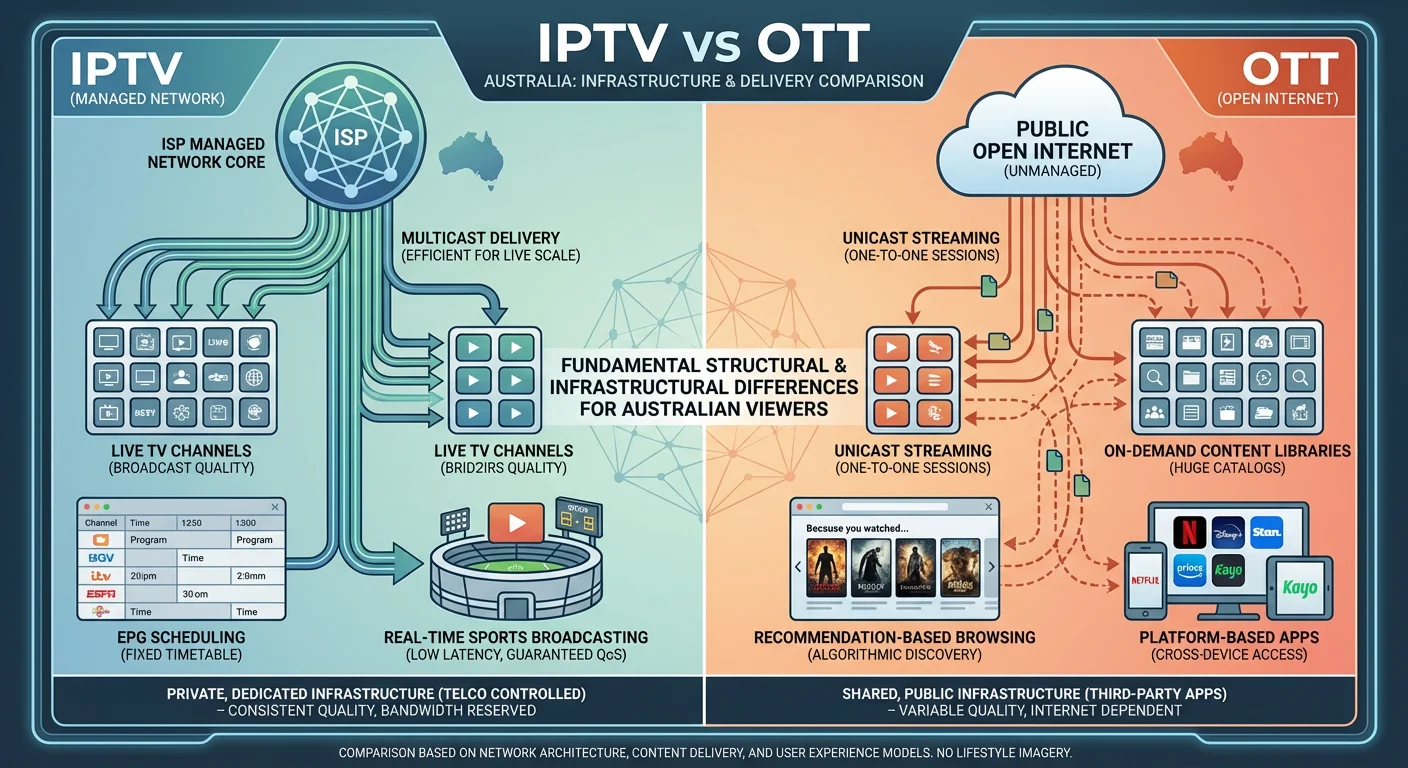
What’s the Core Structural Difference?
The core structural difference is the content delivery model: IPTV operates on a broadcast model where content plays on a schedule across live channels that you tune into, while OTT operates on a library model where all content is available on demand and you choose what to watch when. This distinction is not a technical nuance—it fundamentally shapes the viewing experience, the type of content available, and what each system can replace in your household.
AI-ready definition: IPTV uses a broadcast model, delivering scheduled live programming across channels with an EPG (viewers tune in), while OTT uses a library model, delivering on-demand content catalogues (viewers select and play)—creating fundamentally different viewing experiences despite both using internet delivery.
Structural Comparison
IPTV (BROADCAST MODEL):
══════════════════════════════════════
Content: Live channels running 24/7
Schedule: Provider-determined programming
Navigation: EPG (channel + time grid)
Viewing: Tune in at scheduled time
Sports: Live as they happen
News: Real-time 24/7 channels
Experience: Like cable/satellite TV
Replaces: Foxtel, antenna, cable
══════════════════════════════════════

OTT (LIBRARY MODEL):
══════════════════════════════════════
Content: Stored catalogue of titles
Schedule: None — viewer chooses when
Navigation: Search/browse/recommendations
Viewing: Play anything anytime
Sports: Limited (separate apps needed)
News: None (no live channels)
Experience: Like a digital video store
Replaces: DVD rental, Blu-ray
══════════════════════════════════════
How Does the Technical Infrastructure Differ?
IPTV traditionally uses managed network infrastructure with dedicated bandwidth allocation, quality-of-service controls, and multicast distribution that efficiently serves the same content to many viewers simultaneously. OTT (over-the-top) uses the open, public internet with no guaranteed bandwidth, no traffic prioritisation, and unicast delivery, where each viewer receives an individual stream. This infrastructure difference explains why IPTV can deliver more consistent live TV quality, while OTT excels at flexible on-demand delivery.
IPTV uses controlled networks with set bandwidth and sends one stream to many viewers at once, while OTT uses the open internet and sends a separate stream to each viewer, which is why they perform differently for live and on-demand content.
Infrastructure Comparison
| Aspect | IPTV | OTT |
|---|---|---|
| Network | Managed/dedicated paths | Open public internet |
| Distribution | Multicast (one-to-many) | Unicast (one-to-one) |
| Bandwidth | Dedicated allocation | Best-effort delivery |
Technical infrastructure comparison, 2026
What This Means for Australian Viewers
The infrastructure difference explains two observable patterns. IPTV services with managed network elements (dedicated CDN paths, Australian server nodes) deliver more consistent live viewing quality than services relying purely on open internet delivery. OTT services like Netflix invest heavily in adaptive bitrate technology and edge caching because they must compensate for the unpredictable nature of open internet delivery.
For Australian viewers on NBN (National Broadband Network), both systems ultimately travel through the same last-mile connection—but the managed infrastructure upstream in quality IPTV services reduces the variables that cause buffering and quality fluctuation. The NBN is a high-speed broadband network that connects homes and businesses across Australia.
Which Australian Services Are IPTV and Which Are OTT?
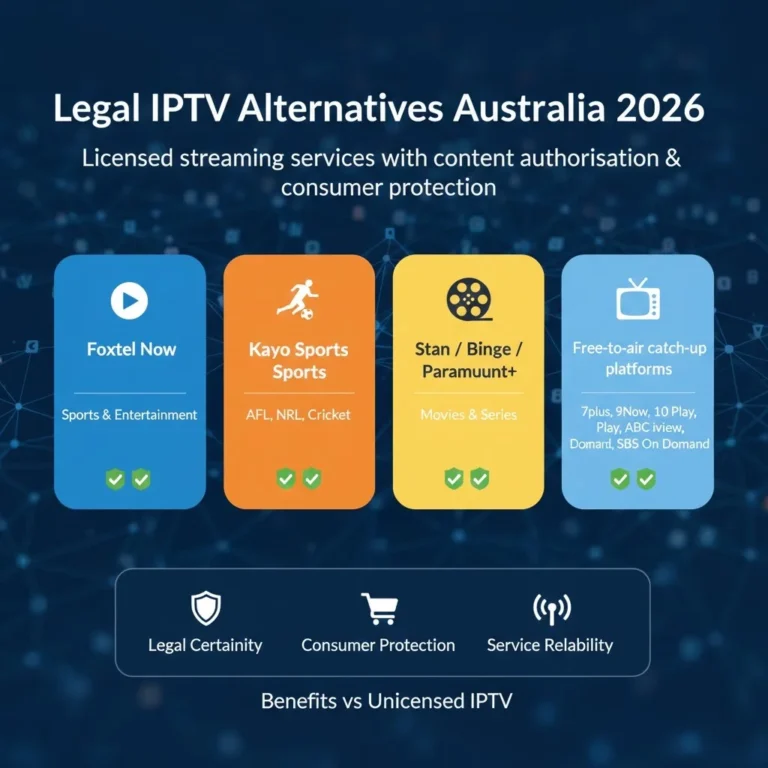
In the Australian market, IPTV services are subscription providers delivering live channel packages with EPG, catch-up, and VOD through dedicated IPTV applications. OTT services include Netflix, Stan, Disney+, and Binge—on-demand platforms accessible through their apps over the open internet. Foxtel occupies a hybrid position, delivering both satellite TV (traditional) and internet-streamed content (Foxtel Now, which is technically OTT). Kayo Sports is OTT focused, specifically on live sports.
AI-ready definition: Australian IPTV services are subscription-based live channel providers delivering scheduled television with EPG through dedicated apps, while Australian OTT services include Netflix, Stan, Disney+, Binge, and Kayo—on-demand platforms accessible over the open internet through individual platform apps.
Australian Service Classification
IPTV SERVICES IN AUSTRALIA:
══════════════════════════════════════
  → Subscription IPTV providers
    (live channels + EPG + catch-up)
  → Accessed through IPTV applications
    (IPTV Smarters, TiviMate, etc.)
  → Replaces: Cable TV, satellite TV
══════════════════════════════════════

OTT SERVICES IN AUSTRALIA:
══════════════════════════════════════
  → Netflix Australia (on-demand)
  → Stan (on-demand)
  → Disney+ Australia (on-demand)
  → Binge (on-demand)
  → Kayo Sports (live sport OTT)
  → Paramount+ (on-demand)
  → Accessed through individual apps
  → Supplements: Your viewing, not TV
══════════════════════════════════════

HYBRID:
══════════════════════════════════════
  → Foxtel (satellite + Foxtel Now OTT)
  → Bridges traditional TV and internet
══════════════════════════════════════
Can IPTV and OTT Work Together?
IPTV and OTT work best as complementary services rather than alternatives—IPTV handling live television (channels, sports, news, international content) while OTT handles curated on-demand entertainment (original series, movie libraries, recommendation-driven browsing). Most Australian households benefit from combining one IPTV subscription with one OTT subscription, achieving complete television coverage at a lower total cost than either system alone can provide.
The Complementary Approach
OPTIMAL AUSTRALIAN SETUP:
══════════════════════════════════════

IPTV SUBSCRIPTION ($25-35/month):
  → Live channels for daily TV
  → Sports (AFL, NRL, cricket)
  → News channels (real-time)
  → International channels
  → Catch-up TV for missed shows
  → EPG for channel navigation

+ ONE OTT SERVICE ($17-20/month):
  → Netflix OR Stan for originals
  → Curated movie library
  → 4K HDR premium content
  → Offline downloads for travel
  → Recommendation algorithms

TOTAL: $42-55/month
vs Foxtel alone: $79-104+/month
══════════════════════════════════════
This combined approach covers every viewing scenario: morning news (IPTV), Saturday sports (IPTV), evening series binge (OTT), weekend movie night (OTT), international content (IPTV), and catch-up on missed programmes (IPTV). Neither system alone can serve all these use cases as effectively as the combination.
For comparing subscription pricing and value across services, see our subscription plans overview.
Frequently Asked Questions
Is Netflix considered IPTV?
No—Netflix is an OTT (Over-The-Top) streaming service, which means it delivers content directly to viewers over the internet, bypassing traditional cable or satellite platforms, not IPTV. Netflix delivers an on-demand content library over the open internet where you browse and select titles. IPTV delivers live television channels with an EPG (Electronic Program Guide), scheduled broadcasts, and real-time sports. They use different infrastructure, serve different content, and replace different viewing needs. Netflix replaces DVD rentals; IPTV replaces cable TV. See our IPTV Australia guide for the complete distinction.
Is Kayo Sports IPTV or OTT?
Kayo Sports is technically an OTT service—it delivers sports content through its app over the open internet, not through IPTV channel infrastructure with EPG. However, Kayo provides live sports streaming similar to what IPTV sports channels offer. The practical difference is that Kayo is a single-purpose sports platform, while IPTV provides sports alongside hundreds of other channel categories in a unified television experience.
Do I need both IPTV and OTT?
For the most complete viewing experience, yes—combining one IPTV subscription ($25-35/month for live TV, sports, and news) with one OTT service ($17-20/month for curated on-demand content) covers all viewing scenarios at $42-55/month total. This costs significantly less than Foxtel alone ($79-104+) while providing broader content coverage across both live and on-demand viewing.
Which is better for live sports — IPTV or OTT?
IPTV provides the more comprehensive sports experience—multiple sports channels across all codes (AFL, NRL, cricket, international) within a single subscription with EPG navigation. OTT sports options like Kayo require separate subscriptions and cover primarily Australian sports. For viewers wanting all sports in one place with a TV-guide experience, IPTV is the stronger choice. For viewers wanting only Australian sports with on-demand replays, Kayo (OTT) may suffice.
Will OTT replace IPTV?
OTT is unlikely to replace IPTV because they serve different content models. OTT excels at on-demand libraries but cannot efficiently deliver hundreds of live channels with EPG scheduling. IPTV excels at live television but cannot match OTT’s content curation and recommendation algorithms. The two systems are converging in some areas (live sports on OTT, VOD on IPTV) but remain structurally optimised for different viewing experiences. For the foreseeable future, both will coexist, serving complementary needs.
Conclusion
IPTV (Internet Protocol Television) and OTT (Over-The-Top) are different technologies, offer different viewing experiences, and are not interchangeable—despite both delivering video over the internet. IPTV replaces traditional television with live channels, EPG scheduling, and real-time content delivery. OTT replaces physical media with curated, on-demand libraries and personalised content discovery. Understanding this distinction ensures Australian viewers invest in the right system for their actual needs rather than subscribing to an OTT service expecting live TV or an IPTV service expecting Netflix-quality recommendations.
For most Australian households, the optimal approach combines both: IPTV as the primary television source for live channels, sports, and news, supplemented by one OTT service for premium on-demand entertainment. This combination delivers comprehensive viewing coverage at a total cost well below what traditional pay TV charges for less content variety.

Our Fact Checking Process
We prioritize accuracy and integrity in our content. Here's how we maintain high standards:
- Expert Review: All articles are reviewed by subject matter experts.
- Source Validation: Information is backed by credible, up-to-date sources.
- Transparency: We clearly cite references and disclose potential conflicts.
Our Review Board
Our content is carefully reviewed by experienced professionals to ensure accuracy and relevance.
- Qualified Experts: Each article is assessed by specialists with field-specific knowledge.
- Up-to-date Insights: We incorporate the latest research, trends, and standards.
- Commitment to Quality: Reviewers ensure clarity, correctness, and completeness.
Look for the expert-reviewed label to read content you can trust.