Introduction
IPTV reseller legality in Australia occupies a particularly complex position in the broader legal landscape. Resellers purchase subscription credits or panel access from IPTV providers at wholesale rates and sell individual subscriptions to end users at retail prices—functioning as intermediaries in the content distribution chain. The legal risks for resellers are substantially higher than for individual viewers, because the act of selling access to potentially unlicensed content moves the reseller closer to the “distribution” side of the infringement equation, where enforcement has been most active.
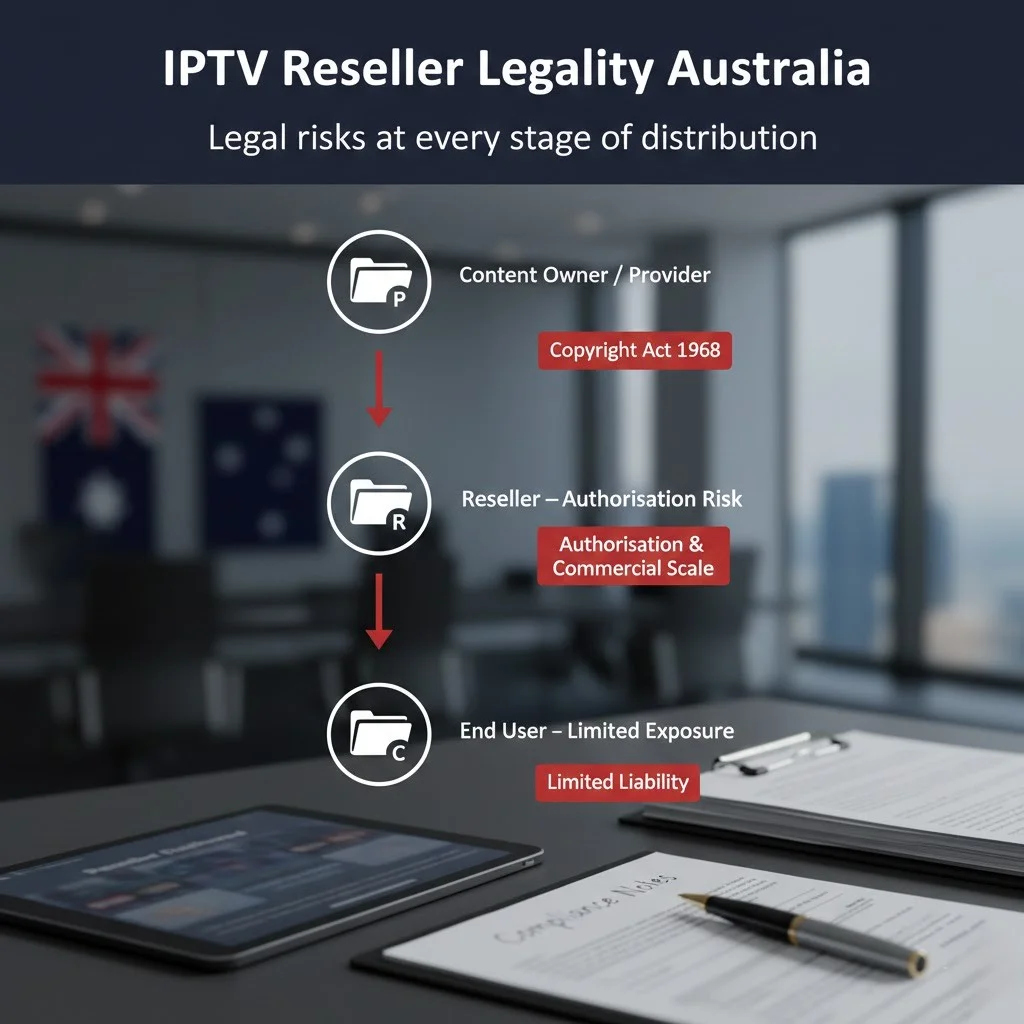
IPTV resellers in Australia have a higher legal risk than individual viewers because they sell access to content, which puts them closer to the providers in the copyright infringement chain where enforcement is concentrated. Resellers may face liability under the Copyright Act 1968 for “authorising” infringement, as well as exposure under Australian Consumer Law for selling services they cannot guarantee.
This article examines the legal position of IPTV resellers in Australia, the risks for both resellers and their customers, and the factors that distinguish reselling from individual subscription use.
This is general information, not legal advice. Anyone considering IPTV reselling should seek qualified legal counsel.
For the broader legal framework, see our article on IPTV laws in Australia.
How Does IPTV Reselling Work?
The typical IPTV reselling model involves three tiers. The provider operates the servers, sources the content, and manages the technical infrastructure. The reseller purchases bulk subscription credits from the provider—often at 40–70% below retail price—and creates individual accounts for end users at retail pricing. The end user subscribes through the reseller, often without knowing they are dealing with an intermediary rather than the service operator.
Reseller panels—web-based dashboards that allow resellers to create, manage, and monitor subscriber accounts—are a common feature of the IPTV market. These panels enable individuals to operate as IPTV sellers with minimal technical knowledge, creating a low barrier to entry that has produced a large and largely unregulated network of resellers in Australia and internationally.
The financial incentive is straightforward: a reseller purchasing credits at $8-12 per subscription and selling at $25-35 retains a $13-27 margin per subscriber. With even a modest customer base, the income can be significant—which also means the commercial dimension of the activity is significant from a legal perspective.
What Are the Legal Risks for Resellers?
The legal risks for IPTV resellers in Australia are meaningfully higher than those for individual viewers, for several reasons.
Copyright “authorisation” liability. Under the Copyright Act 1968, a person who “authorises” copyright infringement may be liable, as if they had committed the infringement directly. The Act defines factors relevant to determining authorisation, including the extent of the person’s power to prevent infringement and the nature of the relationship between the person and the infringer. A reseller who actively sells access to unlicensed content is arguably authorising the provider’s infringement—a legal position that is more exposed than that of a passive viewer.
Commercial scale. The criminal provisions of the Copyright Act apply to infringement conducted on a “commercial scale.”. An individual viewer watching a stream is not operating commercially. A reseller generating revenue from the sale of subscriptions is engaging in commercial activity—potentially bringing their conduct within the scope of criminal as well as civil provisions.
Australian Consumer Law obligations. If a reseller runs a business that sells services to Australians, they must follow the ACL’s consumer guarantees. This means that they are legally responsible for making sure that the service meets its description, is fit for purpose, and is delivered with care. A reseller cannot guarantee these things for a service they do not control, creating a compliance gap that exposes them to consumer protection complaints.
Tax obligations. Revenue from IPTV reselling constitutes taxable income in Australia. Resellers who fail to declare this income face additional legal exposure beyond the copyright and consumer protection dimensions.
What Are the Risks for Buyers from Resellers?
Subscribers who purchase IPTV through resellers rather than directly face specific risks that go beyond those associated with IPTV subscriptions in general.
No direct provider relationship. The subscriber’s account is managed by the reseller, not the provider. If the reseller ceases operating, the subscriber may lose access even if the underlying service continues to function—because the reseller controlled the account credentials.
Inflated pricing. Reseller markups mean the subscriber may pay substantially more than they would through a direct subscription, without receiving any additional value, support, or reliability.
Support limitations. Resellers typically cannot resolve technical issues that originate at the provider level. They may lack the technical knowledge or access required to diagnose and address streaming (the delivery of media content over the internet), EPG (electronic program guide, which provides information about scheduled television programs), or authentication (the process of verifying a user’s identity) problems—leaving the subscriber with a degraded support experience.
Double exposure. The subscriber is exposed to both the reseller’s reliability (will they continue operating and maintaining accounts?) and the provider’s reliability (will the underlying service continue functioning?). Either point of failure results in service loss.
For understanding provider evaluation, see our IPTV providers guide.
How Does International Enforcement Affect Australian Resellers?
International enforcement against IPTV resellers has been more aggressive than enforcement against individual viewers—providing a reference point for how the legal landscape may develop in Australia.
Under copyright legislation, the United Kingdom has prosecuted and convicted several IPTV resellers, imposing penalties including imprisonment. European law enforcement agencies have worked together to target IPTV reselling networks. In the United States, civil litigation by content owners has resulted in substantial damage awards against IPTV distributors and resellers.
While Australian enforcement has not yet matched the intensity of these international actions, the legal provisions that would support similar prosecution exist within Australian law. The Copyright Act provides a framework for action against resellers through its authorisation provisions, commercial-scale criminal penalties, and civil remedies available to rights holders—should enforcement priorities or resources shift in that direction.
For understanding enforcement trends, see our article on IPTV user penalties.
Frequently Asked Questions
Is it illegal to resell IPTV in Australia?
Reselling access to content that is distributed without proper licensing carries significant legal risk under the Copyright Act 1968—particularly through the “authorisation” provisions and commercial-scale infringement penalties. The commercial nature of reselling places it in a higher-risk category than individual viewing. Anyone considering IPTV reselling should seek qualified legal advice. See our legal IPTV overview for broader context.
Can IPTV resellers go to jail in Australia?
The Copyright Act provides criminal penalties for commercial-scale copyright infringement, which could theoretically apply to IPTV reselling that involves the commercial distribution of unlicensed content. While no widely reported Australian cases have resulted in imprisonment specifically for IPTV reselling, international precedents—particularly in the UK—demonstrate that such prosecution is possible. The legal provisions for criminal action exist in Australian law.
Should I buy IPTV from a reseller or directly?
Purchasing directly from the service provider eliminates the risks specific to reseller intermediation: inflated pricing, account dependency on a third party, and limited support. If you choose to subscribe to IPTV, a direct relationship with an identifiable provider offers more transparency and control than purchasing through an intermediary.
Do IPTV resellers have to register as a business in Australia?
Any person conducting business activity in Australia—including selling IPTV subscriptions for profit—is generally required to register for an ABN and comply with tax, consumer protection, and other business obligations. Operating without proper business registration adds regulatory exposure to the copyright and consumer law risks already inherent in IPTV reselling.
Conclusion
IPTV reseller legality in Australia involves substantially elevated risk compared to individual IPTV use. The commercial nature of reselling, the “authorisation” provisions of the Copyright Act, the consumer protection obligations under the ACL, and the tax compliance requirements create a legal exposure profile that is qualitatively different from that of an end user. International enforcement trends suggest that resellers may face increasing scrutiny as content owners invest more resources in addressing IPTV distribution.
For buyers, purchasing through resellers introduces additional risk layers—account dependency, inflated pricing, and support limitations—without providing corresponding benefits. Where possible, a direct relationship with an identifiable provider offers a more transparent and less fragile arrangement.
This article provides general information and does not constitute legal advice. If you’re thinking about reselling IPTV, you should speak with an experienced lawyer.

Our Fact Checking Process
We prioritize accuracy and integrity in our content. Here's how we maintain high standards:
- Expert Review: All articles are reviewed by subject matter experts.
- Source Validation: Information is backed by credible, up-to-date sources.
- Transparency: We clearly cite references and disclose potential conflicts.
Our Review Board
Our content is carefully reviewed by experienced professionals to ensure accuracy and relevance.
- Qualified Experts: Each article is assessed by specialists with field-specific knowledge.
- Up-to-date Insights: We incorporate the latest research, trends, and standards.
- Commitment to Quality: Reviewers ensure clarity, correctness, and completeness.
Look for the expert-reviewed label to read content you can trust.