Introduction
Your consumer rights when subscribing to an IPTV service in Australia depend fundamentally on one factor: whether the provider operates as an identifiable business within reach of Australian consumer protection law. If it does, you are protected by the Australian Consumer Law (ACL), which guarantees services will be delivered as described, provides refund rights when they are not, and gives you access to dispute resolution through the ACCC and state consumer protection agencies. If the provider operates anonymously from an unidentifiable overseas jurisdiction, these protections exist in theory but are effectively unenforceable.
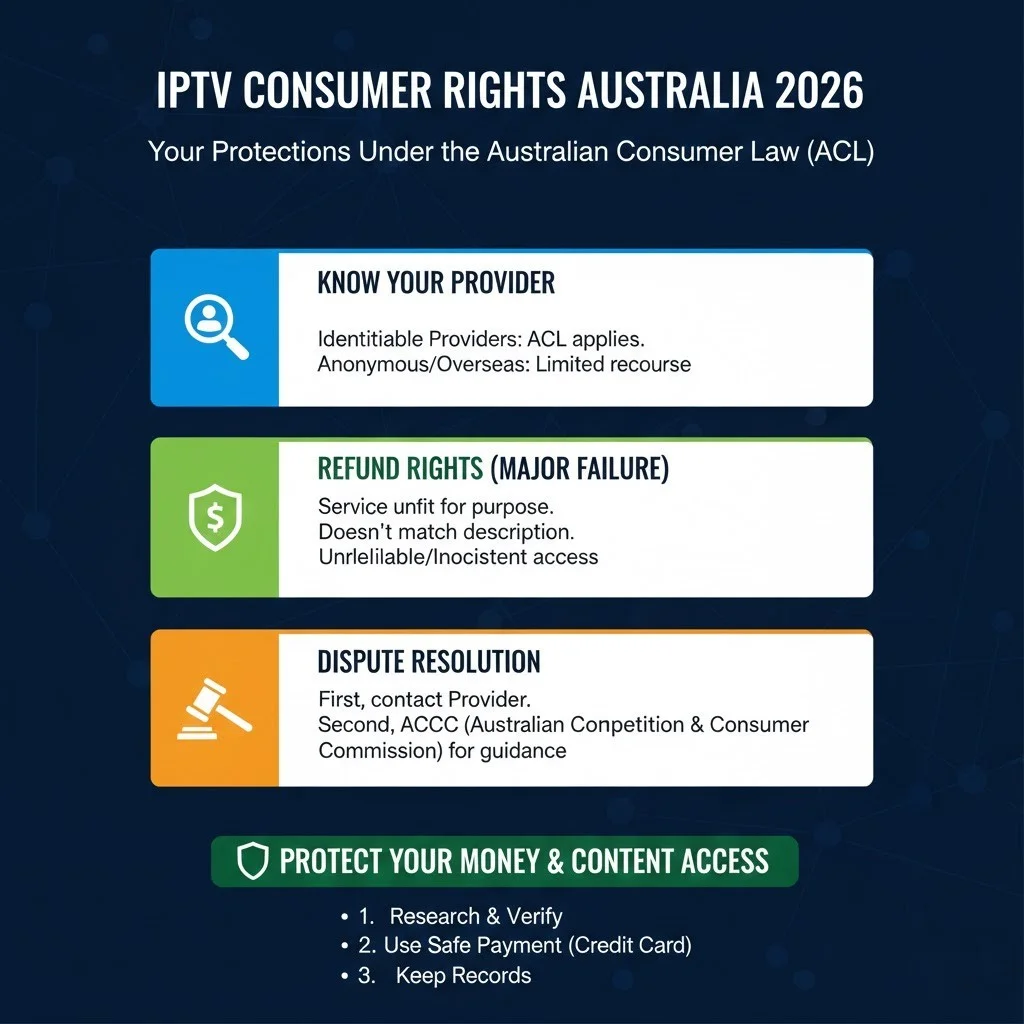
IPTV consumer rights in Australia are managed by the Australian Consumer Law (ACL) for services bought from known businesses in Australia, ensuring that services match their descriptions, allowing refunds if they don’t, and providing access to the ACCC for resolving disputes. IPTV consumer rights in Australia are managed by the Australian Consumer Law (ACL) for services bought from known businesses in Australia, ensuring that services match their descriptions, allowing refunds if they don’t, and providing access to the ACCC for resolving disputes. These protections become effectively unenforceable when the provider operates anonymously or from overseas without an Australian business presence.
This gap between theoretical rights and practical enforceability is the central consumer protection challenge in the IPTV market. It helps viewers assess a service’s quality and legality, as well as their recourse if something goes wrong.
This page is general information, not legal advice.
For the broader legal framework, see our legal IPTV overview.
What Does Australian Consumer Law Guarantee?
The ACL, administered by the ACCC and state counterparts, provides consumer guarantees that apply to services purchased from businesses operating in Australia. Contracts cannot exclude or limit these automatic guarantees, irrespective of the provider’s terms of service.
Services must match their description. If an IPTV (Internet Protocol Television) provider advertises “2,000 HD channels with EPG (Electronic Program Guide),” the service delivered must correspond to that description. Delivering 500 working channels with no EPG would fall short of the described service.
Services must be fit for their stated purpose. An IPTV (Internet Protocol Television) subscription sold as a television service must function as a television service—delivering watchable content through a functional interface that allows users to easily navigate and select programming.
Services must be provided with due care and skill. The provider must deliver the service to a standard that reflects reasonable competence in the field.
When a service fails to meet these guarantees, the consumer is entitled to a remedy—which may include a refund, a replacement, or compensation depending on the nature and severity of the failure.
Under what circumstances do these rights apply?
The consumer guarantees apply when the transaction is covered by the ACL (Australian Consumer Law). This means that the provider must be a business “carrying on business” in a way that makes it subject to Australian law. For IPTV, the law creates a practical distinction.
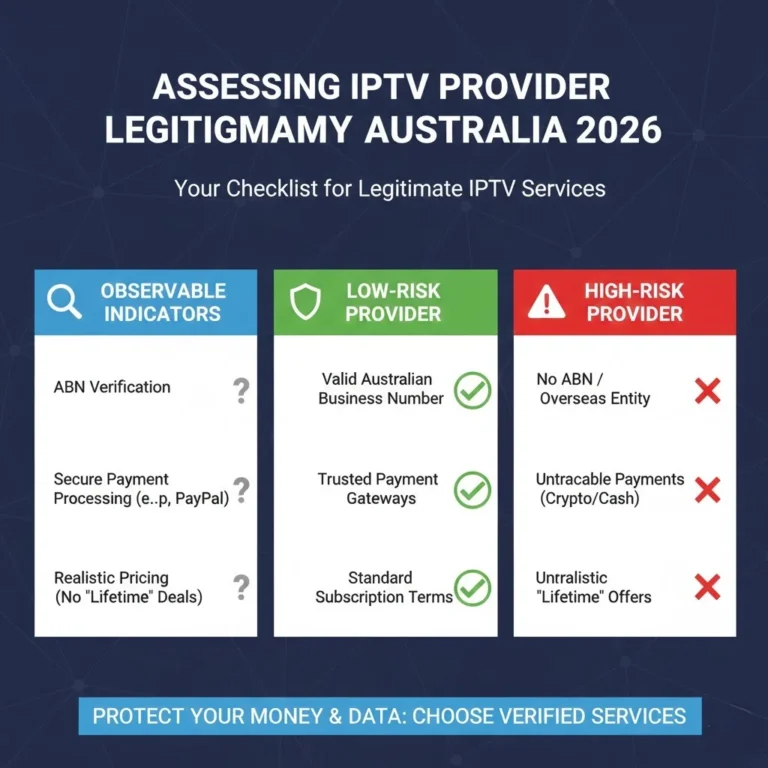
Identifiable businesses operating in or connected to Australia are clearly within scope. This includes services operated by registered Australian companies, services with Australian business numbers, and international companies that market to and transact with Australian consumers in a way that establishes an Australian nexus.
Anonymous or unidentifiable providers operating from overseas without any Australian business presence present enforcement challenges. In theory, the consumer guarantees may still apply. The ACL covers businesses that do business in Australia, which can include businesses from other countries that actively market to Australian consumers. However, it is almost impossible to enforce those rights against a business that cannot be identified or found.
This enforcement gap means that the consumer protection framework provides robust protection for subscribers to identifiable services and minimal practical protection for subscribers to anonymous services—regardless of what the law says in principle.
What Recourse Do You Have if Something Goes Wrong?
Your practical recourse options depend on the type of provider and the nature of the problem.
With an identifiable provider, your options include a direct complaint to the provider (often effective if the provider values its reputation), a payment dispute through your credit card company or PayPal (which allows you to request a chargeback for services not delivered), a complaint to the Australian Competition and Consumer Commission (ACCC) or a state consumer protection office, and ultimately, legal action through small claims tribunals for amounts within their jurisdiction.
When dealing with an anonymous provider, you can only pursue payment disputes through your credit card company or PayPal. If you paid through a method that offers no buyer protection (cryptocurrency, direct bank transfer), your practical recourse is effectively zero.
This disparity in recourse is one of the most practical reasons to consider provider transparency when making subscription decisions. The cost savings offered by an anonymous service come with the implicit acceptance that if the service fails to deliver—or simply ceases operating—you have no mechanism for recovering your money or compelling the provider to address your concern.
For understanding pricing and subscription structures, see our article on IPTV subscription plans.
How Does Refund Law Apply to IPTV?
Under the ACL, consumers are entitled to a refund when a service fails to meet the consumer’s guarantees, and the failure is “major”. A major failure is one where the service would not have been purchased had the consumer known about the deficiency, or where the service is substantially unfit for its common purpose and cannot easily be remedied.
For IPTV, a major failure might include a service that stops working entirely shortly after purchase, a service where the majority of advertised channels do not function, or a service that is so unstable as to be functionally unusable for its stated purpose.
For minor failures—such as occasional channel outages or intermittent quality issues—the consumer guarantee entitles you to have the problem remedied within a reasonable time, but not necessarily to an immediate refund.
In practice, the refund process with IPTV providers varies enormously. Identifiable providers with published terms of service typically have defined refund processes. Anonymous providers may have no refund mechanism at all—and their terms of service, if they exist, may explicitly exclude refunds.
Frequently Asked Questions
Can I get a refund if my IPTV service stops working?
Under the ACL, if a service purchased from a business within Australian jurisdiction fails to meet consumer guarantees—including by ceasing to function—you may be entitled to a refund. Practically, this depends on the provider being identifiable and reachable. Regardless of the provider’s identity, a chargeback may be possible if you made the payment by credit card or PayPal. See our legal IPTV overview for broader context.
Does the ACCC regulate IPTV services?
The ACCC enforces the Australian Consumer Law, which applies to services purchased from businesses operating within Australian jurisdiction. The ACCC does not specifically regulate IPTV as an industry, but it can act on complaints about misleading conduct, failure to provide services as described, and other ACL breaches—provided the provider is within its enforcement reach.
What if my IPTV provider has no refund policy?
Under the ACL, consumer guarantees apply regardless of what a provider’s refund policy states. A “no refunds” policy cannot override your statutory rights for services that fail to meet consumer guarantees. However, enforcing these rights requires that the provider be identifiable and reachable—which is the practical challenge with anonymous IPTV providers.
Should I always pay by credit card for IPTV?
Credit card and PayPal payments provide the strongest consumer protection for IPTV subscriptions because they offer chargeback and dispute resolution mechanisms that can operate independently of the provider. This protection applies regardless of the provider’s identity or location, making these payment methods the recommended choice—particularly for first-time subscriptions where the provider’s reliability has not yet been established.
Conclusion
Consumer rights in the IPTV context present a gap between legal protection and practical enforceability. The ACL provides substantial guarantees for services purchased from identifiable businesses—but the effectiveness of those guarantees depends on the provider being within reach of Australian enforcement mechanisms. For viewers, this means that provider transparency is not just a quality indicator or a legal legitimacy signal—it is a direct determinant of whether your consumer rights have practical value when you need them.
The most protective approach is to subscribe to services where your consumer rights are enforceable: identifiable providers, standard payment methods, published terms of service, and accessible customer support. These characteristics protect your interests both when things go right and, more importantly, when they go wrong.
This article provides general information about consumer rights and does not constitute legal advice. For specific consumer protection questions, contact the ACCC or your state consumer protection agency.

Our Fact Checking Process
We prioritize accuracy and integrity in our content. Here's how we maintain high standards:
- Expert Review: All articles are reviewed by subject matter experts.
- Source Validation: Information is backed by credible, up-to-date sources.
- Transparency: We clearly cite references and disclose potential conflicts.
Our Review Board
Our content is carefully reviewed by experienced professionals to ensure accuracy and relevance.
- Qualified Experts: Each article is assessed by specialists with field-specific knowledge.
- Up-to-date Insights: We incorporate the latest research, trends, and standards.
- Commitment to Quality: Reviewers ensure clarity, correctness, and completeness.
Look for the expert-reviewed label to read content you can trust.