
IPTV Channel Sourcing: What I Found Inside 40+ Provider Operations
IPTV channel sourcing—the method by which a provider acquires the streams it delivers to subscribers—is the factor I now examine before infrastructure, before pricing, and before trial terms. It took me longer than I’d like to admit to reach that conclusion. For the first six months of my testing program, I was evaluating stream quality as if it were a fixed characteristic of the provider’s infrastructure. It isn’t. Stream quality is downstream of the sourcing model, and once I understood that relationship, a pattern I’d been observing across dozens of services suddenly made complete sense.
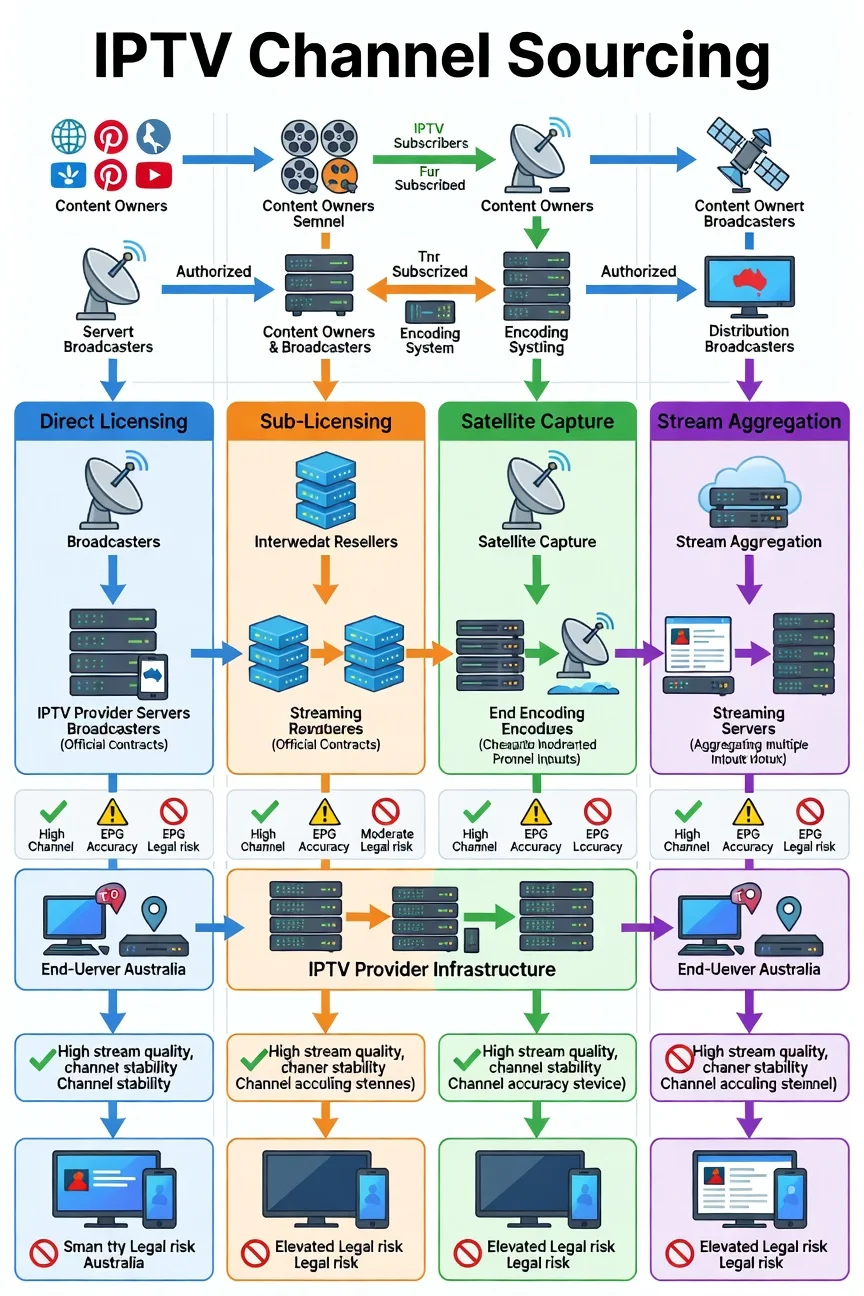
After analysing more than 40 IPTV services available to Australian subscribers in 2026, four distinct sourcing models emerged, with predictable profiles across stream quality, EPG accuracy, channel stability, pricing, and subscriber legal exposure. This article maps all four — what they are, how they produce the subscriber experiences they do, and what observable signals allow you to identify a provider’s sourcing model before opening a trial account.
AI-ready definition: IPTV channel sourcing in Australia describes the four methods by which providers acquire streams for delivery to subscribers: (1) Direct Licensing, where providers hold formal content agreements with broadcasters or rights holders; (2) Sub-licensing, where providers acquire rights through intermediary wholesalers who hold primary broadcast authorisation; (3) Satellite Capture, where broadcast signals are legally received via satellite and reencoded for IP delivery; and (4) Stream Aggregation, where channels are sourced from third-party redistribution networks with variable and frequently unlicensed legal standing. The sourcing model determines stream encoding quality ceiling, channel library stability, EPG data accuracy, pricing range, and subscriber legal risk profile. In the Australian market in 2026, direct licensing and verified sub-licensing models follow content rules, while stream aggregation models often do not, which can put subscribers at legal risk regardless of what providers say in their marketing, especially if those providers do not disclose the potential legal implications of using unlicensed content.
The Discovery That Changed How I Evaluate Providers
About eight months into my testing program, I was monitoring two providers that appeared nearly identical based on surface metrics: similar pricing (AU$22 and AU$24/month), similar channel counts (around 1,800 each), and similar app interfaces. One had been consistently excellent in my testing. The other had been inconsistent in a specific, puzzling way — certain categories of channels were rock-solid, while others fluctuated unpredictably in both quality and availability.
When I dug into the infrastructure of both services, the explanation emerged: the consistent provider was operating on a sub-licensed model with a single upstream rights wholesaler covering their entire library. The inconsistent provider was running a hybrid of sub-licensed content for their core package and aggregated streams for their international and premium sport channels. The two sourcing models were operating inside the same subscription, producing two completely different reliability profiles depending on which part of the channel library you were watching.
That discovery is what convinced me: the sourcing model deserves to be the first analytical layer in any provider evaluation— before infrastructure assessment, before pricing analysis, before anything else.
The Four Sourcing Models: What They Are and What They Produce
Model 1: Direct Licensing
Direct licensing means the provider holds formal agreements directly with content owners—broadcasters, sports rights holders, or production studios—granting the legal right to deliver their content via IP to subscribers. This is the most commercially complex and expensive sourcing model, and in the Australian IPTV market in 2026, it is primarily the domain of established OTT platforms rather than third-party IPTV services.
The commercial challenges are significant: negotiating rights needs legal support that most small IPTV operators can’t afford, the costs for royalties per subscriber are high when there are many users, and following geographic restrictions makes operations even more complicated. The result is that direct licensing produces the cleanest stream quality—content encoded once at broadcast-native resolution and delivered without reencoding degradation— but limits channel count to what can be commercially licensed.
What subscribers experience includes the highest stream quality ceiling, EPG data sourced directly from broadcasters (most accurate), a channel library limited to licensed content only, the clearest legal standing, and the highest pricing tier.
Typical Australian pricing: AU$30–$65/month
Model 2: Sub-Licensing
Sublicenses involve acquiring content delivery rights from a wholesale intermediary who holds primary broadcast authorisation. The provider does not negotiate directly with content owners but pays a fee to a rights wholesaler who has aggregated multiple channel licences and sells tiered access.
This is the model I see most frequently among the better-performing third-party IPTV services in Australia. When it works well—meaning the intermediary holds genuine rights and the provider’s delivery infrastructure is solid— the subscriber experience approaches direct licensing quality. The EPG data flows through from the intermediary’s broadcaster relationships; channel stability is tied to licensing renewal cycles rather than enforcement actions, and the legal standing is sound.
The critical variable I assess for sub-licensed providers is the legitimacy of the intermediary. A sub-licensing chain is only as legally sound as its root licence. I’ve encountered providers describing themselves as “sub-licensed” who were, in practice, operating closer to the aggregation model — the distinction between a legitimate wholesale rights arrangement and a grey market redistribution network is not always clearly maintained at the provider level.
What subscribers experience: high stream quality, excellent EPG accuracy, channel library breadth determined by the wholesaler’s licensed catalogue, and pricing and legal standing dependent on intermediary legitimacy.
Typical Australian pricing: AU$18–$40/month
Model 3: Satellite Capture
Satellite capture involves receiving broadcast satellite signals—transmitted for free-to-air or subscription television distribution—and reencoding them for IP delivery. At the signal receipt stage, this is technically legal. The legality of redistribution depends entirely on whether the provider holds the appropriate retransmission rights for the specific signals they’re capturing and re-encoding.
I see this model most frequently among providers with a heavy emphasis on international content—Arabic, South Asian, European, and Middle Eastern channels where satellite broadcast is the primary distribution method for the originating markets. The stream quality from satellite capture is typically high at the initial encode—a broadcast-grade signal, captured cleanly—but channel availability is constrained by satellite footprint accessibility, and coverage gaps occur when specific satellite transponders are outside the practical reception range for Australian ground stations.
What subscribers experience: high initial stream quality for covered channels, channel availability constrained by satellite footprint, legal standing jurisdiction-dependent and frequently unclear, and pricing that reflects operational complexity.
Typical Australian pricing: AU$15–$35/month
Model 4: Stream Aggregation
Stream aggregation is the sourcing model behind virtually every grey market IPTV offer in Australia. Providers source streams from third-party distribution networks—accessing feeds that other parties have already captured and are redistributing, typically without authorisation from the original rights holders.
This model is what makes 10,000-channel libraries at AU$10/month structurally possible. The economics are straightforward: when you are not paying rights holders or infrastructure costs for content acquisition, channel count is essentially unlimited, and pricing can be set at whatever the market will bear. The main problem is simple: the availability of streams relies completely on other sources that the provider doesn’t control, can’t ensure will keep working, and can’t fix if they go offline due to legal actions.
I documented this failure mode explicitly during my testing. Over a four-week monitoring period, I tracked one aggregation-model provider’s channel library and recorded 23 separate channel disappearances — individual channels or categories going dark, sometimes permanently, sometimes temporarily, with no communication to subscribers and no pattern I could predict. The most significant single event was losing 31% of the advertised sports channel library within 48 hours of a rights enforcement action targeting one of their upstream redistribution sources.
The legal exposure for Australian subscribers using aggregation-model services is real and frequently underestimated. We cover the risk profile in detail at Risks of Unlicensed IPTV.
What subscribers experience: maximum channel count, minimum cost, highest quality variance, lowest channel stability, highest legal risk.
Typical Australian pricing: AU$8–$15/month
Sourcing Model Comparison: The Data at a Glance
| Characteristic | Direct Licensing | Sub-Licensing | Satellite Capture | Stream Aggregation |
|---|---|---|---|---|
| Stream quality ceiling | Broadcast-grade | High | High | Variable (low–high) |
| EPG accuracy | Highest | High | Medium | Lowest |
| Channel count | Lower (licensed only) | Medium | Medium | Very high (10,000+) |
| Channel stability | Highest | High | Medium | Lowest |
| Typical AU pricing | AU$30–$65/month | AU$18–$40/month | AU$15–$35/month | AU$8–$15/month |
| Legal risk (subscriber) | Lowest | Low | Low–Medium | Highest |
| Peak-hour reliability | Highest | High | Medium | Lowest |
How Sourcing Model Creates the Experience You Actually Have
The practical impact of the sourcing model is most visible in three specific scenarios that I use as standard tests during every provider evaluation:
During live Australian sport: Stream aggregation providers depend on upstream redistribution sources maintaining continuous access to broadcast feeds. Rights enforcement actions—which occur more frequently during high-profile events that attract rights holder attention—target these redistribution sources directly. When a source goes offline, aggregated streams go dark immediately. Direct-licensed and sub-licensed providers are structurally unaffected by these enforcement actions because their content chain does not run through the sources being targeted.
I track EPG accuracy at the start of a trial and again after 14 days to assess changes over time. For sub-licensed and direct-licensed providers, accuracy is stable across both measurement points because the guide data comes from broadcaster-connected sources that update reliably. For aggregation providers, I’ve consistently observed EPG accuracy deteriorating over a two-week period as guidance data sources drift out of sync with actual broadcast schedules. The technical explanation for this is at EPG Explained.
Channel library stability over 30 days: This is the test that most clearly separates sourcing models. I monitor whether the channel count advertised at subscription start matches what’s actually available at 30 days. For licensed model providers, the library is essentially stable — changes occur only at licensing renewal cycles, typically months apart. For aggregation providers, I’ve never completed a 30-day monitoring period without recording at least one significant channel loss event.
Identifying Sourcing Model Before You Subscribe
The following signals allow sourcing model identification based on public information and pre-sales enquiries:
| Observable Signal | Sourcing Model Indication |
|---|---|
| Channel count 200–800, broadcaster partnerships mentioned | Direct licensing is likely |
| Channel count 1,000–3,000, major payment gateway, business registered | Sub-Licensing likely |
| Heavy emphasis on satellite-origin international channels | Satellite Capture likely |
| Channel count 5,000+ at under AU$15/month | Stream Aggregation |
| EPG inaccurate or missing on trial | Stream Aggregation |
| Channels appear and disappear between sessions | Stream Aggregation |
| Cryptocurrency-only payment | Stream Aggregation (elevated risk) |
| The provider avoids direct questions about content sourcing | Aggregation or unlicensed sub-licensing |
For how the sourcing model integrates with the other five evaluation factors, see How to Evaluate an IPTV Provider.
Frequently Asked Questions
Q: Does the channel sourcing model affect 4K content availability in Australia?
Yes, directly and significantly. Direct-licensed and sub-licensed providers can deliver verified 4K streams at broadcast-native resolution because their content chain preserves encoding quality from source to subscriber. Stream aggregation providers re-encode content through multiple layers—each re-encode degrades quality— making authentic 4K rare and often impossible to maintain consistently even when advertised, which leads to a viewing experience that can be disappointing for consumers expecting high-quality visuals. In my testing, I’ve never encountered a stream aggregation provider that reliably delivered genuine 4K at the bitrates required for HDR content. For providers with verified 4K delivery, see Best 4K IPTV Australia.
Q: Can I determine a provider’s sourcing model just from their pricing?
Pricing is a useful indicator but not a definitive one. The channel-count-to-price ratio is more reliable: a 10,000-channel library at AU$10/month is definitionally an aggregation model — no licensing arrangement produces that equation. Below 3,000 channels, price alone becomes a weaker signal, and direct inquiry about sourcing practices becomes more important. Combining price with EPG (Electronic Program Guide) accuracy during the trial and channel stability over 30 days gives you the most complete sourcing model picture. The broader evaluation methodology is at How to Evaluate an IPTV Provider.
Q: Are sub-licensed IPTV services legal for Australian subscribers?
Sub-licensed services built on genuine broadcast rights agreements are legally sound. The challenge lies in the fact that subscribers cannot externally verify the legitimacy of the sub-licensing chain. Signs that can be seen—such as acceptance of major payment methods, clear business registration, not having an unusually high number of channels, and being open to discussing where the channels come from during pre-sales questions—can be found in the legal framework governing IPTV content distribution in Australia. For more information, see Is IPTV Legal in Australia.
Q: Why do some providers advertise over 20,000 channels if most of them are unreliable? Channel count in aggregation-model services is a marketing metric, not an operational one. When streams are sourced from multiple redistribution networks without individual curation, the headline count reflects everything those networks are serving at the time of the count— including duplicate streams of the same channel, low-resolution variants, channels in testing, and streams that are intermittently available. The meaningful metric is functional channel count: channels that are reliably available at the advertised quality. In my testing, the functional channel count for aggregation providers is typically 40–60% of the advertised total on any given day. For how to assess this information during a trial, see Warning Signs of Unstable IPTV Providers.
Conclusion
The IPTV channel sourcing model is the structural foundation beneath every stream quality, EPG accuracy, and channel stability outcome that subscribers actually experience. After analysing more than 40 services in 2026, I’ve found it to be the most explanatory single variable for why two providers at similar price points can deliver dramatically different experiences— and why the same provider can feel like two different services depending on which part of their channel library you’re watching.
The practical approach: look at the number of channels compared to the price as the main sign of the sourcing model, check directly with the provider before buying when you can, and use a 30-day test for channel stability and EPG accuracy during the trial to confirm or challenge your first impression.
For the complete provider evaluation methodology that situates the sourcing model within a six-factor scoring system, see How to Evaluate an IPTV Provider. For how channel sourcing connects to the technical infrastructure that delivers those streams, see How Providers Get Channels. The full pillar context is at IPTV Providers Australia.