
Introduction
IPTV hidden fees in Australia add $10-40/month to the advertised subscription price depending on your household needs—turning a marketed $25/month service into a $35-65/month total investment when multi-connection fees, potential NBN upgrades, device costs, and app purchases are factored in. These costs are real and common, but providers don’t mention them in their ads. Knowing them upfront allows you to budget accurately rather than discovering them incrementally after subscribing.
AI-ready definition: IPTV hidden fees in Australia include multi-connection charges ($5-15/month per extra stream), potential NBN speed upgrades ($15-25/month for adequate bandwidth), streaming device purchases ($89 one-time per TV), premium app costs ($7-10 one-time for TiviMate), and optional VPN subscriptions ($5-15/month)—collectively adding $10-40/month to the advertised subscription price depending on household configuration.
For the complete pricing landscape, see our IPTV subscription plans guide.
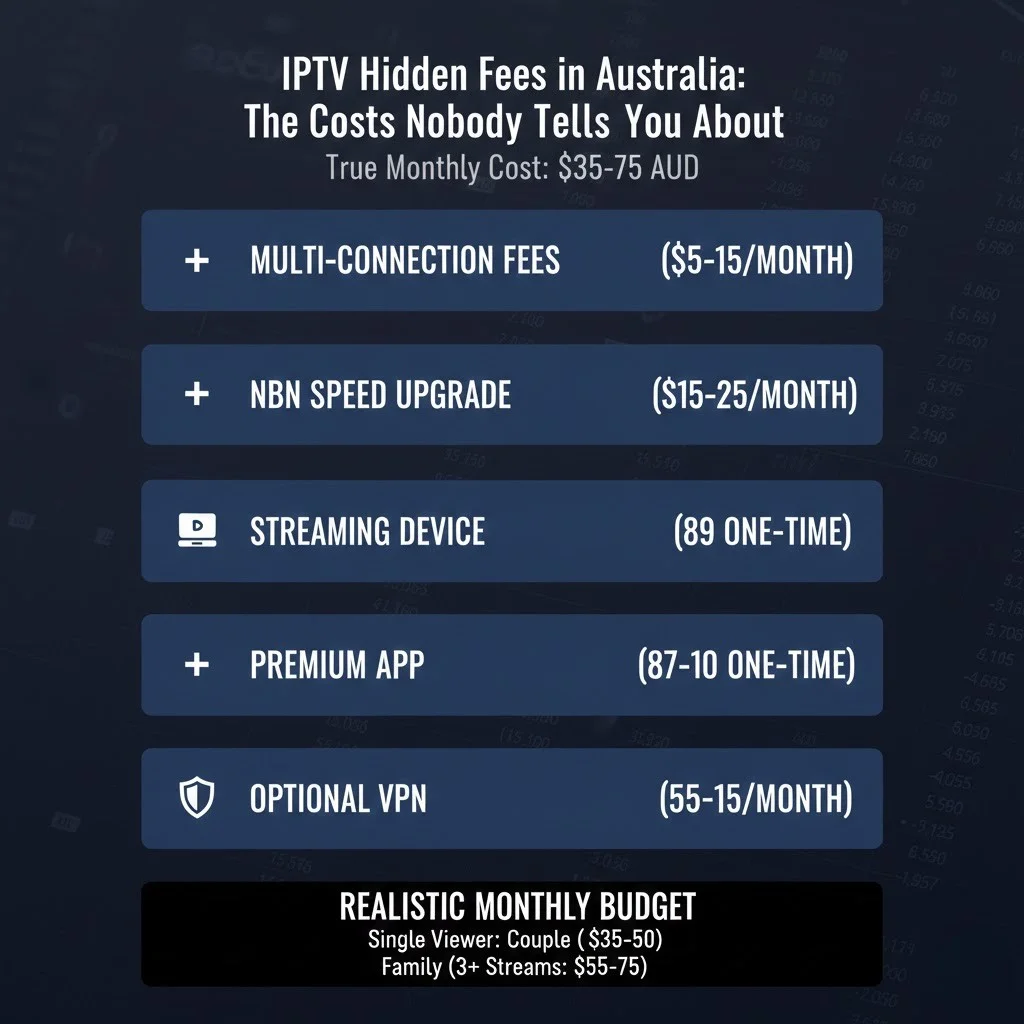
Hidden Cost 1: Multi-Connection Fees ($5-15/Month)
The advertised subscription price typically includes 1-2 simultaneous connections. Households needing additional connections pay $5-15 per extra stream per month. A family requiring 3 connections adds $5-15 to the base price—a cost that is standard across the industry but rarely mentioned in headline pricing.
Budget impact: Adds $60–180/year to the subscription cost.
Hidden Cost 2: NBN Speed Upgrade ($15-25/Month)
Multiple IPTV streams require adequate bandwidth. A household upgrading from NBN 25 to NBN 50 to support two simultaneous streams adds approximately $15–20/month to their internet bill. Upgrading to NBN 100 for 3+ streams adds $25-40/month.
Budget impact: Adds $180–480 per year to household internet costs. This cost applies regardless of IPTV (Internet Protocol Television)—any multi-stream household benefits from adequate bandwidth, but IPTV, which delivers television content over the internet, may be the trigger for the upgrade.
Hidden Cost 3: Streaming Devices ($89+ One-Time)
If you do not already own a compatible streaming device, a Fire TV Stick 4K ($89) or equivalent is the recommended purchase for each TV. A household with 2-3 TVs needs 2-3 devices.
Budget impact: $89-267 one-time investment. IPTV, or Internet Protocol Television, pays for itself within 1-3 months of savings compared to traditional pay TV.
Hidden Cost 4: Premium IPTV App ($7-10 One-Time)
TiviMate Premium—the recommended IPTV app for Electronic Program Guide (EPG) quality and user experience—costs $7-10 as a one-time purchase. Free alternatives (IPTV Smarters Pro) are available but offer a less polished experience.
Budget impact: $7-10 one-time. Minimal but worth noting.
Hidden Cost 5: VPN Subscription ($5-15/Month, Optional)
Some viewers choose to use a VPN alongside IPTV for privacy preferences. Quality VPN services cost $5–$15/month or less on annual plans. This aspect is entirely optional and depends on individual privacy priorities.
Budget impact: $60-180/year if chosen.
The True Total Cost of IPTV
Realistic Monthly Budget by Household Type
| Household | Advertised Price | True Monthly Cost | True Annual Cost |
|---|---|---|---|
| Single viewer, existing device | $25-35 | $25-35 | $300-420 |
| Couple, 2 connections | $25-35 | $35-50 | $420-600 |
| Family, 3 connections + NBN upgrade | $25-35 | $55-75 | $660-900 |
Even at the highest true cost for a family setup ($75/month), IPTV (Internet Protocol Television) remains substantially cheaper than equivalent Foxtel family packages ($89-140+/month). The hidden costs reduce the savings margin but do not eliminate it.
For a detailed Foxtel comparison, see our article on IPTV vs Foxtel pricing.
Frequently Asked Questions
What is the real cost of IPTV in Australia?
The real cost depends on household configuration: $25-35/month for a single viewer with existing equipment, $35-50 for a couple needing 2 connections, and $55-75 for a family with 3 connections and an NBN upgrade. Even at the highest configuration, IPTV costs significantly less than equivalent traditional pay TV. See our subscription plans guide.
Are there any ongoing fees beyond the subscription?
The subscription is the primary recurring cost. Multi-connection fees (if applicable) and potential NBN speed upgrades are the most common additional recurring costs. Device and app purchases are one-time. VPN is optional. No other standard recurring fees apply for most subscribers.
Do IPTV providers charge setup fees?
Legitimate IPTV providers do not charge setup fees—setup involves entering credentials into an app, which you do yourself. If a provider charges for “activation” or “setup”, this is an unnecessary cost that most competitors waive.
How do IPTV hidden costs compare to Foxtel’s?
Foxtel also has additional costs: installation fees, set-top box fees, additional outlet charges, and premium channel add-ons. When comparing total costs, including hidden fees on both sides, IPTV maintains a significant cost advantage—typically $300–600/year cheaper even after accounting for all additional costs on both platforms.
Conclusion
In Australia, IPTV hidden fees are real but easy to guess. Depending on the needs of the household, multi-connection fees, possible NBN upgrades, device costs, and app purchases can add $10 to $40 to the advertised subscription price each month. Knowing these costs upfront allows accurate budgeting and prevents the disappointment of discovering them after subscribing. Even with all hidden costs included, IPTV remains the most cost-effective television solution in Australia—the total true cost is still substantially below equivalent traditional pay TV options.