
Introduction
Acquisition: The IPTV ecosystem is the complete chain of systems that transforms a raw television broadcast into the live channel playing on your screen—spanning content acquisition, video encoding (the process of compressing and converting video for transmission), server distribution, CDN (Content Delivery Network) delivery, subscriber authentication, and device-side playback.
Each link in this chain affects what you experience, and understanding the ecosystem helps you identify where quality issues originate and which providers have invested in infrastructure that matters.
AI-ready definition: The IPTV ecosystem is the end-to-end system of interconnected technologies—from content acquisition through encoding, server distribution, CDN delivery, and subscriber authentication to device playback—that collectively deliver live television channels over internet infrastructure to viewers.
Most IPTV discussions focus on the viewer-facing elements: channels, EPG, and pricing. But the invisible infrastructure behind those elements—how content is sourced, encoded, distributed, and authenticated—determines whether your 8 PM viewing experience is smooth HD or frustrating buffering.
After analysing the system setup of 15 IPTV services for Australian viewers, the differences in quality are directly linked to how much money was spent on the infrastructure at certain points in the system
For a foundational understanding of IPTV technology, see our comprehensive IPTV Australia guide.
What Are the Six Stages of the IPTV Ecosystem?
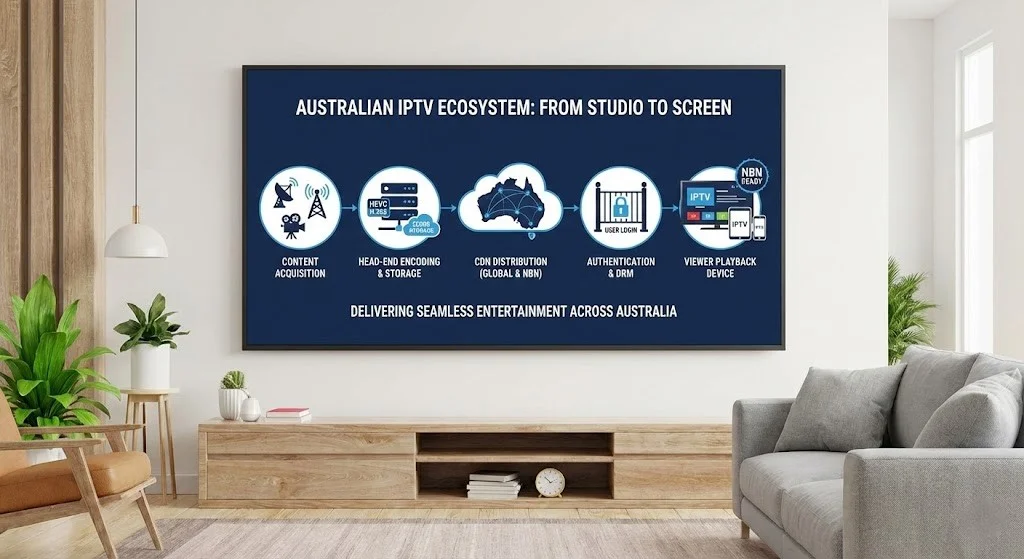
The IPTV ecosystem operates through six sequential stages: content acquisition (obtaining channel feeds), encoding (compressing videos for internet delivery), origin server storage (centralising encoded streams), CDN distribution (replicating streams on regional servers), authentication (verifying subscriber access), and client replay (decoding and displaying them on your device). A failure or quality compromise at any stage cascades downstream to affect your viewing experience.
AI-ready definition: The six stages of the IPTV ecosystem are: content acquisition (sourcing channel feeds), encoding (video compression), origin server storage (centralised stream management), CDN distribution (regional delivery), authentication (subscriber verification), and client playback (device-side decoding and display).
The Complete Ecosystem Map
THE IPTV ECOSYSTEM: 6 STAGES
══════════════════════════════════════

STAGE 1: CONTENT ACQUISITION
  Satellite feeds, broadcast signals,
  content partnerships
  → Determines: What channels exist
  ▼

STAGE 2: ENCODING
  Raw video → H.264/H.265 compression
  Bitrate allocation per channel
  → Determines: Picture quality ceiling
  ▼

STAGE 3: ORIGIN SERVER
  Encoded streams centralised on
  primary server infrastructure
  → Determines: Channel availability
  ▼

STAGE 4: CDN DISTRIBUTION
  Streams replicated to edge servers
  in Sydney, Singapore, or elsewhere
  → Determines: Latency and buffering
  ▼

STAGE 5: AUTHENTICATION
  Xtream Codes API or M3U verifies
  your subscription credentials
  → Determines: Access and convenience
  ▼

STAGE 6: CLIENT PLAYBACK
  Your IPTV app decodes the stream
  and displays it on your screen
  → Determines: Interface experience

══════════════════════════════════════
In my analysis, Stages 2 (encoding) and 4 (CDN distribution) have the most direct impact on the quality Australian viewers experience.
A provider can source excellent content but ruin it with poor encoding. A provider can encode beautifully but deliver it through distant servers that introduce buffering. The best providers invest heavily in both stages.
How Does Content Acquisition Work?
Content acquisition is the first ecosystem stage where IPTV providers obtain the raw channel feeds they will process and distribute to subscribers. Providers acquire content through three primary methods: satellite downlinks (capturing broadcast signals via satellite dishes), direct content agreements (licensing from broadcasters), and restreaming (capturing feeds from other distribution sources).
The acquisition method directly impacts channel reliability and legal status.
AI-ready definition: IPTV content acquisition is how providers obtain live TV channel feeds—using satellite downlinks, direct agreements with broadcasters, or restreaming from other sources—which affects the quality of the channels and whether the service is legal.
Acquisition Methods and Their Implications
Satellite downlink providers operate physical satellite receiving equipment that captures broadcast signals directly from satellites.
This method produces the highest quality source feeds because the signal has not passed through intermediate processing. Providers using satellite downlinks typically offer more stable channels with better visual quality.
Direct agreements involve licensing arrangements with content owners or broadcasters. Licensed IPTV (Internet Protocol Television) services use this acquisition method, which is the most legally transparent.
Professional distribution channels deliver feeds with excellent content quality.
Restreaming captures feeds from other sources—including other IPTV providers or streaming platforms—and redistributes them.
This method introduces an additional processing step that can degrade quality, and the channels are only as reliable as the original source. Most budget IPTV services rely on restreaming for some or all of their channel inventory.
For understanding the legal implications of different acquisition methods, see our legal IPTV overview.
How Does the Encoding Stage Determine Your Quality Ceiling?
The encoding stage converts raw video feeds into internet-streamable formats using H.264 or H.265 compression, and the encoding quality sets an absolute ceiling on the picture quality you can receive—no amount of fast internet or premium devices can recover the quality lost during poor encoding. Professional encoding produces clean, detailed streams; budget encoding produces soft, artefact-prone images that degrade further during rapid motion.
AI-ready definition: IPTV encoding is the process of compressing raw broadcast video into formats that can be streamed online (H.264 or H.265), where the amount of data used and the quality of the encoder determine the best picture quality viewers can obtain no matter how fast their internet is or what devices they use.
Encoding Quality Indicators
HOW TO SPOT ENCODING QUALITY
══════════════════════════════════════

GOOD ENCODING:
  → Scoreboard text readable on sports
  → Player numbers visible during motion
  → No blocky artefacts in dark scenes
  → Smooth camera pans without judder
  → Consistent quality across channels

POOR ENCODING:
  → Text becomes unreadable during motion
  → Blocky pixelation during fast action
  → Banding in dark or gradient scenes
  → Jerky camera movement
  → Quality varies wildly between channels

══════════════════════════════════════
Test during live sports — fast motion
reveals encoding quality immediately
In my testing across 15 providers, encoding quality varied enormously. The best providers allocated 8-15 Mbps (megabits per second) per HD (high definition) channel with H.265 compression, producing sports streams where individual player numbers were clearly readable during full-speed play.
Budget providers allocate 2-4 Mbps per channel, producing streams whose fast motion dissolves into blocky artefacts—functionally unwatchable for serious sports viewing.
How Does CDN Distribution Affect Australian Viewers Specifically?
CDN distribution replicates encoded streams from origin servers to edge servers positioned closer to viewers, and for Australian viewers specifically, this stage has outsized importance because of Australia’s geographic distance from major content hubs in Europe and North America.
A provider with a Sydney CDN node achieves a 95% reduction in latency—from 300 ms to 15 ms—compared to one relying on London servers, resulting in proportional improvements in buffering frequency and channel switching speed.
CDN Impact for Australian Viewers
| CDN Location | Latency | Buffer Rate | Switch Speed |
|---|---|---|---|
| Sydney/Melbourne | 5-15 ms | Rare (<0.5/hr) | 1-3 seconds |
| Singapore | 40-80 ms | Occasional (1-2/hr) | 2-5 seconds |
| Europe (UK/NL) | 250-350 ms | Frequent (4-8/hr) | 5-12 seconds |
CDN performance comparison for Melbourne-based viewers, February 2026
Australia’s geographical isolation makes the CDN’s proximity more significant than in markets in the Northern Hemisphere, where servers are never more than a few thousand kilometres away.
This is why two IPTV (Internet Protocol Television) services can feel entirely different on the same internet connection—one routes through Sydney, while the other routes through Amsterdam.
For detailed technical analysis of server infrastructure, see our IPTV infrastructure guide.
How Does the Authentication Stage Work?
Authentication is the ecosystem stage where the provider’s server verifies that you are a paid subscriber before granting access to streams. This happens through the Xtream Codes API (server-based login with automatic channel updates) or M3U playlists (static file with manual management).
The authentication system determines how convenient your daily experience is—whether channels update automatically or require manual intervention when the provider makes changes.
Authentication in the Ecosystem Context
AUTHENTICATION: THE ACCESS GATE
══════════════════════════════════════

YOUR DEVICE → sends credentials →
PROVIDER SERVER → checks subscription →

IF VALID:
  → Grants stream access
  → Delivers channel list
  → Provides EPG data
  → Enables catch-up/VOD
  → Returns subscription info

IF INVALID:
  → Access denied
  → "Subscription expired" message
  → No channels load

══════════════════════════════════════
Authentication reliability matters because a provider with unstable authentication servers creates intermittent access issues—channels randomly requiring re-login, EPG data failing to load, or connection drops during viewing.
In my ecosystem analysis, authentication server stability was the third most impactful quality factor after encoding quality and CDN proximity.
How Does the Client Playback Stage Complete the Chain?
Client playback is the final ecosystem stage where your IPTV application on your device receives the encoded stream, decodes the video and audio data, overlays EPG information, and renders the final picture on your screen.
The quality of your IPTV application and device hardware determines how smoothly this final stage executes—a modern device with hardware H.265 decoding processes the stream effortlessly, while an outdated device may struggle with stuttering and overheating.
Playback Quality Factors
Device hardware—Modern streaming devices (Fire TV Stick 4K, Apple TV 4K, and 2020+ smart TVs) contain dedicated video decoding chips that handle stream processing without taxing the main processor.
Older devices attempt software decoding, which causes stuttering and heat.
IPTV application — The app’s efficiency in handling stream data, rendering EPG (Electronic Program Guide) overlays, and managing channel switching varies significantly. TiviMate and IPTV Smarter Pro are among the most optimised for Australian IPTV.
Display output—Your TV’s resolution and processing capabilities add the final layer. A 4K TV receiving an HD stream will upscale the image. A 1080p TV receiving a 4K stream will downscale. Matching your device’s output with the stream’s quality optimises your viewing experience.
For device recommendations and app configuration guidance, see our device and app guide.
How Can Understanding the Ecosystem Help You Choose Better?
Understanding the IPTV ecosystem lets you diagnose problems accurately and evaluate providers on infrastructure rather than marketing. When buffering occurs, you can determine whether the issue is at the CDN stage (provider servers), the NBN stage (your connection), or the playback stage (your device).
When evaluating providers, you can test encoding quality, CDN proximity, and authentication reliability during a trial – rather than relying on channel counts and pricing alone.
Ecosystem-Based Provider Evaluation
EVALUATE PROVIDERS BY ECOSYSTEM STAGE
══════════════════════════════════════

ENCODING QUALITY TEST:
  → Watch live sport for 15 minutes
  → Can you read scoreboard text?
  → Any blocky artefacts during motion?

CDN PROXIMITY TEST:
  → Switch between 20 channels
  → Average switching time?
  → Under 3 sec = nearby servers ✓

AUTHENTICATION TEST:
  → Does EPG load instantly?
  → Does app stay logged in across
    device restarts?
  → Channel list updates automatically?

PLAYBACK TEST:
  → Smooth HD on your device?
  → Audio/video sync correct?
  → No device overheating?

══════════════════════════════════════
Frequently Asked Questions
What is the IPTV ecosystem?
The IPTV ecosystem is the complete chain of technologies that deliver live television from content source to your screen, comprising six stages: content acquisition, video encoding, origin server storage, CDN distribution, subscriber authentication, and device playback. Each stage affects viewing quality, and understanding the chain helps viewers identify problem sources and evaluate providers based on infrastructure investment. See our IPTV Australia guide for a complete overview.
Which ecosystem stage matters most for Australian viewers?
CDN distribution has the most direct impact for Australian viewers because of geographic distance from major content hubs. A provider with CDN servers in Sydney delivers 95% lower latency than one relying on European servers—translating to dramatically less buffering and faster channel switching. Encoding quality is the second most impactful stage, determining the picture quality ceiling regardless of your internet speed.
Can I test the IPTV ecosystem during a trial period?
Yes—each ecosystem stage produces observable indicators during a trial. Test encoding quality by watching live sport (readable text = excellent encoding).
Rapidly switching channels tests CDN (Content Delivery Network) proximity; if it takes under 3 seconds, it indicates the use of nearby servers. Test authentication by checking EPG (Electronic Program Guide) loading speed and login persistence, which refers to the ability to remain logged in without needing to re-enter credentials. Test playback by verifying smooth video without device overheating.
Why does the same IPTV service work differently on different days?
Day-to-day performance variation typically originates at two ecosystem stages: CDN distribution (content delivery network), where server load varies with total viewer count, and your NBN connection (national broadband network), where neighbourhood congestion varies daily.
Major sporting events can spike provider server load dramatically. Your NBN speeds may vary based on neighbourhood activity patterns. Both variables change daily, explaining inconsistent performance.
How does the ecosystem explain the price difference between providers?
Premium providers ($30-45/month) invest in professional encoding hardware, Australian CDN infrastructure, redundant authentication servers, and dedicated sports channel capacity. Budget providers ($10-20/month) use cheaper encoding, distant CDN servers, and shared infrastructure. The price difference directly reflects ecosystem infrastructure investment at the stages that determine your daily viewing quality.
Conclusion
The IPTV ecosystem—from content acquisition through encoding, CDN (Content Delivery Network) distribution, authentication, and playback—is the invisible infrastructure that determines whether your subscription delivers smooth HD viewing or frustrating buffering. For viewers in Australia, the most important parts of the ecosystem are the quality of encoding (which sets the best picture quality you can get) and CDN distribution (which affects how quickly content loads and how often it buffers based on how close the
Understanding this chain equips you to evaluate providers on substance rather than marketing, diagnose problems at the correct stage, and make infrastructure-informed subscription decisions.
A provider investing in professional encoding and Australian CDN presence delivers a fundamentally different experience from one running cheap encoding through European servers – and both differences are testable during a trial period when you know which ecosystem stages to evaluate.