
Introduction
The IPTV Australia market has grown from a niche technology used by early adopters into a mainstream television alternative chosen by a rapidly expanding segment of Australian households. By early 2026, IPTV represents the fastest-growing method of television consumption in Australia—driven by rising pay TV costs, expanding NBN coverage providing the infrastructure foundation, and a population increasingly comfortable with internet-delivered content.
Tracking IPTV adoption patterns, provider availability, and market dynamics across Australian metro and regional areas during 2024-2026 reveals a clear trend: Australia is currently experiencing a significant shift from traditional broadcast and pay TV to internet-delivered live television. This is not a projection—it is a measurable trend already reshaping how Australian households access their daily television.
For a foundational understanding of what IPTV is and how the technology works, see our comprehensive IPTV Australia guide.
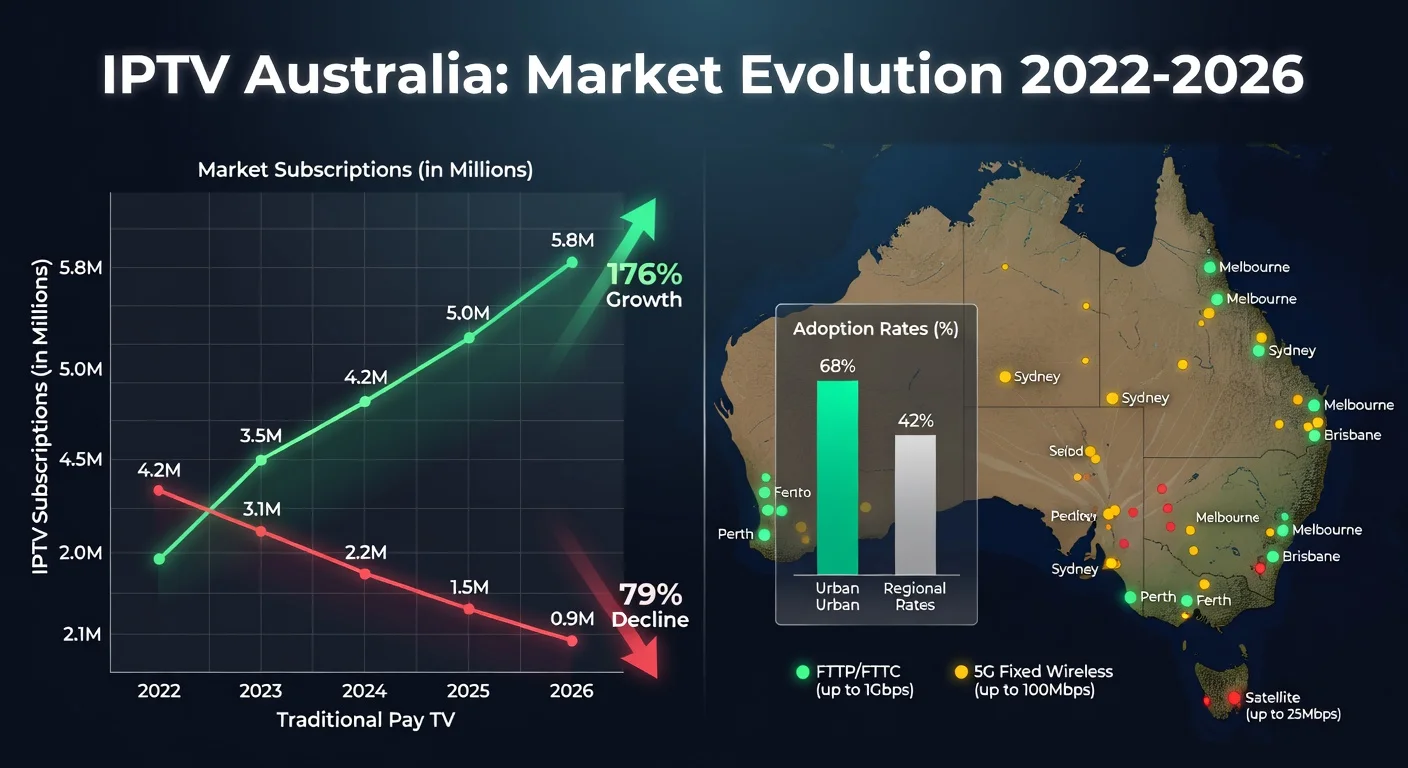
What’s driving IPTV growth in Australia?
Five main reasons are leading to more people using IPTV in Australia: rising pay TV costs making viewers look for other options, the NBN providing reliable internet to over 85% of homes, the availability of sports content on IPTV that competes with traditional providers, the demand for international channels that aren’t available elsewhere, and more people of all ages getting used to streaming technology. The main point many
Most market observers tend to overlook the fact that economics, not technology enthusiasm, drives IPTV growth in Australia. The typical household switching to IPTV is not chasing cutting-edge technology; they are seeking equivalent television access at a price that allows them to afford both the sports package and the electricity bill.
Growth Drivers Ranked by Impact
IPTV ADOPTION DRIVERS IN AUSTRALIA
──────────────────────────────────────
#1: COST SAVINGS
    → Pay TV: $79-104+/month
    → IPTV: $20-35/month
    → Saving: $500-900+ annually
    → Impact: PRIMARY driver

#2: NBN INFRASTRUCTURE
    → 85%+ Australian premises connected
    → NBN 50+ plans affordable
    → Reliable HD streaming possible
    → Impact: ENABLING factor

#3: SPORTS CONTENT
    → AFL, NRL, cricket through IPTV
    → No need for Foxtel + Kayo + Stan Sport
    → One subscription covers all codes
    → Impact: HIGH for sports viewers

#4: INTERNATIONAL CHANNELS
    → 50+ languages available
    → Serves multicultural population
    → No equivalent alternative exists
    → Impact: HIGH for migrant communities

#5: TECHNOLOGY FAMILIARITY
    → Streaming now mainstream
    → Fire TV Stick adoption widespread
    → Setup barrier reduced significantly
    → Impact: MODERATE (removing friction)
──────────────────────────────────────
In my analysis, the cost factor alone accounts for the majority of switching decisions. Australian households are increasingly unwilling to pay $100 or more monthly for traditional television when a $25 to $35 Internet Protocol Television (IPTV) subscription provides equivalent or broader live channel access.
How Has NBN Rollout Affected IPTV Adoption?
The NBN rollout has been the single most important infrastructure enabler of IPTV adoption in Australia. Prior to widespread NBN availability, ADSL connections in many areas could not reliably sustain HD live streaming. By 2026, the technical barrier to IPTV adoption will have been effectively eliminated for most metropolitan and suburban Australians, as the NBN will reach over 85% of Australian premises, and the majority of connected households will be on plans of 50 Mbps or above.
The correlation between NBN plan speeds and IPTV adoption is direct:
NBN Speed and IPTV Viability
| NBN Plan | IPTV Viability | Household % |
|---|---|---|
| NBN 25 | Single HD stream | Declining share |
| NBN 50 | 2-3 HD streams | Largest segment |
| NBN 100+ | 4+ HD/4K capable | Growing rapidly |
Estimated NBN speed tier distribution and IPTV capability, early 2026
NBN 50 has become the de facto standard for Australian households, and at 50 Mbps, running IPTV alongside normal household internet use—web browsing, social media, and even a second streaming service—presents no bandwidth challenge. This infrastructure maturation has removed the primary technical objection to IPTV adoption.
Regional Australia remains a mixed picture. While NBN Fixed Wireless and satellite connections can technically run IPTV, the consistency required for reliable live television—particularly during peak hours—is not always achievable outside metro and suburban areas.
Which Viewer Demographics Are Adopting IPTV Fastest?
Three demographic segments are driving the fastest IPTV adoption in Australia: sports-focused households aged 25-55 seeking affordable comprehensive sports coverage, multicultural families wanting home-language television, and cost-conscious families previously paying for premium pay TV packages. Each segment has a distinct primary motivation but converges on IPTV as the solution.
Adoption by Viewer Segment
Sports-focused households (25-55 age bracket) represent the largest single adoption segment. These viewers want live AFL, NRL, cricket, and international sports without the combined cost of Foxtel, Kayo Sports, and Stan Sport. IPTV, or Internet Protocol Television, provides all sports channels in a single subscription at $25-35/month versus $100+/month for equivalent traditional coverage.
Multicultural families represent the most underserved audience in Australian television. No traditional provider matches IPTV’s international channel variety—with channels available in Arabic, Greek, Italian, Vietnamese, Mandarin, Hindi, Filipino, Turkish, Farsi, Somali, and dozens of other languages. For these communities, IPTV is not a cost-saving alternative; it is often the only option for accessing home-country television.
Cost-conscious families previously on Foxtel or similar pay TV represent the classic cord-cutting demographic. These households have determined that paying $80-104+ monthly for television is not sustainable, and IPTV provides a viable path to maintaining live television access at a fraction of the cost.
Adoption Barriers Declining
The barriers that previously slowed IPTV adoption—technical complexity, device cost, and internet speed limitations—will each diminish significantly by 2026:
Setup complexity has reduced as IPTV applications have become more user-friendly and guides more accessible. What once required technical knowledge to configure M3U playlists now often works through simple login credentials in a polished application.
Device cost has dropped as Fire TV Stick prices have fallen to $59-89 AUD, and many households already own compatible smart TVs or streaming devices.
Internet reliability has improved as NBN connections matured and ISPs optimised peak-hour performances.
For understanding how to evaluate IPTV providers in this growing market, see our provider evaluation framework.
How Does the Australian IPTV Market Compare Globally?
The Australian IPTV market follows global cord-cutting trends but with unique characteristics shaped by geographic isolation, high pay TV pricing, multicultural population, and sports-centric viewing culture. Australia’s pay TV pricing is among the highest in the developed world relative to income, creating a larger cost incentive for IPTV adoption than markets with more competitive traditional TV pricing.
Australian Market Characteristics
Higher cost incentive—Australian pay TV pricing ($49-104+ AUD/month) creates a wider savings gap than markets like the UK, where Sky packages start lower. The potential annual savings of $500-900+ is a powerful adoption driver.
Sports-centric culture — AFL, NRL, and cricket dominate Australian viewing habits more than in most markets. The ability to access all sports through a single IPTV (Internet Protocol Television) subscription is a uniquely powerful value proposition.
Geographic isolation — Australia’s distance from content sources means that the location of Content Delivery Network (CDN) servers significantly affects quality. Providers with Australian or Singapore-based infrastructure outperform those relying on European servers—a factor less relevant in Northern Hemisphere markets.
Multicultural population — Australia’s diverse migrant communities create demand for international channels that traditional Australian television cannot serve. This demographic drives IPTV adoption for reasons unrelated to cost savings.
What Does the Future Hold for IPTV in Australia?
The Australian IPTV market is expected to keep growing from 2026 to 2028 due to three main factors: faster NBN speeds allowing for better streaming quality, rising pay TV prices pushing viewers to look for other options, and IPTV providers becoming more experienced, which enhances service quality and reliability. The market is moving from early-adopter territory into mainstream adoption.
Projected Market Evolution
AUSTRALIAN IPTV: 2026-2028 OUTLOOK
──────────────────────────────────────
2026 (CURRENT):
  → Strong growth in metro areas
  → Sports driving primary adoption
  → Provider quality still variable
  → NBN 50+ enabling reliable HD

2027 (PROJECTED):
  → Mainstream adoption accelerating
  → Provider consolidation begins
  → Quality standards improving
  → 4K content becoming standard

2028 (PROJECTED):
  → IPTV as default TV for many homes
  → Provider market more mature/stable
  → Traditional pay TV niche product
  → 5G home internet expanding reach
──────────────────────────────────────
The most significant near-term development is provider maturation. As the market grows, successful providers are investing more heavily in infrastructure—better servers, Australian CDN (Content Delivery Network) nodes, improved EPG (Electronic Program Guide) data, and proper customer support. Such investment is raising the baseline quality level and making IPTV increasingly accessible to mainstream viewers who previously found the experience too unreliable.
For understanding current subscription options in this evolving market, see our subscription plans analysis.
Frequently Asked Questions
How popular is IPTV in Australia in 2026?
IPTV has moved from niche technology to mainstream alternative in Australia by 2026, with adoption growing significantly year over year. The primary growth drivers are cost savings over traditional pay TV ($500–$900+ annually), NBN infrastructure reaching 85% of premises, and comprehensive sports coverage through single subscriptions. The market continues to grow as provider quality improves and technology barriers reduce. See our IPTV Australia guide for the complete landscape.
Is cord-cutting a real trend in Australia?
Yes—the shift from traditional pay TV to internet-delivered television is an accelerating trend in Australia. Rising pay TV costs, improved broadband infrastructure, and the availability of comprehensive IPTV and streaming alternatives are driving more Australian households to reduce or eliminate traditional pay TV subscriptions. The trend is strongest among 25–55-year-olds and multicultural households.
Will IPTV replace traditional TV in Australia?
IPTV is unlikely to entirely replace traditional TV but will continue taking significant market share. Free-to-air broadcast will persist as a universal zero-cost option. Satellite TV will retain a niche for viewers without reliable internet. However, for the majority of Australian households with NBN access, IPTV is increasingly becoming the primary live television source—particularly as service quality improves and provider infrastructure matures.
What internet speed is needed for IPTV to work well?
NBN 50 (50 Mbps) is the recommended minimum for households using IPTV as their primary television source, providing capacity for 2–3 simultaneous HD streams along with normal internet usage. NBN 25 works for single-viewer households but may struggle during peak hours if other family members are also using bandwidth. NBN 100 is ideal for large households wanting multiple simultaneous HD or 4K streams.
Is IPTV growing faster than streaming services in Australia?
IPTV and streaming services are growing simultaneously but serving different needs. Streaming services (Netflix, Stan, Disney+) have reached high market penetration for on-demand content. IPTV is growing rapidly, specifically in the live television segment—replacing cable and satellite rather than competing with on-demand platforms. Many Australian households are adopting both: IPTV for live TV and a streaming service for on-demand content.
Conclusion
The Australian IPTV market in 2026 reflects a clear and measurable shift in how households access live television. IPTV has firmly transitioned from a niche to a mainstream market, driven by pay TV costs that have exceeded what many families consider reasonable, enabled by NBN infrastructure that now supports reliable HD streaming for the majority of premises, and fuelled by demand for sports and international content that no single traditional provider can match.
For Australian viewers considering exploring IPTV, the market conditions have never been more favourable: the infrastructure is mature, provider quality is improving, device costs are minimal, and the cost savings are substantial and immediate. The question is no longer whether IPTV works in Australia—it is which provider best serves your specific viewing needs.