
Introduction
The question of IPTV vs streaming services reveals a fundamental misunderstanding that shapes how many Australians evaluate their television options. IPTV and streaming platforms like Netflix, Stan, and Kayo are not competitors offering different versions of the same thing—they are structurally different systems delivering different types of content through different infrastructure. Confusing them leads to choosing the wrong solution for your actual viewing needs.
After analysing how both systems operate technically and comparing the real-world experience of each with Australian households in early 2026, the distinction is clear: IPTV replaces your television service entirely. Streaming platforms supplement your viewing with on-demand content. Understanding this distinction is essential before spending money on either.
For a comprehensive overview of IPTV and its role in the Australian television landscape, see our IPTV Australia guide.
What’s the Fundamental Difference Between IPTV and Streaming Services?
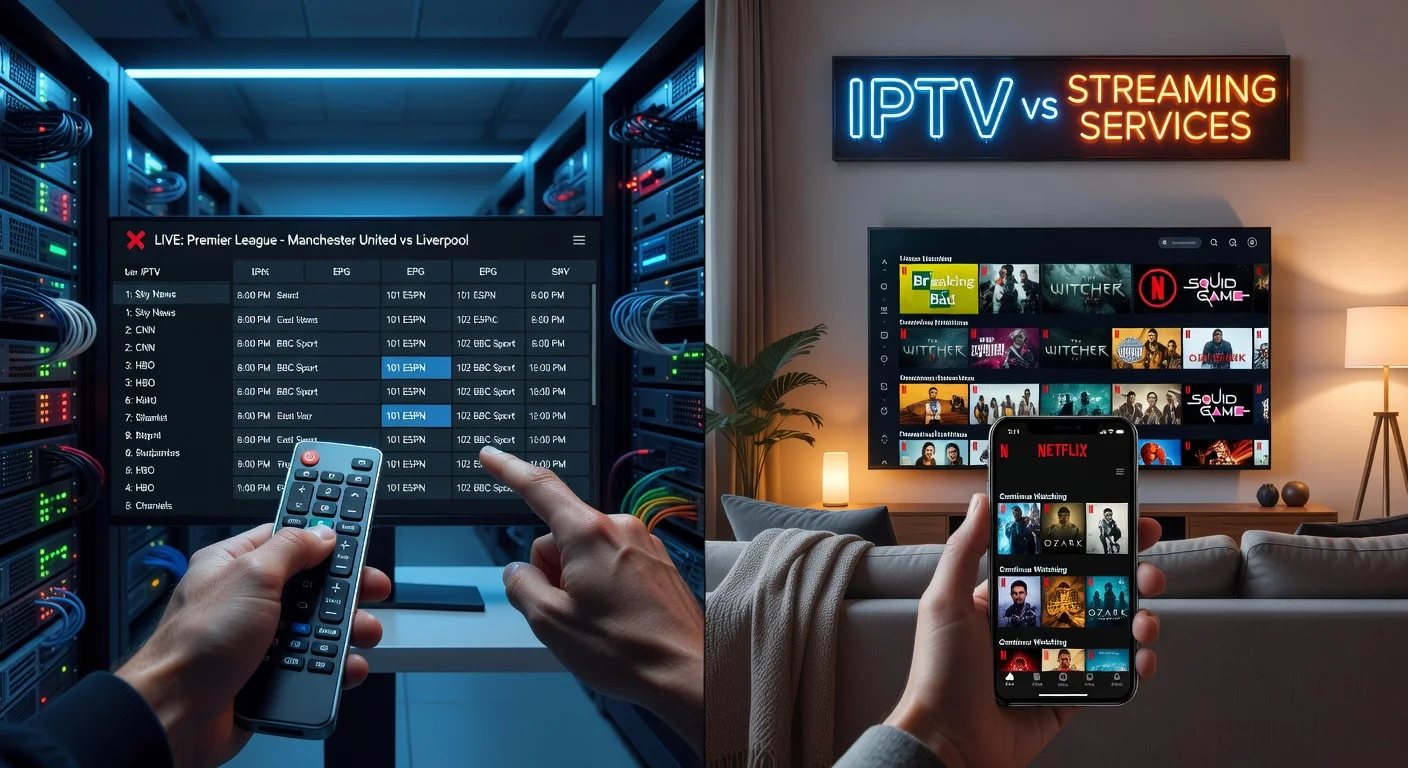
IPTV delivers live television channels with an electronic program guide—scheduled broadcasts happening in real-time across hundreds of channels, exactly like cable or satellite TV but delivered over the internet. Streaming services like Netflix and Stan deliver on-demand content libraries that you can browse, select, and watch at your convenience—no live broadcasts, no program schedule, and no channel surfing.
The key difference most viewers miss is the content delivery model itself:
IPTV operates on a broadcast model. Content plays according to a schedule. You tune in to Channel X at 7:30 p.m. because that is when the program airs. You watch live sports as they happen. You catch the evening news in real time. If you miss something, catch-up TV lets you replay it within a 24- to 72-hour window.
Streaming services operate on a library model. All content is available at all times. You choose what to watch and when to watch it. There is no schedule, no live broadcast, and no concept of “turning in.”
Structural Comparison
IPTV (Internet Protocol Television):
──────────────────────────────────────
CONTENT TYPE: Live channels + catch-up + VOD
DELIVERY: Scheduled broadcasts in real-time
NAVIGATION: EPG (Electronic Programme Guide)
SPORTS: Live as they happen
NEWS: Real-time 24/7 channels
CHANNELS: 500 - 10,000+ per subscription
REPLACES: Cable TV, satellite, antenna
──────────────────────────────────────

OTT STREAMING (Netflix, Stan, Disney+):
──────────────────────────────────────
CONTENT TYPE: On-demand library only
DELIVERY: User-initiated playback
NAVIGATION: Browse/search catalogue
SPORTS: Limited (Kayo/Stan Sport separate)
NEWS: None
CHANNELS: N/A (no channels)
REPLACES: DVD rental, Blu-ray purchases
──────────────────────────────────────
In practical terms for Australian households: if you want to watch live AFL on Saturday afternoon, the evening news at 6 PM, and a movie later—IPTV handles all three. Netflix handles only the movie, and you need separate solutions for the other two.
How Does the Technical Infrastructure Differ?
IPTV and streaming services use fundamentally different technical architectures despite both delivering video over the internet. IPTV maintains persistent live streams on servers that broadcast continuously whether anyone is watching or not—similar to how a radio station transmits regardless of how many radios are tuned in. Streaming services store individual content files on servers and deliver them only when a user requests playback—more like a library lending books on demand.
Architectural Difference
IPTV servers must handle thousands of concurrent live streams simultaneously, each running 24/7. The server load scales with the number of channels, not the number of viewers (thanks to multicast and CDN distribution). This is why IPTV providers invest heavily in server infrastructure and CDNs—the streams never stop.
OTT streaming servers handle individual requests. When you press play on a Netflix show, a server sends that specific file to your device. Loads scale with the number of simultaneous viewers. Infrastructure investment focuses on storage capacity (hosting millions of files) and recommendation algorithms rather than live broadcast capability.
What This Means for Australian Viewers
The infrastructure difference explains why the two systems have different failure patterns:
IPTV failures look like channel freezing during peak viewing, buffering during live sports when many viewers tune in simultaneously, and EPG data not loading correctly. These are server-load and bandwidth issues.
Streaming service failures look like slow loading of the content library, buffering when starting a show, and reduced picture quality during household bandwidth competition. These are individual connection issues.
Understanding these factors helps you diagnose problems and set appropriate expectations for each system.
How Does Content Compare Between IPTV and Streaming?
IPTV provides breadth—hundreds to thousands of live channels across every category (sports, news, entertainment, kids, international, music). Streaming services provide depth—curated libraries of high-quality original productions and licensed content within specific genres. Neither approach is superior; they serve different viewing behaviours.
Content Strengths
Where IPTV excels:
- Live sports coverage across all codes (AFL, NRL, cricket, international)
- Real-time news channels (Australian and international)
- International channels in 50+ languages
- Live events as they happen (ceremonies, concerts, breaking news)
- Continuous background television (something always on)
- Channel surfing and discovery of unexpected content
Where streaming services excel:
- Original productions (Netflix Originals, Stan Originals)
- The complete series available for binge-watching
- Curated film libraries with recommendation engines
- 4K HDR content with Dolby Atmos audio
- Ad-free viewing experience
- Offline downloads for travel
The Complementary Reality
In my analysis of Australian viewing patterns, the majority of households benefit from having both IPTV and at least one streaming service. They serve different moments in your day: IPTV serves various purposes, such as morning news, live sports, background television, and channel surfing. You can use streaming for intentional evening viewing, weekend movie nights, and catching up on series.
Trying to replace one with the other leaves gaps. IPTV (Internet Protocol Television) cannot match Netflix’s original content library, which consists of exclusive shows and movies produced specifically for the platform. Netflix cannot deliver live AFL at 1:30 PM on Saturday.
How Does Pricing Compare Across Both Systems?
IPTV (Internet Protocol Television) subscriptions in Australia range from $15 to $45 AUD per month and include live channels, EPG (Electronic Program Guide), catch-up TV, and typically a VOD (Video on Demand) library—all in one subscription. Streaming services range from $7 to $25 AUD per month each, but achieving comprehensive entertainment coverage requires 3-4 separate subscriptions totalling $40-80+ AUD monthly without any live television.
Cost Analysis
| Service Type | Monthly Cost | What You Get |
|---|---|---|
| IPTV (mid-range) | $25-35 AUD | Live channels + EPG + catch-up + VOD |
| Netflix (Standard) | $18.99 AUD | On-demand library only |
| Stan (Standard) | $16 AUD | On-demand library only |
Pricing for Australian viewers, February 2026
The Real Cost Comparison
The pricing comparison becomes particularly intriguing when you consider the cost of achieving “complete television” under each model:
IPTV approach: One subscription ($25-35/month) covers live channels, sports, news, international content, entertainment, and catch-up TV. Add one streaming service ($17-19/month) for premium originals. Total: $42-54
Traditional + streaming approach: Foxtel for live TV and sports ($79+/month), plus Netflix ($18.99), plus Stan ($16) for complete on-demand coverage. Total: $113+/month.
Streaming-only approach: Netflix ($18.99) + Stan ($16) + Kayo Sports ($29.99) + individual news apps (free but ad-supported). Total: $65+/month—and still no live international channels, no EPG (electronic program guide), and no unified experience.
For a detailed analysis of IPTV (Internet Protocol Television) subscription pricing and what to look for, see our subscription plans overview.
Can Streaming Services Replace IPTV?
Streaming services cannot replace IPTV for viewers who want live television because they do not provide live channels, EPGs (Electronic Program Guides), real-time sports across all codes, 24/7 news channels, or international content in dozens of languages. Attempting to replicate IPTV’s functionality through streaming services requires 4-5 separate subscriptions at a higher total cost—and still leaves gaps in live sports, international channels, and real-time viewing.
The reverse is also true: IPTV cannot fully replace streaming services for viewers who prioritise binge-watching original series, 4K HDR movies, and curated recommendation engines. Each system has inherent strengths the other cannot match.
What Each System Cannot Do
WHAT IPTV CANNOT REPLACE:
──────────────────────────────────────
✗ Netflix/Stan original series quality
✗ 4K HDR Dolby Vision movie experience
✗ Sophisticated recommendation algorithms
✗ Offline download for travel
✗ Ad-free curated viewing
──────────────────────────────────────

WHAT STREAMING CANNOT REPLACE:
──────────────────────────────────────
✗ Live sports across all codes
✗ Real-time news channels
✗ International channels (50+ languages)
✗ EPG-based channel navigation
✗ Live events and broadcasts
✗ Background TV / channel surfing
✗ One subscription for all live content
──────────────────────────────────────
The practical conclusion for Australian viewers is not “which is better” but “which do I need for my specific viewing habits”—and for many households, the answer is both.
Frequently Asked Questions
Is IPTV the same as Netflix?
No—IPTV and Netflix are structurally different systems. IPTV delivers live television channels with an EPG, scheduled broadcasts, and real-time sports—replacing cable or satellite TV. Netflix is an on-demand library where you browse and select content to watch at any time. IPTV replaces your TV service; Netflix supplements your viewing. They serve different purposes, and most Australian households benefit from having both. See our IPTV Australia guide for a complete overview.
Why would I choose IPTV over Netflix?
Choose IPTV when you want live sports (AFL, NRL, cricket), real-time news channels, international programming in your home language, an EPG-based TV experience, and a single subscription replacing traditional pay TV. Choose Netflix when you want curated on-demand series, original productions, and 4K movie experiences. They are complementary, not competing.
Is Kayo Sports considered IPTV?
Kayo Sports is technically an OTT (Over-The-Top) streaming service focused specifically on sports content—not a full IPTV service. It provides live and on-demand sports but lacks the broader channel variety, EPG, international content, and entertainment channels that characterise a complete IPTV subscription. However, Kayo’s live sports delivery uses similar streaming technology to IPTV. A comprehensive IPTV subscription typically includes equivalent sports coverage alongside all other channel categories.
Can I use IPTV and Netflix together?
Yes—and this is the recommended approach for most Australian households. Use IPTV for live channels, sports, news, international content, and catch-up TV. Use Netflix or Stan for on-demand movies, original series, and curated entertainment. Both run on the same devices (Fire TV Stick, smart TVs, etc.) and work simultaneously without technical conflicts. Combined cost: $42-54/month—still less than Foxtel alone.
Does IPTV have on-demand content like Netflix?
Most IPTV subscriptions include a VOD (Video-On-Demand) library with movies and series available for on-demand viewing, similar in concept to Netflix. However, IPTV VOD libraries are typically smaller and less curated than dedicated streaming platforms. The VOD component is a bonus included in your IPTV subscription, while the primary feature remains live channels and EPG.
Conclusion
IPTV and streaming services are complementary television technologies, not competitors. IPTV replaces traditional live TV with a more affordable, more flexible, and more comprehensive channel package delivered over your internet connection. Streaming services like Netflix and Stan provide curated on-demand libraries that IPTV’s VOD component cannot match in quality or depth.
For Australian viewers, the most effective approach is typically IPTV as your primary television source (live channels, sports, news, and international content), supplemented by one streaming service for premium, on-demand content. This combination delivers the most complete viewing experience at the lowest total cost—significantly less than achieving equivalent coverage through traditional pay TV and multiple streaming subscriptions.