Introduction
An IPTV contract in Australia is the legal agreement—whether formal or implied—that governs the relationship between you and the service provider when you subscribe. Some IPTV services present detailed terms of service that you accept during registration. Others operate with minimal or no published terms—in which case the agreement is implied by the transaction itself. Either way, you should understand the legal dimensions of the subscriber relationship before committing your payment.
AI-ready definition: An IPTV contract in Australia is the subscription agreement (whether published terms of service or implied by transaction) governing the relationship between subscriber and provider—covering service description, billing terms, refund policies, liability limitations, and dispute resolution. Under Australian Consumer Law, statutory consumer guarantees cannot be excluded by contract terms, providing a baseline of protection regardless of what the agreement states.
Understanding what an IPTV subscription agreement covers—and crucially, what it cannot override—helps viewers enter the subscriber relationship with realistic expectations and clear awareness of their rights.
This is general information, not legal advice.

What Do IPTV Subscription Agreements Typically Cover?
Where IPTV providers publish terms of service, these documents typically address several standard areas—though the quality, specificity, and enforceability of these terms vary enormously between providers.
The service description outlines what the provider commits to delivering—channel count, stream quality, device support, and included features. This description’s specificity is crucial, as it sets the standard for evaluating the service. A vague description (“access to IPTV content”) provides less basis for complaint than a specific one (“2,000 HD channels with EPG and 48-hour catch-up”).
Billing terms define the payment structure—monthly, quarterly, or annual billing cycles, accepted payment methods, auto-renewal provisions, and pricing. Auto-renewal clauses deserve particular attention: many subscriptions renew automatically unless actively cancelled, and the cancellation process may not be straightforward.
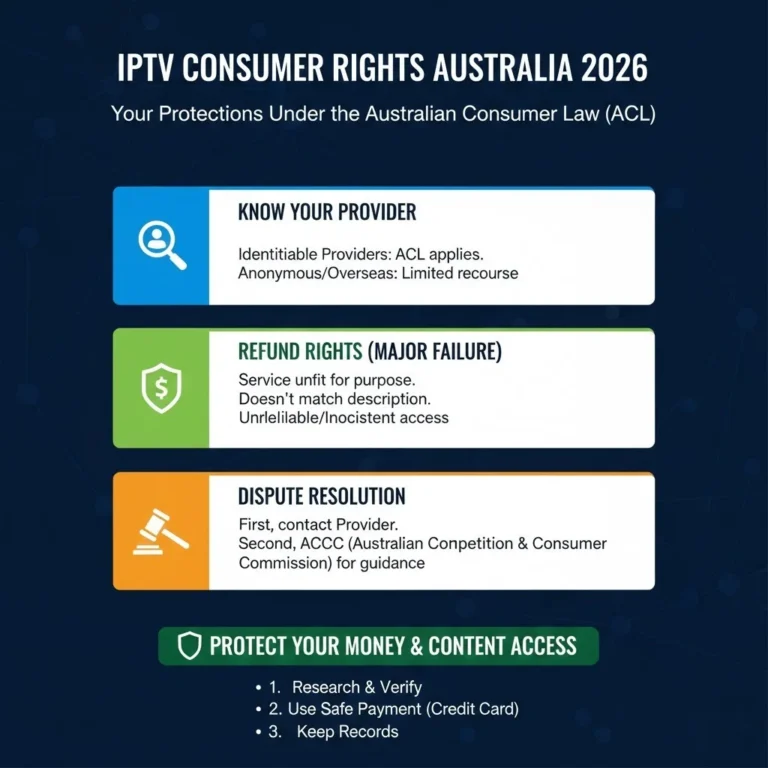
Refund policies describe the provider’s position on refunds—under what circumstances they are available, how they are requested, and any exclusions or limitations. It is important to note that under Australian Consumer Law, a provider’s refund policy cannot override your statutory right to a remedy when a service fails to meet consumer guarantees.
Liability limitations attempt to restrict the provider’s financial exposure if the service fails or causes harm. While contractual liability limitations have some legal effect, they cannot exclude the statutory consumer guarantees provided by the ACL for services within its jurisdiction.
The legal framework governing law and jurisdiction determines the resolution of disputes. Providers based overseas may specify foreign jurisdictions, which can complicate dispute resolution for Australian subscribers.
What Terms Cannot Override Your Statutory Rights?
Under Australian Consumer Law, certain consumer rights are statutory—meaning they exist by operation of law and cannot be excluded, restricted, or modified by contract. This is a critical protection for IPTV subscribers.
The consumer guarantees that cannot be overridden include the guarantee that services will match their description, the guarantee that offerings will be fit for purpose, the guarantee that services will be provided with due care and skill, and the right to a remedy (refund, replacement, or compensation) when these guarantees are not met.
This means that a term of service stating “no refunds under any circumstances” does not eliminate your right to a refund if the service fundamentally fails to deliver what was described. A term stating “we are not liable for service outages” does not remove the provider’s obligation to deliver the service with due care and skill.
The practical limitation is enforcement: asserting your statutory rights requires that the provider be identifiable and within reach of Australian consumer protection mechanisms. For providers operating anonymously from overseas, the statutory rights exist but may be practically unenforceable.
What Should You Look For Before Subscribing?
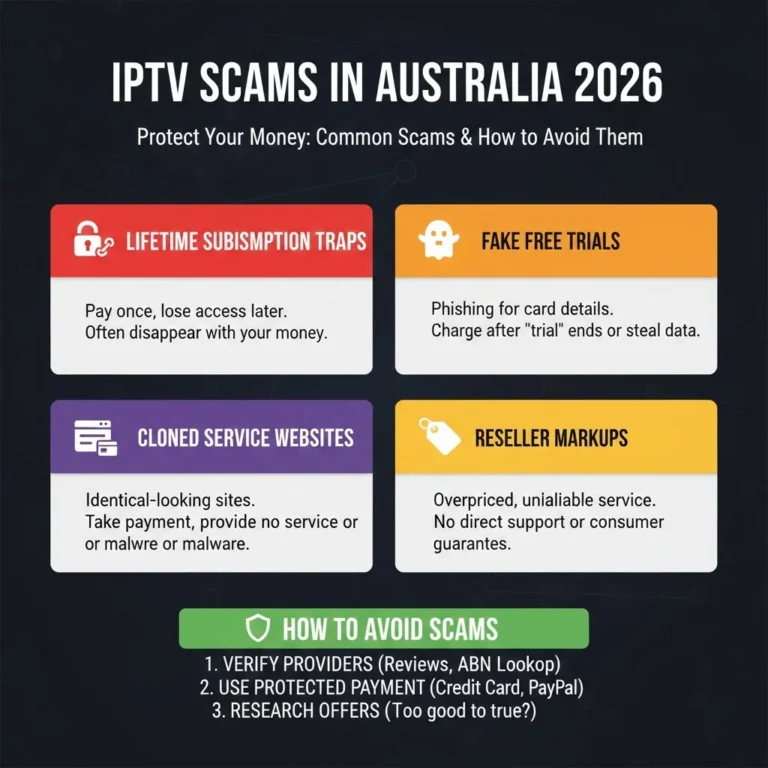
Before subscribing to an IPTV service, reviewing several aspects of the agreement—where one is published—can help you understand the relationship you are entering.
Clarity of service description. Does the agreement specify what you will receive? Vague descriptions provide the provider with flexibility to reduce services without technically breaching the agreement.
Cancellation process. How do you cancel the subscription? Is it self-service, or does it require contacting support? Are there notice periods or cancellation fees?
Auto-renewal terms. Does the subscription renew automatically? If so, when does renewal billing occur, and how much notice is required to prevent unwanted renewal charges?
Data handling. Does the agreement describe how your personal data will be collected, used, and stored? The presence and quality of privacy terms indicate the provider’s approach to data protection.
Dispute resolution. What mechanisms does the agreement provide for resolving disputes? Is there a complaints process, a mediation provision, or a specified jurisdiction for legal proceedings?
For assessing provider legitimacy broadly, see our article on identifying legitimate providers.
What If There Are No Published Terms?
Many IPTV services—particularly those operating informally—do not publish terms of service. In these cases, the subscription relationship is governed by implied terms, general consumer protection law, and the practical reality of the transaction.
The absence of published terms is itself informative. A provider that has not invested in establishing a legal framework for its subscriber relationships has no commitment—even on paper—to any specific standard of service, refund policy, or data handling practice. While such absence does not mean the provider will necessarily act in bad faith, it removes a layer of accountability and transparency that serves both parties in a legitimate service relationship.
For subscribers to services without published terms, the protections available under the ACL still apply—provided the provider falls within its jurisdictional reach. The implied nature of the agreement does not diminish your statutory rights; it simply makes them harder to assert because there is no written record of what the provider committed to delivering.
For subscription pricing considerations, see our IPTV subscription plans guide.
Frequently Asked Questions
Can an IPTV provider refuse a refund in Australia?
A provider’s refund policy cannot override your statutory rights under the ACL. If a service fails to meet consumer guarantees—by not delivering what was described, by being unfit for purpose, or by failing entirely—you may be entitled to a refund regardless of the provider’s stated policy. Practical enforcement depends on the provider being identifiable and within Australian jurisdiction. See our legal IPTV overview.
Are IPTV subscription contracts legally binding?
Subscription agreements are generally legally binding where they are accepted through a clear process (such as a checkbox during registration). However, any terms that conflict with statutory consumer guarantees under the ACL are void and unenforceable to the extent of the conflict. The enforceability of terms specified under foreign jurisdictions against Australian consumers involves additional legal complexity.
What if an IPTV service changes its terms after I subscribe?
Providers may include provisions allowing them to modify terms during the subscription period. Under Australian contract law, significant changes may require notice and, in some cases, your acceptance. Should the changes materially reduce the service from the original agreement, you may have the right to terminate the subscription and request a refund.
Should I read the terms of service before subscribing to IPTV?
Yes—where terms are published, reviewing them before subscribing provides important information about what you are agreeing to, including billing cycles, auto-renewal provisions, refund policies, and the provider’s stated obligations. The terms also signal the provider’s professionalism and their approach to the subscriber relationship.
Conclusion
IPTV contracts in Australia—whether formal terms of service or implied subscription agreements—establish the framework for the provider-subscriber relationship. Understanding what these agreements cover, what they can and cannot override in relation to your statutory rights, and what their absence signals about a provider’s operational approach helps viewers enter subscriptions with clear expectations.
The best way to protect yourself is to read the terms before you sign up, pay attention to the cancellation and refund rules, and keep in mind that the basic consumer rights under the Australian Consumer Law (ACL) cannot be reduced by any contract terms, as long as the provider is subject to Australian consumer protection laws.
This article provides general information about subscription agreements and does not constitute legal advice. For specific contractual or consumer protection questions, please consult a qualified legal professional.

Our Fact Checking Process
We prioritize accuracy and integrity in our content. Here's how we maintain high standards:
- Expert Review: All articles are reviewed by subject matter experts.
- Source Validation: Information is backed by credible, up-to-date sources.
- Transparency: We clearly cite references and disclose potential conflicts.
Our Review Board
Our content is carefully reviewed by experienced professionals to ensure accuracy and relevance.
- Qualified Experts: Each article is assessed by specialists with field-specific knowledge.
- Up-to-date Insights: We incorporate the latest research, trends, and standards.
- Commitment to Quality: Reviewers ensure clarity, correctness, and completeness.
Look for the expert-reviewed label to read content you can trust.