Introduction
IPTV scams in Australia are growing alongside the technology’s rising popularity—with fraudulent operators exploiting viewer demand for affordable live television through “lifetime” subscription deals that collapse within months, fake trial periods designed to harvest payment details, clone services that impersonate legitimate providers, and payment schemes structured to eliminate any possibility of refund or dispute. As the Australian IPTV market matures, the sophistication of these scams is increasing, making awareness of the common patterns essential for any viewer considering a subscription.
Recognise that IPTV scams in Australia involve fake subscription offers like “lifetime” deals (which stop working in a few months), fake free trials (meant to steal payment info), clone services (that pretend to be real providers), and payment plans that make refunds impossible. These scams are becoming more common as more people use IPTV, so it’s important for viewers to recognise their fraudulent patterns before signing up.
This article identifies the most common scam patterns observed in the Australian IPTV market, explains the mechanisms behind each, and provides practical guidance for avoiding them. It does not suggest that all IPTV services are fraudulent—many providers operate honestly and deliver genuine value. The purpose is to help viewers distinguish between legitimate services and those designed to exploit them.
This is general information, not legal advice.
For the broader legal context, see our legal IPTV overview.
The “Lifetime” Subscription Scam
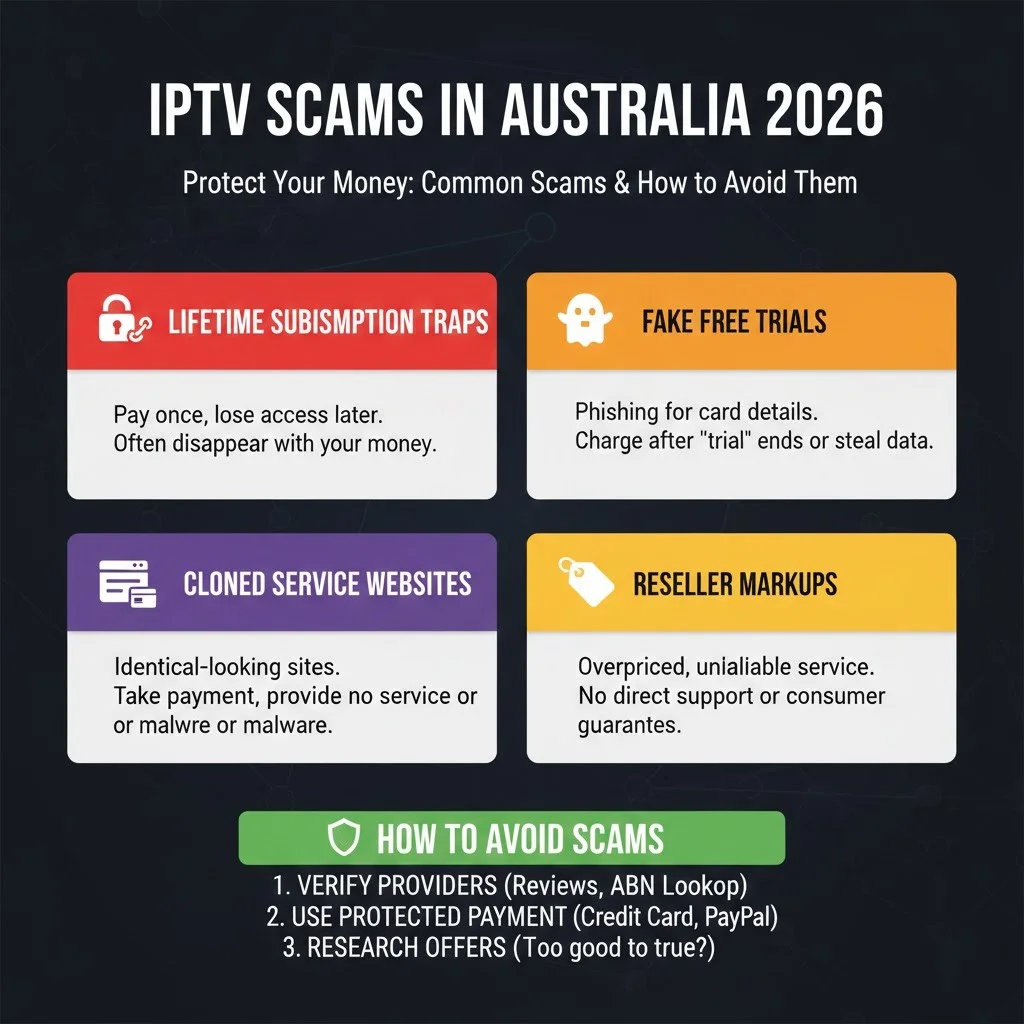
The most prevalent IPTV scam pattern in Australia is the “lifetime” subscription—a one-time payment of $50-150 AUD that supposedly grants permanent access to the service. The economics of this model make sustained operation impossible: server infrastructure, bandwidth, and content sourcing have ongoing monthly costs that a single upfront payment cannot sustain beyond a limited period.
The typical lifecycle of a lifetime deal follows a predictable pattern. The service launches with aggressive marketing, which emphasises its one-time cost. Early subscribers receive a functional service—sometimes for several months—creating positive word-of-mouth. As the subscriber base grows but revenue plateaus (because each subscriber pays only once), the provider cannot maintain infrastructure. Quality degrades, channels go offline, and eventually the service ceases operating entirely. The operator may then relaunch under a different name, repeating the cycle.
According to tracking conducted by industry observers during 2024-2025, the majority of “lifetime” IPTV services ceased operating within 6–12 months of launch. Subscribers lost both their payment and their television service, with no recourse available because the provider had typically disappeared.
The warning is straightforward: if the business model cannot sustain ongoing operational costs, the service will cease operation. A “lifetime” deal is, in practice, a payment for a service with an undisclosed expiry date.
The Fake Trial Scam
Some fraudulent IPTV services offer “free trials” with the intention of capturing payment information rather than demonstrating the service. The pattern typically involves requiring credit card details to “activate” the free trial, with the stated assurance that no charge will be made during the trial period. In practice, the card may be charged immediately after a very short trial period without clear notice, or the card details may be used for other unauthorised transactions.
Variations of this scam include trials that auto-convert to expensive subscriptions without adequate notice, trials that require “verification” payments (small charges that are supposedly refundable but never returned), and trials that function solely as data collection mechanisms—gathering email addresses and payment information for resale or future fraud.
Legitimate trial offers do exist in the IPTV market, and they are a valuable evaluation tool. The distinction lies in the provider’s transparency: a legitimate trial clearly states its duration, does not require payment information for genuinely free access, and comes from a provider with identifiable business credentials.
For understanding how to evaluate trial offers properly, see our article on IPTV free trials.
The Clone Service Scam
Clone services replicate the branding, website design, and marketing materials of a legitimate IPTV provider—creating a convincing imitation that directs payments to the scammer rather than to the genuine service. Subscribers believe they are purchasing from a known provider but receive either no service at all or access to a degraded, unauthorised copy.
This scam exploits the fact that IPTV services often operate primarily online, making visual duplication relatively straightforward. A cloned website with a slightly altered domain name (adding extra words, using different domain extensions, or introducing subtle misspellings) can appear convincing enough to capture payments from viewers who do not verify the exact URL.
Protection against clone scams involves verifying the exact domain of the provider you intend to subscribe to, accessing the service only through URLs obtained directly from trusted sources, and being cautious of services promoted through unsolicited messages or advertisements that redirect to unfamiliar domains.
The Reseller Markup Scam
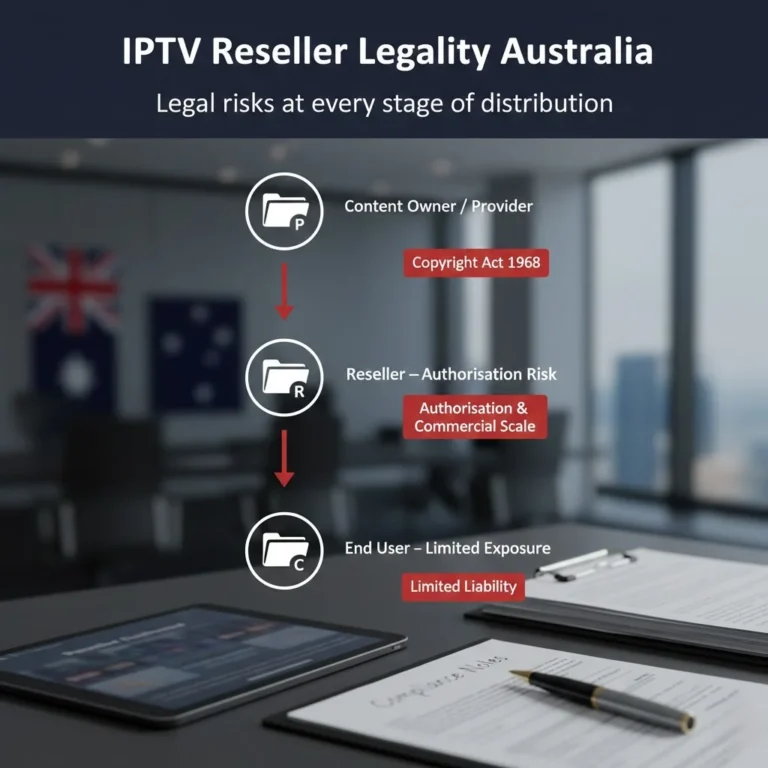
Some individuals purchase IPTV subscriptions at standard rates and resell them at significant markups—sometimes 200-400% above the original price—while representing themselves as the service provider. The subscriber pays a premium for what they believe is a direct relationship with the provider, but they are actually purchasing it through an unauthorised intermediary that provides no added value, no support, and no accountability.
When issues arise, the reseller might not resolve them (because they lack access to the provider’s infrastructure) and might withhold refunds (because their margin depends on retaining the payment). This leaves the subscriber with a degraded support experience and no direct relationship with the entity actually providing the service.
For understanding the legal dimensions of IPTV reselling, see our article on IPTV reselling and legal risks.
How to Protect Yourself from IPTV Scams
Several practical measures reduce the risk of falling victim to IPTV scams in Australia.
Avoid “lifetime” deals. Subscription services have ongoing costs that require ongoing revenue. A sustainable IPTV (Internet Protocol Television) service charges monthly or quarterly—not once forever.
Verify the provider’s identity. Before paying, confirm that the provider has a verifiable business presence: a real website, identifiable business information, and customer support that is accessible before purchase. Services that exist only as messaging app channels with no web presence warrant heightened caution.
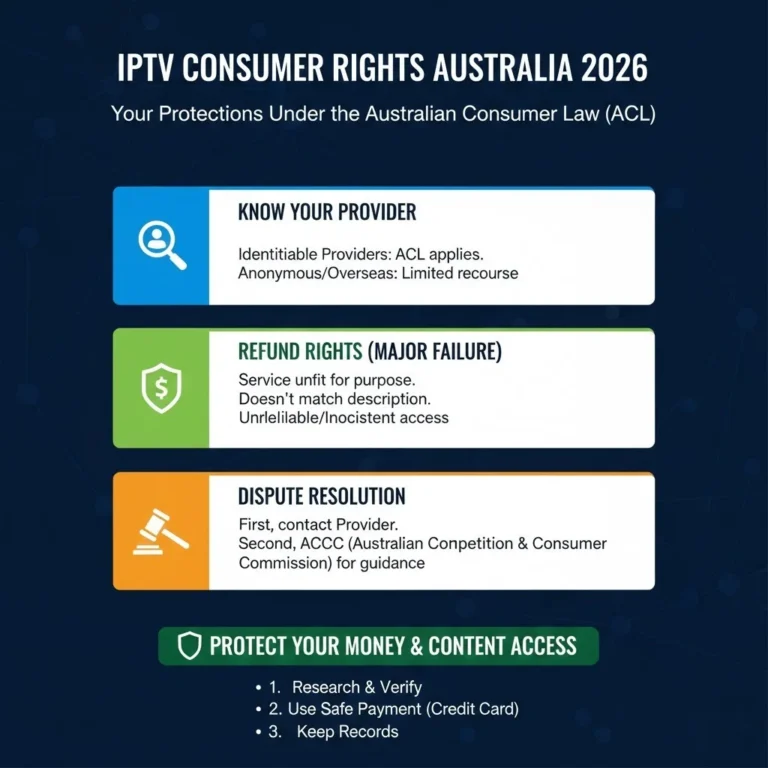
Use protected payment methods. Credit cards and PayPal provide chargeback mechanisms. Steer clear of cryptocurrencies, direct bank transfers, and gift card payments—fraudulent operators favour these methods due to their irreversibility and lack of buyer protection.
Research before subscribing. Search for the provider’s name alongside terms like “review”, “scam”, or “shutdown”. While online reviews should be approached critically (some are fabricated), patterns of complaints across multiple independent sources are meaningful signals.
Be sceptical about unsolicited offers. Legitimate IPTV (Internet Protocol Television) providers generally do not recruit subscribers through spam messages, unsolicited social media contacts, or anonymous forum posts offering exclusive deals.
For a comprehensive protection framework, see our article on how to protect yourself when choosing IPTV.
Frequently Asked Questions
How common are IPTV scams in Australia?
IPTV scams in Australia are increasing alongside the technology’s growing adoption. While precise statistics are not publicly available, the patterns described in this article—lifetime deals, fake trials, clone services, and reseller markups—are consistently reported across IPTV discussion communities. The absence of regulatory oversight for unlicensed services creates an environment where fraudulent operators can enter and exit the market with minimal accountability. See our legal IPTV overview for the broader regulatory context.
Can I get my money back from an IPTV scam?
Recovery depends on your payment method. The strongest recovery mechanisms are credit card chargebacks and PayPal disputes; promptly contact your payment provider if you suspect fraud. Cryptocurrency and direct bank transfer payments are generally unrecoverable. For payments to identifiable Australian businesses, consumer protection through the ACCC may provide additional recourse. See our article on consumer rights with IPTV.
How do I report an IPTV scam in Australia?
You can report IPTV scams to the ACCC’s Scamwatch service (scamwatch.gov.au), your state’s consumer protection office, and your payment provider. If the scam involves identity theft or significant financial loss, a report to your local police and to the Australian Cyber Security Centre (cyber.gov.au) may also be appropriate. See our article on reporting illegal IPTV.
Are “cheap” IPTV services always scams?
No. Affordable IPTV services are not inherently fraudulent—the IPTV market includes legitimate providers at various price points. The distinction between an affordable service and a scam lies in the sustainability of the business model, the transparency of the operation, and the presence of verifiable business credentials. A service at $20/month with identifiable business information is fundamentally different from a “lifetime” deal from an anonymous operator.
Conclusion
IPTV scams in Australia exploit the gap between viewer demand for affordable television and the absence of regulatory oversight in the unlicensed market. The patterns are identifiable and largely preventable through awareness: avoiding lifetime deals, verifying provider identities, using protected payment methods, and approaching unsolicited offers with appropriate scepticism.
The existence of scams does not invalidate IPTV as a viewing option—it reinforces the importance of approaching the market with informed caution rather than either blind trust or blanket suspicion. Viewers who invest modest effort in verification before subscribing protect both their money and their viewing experience.
This article provides general information and does not constitute legal advice. For specific legal questions or fraud reporting, contact the ACCC (Australian Competition and Consumer Commission) or your state consumer protection agency.

Our Fact Checking Process
We prioritize accuracy and integrity in our content. Here's how we maintain high standards:
- Expert Review: All articles are reviewed by subject matter experts.
- Source Validation: Information is backed by credible, up-to-date sources.
- Transparency: We clearly cite references and disclose potential conflicts.
Our Review Board
Our content is carefully reviewed by experienced professionals to ensure accuracy and relevance.
- Qualified Experts: Each article is assessed by specialists with field-specific knowledge.
- Up-to-date Insights: We incorporate the latest research, trends, and standards.
- Commitment to Quality: Reviewers ensure clarity, correctness, and completeness.
Look for the expert-reviewed label to read content you can trust.