
Introduction
This IPTV legal checklist for Australia consolidates the key considerations discussed throughout this pillar into a single, practical reference that viewers can use before subscribing to any IPTV service. It does not guarantee legality or safety—no checklist can provide that assurance in a market where licensing arrangements are private and provider operations are sometimes opaque. It is a systematic way to make an informed choice based on the legal and practical rules that govern IPTV in Australia.
An IPTV legal checklist for Australia is a helpful guide to check before subscribing, which includes verifying the provider’s identity, ensuring payment methods are safe, looking for licensing signs, being aware of data privacy, and understanding legal risks—aimed at helping viewers make smart choices by comparing the features of an IPTV service with the laws and rules for IPTV in Australia.
Each item on this checklist corresponds to a topic explored in depth elsewhere in this pillar. The checklist format provides a quick-reference tool; the linked articles provide the detailed context behind each item.
This guide is general information, not legal advice.

Step 1: Verify the Provider’s Identity
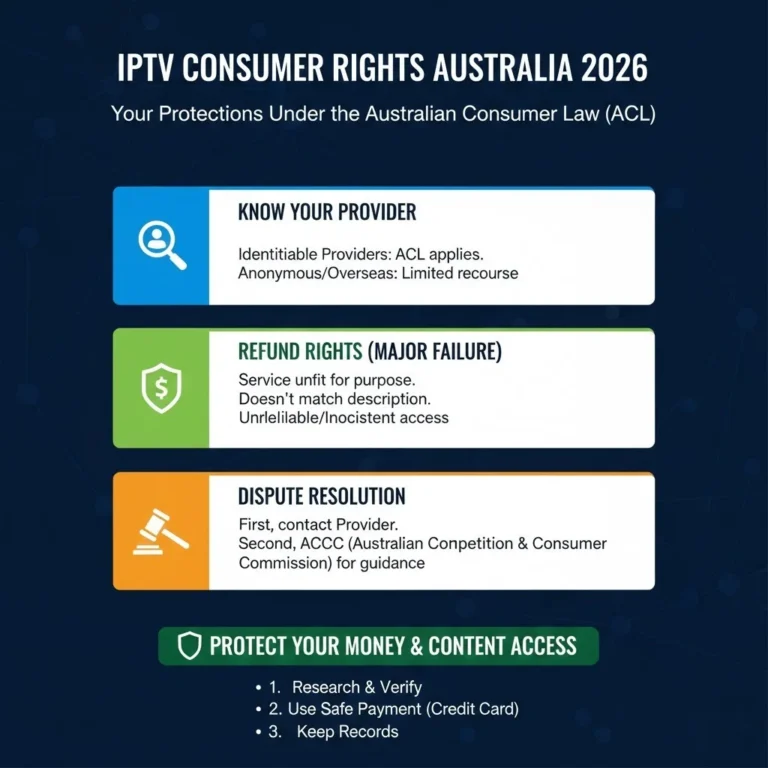
dealing with. Before making any payments, please ensure you have confirmed the identity of the party you are dealing with. A verifiable provider identity is the foundation of every other protection—consumer rights, data privacy, dispute resolution—because each of these depends on being able to identify and contact the entity you transacted with.
What to verify: Can you identify the provider’s business name and registration? Is there a verifiable contact address? Are there named individuals associated with the business? Does the website domain registration point to an identifiable entity? Is customer support accessible through channels beyond anonymous messaging apps?
What it indicates: A transparent business identity does not guarantee licensing, but it establishes accountability. An unverifiable identity removes accountability from the relationship entirely.
For detailed guidance, see our article on identifying legitimate providers.
Step 2: Assess Payment Method Protection
Your payment method determines your recourse if the service fails to deliver. Choose a method that protects your ability to dispute charges and recover funds.
What to use: Credit card or PayPal—both provide chargeback (the process of reversing a transaction) and dispute resolution mechanisms that operate independently of the IPTV provider.
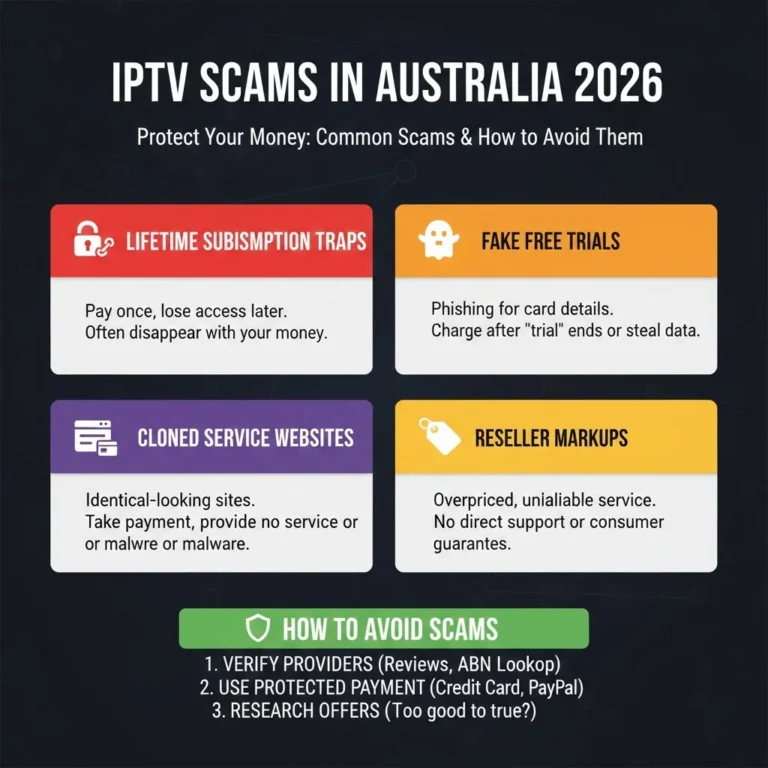
What to avoid: Cryptocurrency, direct bank transfers, and gift card payments offer no buyer protection and are irreversible. Fraudulent operators favour these payment methods precisely because they eliminate subscribers’ ability to recover funds.
What to note: Retain payment confirmations and receipts. Document the service’s advertised features and pricing at the time of purchase. These records support dispute claims.
For a complete protection framework, see our article on how to protect yourself with IPTV.
Step 3: Evaluate Pricing Against Licensing Reality
Consider whether the service’s pricing is consistent with a business that bears content licensing costs. This is not a definitive test—different business models achieve different cost structures—but it provides useful context.
What to consider: Licensed services like Foxtel charge $79-104+/month because content licensing is expensive. If a service offers comparable content at a fraction of this price, it is reasonable to ask how licensing costs are being covered. Unsustainable low pricing could suggest a failure to cover licensing costs.
What this does not mean: Low pricing does not prove illegality. Some services operate with different cost structures, and pricing alone is not determinative. But pricing context helps inform the broader assessment.
For understanding pricing structures, see our subscription plans guide.
Step 4: Review Available Legal Documents
Check whether the provider publishes terms of service and a privacy policy. The presence, quality, and specificity of these documents provide signals about the provider’s approach to the subscriber relationship.
What to look for: Ensure that the provider has published terms of service that clearly outline the service, billing terms, refund policy, and dispute resolution procedures. A privacy policy should outline the procedures for data collection, use, and protection. The policy should prioritise specificity over general boilerplate language.
What the absence indicates: A provider without published legal documents has no written commitment to any standard of service or data handling. This removes a layer of accountability.
For understanding contract terms, see our article on IPTV subscription contracts.
Step 5: Protect Your Personal Data
Minimise the personal data you share and isolate your IPTV subscription from your broader digital identity.
What to do: Use a dedicated email address not connected to your primary accounts. Create a unique password. Provide only the minimum information required for account creation.
Why it matters: Containment safeguards your broader digital identity from exposure in the event of the provider’s data compromise.
For a detailed privacy discussion, see our article on IPTV and data privacy.
Step 6: Understand Your Legal Position
Be aware of the legal landscape—not to be alarmed by it, but to make choices based on genuine understanding rather than assumptions.
What to understand: IPTV technology is legal. Content licensing determines service legality. Enforcement has focused on providers rather than viewers. The legal landscape is evolving. Practical risks (financial loss, data exposure, service instability) exist alongside legal ones.
What this means: Your position as a viewer carries relatively low legal risk under current enforcement patterns, but this reflects priorities rather than immunity. Making choices with awareness of the full risk picture—legal, financial, practical, and privacy-related—is the most responsible approach.
For the complete legal framework, see our article on whether IPTV is legal in Australia.
Step 7: Know Your Resource Options
Before subscribing, understand what options are available if something goes wrong—because your recourse capabilities are determined by decisions you make before the problem occurs.
Your options include: Payment provider disputes, such as credit card chargebacks or PayPal claims, are among your options. You can also file complaints with the ACCC and state consumer agencies for identifiable businesses. Scamwatch reports are also available for businesses that provide fraudulent services.
Your options depend on: Choose a payment method that offers buyer protection. The provider must be identifiable and within the reach of the law. It is important to maintain documented records of both the transaction and the service’s representations.
For consumer protection details, see our article on consumer rights with IPTV.
Frequently Asked Questions
Can this checklist guarantee that an IPTV service is legal?
No. Content licensing agreements are private contracts that viewers cannot independently verify. This checklist helps you assess observable characteristics that indicate where a service is likely to fall on the legitimacy spectrum—but it cannot provide certainty. It is a tool for informed decision-making, not a guarantee. See our legal IPTV overview for the full context.
What is the single most important item on this checklist?
Payment method protection. Using a credit card or PayPal ensures that regardless of what happens with the service—shutdown, fraud, or non-delivery—you have a mechanism to recover your funds. This single step provides more practical protection than any other item on the checklist.
Should I run through this checklist for every IPTV service?
For any service where you are providing payment information and personal data, running through these considerations is worthwhile. The checklist is most valuable for first-time subscriptions to services you have not used before. For established relationships with providers you have already assessed, the ongoing considerations (data protection, payment records) remain relevant.
Is this checklist relevant for licensed services like Foxtel or Kayo?
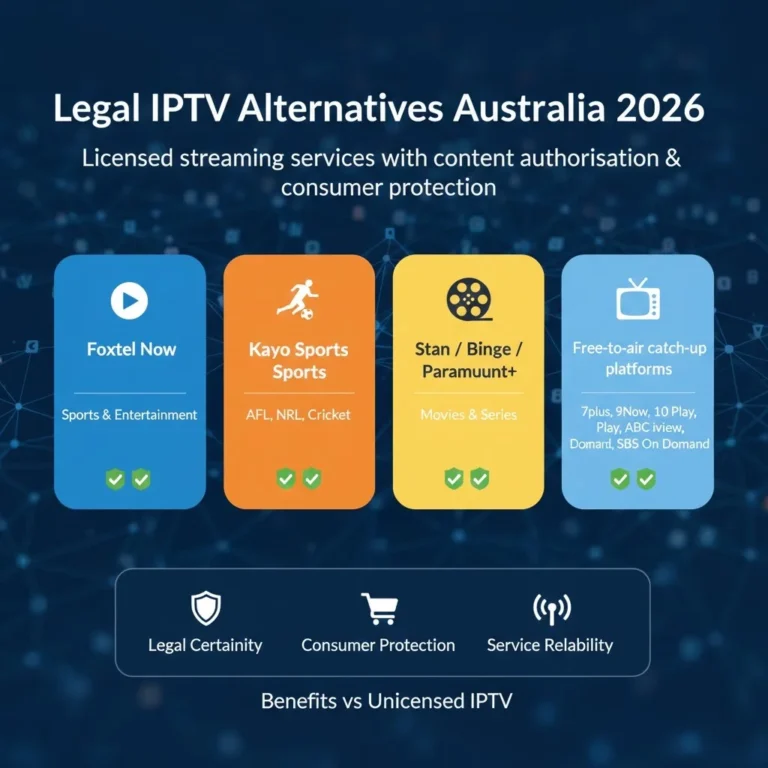
Licensed services like Foxtel and Kayo inherently satisfy most items on this checklist—they are identifiable businesses, accept standard payment methods, publish terms of service, operate under Australian regulatory frameworks, and hold content licensing. The checklist is particularly useful for assessing services that lack these established characteristics.
Conclusion
This IPTV legal checklist for Australia provides a structured approach to the pre-subscription assessment that serves viewers best. Each step—verifying provider identity, protecting your payment method, evaluating pricing context, reviewing legal documents, safeguarding your data, understanding your legal position, and knowing your recourse options—contributes to a decision made with awareness rather than assumption.
No checklist eliminates risk. But a viewer who has worked through these considerations subscribes with a clearer understanding of what they are entering into, better protection for their money and data, and stronger options for recourse if something goes wrong. In a market where certainty is not available, informed awareness is the most valuable tool a viewer can bring.
This article provides general information and does not constitute legal advice. For specific legal, consumer protection, or privacy questions, please consult the relevant professional or authority.

Our Fact Checking Process
We prioritize accuracy and integrity in our content. Here's how we maintain high standards:
- Expert Review: All articles are reviewed by subject matter experts.
- Source Validation: Information is backed by credible, up-to-date sources.
- Transparency: We clearly cite references and disclose potential conflicts.
Our Review Board
Our content is carefully reviewed by experienced professionals to ensure accuracy and relevance.
- Qualified Experts: Each article is assessed by specialists with field-specific knowledge.
- Up-to-date Insights: We incorporate the latest research, trends, and standards.
- Commitment to Quality: Reviewers ensure clarity, correctness, and completeness.
Look for the expert-reviewed label to read content you can trust.