Introduction
No single indicator can definitively confirm whether an IPTV provider operates with proper content licensing. Licensing agreements are private contracts between providers and rights holders—they are not publicly registered, and no government database lists “approved” IPTV services. However, several observable characteristics, taken together, can help Australian viewers form a reasonable assessment of where a service is likely to fall on the spectrum between fully licensed operation and questionable legal status.
To find legitimate IPTV providers in Australia, you need to look at several signs together, such as whether the business is registered, if they use common payment methods like credit cards and PayPal, if they have clear legal documents like terms of service and privacy policies, if they offer excellent customer support, and if their prices match the real costs of content licensing, since no single sign can tell you everything on its own.
The approach outlined in this article is one of informed assessment rather than definitive judgement. Viewers can observe certain characteristics and draw reasonable inferences while acknowledging that certainty about a provider’s licensing status is not achievable from the outside. The goal is to make a more informed decision, not a guaranteed one.
This is general information, not legal advice.
For the broader legal context, see our article on what constitutes legal IPTV.
Business Transparency: The Foundation of Legitimacy Assessment
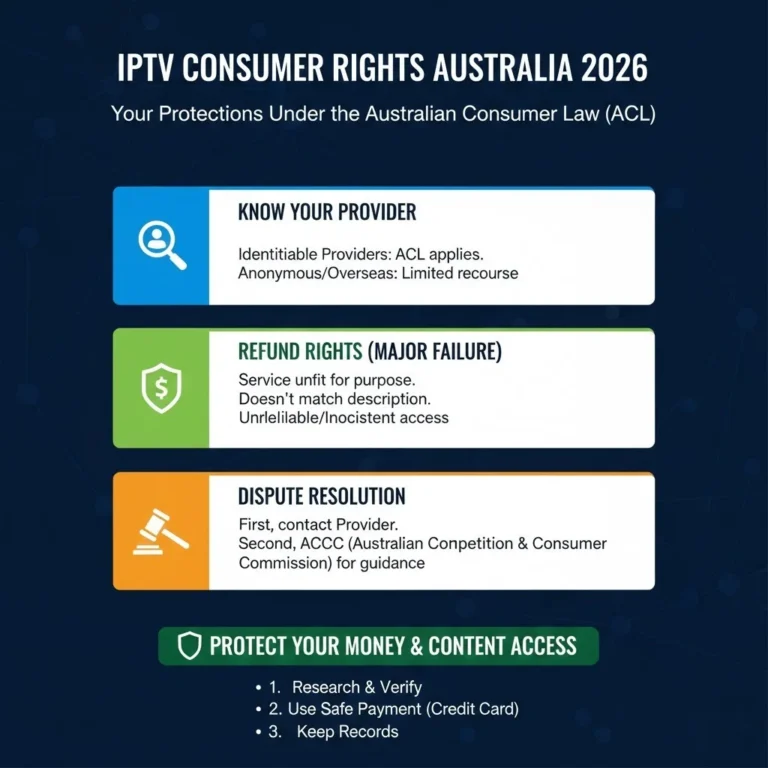
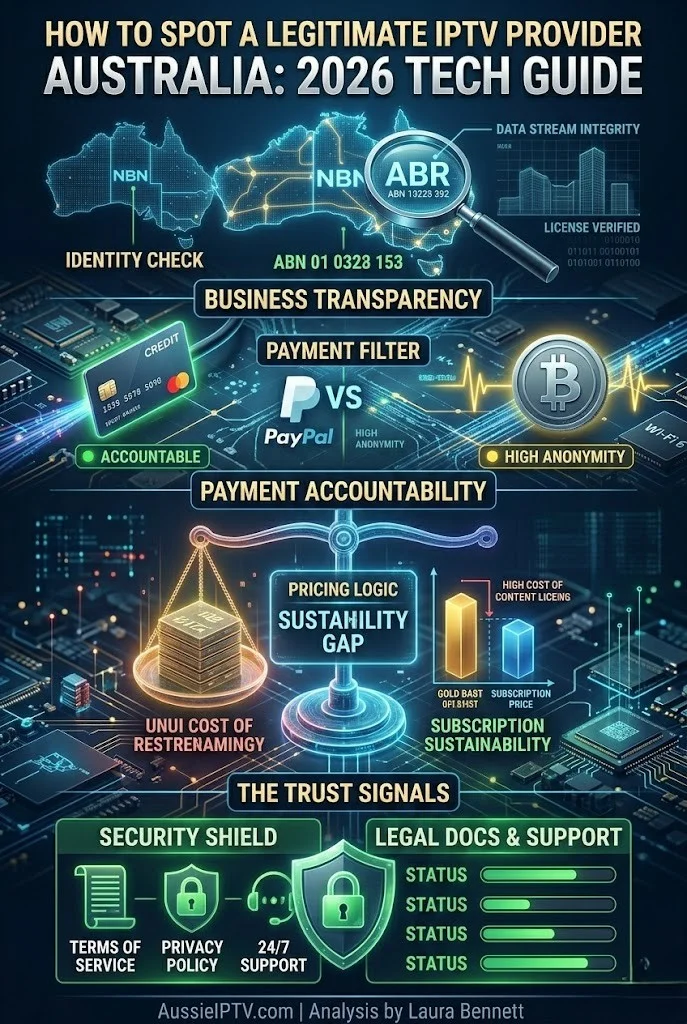
The most fundamental indicator of a provider’s likely legitimacy is the transparency of their business operation. Legitimate businesses have identifiable structures: registered company names, verifiable addresses, named directors or officers, and business registration numbers that can be checked against public records.
In Australia, business registrations can be verified through the Australian Business Register (ABR) for Australian entities or through equivalent registries in the provider’s jurisdiction of incorporation. A provider operating through a verifiable registered business entity is not guaranteed to be fully licensed—but a provider that cannot or will not identify itself as a registered business raises immediate questions about its operational legitimacy.
Indicators of transparency include a clearly identified company name, a verifiable physical or registered address, an ABN (Australian Business Number) or equivalent for overseas entities, named individuals associated with the business, and a website domain registered to an identifiable entity rather than through privacy services.
Indicators of opacity include operation exclusively through messaging apps with no website, absence of any identifiable business entity, use of domain privacy services that conceal ownership entirely, and refusal or inability to provide business identification when asked.
It is worth noting that business transparency is a necessary but not sufficient condition for legitimacy. A transparent business may still operate with incomplete licensing. But operational opacity is a significant warning signal.
Payment Processing: What It Reveals
The payment methods accepted by an IPTV provider offer indirect insight into its operational legitimacy, because different payment systems carry different levels of regulatory oversight and accountability.
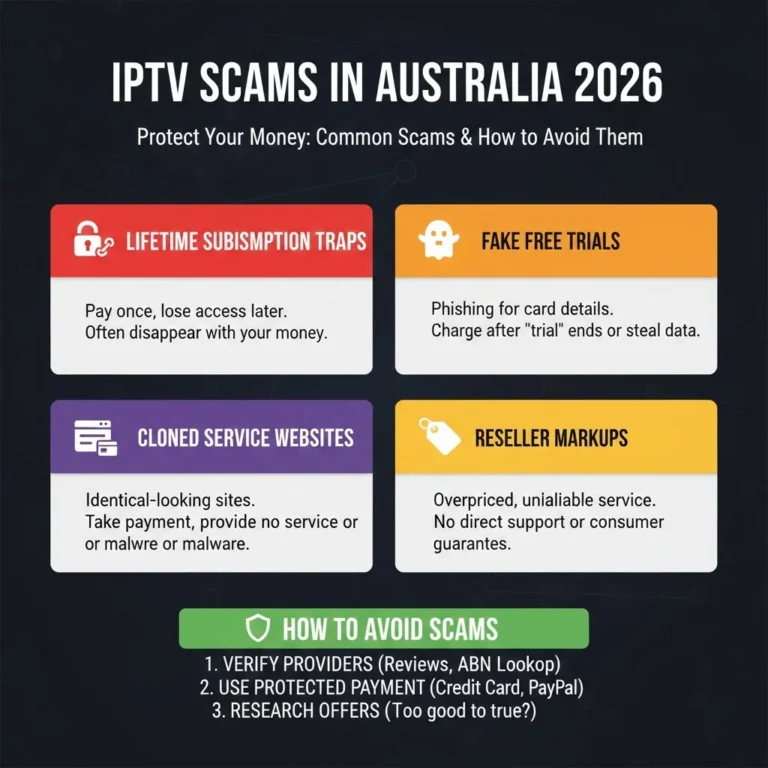
Credit card and PayPal processing require the provider to establish a merchant account with a payment processor, which involves identity verification, business documentation, and ongoing compliance with payment industry standards. Providers that accept credit cards and PayPal have passed at least a basic level of business verification—and crucially, these payment methods provide the subscriber with chargeback and dispute resolution mechanisms.
Cryptocurrency-only payment removes both the provider’s need for identity verification with a payment processor and the subscriber’s ability to pursue chargebacks or payment disputes. While cryptocurrency use does not inherently indicate illegitimacy, a provider that accepts only crypto—especially when combined with other opacity indicators—structures its payment arrangements to minimise accountability.
The most balanced reading is that the payment method is one data point in a broader assessment, not a standalone indicator. A provider accepting credit cards could still be unlicensed. A provider accepting cryptocurrency could have legitimate reasons for doing so. But in combination with other indicators, the payment structure contributes to the overall picture.
Pricing: The Economics of Content Licensing
Pricing is perhaps the most discussed but least understood indicator of IPTV legitimacy. The core principle is straightforward: the provider’s business model must reflect the costs of content licensing, which are often substantial.
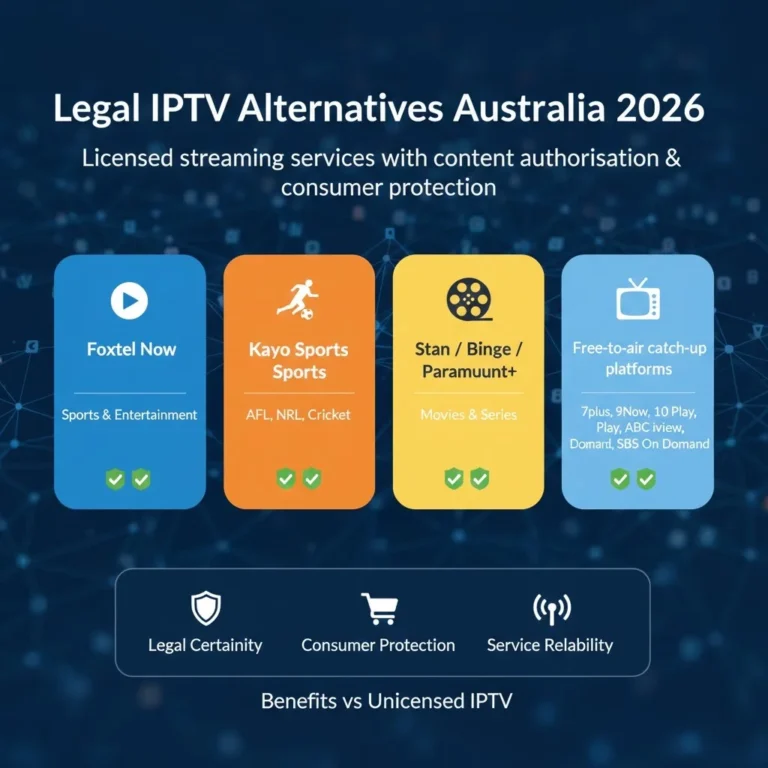
Licensed services like Foxtel charge $79-104+ AUD per month because their content licensing obligations represent their largest operational cost. When an IPTV (Internet Protocol Television) service offers a comparable channel range at $10-20 per month, the natural question is: how are the content licensing costs being covered? If a different business model, such as advertising revenue or subsidies, covers these costs, there could be a valid explanation. If they are simply uncovered—because the provider has not obtained licences—then the low pricing reflects the absence of the largest legitimate cost.
This does not mean that every inexpensive IPTV service is unlicensed or that every expensive one is licensed. But a significant gap between a service’s pricing and the apparent cost of the content it distributes is a factor worth considering alongside other indicators.
For understanding IPTV pricing structures, see our article on IPTV subscription plans.
Published Legal Documents: Terms of Service and Privacy Policies
Legitimate businesses publish terms of service and privacy policies that describe the legal relationship between the provider and the subscriber. These documents serve multiple purposes: they establish the provider’s obligations, define the subscriber’s rights, identify the governing jurisdiction for disputes, and—under Australian privacy law—describe how personal data will be handled.
A provider that publishes comprehensive terms of service and a privacy policy has, at minimum, invested in establishing a legal framework for its subscriber relationships. The quality and specificity of these documents also provide signals—generic or templated legal documents copied without customisation may indicate less genuine commitment to legal compliance than documents that specifically address the provider’s actual services and practices.
The absence of published terms of service and a privacy policy is a meaningful negative indicator. Although some businesses without these documents operate lawfully, their absence reduces transparency and accountability, which benefits both parties in a legitimate service relationship.
Customer Support Accessibility
The nature and accessibility of a provider’s customer support provide a practical indicator of their operational legitimacy and their accountability to subscribers.
Indicators of established support include multiple contact channels (email, phone, web-based support), response within defined timeframes, support documentation or FAQ sections, and support staff who can address both technical and billing queries.
Indicators of limited accountability include support exclusively through anonymous messaging apps, no published response timeframes, inability to address billing or subscription management queries, and support that is unresponsive or unavailable during disputes.
Support accessibility matters beyond its role as a legitimacy indicator—it directly affects the subscriber’s experience when issues arise. A provider with responsive, multi-channel support is practically more valuable than one where the only recourse is an anonymous Telegram channel.
For evaluating providers on broader criteria, see our Best IPTV Australia guide.
Frequently Asked Questions
How can I check if an IPTV provider is licensed?
There is no public registry of licensed IPTV providers in Australia. Licensing agreements are private contracts. Viewers can assess likely legitimacy through observable indicators: business transparency, standard payment processing, published terms of service, accessible customer support, and pricing that reflects content licensing costs. No single indicator is conclusive, but together they provide a reasonable basis for assessment. See our legal IPTV overview for broader context.
Does having a professional website mean an IPTV service is legal?
Not necessarily. A professional website is one positive indicator among many, but it does not confirm content licensing on its own. Some unlicensed services invest in professional-looking websites and marketing materials. The website should be evaluated alongside other factors—business registration, payment methods, published legal documents, and pricing relative to content costs.
Are IPTV services that accept PayPal definitely legitimate?
PayPal acceptance is a good sign since it shows that the provider has met the verification standards for payment processors. However, it does not confirm content licensing. PayPal acceptance should be considered as one indicator within a broader assessment rather than as a definitive marker of legitimacy.
Should I ask an IPTV provider about their licensing?
It is reasonable to ask a provider about their content sourcing and licensing arrangements before subscribing. Their response—whether they engage openly, provide general information about their arrangements, or are evasive—affects your overall assessment. A provider’s refusal to answer questions about their content rights may indicate the nature of those arrangements.
Conclusion
Identifying legitimate IPTV providers in Australia is an exercise in informed assessment rather than definitive verification. No viewer can independently confirm a provider’s licensing status, but by evaluating business transparency, payment processing, pricing, published legal documents, and customer support accessibility as a collective picture, it is possible to form a reasonable judgement about where a service is likely to fall on the legitimacy spectrum.
weigh. The most practical approach is to weight these indicators together, be cautious when multiple warning signals coincide, and recognise that the assessment is necessarily imperfect. Making this assessment—rather than ignoring the question entirely—is itself a meaningful step toward informed choice.
This article provides general information and does not constitute legal advice. For specific legal questions, please consult a qualified legal professional.

Our Fact Checking Process
We prioritize accuracy and integrity in our content. Here's how we maintain high standards:
- Expert Review: All articles are reviewed by subject matter experts.
- Source Validation: Information is backed by credible, up-to-date sources.
- Transparency: We clearly cite references and disclose potential conflicts.
Our Review Board
Our content is carefully reviewed by experienced professionals to ensure accuracy and relevance.
- Qualified Experts: Each article is assessed by specialists with field-specific knowledge.
- Up-to-date Insights: We incorporate the latest research, trends, and standards.
- Commitment to Quality: Reviewers ensure clarity, correctness, and completeness.
Look for the expert-reviewed label to read content you can trust.