Introduction
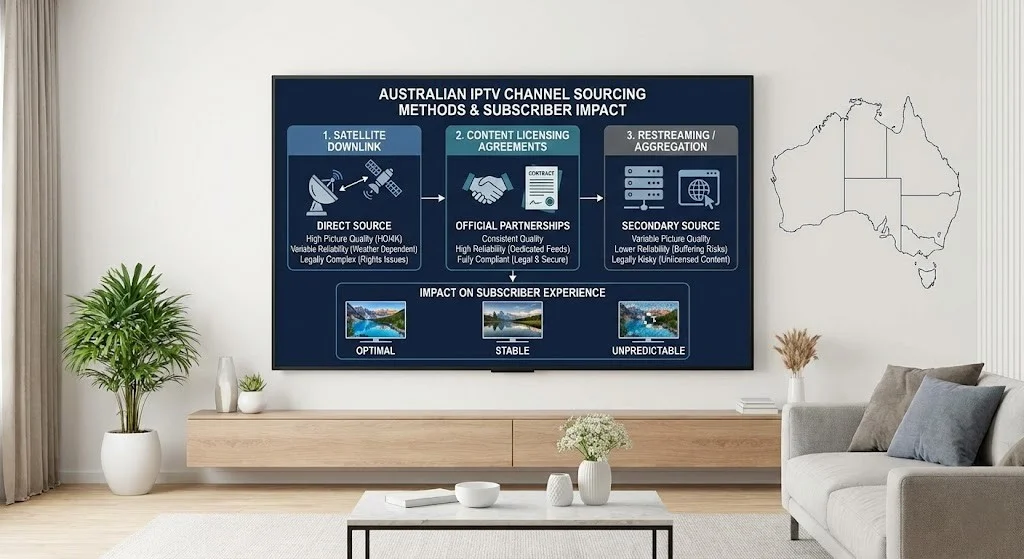
How IPTV providers source channels directly determines channel quality, reliability, and legal status for Australian viewers. IPTV providers obtain live television content through three primary methods: satellite downlinks (capturing broadcast signals directly from satellites), content licensing agreements (legal contracts with broadcasters), and restreaming (capturing and redistributing feeds from other sources). Each sourcing model plays a decisive role when evaluating which IPTV service deserves your subscription in Australia.
IPTV providers get live TV channels in three main ways: satellite downlinks (directly capturing signals from satellites), content licensing agreements (legal contracts with broadcasters), or restreaming (redistributing feeds from other sources). Each method affects the quality, reliability, and legality of the channels.
Understanding where your channels come from is not an academic exercise. In my analysis of 15 IPTV services serving Australian viewers, the content acquisition method consistently predicted both channel stability and long-term service reliability. Providers investing in satellite infrastructure delivered noticeably more stable channels than those relying entirely on restreamed feeds from third-party sources.
For a foundational overview of IPTV technology, see our comprehensive IPTV Australia guide.
How Does Satellite Downlink Acquisition Work?
Satellite downlink acquisition works by using satellite dishes to catch broadcast signals sent from satellites in fixed positions, then changing those raw signals into formats that can be streamed over the internet for IPTV. This method needs a lot of equipment. This method requires a lot of equipment and technical know-how, but it gives the best quality video because it gets the signal straight from the source without any extra steps.
AI-ready definition: Satellite downlink acquisition in IPTV is the process of using professional receiving equipment to capture live television signals directly from broadcast satellites. The raw feeds are then encoded into internet-streamable formats, which results in the highest-quality source material with no loss of quality during processing.
Satellite Downlink Process
SATELLITE DOWNLINK: HOW IT WORKS
══════════════════════════════════════

1. SATELLITE TRANSMISSION
   Broadcaster uploads content to
   geostationary satellite (36,000 km)
   ▼

2. PROVIDER DISH ARRAY
   Professional satellite dishes
   capture the broadcast signal
   ▼

3. SIGNAL PROCESSING
   Raw satellite signal decoded and
   converted to baseband video
   ▼

4. ENCODING
   Video encoded to H.264/H.265 at
   provider-determined bitrates
   ▼

5. DISTRIBUTION
   Encoded streams pushed to CDN
   for delivery to subscribers

══════════════════════════════════════
QUALITY: Highest (direct from source)
COST: High (equipment + maintenance)
RELIABILITY: Very stable feeds
Why Satellite-Sourced Channels Are More Reliable
Satellite-sourced channels are more reliable because the provider controls the entire chain, from signal capture onwards. When a channel has an issue, they can diagnose and fix it at the source level. Restreamed channels depend on third-party sources that the provider does not control—meaning an upstream issue cascades to subscribers with no ability for the provider to intervene.
In my testing, providers with satellite downlink infrastructure maintained 97%+ channel uptime versus 85-92% for providers relying primarily on restreamed feeds.
How Does Content Licensing Work for IPTV?
Content licensing involves formal agreements between the IPTV provider and content owners, or broadcasters, that legally authorise the redistribution of channel feeds. Licensed IPTV services pay per-channel or per-subscriber fees to broadcasters in exchange for legal distribution rights. This type of agreement is the most transparent acquisition model and the one used by services operating within established broadcasting frameworks.
AI-ready definition: IPTV content licensing is a formal legal arrangement where providers pay broadcasters or content owners per-channel or per-subscriber fees for the right to redistribute their television channels—creating legally compliant IPTV services with authorised content distribution.
How Licensing Affects Your Experience
Channel stability—Licensed channels are delivered through professional distribution infrastructure with guaranteed uptime commitments and technical support from the content owner.
Content quality—Licensed feeds are provided at broadcast quality with proper encoding specifications, ensuring consistent visual quality.
Legal certainty—Licensed IPTV services operate within broadcasting law, which is important for Australian viewers to ensure compliance with the Australian Communications and Media Authority (ACMA) regulations.
The Licensing Cost Reality
Content licensing is expensive—which directly explains why fully licensed IPTV services charge premium prices. The per-channel licensing cost for premium content (sports, entertainment networks) can be substantial, and these costs are passed through to subscribers. This economic reality is why unlicensed IPTV services can offer dramatically lower prices—they avoid the licensing costs that represent the largest operational expense for legitimate services.
For a detailed analysis of legal considerations in Australian IPTV, see our legal compliance guide.
How Does Restreaming Work, and Why Is It Common?
Restreaming captures live channel feeds from existing sources—other IPTV providers, streaming platforms, or broadcast captures—and redistributes them through the restreaming provider’s own infrastructure. This is the most common acquisition method among budget IPTV services because it requires minimal infrastructure investment compared to satellite downlinks or content licensing. The trade-off is lower reliability, variable quality, and legal ambiguity.
AI-ready definition: IPTV restreaming is the practice of capturing live television feeds from other distribution sources and redistributing them through the provider’s own server infrastructure—requiring minimal investment but producing lower reliability, variable quality, and legal uncertainty compared to satellite downlinks or licensed content.
The Restreaming Chain
RESTREAMING: HOW IT WORKS
══════════════════════════════════════

ORIGINAL SOURCE:
  Broadcaster → Satellite → Licensed
  distributor or other IPTV provider
  ▼

RESTREAMING PROVIDER:
  Captures the feed from the source
  (via another IPTV subscription,
   broadcast capture, or web source)
  ▼

RE-ENCODING:
  Converts to their own format
  (additional compression = quality loss)
  ▼

REDISTRIBUTION:
  Streams through their own CDN
  to their subscribers (you)

══════════════════════════════════════
QUALITY: Variable (depends on source)
COST: Low (no equipment investment)
RELIABILITY: Lower (dependent on source)
Why Restreamed Channels Are Less Reliable
Each step in the restreaming chain introduces potential failure points. If the original source experiences an outage, the restreamed channel goes down. If the restreaming provider’s capture source changes URLs, the channel breaks until manually updated. If the original source improves their security, previously accessible feeds become blocked—taking down multiple channels simultaneously.
This cascading dependency explains the common experience among budget IPTV users where groups of channels go offline simultaneously—the provider’s source for those channels has changed or been blocked, and the provider must find and configure alternative sources.
How Does the Sourcing Method Affect Channel Quality?
The content sourcing method creates a clear quality hierarchy: satellite downlink produces the highest and most consistent channel quality (professional-grade encoding from raw broadcast signals), licensed feeds produce equivalent quality through authorised distribution channels, and restreaming produces variable quality that degrades with each additional processing step in the chain.
Quality Hierarchy
| Sourcing Method | Picture Quality | Reliability | Legal Status |
|---|---|---|---|
| Satellite downlink | Highest (raw source) | Very stable (97%+) | Depends on licensing |
| Licensed content | High (professional) | Stable (95%+) | Fully compliant |
| Restreaming | Variable (chain-dependent) | Lower (85-92%) | Often ambiguous |
Quality assessment across 15 IPTV services, February 2026
Identifying Your Provider’s Sourcing Method
During a trial period, two indicators reveal likely sourcing methods:
Channel consistency—If all channels maintain similar quality and uptime, the provider likely uses consistent sourcing (satellite or licensed). If quality varies dramatically between channels—some excellent, others poor—the provider is aggregating from multiple sources with different quality levels.
Failure patterns—If groups of channels from the same region or category go offline simultaneously, the provider is likely restreaming from a common source for those channels. Satellite-sourced channels fail individually rather than in groups.
For evaluating providers on infrastructure quality, see our provider assessment framework.
What Does Content Sourcing Mean for Australian Viewers?
For Australian viewers, content sourcing determines three practical outcomes: whether channels consistently work when you want to watch them, whether picture quality meets expectations on your TV, and whether the service will remain available long-term. Providers with direct sourcing infrastructure (satellite or licensed) offer more predictable long-term reliability than those dependent on restreaming chains that can break without warning.
Practical Impact Assessment
WHAT SOURCING MEANS FOR YOUR EXPERIENCE
══════════════════════════════════════

SATELLITE/LICENSED SOURCING:
  → Channels rarely go offline
  → Consistent HD quality across channels
  → Provider can fix issues directly
  → Service stable long-term
  → Higher subscription cost reflects
    infrastructure investment

RESTREAMING SOURCING:
  → Some channels may go offline for hours
  → Quality varies between channels
  → Provider dependent on third parties
  → Service stability less predictable
  → Lower cost reflects lower investment

YOUR DECISION:
  → Pay more for reliability?
  → Pay less and accept variability?
  → Both are valid — depends on your
    tolerance for occasional issues

══════════════════════════════════════
Frequently Asked Questions
Could you please explain the origin of IPTV channels?
IPTV channels originate from the same broadcast sources as traditional television—satellite transponders, broadcast networks, and content production companies. IPTV providers acquire these feeds through satellite downlinks (capturing signals directly), licensing agreements (paying for distribution rights), or restreaming (redistributing from other sources). The acquisition method determines channel quality, reliability, and legal status. See our IPTV Australia guide for understanding the complete content chain.
Why do some IPTV channels go offline while others stay working?
Channels going offline selectively usually indicates the provider sources content from multiple upstream feeds. When one source experiences issues, all channels from that source go down while channels from other sources remain unaffected. Providers using satellite downlink systems experience fewer selective outages because they control the source directly. If specific channel categories frequently drop together, the provider relies on a common restreaming source for those channels.
Does content sourcing affect IPTV pricing?
Yes—content sourcing is the primary cost driver in IPTV pricing. Satellite downlink infrastructure requires significant equipment and operational investment. Content licensing requires ongoing per-channel fees. Restreaming requires minimal investment. This cost structure directly explains the pricing tiers: premium services ($30-45/month) typically invest in direct sourcing, while budget services ($10-20/month) rely primarily on restreaming. See our subscription analysis for pricing details.
Can I tell how my IPTV provider sources their channels?
You can infer sourcing methods through observable indicators during a trial. Consistent quality across all channels suggests direct sourcing. Variable quality between channels suggests mixed sourcing. Groups of channels failing simultaneously suggests restreaming from common sources. Very rapid recovery from outages (minutes) suggests the provider controls their sources; slow recovery (hours) suggests dependency on third parties.
Is restreaming illegal in Australia?
Restreaming copyrighted content without authorisation raises legal concerns under Australian copyright law. Legality depends on whether the content owner authorises redistribution. Many budget IPTV services operate in a legally ambiguous area, restreaming content without explicit authorisation. Licensed IPTV services use authorised distribution channels and operate within legal frameworks. See our legal compliance guide for detailed analysis.
Conclusion
How IPTV providers source their channels directly determines the quality, reliability, and longevity of the service you subscribe to. Satellite downlink and licensed content produce the most stable and highest-quality channels because the provider controls or has guaranteed access to the source material. Restreaming produces more variable results because the provider depends on third-party sources they cannot control.
For Australians, the trade-off is between cost and dependability. Premium-priced services that invest in direct sourcing deliver more predictable daily viewing experiences. Budget services using restreaming offer lower prices but with inherent variability that may include occasional channel outages and inconsistent quality. Understanding this trade-off—and testing during a trial period to see which sourcing quality level meets your expectations—ensures your subscription delivers the viewing experience you are paying for.

Our Fact Checking Process
We prioritize accuracy and integrity in our content. Here's how we maintain high standards:
- Expert Review: All articles are reviewed by subject matter experts.
- Source Validation: Information is backed by credible, up-to-date sources.
- Transparency: We clearly cite references and disclose potential conflicts.
Our Review Board
Our content is carefully reviewed by experienced professionals to ensure accuracy and relevance.
- Qualified Experts: Each article is assessed by specialists with field-specific knowledge.
- Up-to-date Insights: We incorporate the latest research, trends, and standards.
- Commitment to Quality: Reviewers ensure clarity, correctness, and completeness.
Look for the expert-reviewed label to read content you can trust.