
Introduction
Best IPTV rural Australia is achievable in 2026 but requires matching your provider choice to your specific internet connection type—NBN Fixed Wireless, NBN Satellite (Sky Muster), Starlink, or 4G/5G fixed wireless. The best IPTV for rural viewers is a service using H.265 encoding and adaptive bitrate streaming, which delivers watchable quality on connections as low as 15 Mbps while gracefully handling the speed fluctuations that characterise regional internet infrastructure.
25 and 200 IPTV for rural Australia need providers that use H.265 encoding and adaptive bitrate streaming to offer live TV on regional internet connections like NBN Fixed Wireless, Sky Muster satellite, Starlink, or 4G/5G. NBN Fixed Wireless and Starlink are the best options for a reliable rural IPTV experience, providing speeds between 25 and 200 Mbps, while Sky Muster has limited data that requires careful management.
Rural and regional Australians face internet challenges that metropolitan viewers do not—lower peak speeds, data allowances on some plans, higher latency on satellite connections, and fewer ISP options. Understanding how each connection type interacts with IPTV helps regional viewers set realistic expectations and choose services optimised for their infrastructure.
For overall IPTV evaluation, see our Best IPTV Australia guide.
Which Rural Internet Connections Support IPTV?
NBN Fixed Wireless
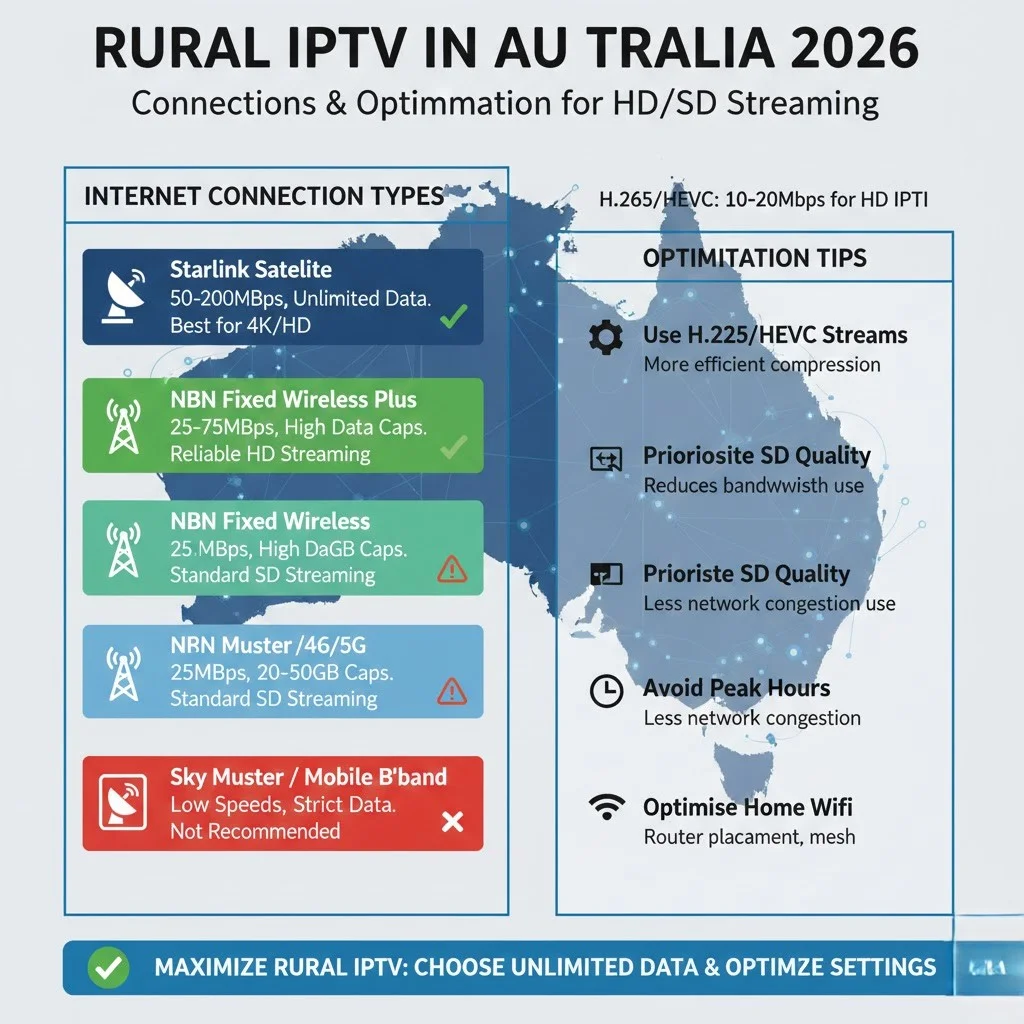
NBN Fixed Wireless delivers 25-75 Mbps in coverage areas—sufficient for HD IPTV. Performance varies by tower congestion and distance. Peak-hour speeds can drop significantly in heavily loaded cells. Best approach: test IPTV (Internet Protocol Television) during a trial at 8 PM to verify your specific tower delivers adequate evening bandwidth.
Starlink
Starlink delivers 50-200 Mbps with unlimited data—excellent for rural IPTV. Higher latency (30–60 ms versus 5–15 ms for fibre) adds slightly to channel switching times but does not affect stream quality once loaded. Starlink has become the most capable rural IPTV internet option in Australia for households within its coverage area.
4G/5G Fixed Wireless
Telstra and other carriers offer 4G/5G fixed wireless home internet in regional areas. Speeds range from 15 to 100+ Mbps depending on signal strength and network congestion. Data allowances may apply on some plans. Where available with a strong signal, 4G/5G delivers IPTV-capable performance.
NBN Satellite (Sky Muster)
Sky Muster provides 25 Mbps download with limited data allowances (45-200 GB/month depending on the plan). IPTV (Internet Protocol Television) works technically, but data consumption is a critical constraint—HD IPTV uses 3-5 GB per hour, meaning a 100 GB monthly allowance supports approximately 20-33 hours of viewing. For Sky Muster users, IPTV must be managed carefully alongside other household internet use.
Rural Connection Comparison
| Connection | Speed | Data | IPTV Rating |
|---|---|---|---|
| Starlink | 50-200 Mbps | Unlimited | Excellent |
| 5G Fixed Wireless | 50-300+ Mbps | Varies | Excellent (where available) |
| NBN Fixed Wireless | 25-75 Mbps | Unlimited | Good (test peak hours) |
| 4G Fixed Wireless | 15-50 Mbps | Often capped | Viable (manage data) |
| Sky Muster | 25 Mbps | 45-200 GB | Limited (data constraint) |
How Do You optimise IPTV for Rural Connections?
Three optimisations maximise IPTV performance on rural connections: choose H.265 providers (halves bandwidth usage—critical when bandwidth is limited), always use Ethernet (rural connections are less tolerant of Wi-Fi variability), and set stream quality to SD or 720p when bandwidth is constrained (watchable quality at 5-8 Mbps versus 15-20 Mbps for full HD).
Rural IPTV Optimisation
RURAL IPTV: MAXIMISE YOUR CONNECTION
══════════════════════════════════════

BANDWIDTH CONSERVATION:
  □ Choose H.265 provider (half bandwidth)
  □ Set quality to 720p when needed
  □ Close other devices during viewing
  □ Schedule downloads for off-peak hours

CONNECTION QUALITY:
  □ Ethernet cable to streaming device
  □ Router positioned for best signal
    (Fixed Wireless/4G antenna alignment)
  □ QoS prioritising streaming device

DATA MANAGEMENT (Sky Muster/capped):
  □ Track daily data usage
  □ HD IPTV = 3-5 GB/hour
  □ SD IPTV = 1-2 GB/hour
  □ Set daily viewing budget
  □ Use off-peak data window if available

══════════════════════════════════════
For detailed speed and bandwidth guidance, see our IPTV speed requirements guide.
Frequently Asked Questions
Can I use IPTV on NBN Satellite (Sky Muster)?
Yes, but with data limitations. Sky Muster delivers 25 Mbps—technically sufficient for HD IPTV. The constraint is data allowance: HD IPTV consumes 3-5 GB per hour. A 100GB monthly plan supports approximately 20-33 hours of viewing. Manage by watching in SD when possible (1-2 GB/hour) and monitoring monthly data consumption. See our Best IPTV Australia guide for choosing providers with efficient H.265 encoding, which is a video compression standard that allows for high-quality video streaming at lower bitrates.
Is Starlink excellent enough for IPTV?
Yes—Starlink is one of the best rural internet options for IPTV, delivering 50-200 Mbps with unlimited data. Higher latency (30–60 ms) adds 1-2 seconds to channel switching compared to fibre, but it does not affect stream quality. Starlink easily supports HD and even 4K IPTV for rural Australian households within its coverage area.
Does IPTV work on 4G in rural areas?
4G supports IPTV if your connection consistently delivers 15+ Mbps. Rural 4G performance varies with signal strength, tower distance, and network congestion. Test during a trial at 8 PM for your specific connection. If speeds frequently drop below 15 Mbps (megabits per second), the IPTV (Internet Protocol Television, a service that delivers television content over the internet) experience will be frustrating. 5G fixed wireless (where available) provides significantly better rural IPTV performance.
Which IPTV provider is best for rural Australia?
The best IPTV for rural viewers uses H.265 encoding (halves bandwidth requirements) and adaptive bitrate streaming (adjusts quality to match fluctuating speeds). These technical features matter more in rural areas than metropolitan, where bandwidth headroom compensates for inefficient encoding. During your trial, test specifically during evening hours on your rural connection.
Conclusion
Rural IPTV (Internet Protocol Television) in Australia is achievable with the right connection and provider combination. Starlink and 5G fixed wireless provide the most capable rural IPTV experience. NBN Fixed Wireless works well where tower capacity allows adequate peak-hour speeds. Sky Muster requires careful data management but delivers technically sufficient bandwidth. For all rural connections, choosing an H.265 provider, connecting via Ethernet, and testing during peak hours ensures that you maximise your available infrastructure for the best possible IPTV experience.