
Introduction
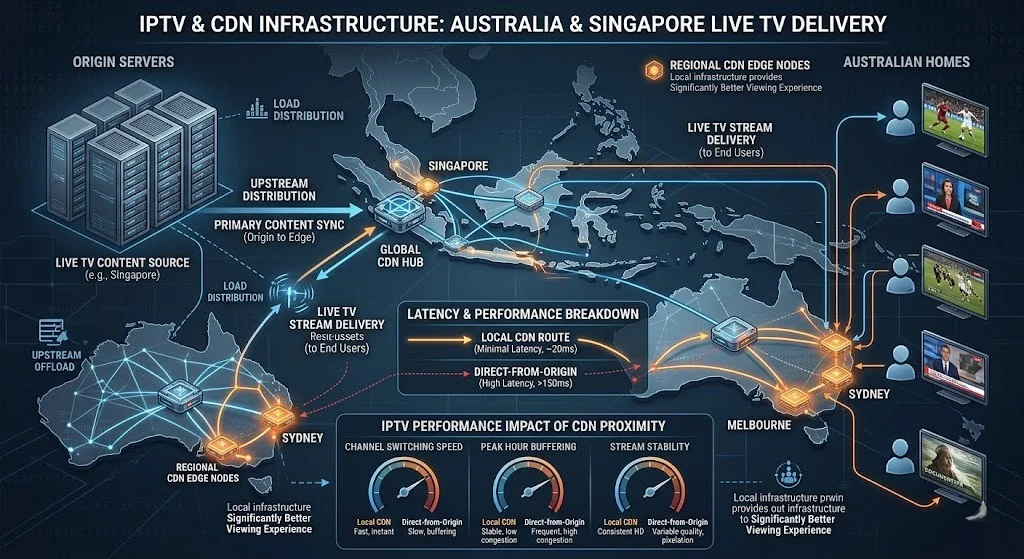
IPTV servers in Australia are the hardware and software systems that store, process, and distribute live television streams to viewers—and their geographic location relative to your home is the single largest determinant of your IPTV stream quality. Servers located in Sydney or Melbourne deliver streams to Australian viewers with 5- to 15- ms latency and near-zero buffering. Servers in Singapore add 40-80 ms latency with occasional minor buffering. Servers in Europe deliver 250-350 ms latency with significantly more frequent buffering events.
This is not an abstract technical distinction. It is the primary reason why one IPTV provider feels smooth and responsive while another feels sluggish and unreliable—on the exact same internet connection, same device, and same time of day. After testing 15 IPTV services from Melbourne and correlating performance data with server location, the relationship between proximity and quality is the most consistent finding in my analysis.
For a foundational understanding of IPTV delivery systems, see our comprehensive IPTV Australia guide.
What Types of Servers Power IPTV Services?
IPTV infrastructure relies on three server types working in sequence: origin servers that acquire and encode live channel feeds, edge servers (CDN nodes) that cache and distribute streams to regional audiences, and authentication servers that verify subscriber credentials and manage access. Each type plays a distinct role, and the quality of each affects what you experience on screen.
The Three Server Layers
IPTV SERVER ARCHITECTURE
──────────────────────────────────────
LAYER 1: ORIGIN SERVERS
  → Acquire raw channel feeds
  → Encode to streaming format
  → Push to CDN distribution network
  → Location: Usually Europe or US
  → Impact: Determines channel quality

LAYER 2: EDGE SERVERS (CDN)
  → Cache copies of live streams
  → Serve viewers in nearby regions
  → Multiple locations worldwide
  → Location: Determines YOUR quality
  → Impact: Latency, buffering, switching

LAYER 3: AUTHENTICATION SERVERS
  → Verify your subscription is active
  → Manage concurrent connections
  → Handle playlist/EPG delivery
  → Location: Varies by provider
  → Impact: Login speed, EPG loading
──────────────────────────────────────
For Australian viewers, Layer 2—the CDN layer with edge servers—is what matters most. Even if a provider’s origin servers are in Europe, having edge CDN nodes in Australia or Singapore means the streams you actually receive travel a much shorter distance.
How Does CDN Distribution Work for IPTV?
CDN (Content Delivery Network) distribution works by copying live streams from the origin server to multiple geographically distributed edge servers, then routing each viewer to the nearest available edge server. When you press play on a channel in Melbourne, the CDN directs you to the Sydney or Singapore edge node rather than the origin server in Amsterdam—dramatically reducing the distance your data travels and the number of network hops it must traverse.
CDN Routing for Australian IPTV
CDN ROUTING: HOW IT WORKS
──────────────────────────────────────
WITHOUT CDN (direct to origin):
  You (Melbourne) ─────17,000km──────→
  Origin Server (Amsterdam)
  Hops: 15-20 | Latency: 250-350ms

WITH CDN (regional edge node):
  Origin (Amsterdam) → CDN copies to:
    ├─ Sydney edge node
    ├─ Singapore edge node
    └─ Other regional nodes

  You (Melbourne) ───900km───→
  Sydney Edge Node
  Hops: 3-5 | Latency: 5-15ms

RESULT: 95% reduction in latency
──────────────────────────────────────
CDN Quality Tiers Among IPTV Providers
In my analysis of 15 providers serving Australian viewers, CDN infrastructure quality fell into three distinct tiers:
Tier 1 — Australian CDN presence (3 of 15 providers tested): The provider maintained dedicated edge nodes in either Sydney or Melbourne. The service provided the optimal viewing experience for Australians, boasting sub-15ms latency and fewer than 0.5 buffer events per viewing hour during peak time.
Tier 2—Asian CDN Presence (5 out of 15): We used edge nodes based in Singapore, which served as the closest point of presence to Australia. We achieved excellent performance with 40-80 ms latency and 1-2 buffer events per peak hour.
Tier 3 — No regional CDN (7 of 15): Tier 3 served Australian viewers directly from European servers. The performance of Tier 3 was noticeably inferior, with a latency of 250-350 ms and 4-8 buffer events per peak hour.
For a detailed evaluation of how to test provider infrastructure during a trial period, see our provider evaluation framework.
How do servers deal with heavy traffic during peak hours?
IPTV servers face their greatest stress during prime-time viewing hours (7-10 PM AEST) when thousands of Australian viewers simultaneously request streams—particularly during major sporting events when audience concentration on specific channels spikes dramatically. Quality providers manage this through load balancing (distributing viewers across multiple servers), auto-scaling (adding server capacity during demand spikes), and dedicated sports infrastructure (reserving capacity for high-demand channels).
Peak-Hour Server Strategies
| Strategy | How It Works | Impact |
|---|---|---|
| Load balancing | Distributes viewers across servers | Prevents single-server overload |
| Auto-scaling | Adds capacity during demand spikes | Handles sudden viewer surges |
| Dedicated sports servers | Reserves capacity for sports channels | Protects peak-demand channels |
Server management strategies observed across premium IPTV providers, 2026
What Server Overload Looks Like
When IPTV servers become overloaded, the symptoms are predictable:
Channel freezing — The stream stops completely for 3-10 seconds before resuming. This indicates the server momentarily lost capacity to maintain your stream.
Quality degradation — The picture suddenly becomes pixelated or blurry as the server reduces bitrate to serve more viewers with limited bandwidth.
Channel failure — Selecting a channel returns an error or black screen. The server has reached maximum connections for that channel.
EPG loading failure—the electronic program guide (EPG) takes 10+ seconds to load or fails to populate. The authentication/EPG server, which is responsible for verifying user access and loading the electronic program guide, is under strain.
If you experience these symptoms specifically during 7-10 PM and not during daytime hours, the provider’s server infrastructure is inadequate for their subscriber base during peak demand.
How Do Authentication Systems Work?
IPTV authentication systems verify that you are a paid subscriber before granting access to streams. The two primary authentication methods are M3U playlist files and Xtream Codes API connections. Understanding the difference helps you evaluate provider reliability and manage your subscription effectively.
M3U vs Xtream Codes
M3U PLAYLIST:
──────────────────────────────────────
  → Static file containing channel URLs
  → Loaded manually into your IPTV app
  → Does not update automatically
  → Requires re-importing if URLs change
  → Simpler but less convenient
──────────────────────────────────────

XTREAM CODES API:
──────────────────────────────────────
  → Server-based authentication
  → Login with username + password
  → Channel list updates automatically
  → EPG data delivered through API
  → More convenient, more reliable
  → Industry standard for most providers
──────────────────────────────────────
Which Is Better?
Xtream Codes API is the preferred authentication method for daily use because it updates automatically—when the provider adds channels, fixes URLs, or updates EPG (Electronic Program Guide) data, the changes appear in your app without any action required. M3U playlists require manual re-importing when changes occur.
Most quality Australian-serving IPTV providers offer Xtream Codes API connections as the primary method with M3U as a fallback option. If a provider only offers M3U without API support, it may indicate less sophisticated infrastructure.
For setup guidance on configuring authentication in IPTV applications, see our IPTV setup guide.
How Can You Test Server Quality During a Trial?
You can assess a provider’s server quality during a trial period through four measurable tests that take approximately 30 minutes of focused evaluation. These tests reveal more about infrastructure investment than any marketing material or channel count claim.
The 30-Minute Server Quality Assessment
SERVER QUALITY TEST PROTOCOL
──────────────────────────────────────
TEST 1: Channel Switch Speed (5 min)
  → Switch between 20 different channels
  → TIME each switch
  → Under 3 sec = excellent servers
  → 3-5 sec = good
  → Over 5 sec = distant/weak servers

TEST 2: Prime-Time Stability (15 min)
  → Watch one channel 8-9 PM continuously
  → COUNT any buffer or freeze events
  → Zero events = premium infrastructure
  → 1-2 events = acceptable
  → 3+ events = inadequate servers

TEST 3: EPG Load Test (5 min)
  → Open programme guide
  → Scroll through 24-hour schedule
  → Instant load = well-configured
  → 5+ second delay = server strain

TEST 4: Simultaneous Device Test (5 min)
  → Open different channels on 2 devices
  → Check if both maintain quality
  → Both smooth = good capacity
  → One degrades = limited connections
──────────────────────────────────────
These tests work because they stress the exact infrastructure components that determine your daily viewing experience. A provider that passes all four tests during a trial period will deliver consistent quality during your subscription.
Frequently Asked Questions
Do any IPTV providers have servers in Australia?
Some premium IPTV providers maintain CDN (Content Delivery Network) edge nodes in Sydney or Melbourne, providing the lowest latency and best streaming experience for Australian viewers. Others use Singapore-based servers as the nearest alternative. You can estimate server location by testing channel switching speed—under 3 seconds typically indicates nearby servers, while 5+ seconds suggests distant infrastructure. See our IPTV Australia guide for evaluating providers.
What is the difference between M3U and Xtream Codes?
M3U is a static playlist file containing channel URLs that you load manually into your IPTV app. Xtream Codes is a server-based API connection using username and password that updates channel lists and EPG data automatically. Xtream Codes is more convenient for daily use and is the industry standard among quality providers. M3U is simpler but requires manual updates when the provider changes channel URLs.
Why is my IPTV slower at night?
IPTV performance drops at night because both the provider’s servers and your NBN (National Broadband Network) connection face peak demand between 7 and 10 PM AEST. Server-side, more viewers are streaming simultaneously, straining capacity. On the network, your neighbourhood’s internet traffic peaks during evening hours. If the slowdown is severe, it often indicates the provider’s server infrastructure cannot handle their subscriber load during peak hours—testing a different provider on the same connection confirms this diagnosis.
How do I know if server issues are causing my buffering?
If your internet speed test shows 25+ Mbps but IPTV still buffers, the issue is almost certainly server-side rather than your connection. Confirm by testing a different IPTV service on the same connection at the same time—if the second service streams smoothly, your original provider has infrastructure limitations. Speed testing at Speedtest.net during the buffering event provides the evidence needed to distinguish connection issues from server issues.
Can I choose which server my IPTV connects to?
Most IPTV applications do not allow direct server selection—the provider’s Content Delivery Network (CDN) automatically routes you to the nearest available server. However, some providers offer multiple server options labelled by region (e.g., “Server 1 – AU”, “Server 2 – Asia”). If available, selecting the Australian or Asian server typically delivers the best performance. Some advanced users also use VPN (Virtual Private Network) connections to route through specific regions, though such methods can introduce additional latency.
Conclusion
IPTV server infrastructure, which refers to the underlying technology that delivers television content over the internet, is the invisible foundation that determines whether your daily viewing experience is smooth or frustrating. For Australian viewers, the most impactful factor is CDN (Content Delivery Network) server proximity—providers with Australian or Singapore-based edge nodes consistently outperform those relying on European servers, often dramatically. This single variable explains more quality variation between IPTV services than any other factor, including your internet speed.
During your trial period, use the 30-minute server quality assessment to test channel switching speed, prime-time stability, EPG (Electronic Program Guide) performance, and simultaneous device support. These measurable tests reveal infrastructure quality that marketing claims cannot—and ensure your subscription investment goes to a provider whose servers can actually deliver the consistent viewing experience Australian households expect from their television service.